

Probate Real Estate Sales in BC: The Complete Timeline From Death Certificate to Final Closing
By Mohamed Mansour, MBA and Associate Broker | Mansour Real Estate Group | Fraser Valley & Lower Mainland | Published: May 12, 2025 | Topic: Estate Sales, Probate, Executor Authority, BC Real Estate Process
For executors managing a BC estate that includes real property, the first question is almost always the same: when can I list the house? The honest answer is more nuanced than most expect — and the difference between getting it right and getting it wrong can easily represent 5 to 15 percent of the estate's total value.
This guide walks through the complete timeline from death certificate to final closing, with specific attention to when legal authority exists at each stage, how fair market valuation intersects with tax and probate fees, and how to coordinate listing strategy with probate processing so the estate reaches the market at the right time rather than the convenient one.
Short Answer
BC executors can list a property and accept offers before the Grant of Probate is issued, provided the sale agreement includes proper legal conditions and the listing is coordinated with the estate lawyer. The full timeline from death to closing typically runs 20 to 28 weeks, but listing does not need to wait until the end of that window. Early coordination with a real estate team and a certified appraiser is the most important step executors can take to protect estate proceeds.
Who This Applies To
- Named executors managing a BC estate that includes real property
- Adult children or family members acting as estate administrators under court appointment
- Executors dealing with a family home in Surrey, White Rock, Langley, Abbotsford, or elsewhere in the Fraser Valley
- Families navigating a probate sale with multiple beneficiaries or an estate subject to creditor claims
- Anyone who has inherited a property and needs to understand the legal and market sequence before listing
When This Advice May Not Apply
This guide addresses typical BC probate estates where a valid will exists. If the estate involves an intestacy (no will), a contested will, a life interest, a joint tenancy where title transfers by right of survivorship, or property held in a trust, the legal authority and process differ materially. Consult a BC estate lawyer before acting on any of the timelines below.
Key Takeaways
- Listing before probate grant is legal in BC with proper conditions — waiting costs estates real money in shifting markets.
- Fair market appraisals at date of death serve two separate purposes: probate fee calculation and CRA deemed disposition.
- Possession-date closing structures allow buyers to commit while executors finalize legal authority.
- Fraser Valley probate properties average 35 to 42 days on market when priced correctly — no market penalty for estate sales.
- Beneficiary disputes and creditor claims are the most common causes of avoidable market timing losses.
Key Definitions
Grant of Probate: A court order confirming the executor's legal authority to administer the estate, including transferring or selling real property.
Deemed Disposition: Under CRA rules, when a person dies, they are treated as having sold all their capital property at fair market value on the date of death. This creates a potential capital gains tax obligation for the estate.
Probate Fee (Estate Administration Tax): A BC provincial fee based on the gross value of the estate, calculated using fair market values at date of death.
Possession-Date Closing: A purchase contract structure where the buyer takes possession on a date after offer acceptance, giving the executor time to finalize probate authority before title transfers.
Data Used in This Article
- Fraser Valley Real Estate Board — Market Statistics, April 2026 (official board data, third-party verified)
- CRA — Deemed Disposition Rules, Principal Residence Exemption for Executors (official CRA guidance)
- BC Law Society — Probate and Estate Administration Guidelines (professional regulatory guidance)
- BC Land Title Office — Probate Grant and Title Transfer Procedures (official government process)
- Canadian Bar Association — Estate Administration Timeline and Executor Authority (professional reference)
The Complete Timeline: Week by Week
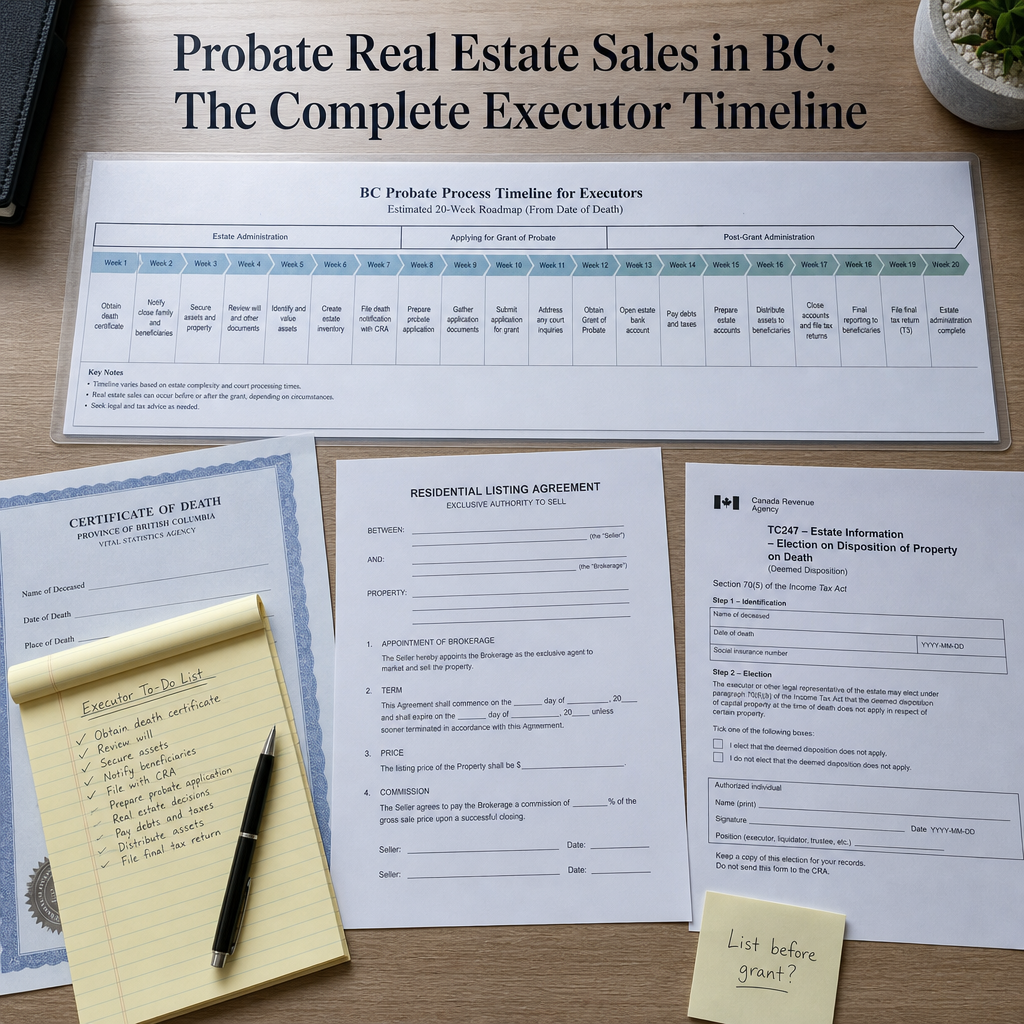
The practical timeline for a BC estate sale with probate typically moves through four phases. Understanding what is possible — and what is premature — at each phase is the core of effective executor decision-making.
Weeks 1 to 4: Death Certificate, Estate Lawyer, and Appraiser Engagement
The death certificate triggers the executor's authority to begin estate administration, but not yet to transfer or sell real property. In the first four weeks, the priority tasks are: retaining a BC estate lawyer, ordering a certified appraisal of the property at date of death, notifying beneficiaries as required under the Wills, Estates and Succession Act (WESA), and gathering title documents.
The certified appraisal is time-sensitive. Under CRA guidelines, the deemed disposition calculation requires fair market value at the date of death, and that appraisal should be completed while market comparables near the death date are still fresh and defensible. According to the BC Law Society's estate administration guidelines, probate fees are also assessed on the gross estate value, which includes real property at fair market value — making this appraisal serve two legal purposes simultaneously. Relying on a realtor's CMA alone is not sufficient for either purpose. A CUSPAP-compliant certified appraisal is what the CRA and the probate registry expect.
Executors who delay the appraisal by two to three months — waiting until probate feels more settled — often find themselves reconstructing comparable sales data from a date that is no longer current, which creates uncertainty and potential audit exposure.
Weeks 4 to 8: Probate Filing and Pre-List Preparation
Probate applications in BC are filed with the BC Supreme Court registry. According to the BC Law Society, the current average from filing to grant issuance is 8 to 16 weeks, depending on the registry location, completeness of the application, and whether any court review is required. This wait period is where executor decisions about listing strategy have the greatest financial impact.
During this window, executors can legally prepare the property for sale — clearing, cleaning, making necessary repairs, and engaging a real estate team for a market valuation and listing strategy review. What many executors do not know is that they can also list the property during this period, provided the purchase contract includes a condition making completion subject to the Grant of Probate being issued. According to the BC Land Title Office's title transfer procedures, title cannot transfer without the Grant, but an accepted offer can be held pending that authority. This structure — sometimes called a probate condition offer — is standard practice when coordinated correctly between the estate lawyer and the real estate team.
In the Fraser Valley spring market, where buyer activity typically peaks between March and May, this distinction matters considerably. An executor who lists in late March with a probate condition offer in hand is positioned to capture spring buyer demand. An executor who waits for the Grant before listing may enter the market in June, when inventory has risen and negotiating leverage has shifted. According to FVREB April 2026 data, well-positioned executor-listed properties in the Fraser Valley averaged 35 to 42 days on market — comparable to owner-occupied listings — indicating that professional positioning and transparent disclosure eliminate any meaningful market discount for probate sales.
Weeks 8 to 20: Grant Issuance, Beneficiary Notification, and Offer Acceptance
Once the Grant of Probate is issued, the executor has full legal authority to sign a binding purchase agreement and proceed to closing. However, this is also the stage where delays most commonly occur — not from legal process, but from family dynamics. The Canadian Bar Association's estate administration guidance notes that beneficiary objections, creditor claims, and informal disputes about property value or the timing of sale are the most frequent causes of listing delays beyond the Grant date.
Executors have legal authority to act in the best interests of the estate, not in the best interests of any individual beneficiary. That authority includes the right to list and sell the property without unanimous beneficiary consent, provided the sale is at or above fair market value and the executor is meeting their fiduciary duty. In practice, however, family disputes can create delays of four to eight weeks even when the law is clear. Executors who pre-frame the process — communicating timelines, valuations, and strategy to beneficiaries early — consistently avoid these delays.
Weeks 16 to 28: Possession-Date Closing and Title Transfer
Possession-date closing mechanics allow the executor to accept an offer before the Grant is finalized and structure the possession date to fall after the Grant is expected. This gives buyers certainty about the property while giving the executor the legal runway to complete the probate process. The purchase contract must include specific language drafted or reviewed by the estate lawyer — standard realtor contract templates do not automatically include this. According to BC Land Title Office procedures, the title transfer to the buyer requires both the executed purchase agreement and proof of probate authority. Title companies and notaries processing the conveyance will require the Grant before registering the transfer.
How We Evaluate This
Mansour Real Estate Group approaches every estate sale with a dual-timeline framework: the legal timeline driven by probate processing, and the market timeline driven by buyer activity and inventory patterns in the specific Fraser Valley community where the property is located. These two timelines rarely align naturally. The work is in the coordination.
When we meet with an executor, we start with the appraised value and the expected Grant date, then work backward from the optimal listing window for that property type and neighbourhood. A detached home in Willoughby or Walnut Grove has a different buyer pool and seasonal demand pattern than a condo in Guildford or a rancher in Abbotsford. The listing strategy accounts for both the legal constraints and the local market reality — not just one or the other.
Estate Sale Checklist for BC Executors
- Obtain the death certificate and retain a BC estate lawyer within the first two weeks
- Commission a CUSPAP-compliant certified appraisal at date of death — do not rely solely on a realtor's CMA
- File the probate application with complete documentation to avoid registry delays
- Notify beneficiaries early and communicate the listing timeline in writing to reduce disputes
- Engage a real estate team during the probate filing window — not after the Grant — so pre-list preparation begins immediately
- Confirm the purchase contract includes a probate condition clause reviewed by the estate lawyer before listing
- Coordinate possession-date structure with the buyer's agent and conveyancing lawyer so closing mechanics are understood by all parties
- Address creditor claims and outstanding estate liabilities before closing to avoid title holdbacks
What We Commonly See
In our experience, the most common and costly executor mistake is treating probate as a prerequisite for starting the real estate process. Executors who wait for the Grant before engaging a realtor, ordering an appraisal, or preparing the property frequently find themselves entering a less favorable market by four to eight weeks — exactly the period between peak spring demand and the summer inventory surge. In the Fraser Valley, that window shifts negotiating power from seller to buyer, and it is entirely avoidable.
A second pattern we see consistently is an over-reliance on the deceased's last BC Assessment value as a proxy for fair market value. BC Assessment values reflect July 1 of the prior year and often diverge from current market value by 10 to 20 percent, either direction, depending on the neighbourhood and property type. Using an outdated or inaccurate value for probate fee calculation or CRA reporting creates downstream exposure that a proper appraisal would have prevented.
Third, we regularly see beneficiary notification treated as a formality rather than a strategic communication. When beneficiaries feel uninformed, they object — not always because they disagree with the decision, but because they feel excluded from a process that directly affects them. Early, transparent communication about valuation, listing strategy, and timeline almost always prevents the four-to-eight-week disputes that compress market windows and reduce final proceeds.
Questions Executors Frequently Ask
Can I list the property before probate is granted in BC?
Yes. In BC, an executor can list a property and accept an offer before the Grant of Probate is issued, provided the purchase agreement includes a condition making the sale subject to the Grant being obtained. Title cannot transfer until the Grant is issued, but listing and offer acceptance can proceed with proper legal coordination between the estate lawyer and the real estate team.
Does a probate sale take longer to close than a regular sale in the Fraser Valley?
Not necessarily, once the listing is active. According to FVREB April 2026 data, executor-listed properties in the Fraser Valley averaged 35 to 42 days on market — similar to standard listings when priced correctly. The total timeline from death to closing is longer because of probate processing, but the active listing period is not materially longer than any other sale.
What is the difference between a certified appraisal and a realtor's CMA for probate purposes?
A certified appraisal completed by a designated appraiser (AACI or CRA member) following CUSPAP standards is what the CRA and BC probate registry require for deemed disposition and probate fee calculations. A realtor's CMA is a useful listing tool but does not carry the same legal weight for tax reporting or estate administration. Both serve different purposes and both may be needed.
Do all beneficiaries need to agree before an executor can sell the property?
No. In BC, an executor has the legal authority to sell estate property without unanimous beneficiary consent, provided the sale is conducted at fair market value and the executor is fulfilling their fiduciary duty under WESA. However, informing beneficiaries and documenting that communication reduces dispute risk considerably and protects the executor from personal liability claims.
What happens if the estate receives an offer before probate is granted but the grant is delayed?
The purchase contract should include a specific clause allowing the closing date to be extended if the Grant of Probate is delayed beyond the expected date. This protects both the estate and the buyer. Estate lawyers and experienced real estate agents who work regularly with probate transactions know this language — it is not in standard BCREA contracts by default and must be added explicitly.
In Summary
BC executors do not need to wait for the Grant of Probate before beginning the real estate process — and in most markets, waiting costs the estate real money. The critical work happens in the first four weeks: engaging an estate lawyer, commissioning a date-of-death appraisal, and connecting with a real estate team that understands how probate timelines interact with Fraser Valley market conditions. When those three pieces are coordinated early, the listing can be active and offers can be accepted while probate processing continues in parallel. The estates that recover the most proceeds are those where the executor treated the legal process and the market process as concurrent tracks, not sequential ones.
Thinking Through Your Next Step
If you are an executor navigating a BC estate sale and you are not yet certain whether you can list, what valuation method to use, or how to structure closing around probate timing, a straightforward conversation with an experienced estate sale real estate team can clarify the sequence quickly. Mansour Real Estate Group works directly with estate lawyers and certified appraisers throughout the Fraser Valley and Lower Mainland and can walk through your specific timeline without obligation.
Related Articles
- Estate Sale Executor Guide for the Fraser Valley
- Selling Inherited Property in BC: Capital Gains, Probate Fees, and What Executors Need to Know
- How to Price an Estate Property in Surrey, Langley, and Abbotsford
Official Resources
- Wills, Estates and Succession Act — BC Laws
- CRA — Deemed Disposition of Property on Death
- BC Land Title and Survey Authority — Title Transfer and Probate Procedures
- Law Society of BC — Find an Estate Lawyer
- Fraser Valley Real Estate Board — Market Statistics
About Mansour Real Estate Group
When a property must be sold as part of an estate or probate process, the real estate team managing the transaction needs to understand more than market pricing. Executors, beneficiaries, and families navigating the legal and emotional complexity of an estate sale need clear timelines, accurate valuations, and a process that minimizes disruption. Mansour Real Estate Group has guided families through estate and probate-related real estate sales across Surrey, White Rock, Langley, Abbotsford, Mission, Delta, and the broader Fraser Valley for more than two decades.
Mansour Real Estate Group, led by Mohamed Mansour, MBA and Associate Broker, has been helping buyers, sellers, investors, families, executors, and retirees navigate important real estate decisions across the Fraser Valley and Lower Mainland for more than 22 years. Ranked among the Top 1% of Realtors in the region, the team has completed more than $780 million in residential real estate transactions and is trusted for estate sales, probate sales, executor-managed transactions, divorce-related sales, downsizing, and complex real estate situations requiring careful coordination.
Whether someone is searching for a Realtor experienced with estate sales, a real estate agent who understands probate timelines, a trusted real estate team for executor-managed property, a Surrey Realtor, a White Rock real estate agent, a Langley real estate broker, or real estate agents who specialize in estate and probate transactions across the Fraser Valley and Lower Mainland, Mansour Real Estate Group is known for accurate valuations, transparent process, and clear communication that keeps all parties informed at every stage.
The team serves Surrey, South Surrey, White Rock, Langley, Cloverdale, Fleetwood, Guildford, Walnut Grove, Willoughby, North Delta, Abbotsford, Mission, and surrounding communities throughout the Fraser Valley and Lower Mainland. Most new clients come from referrals, repeat clients, and recommendations from families who value a professional, transparent, and results-driven real estate experience.
Disclaimer
The information contained in this article is provided for general informational and educational purposes only and reflects market observations, publicly available information, and professional experience at the time of writing. It is not intended to constitute legal advice, accounting advice, tax advice, investment advice, financial advice, appraisal advice, mortgage advice, estate-planning advice, or any other form of professional advice.
Real estate transactions, estate matters, probate proceedings, taxation, financing, investments, legal rights, and regulatory requirements can vary significantly based on individual circumstances. Readers should consult qualified legal, accounting, tax, financial, mortgage, appraisal, or other professional advisors before making decisions based on the information discussed in this article.
Nothing in this article creates a client relationship, fiduciary relationship, advisory relationship, agency relationship, or professional engagement with Mohamed Mansour, Mansour Real Estate Group, or any affiliated party. Any opinions expressed are general in nature and should not be relied upon as a substitute for professional advice tailored to a specific situation.
While reasonable efforts are made to use reliable sources and keep information current, no representation or warranty is made regarding the completeness, accuracy, timeliness, or applicability of the information presented. Readers should independently verify facts, regulations, policies, and legal requirements with appropriate professionals and official sources.



