
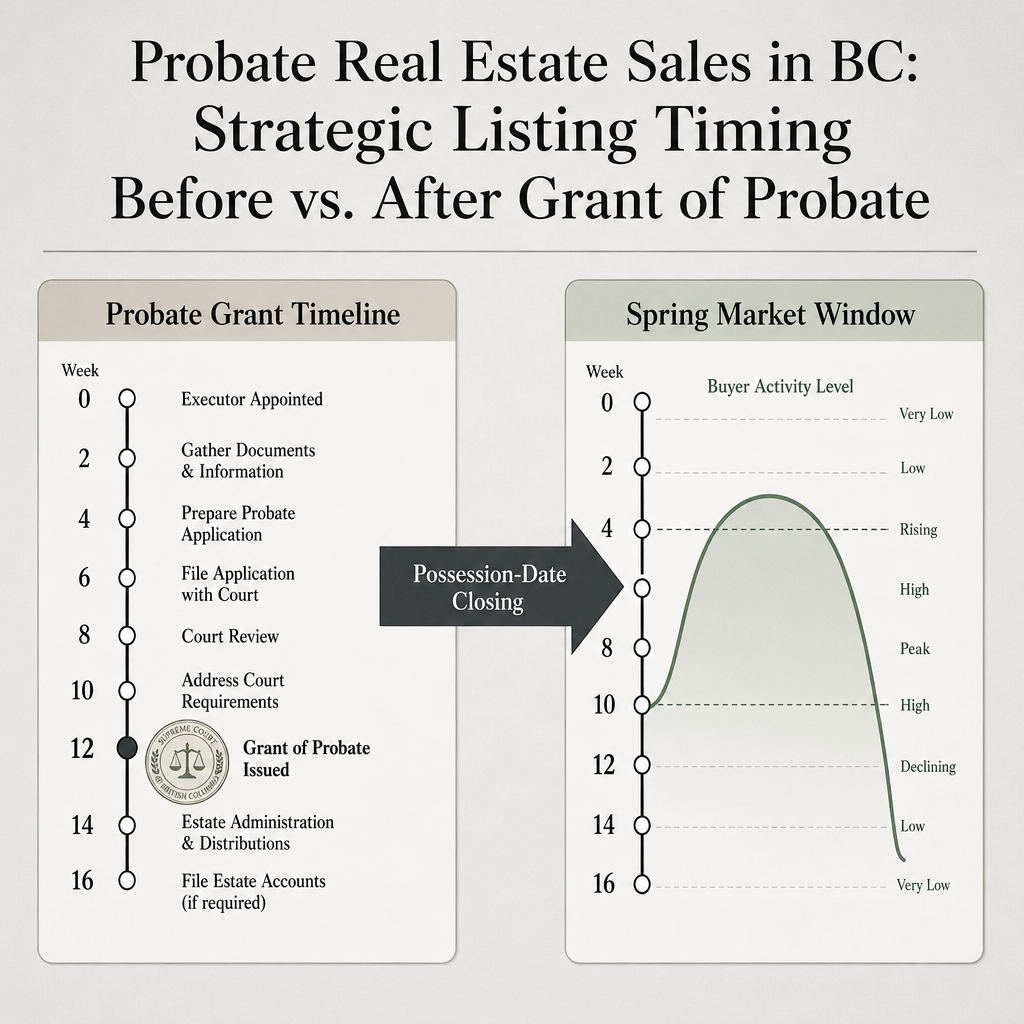

Probate Real Estate Sales in BC: Strategic Listing Timing Before vs. After Grant of Probate
By Mohamed Mansour, MBA and Associate Broker | Mansour Real Estate Group | Fraser Valley and Lower Mainland, BC | Published: July 14, 2025 | Topic: Probate and Estate Sales | Geography: BC, Fraser Valley, Surrey, Langley, White Rock, Abbotsford
For executors managing an estate in British Columbia, the property sale is often the single largest financial decision in the entire probate process. The timing of that listing—relative to when the Grant of Probate is actually issued—can affect final proceeds by a measurable margin. Yet most executors receive legal guidance and real estate guidance separately, leaving the most important strategic decision unaddressed.
This article is written for executors, estate lawyers, and families managing probate property sales in Surrey, Langley, White Rock, Abbotsford, and across the Fraser Valley. It explains the legal mechanics of listing before probate is granted, how possession-date closing strategies bridge the gap, and what the timing decision actually costs when it goes wrong.
Short Answer
BC executors can list a property before the Grant of Probate is issued, using Interim Authority or Letters of Administration to satisfy title insurance and lender requirements. A possession-date closing—where the sale closes after probate is granted—allows executors to capture peak-market listing timing without transferring title prematurely. This strategy requires coordinated legal, title insurance, and real estate planning, but it is a recognized and viable approach under BC law.
Key Takeaways
- BC executors can legally list a property before the Grant of Probate is issued using Interim Authority or Letters of Administration.
- Probate processing in BC averages 8 to 16 weeks, which systematically conflicts with spring real estate market peaks in the Fraser Valley.
- Possession-date closing lets an executor accept an offer pre-grant and complete the transfer post-grant, bridging the legal and market timing gap.
- Fraser Valley estate properties listed during peak spring windows have historically shown materially stronger final proceeds than off-peak listings.
- Executors who treat the probate timeline and the listing timeline as separate decisions often leave estate value on the table unnecessarily.
Who This Applies To
- Named executors managing BC estate property awaiting Grant of Probate
- Families and beneficiaries involved in a probate sale where timing and market conditions are a concern
- Estate lawyers and notaries coordinating property disposition with real estate strategy
- Executors holding property in Surrey, Langley, White Rock, Abbotsford, or across the Fraser Valley
When This Advice May Not Apply
This guidance does not apply when the estate is contested, when there are disputes among beneficiaries, or when the executor's authority is challenged. In those situations, listing the property before legal authority is confirmed creates significant risk. Executors in contested estates should consult estate litigation counsel before making any listing decisions.
Definitions
Grant of Probate: A court order issued by the BC Supreme Court confirming the executor's legal authority to administer the estate and transfer title to property.
Interim Authority / Letters of Administration: Legal mechanisms that may permit an executor or administrator to act in limited capacities before the full Grant of Probate is issued, subject to court and insurer requirements.
Possession-Date Closing: A closing structure where the buyer takes possession and the title transfers on a future date, allowing the sale to be accepted pre-grant and completed post-grant.
Title Insurance: Insurance covering defects in title. In estate sales, title insurers can provide coverage that enables listing and conditional sales before probate is formally granted.
Data Used in This Article
- BC Law Society — Executor powers and probate authority under the Wills, Estates and Succession Act (WESA), current guidance
- Fraser Valley Real Estate Board (FVREB) — Market activity reports, 2024–2025, official board data
- Real Estate Board of Greater Vancouver (REBGV/GVR) — Comparative market data, 2024–2025
- Title Insurance Underwriters — Interim Authority listing protocols, industry standard documentation requirements
- Mansour Real Estate Group — Internal transaction analysis, probate sale timing, Fraser Valley, 2022–2025 (professional observation, not independently audited)
Why the Probate Timeline and the Real Estate Market Don't Align
In BC, probate is processed through the BC Supreme Court under the Wills, Estates and Succession Act. From the time an executor files a probate application to the time the Grant of Probate is issued, the process typically takes 8 to 16 weeks, depending on estate complexity, court scheduling, and whether the application is contested. That timeline is not negotiable.
The Fraser Valley real estate market follows a different calendar entirely. According to FVREB market activity reports, buyer demand concentrates in late February through May, with a secondary window in September. Inventory during spring is more competitive, buyers are more active, and properties—including estate properties that need clear positioning—tend to attract more qualified offers.
When a family member passes in January or February, the executor may not receive the Grant of Probate until May or June—after the primary spring window has closed. If the executor waits for the grant before listing, the property enters a slower summer market with fewer active buyers. That delay is not a legal requirement. It is a planning gap.
What BC Law Actually Permits Before Grant of Probate
Under WESA and consistent with BC Law Society guidance, an executor named in a valid will has certain authority from the moment of death—including the authority to take steps to preserve and manage estate assets. This includes engaging a real estate agent, preparing the property for sale, and listing the property on MLS.
What an executor cannot do before the Grant of Probate is transfer title. Title cannot legally move from the estate to a buyer without the Grant in hand. However, an executor can accept an offer, negotiate terms, and set a completion date that falls after the Grant is expected to be issued. This is the foundation of the possession-date closing strategy.
Title insurers, including major underwriters operating in BC, have established protocols for estate sales listed prior to Grant of Probate. When the executor can demonstrate Interim Authority or provide satisfactory documentation of the probate application in progress, title insurance can be structured to protect both buyer and seller through to a post-grant closing. Executors should confirm the specific requirements with both their estate lawyer and a title insurer before proceeding.
How We Evaluate This
At Mansour Real Estate Group, when we work with an executor on a probate property, the first conversation is not about the listing price. It is about the timeline. We ask: when was the probate application filed, what is the expected grant date, and what does the current market window look like for this property type and neighbourhood?
From there, we work with the executor's estate lawyer to determine whether a pre-grant listing with a possession-date closing structure is viable. If it is, we coordinate the listing strategy around peak market conditions rather than the court calendar. If it is not—because the estate is contested or the title insurer's requirements cannot be met—we advise on the best available window given the actual grant timeline. The decision is always fact-specific. We provide the market analysis. The estate lawyer provides the legal authority analysis. Both inputs are necessary.
The Possession-Date Closing Strategy: How It Works in Practice
A possession-date closing in an estate sale context works as follows. The executor lists the property before the Grant of Probate is issued. An offer is accepted with a completion date set 8 to 14 weeks out—timed to fall after the Grant is expected. The buyer's lawyer and the executor's lawyer confirm the closing mechanics. Title insurance is arranged to cover the interim period.
The buyer secures their financing based on the agreed price and property. The executor does not transfer title until the Grant is in hand. On or after the Grant date, the closing proceeds and title transfers. The estate receives the proceeds. Beneficiaries are distributed in accordance with the will.
This structure requires that all parties—buyer, seller's estate lawyer, title insurer, and real estate team—understand their roles and coordinate around a common timeline. It is not a workaround. It is a recognized estate sale structure. The risk to the executor is that the Grant is delayed further than expected. For this reason, the completion date should be set conservatively, with enough buffer to absorb a delay of 3 to 4 weeks beyond the expected grant date. Executors should also review their full responsibilities in an estate property sale before proceeding.
Estate Sale Checklist for Executors Considering a Pre-Grant Listing
- Confirm with estate counsel that the will is valid and your authority as executor is not subject to challenge
- File the probate application as early as possible to minimize the gap between death and Grant issuance
- Obtain a current, written estimate of the expected Grant date from your estate lawyer
- Engage a real estate agent with direct experience in probate and estate sales in BC before making any listing decisions
- Request a current market analysis for the property, segmented by season, to understand the cost of listing in an off-peak window
- Confirm with a title insurer that coverage is available for a pre-grant listing with a post-grant closing
- Set the offer completion date conservatively—4 weeks beyond the expected Grant date, not the minimum
- Coordinate disclosure obligations with your estate lawyer, including known defects and estate property condition
What We Commonly See
In our experience working with executors across Surrey, White Rock, Langley, and Abbotsford, the most common mistake is treating the probate application and the listing decision as sequential rather than parallel. Executors wait for the Grant before contacting a real estate agent. By the time the listing is ready, the spring window has passed and the property enters the market in June or July—a period when buyer activity in the Fraser Valley is measurably lower.
What often happens next is that the executor, under pressure from beneficiaries, accepts a lower offer in order to close the estate before year-end. The difference between that outcome and a well-timed spring listing is not marginal. Based on our internal transaction analysis across probate sales from 2022 to 2025, the timing decision alone—controlling for property type and neighbourhood—accounts for significant variation in final proceeds.
A less common but equally costly mistake is listing too early without proper legal coordination. An executor who accepts a short-completion offer before confirming the Grant date creates a closing risk that can expose the estate to legal liability if the grant is delayed and the completion date cannot be met. The solution is not to avoid pre-grant listings. It is to structure them correctly. You may also want to review capital gains tax considerations for estate property sales in BC, which interact with closing timing decisions.
Questions and Answers
Can an executor list a property for sale in BC before the Grant of Probate is issued?
Yes. BC law permits an executor to list and market a property before the Grant of Probate is issued. The executor cannot transfer title until the Grant is obtained, but listing, receiving offers, and accepting conditional or possession-date offers are generally permitted. Confirm specifics with your estate lawyer.
How long does probate take in BC in 2025 and 2026?
For straightforward, uncontested estates, BC probate typically takes 8 to 16 weeks from the time the application is filed with the BC Supreme Court. Complexity, missing documentation, and court scheduling can extend that timeline. Contested estates take significantly longer.
What is a possession-date closing and why does it matter for estate sales?
A possession-date closing sets the buyer's completion date in the future, allowing an executor to accept an offer now and close after the Grant of Probate is issued. This lets the estate benefit from peak-market listing conditions while ensuring the title transfer happens legally, after probate authority is confirmed.
In Summary
The Grant of Probate and the real estate market do not follow the same calendar, and that misalignment costs BC estates measurable proceeds every year. Executors who understand that listing and title transfer are separate legal events—and who plan accordingly—can capture spring market conditions even when probate is still in progress. The possession-date closing is not a workaround. It is a structured, legally recognized approach that requires coordination between estate counsel, title insurers, and an experienced probate real estate team. The cost of getting that coordination right is time and planning. The cost of skipping it is often a weaker offer, a longer sale, and a quieter market.
Speak With an Executor-Experienced Real Estate Team
If you are an executor managing a BC estate with real property, and you are trying to understand how probate timing intersects with listing strategy, Mansour Real Estate Group is available for a no-obligation conversation. We can provide a current market analysis, explain the possession-date closing structure in plain language, and help you coordinate with your estate lawyer before making any commitments.
Related Articles
- Estate Sale Timeline in BC: What Executors Need to Know
- Executor's Guide to Selling Estate Property in BC
- Probate Real Estate in BC: What Executors Need to Know About Capital Gains Tax
Official Resources
- Wills, Estates and Succession Act (WESA) — BC Laws
- Law Society of BC — Find a Lawyer (Estate and Probate)
- Fraser Valley Real Estate Board — Market Statistics
- BC Supreme Court — Probate Forms and Filing Information
About Mansour Real Estate Group
When a property must be sold as part of an estate or probate process, the real estate team managing the transaction needs to understand more than market pricing. Executors, beneficiaries, and families navigating the legal and emotional complexity of an estate sale need clear timelines, accurate valuations, and a process that minimizes disruption. Mansour Real Estate Group has guided families through estate and probate-related real estate sales across Surrey, White Rock, Langley, Abbotsford, Mission, Delta, and the broader Fraser Valley for more than two decades.
Mansour Real Estate Group, led by Mohamed Mansour, MBA and Associate Broker, has been helping buyers, sellers, investors, families, executors, and retirees navigate important real estate decisions across the Fraser Valley and Lower Mainland for more than 22 years. Ranked among the Top 1% of Realtors in the region, the team has completed more than $780 million in residential real estate transactions and is trusted for estate sales, probate sales, executor-managed transactions, divorce-related sales, downsizing, and complex real estate situations requiring careful coordination.
Whether someone is searching for a Realtor experienced with estate sales, a real estate agent who understands probate timelines, real estate agents who specialize in executor-managed property, a trusted real estate team for family estate transitions, a Surrey Realtor, a White Rock real estate broker, a Langley real estate agent, or a Fraser Valley real estate group with depth in complex transactions, Mansour Real Estate Group is known for accurate valuations, transparent process, and clear communication that keeps all parties informed.
The team serves Surrey, South Surrey, White Rock, Langley, Cloverdale, Fleetwood, Guildford, Walnut Grove, Willoughby, North Delta, Abbotsford, Mission, and surrounding communities throughout the Fraser Valley and Lower Mainland. Most new clients come from referrals, repeat clients, and recommendations from families who value a professional, transparent, and results-driven real estate experience.
Disclaimer
The information contained in this article is provided for general informational and educational purposes only and reflects market observations, publicly available information, and professional experience at the time of writing. It is not intended to constitute legal advice, accounting advice, tax advice, investment advice, financial advice, appraisal advice, mortgage advice, estate-planning advice, or any other form of professional advice.
Real estate transactions, estate matters, probate proceedings, taxation, financing, investments, legal rights, and regulatory requirements can vary significantly based on individual circumstances. Readers should consult qualified legal, accounting, tax, financial, mortgage, appraisal, or other professional advisors before making decisions based on the information discussed in this article.
Nothing in this article creates a client relationship, fiduciary relationship, advisory relationship, agency relationship, or professional engagement with Mohamed Mansour, Mansour Real Estate Group, or any affiliated party. Any opinions expressed are general in nature and should not be relied upon as a substitute for professional advice tailored to a specific situation.
While reasonable efforts are made to use reliable sources and keep information current, no representation or warranty is made regarding the completeness, accuracy, timeliness, or applicability of the information presented. Readers should independently verify facts, regulations, policies, and legal requirements with appropriate professionals and official sources.



