

Probate Real Estate Sales in BC: How Timing Decisions Affect What the Estate Actually Recovers
By Mohamed Mansour, MBA and Associate Broker | Mansour Real Estate Group | Fraser Valley, BC | Published: May 15, 2026
Executors in BC face a decision that most estate-planning guides don't address directly: whether to list the estate property before or after the Grant of Probate arrives, and how to price it accurately when the market is shifting and the property has been sitting vacant. In the Fraser Valley's current buyer's market, that decision has a measurable financial consequence.
This article is written for executors, estate lawyers, and families managing the sale of a residential property through BC's probate process. It covers timing strategy, carrying cost exposure, pricing methodology, and what we consistently see go wrong when legal timelines and market windows fall out of alignment.
Short Answer
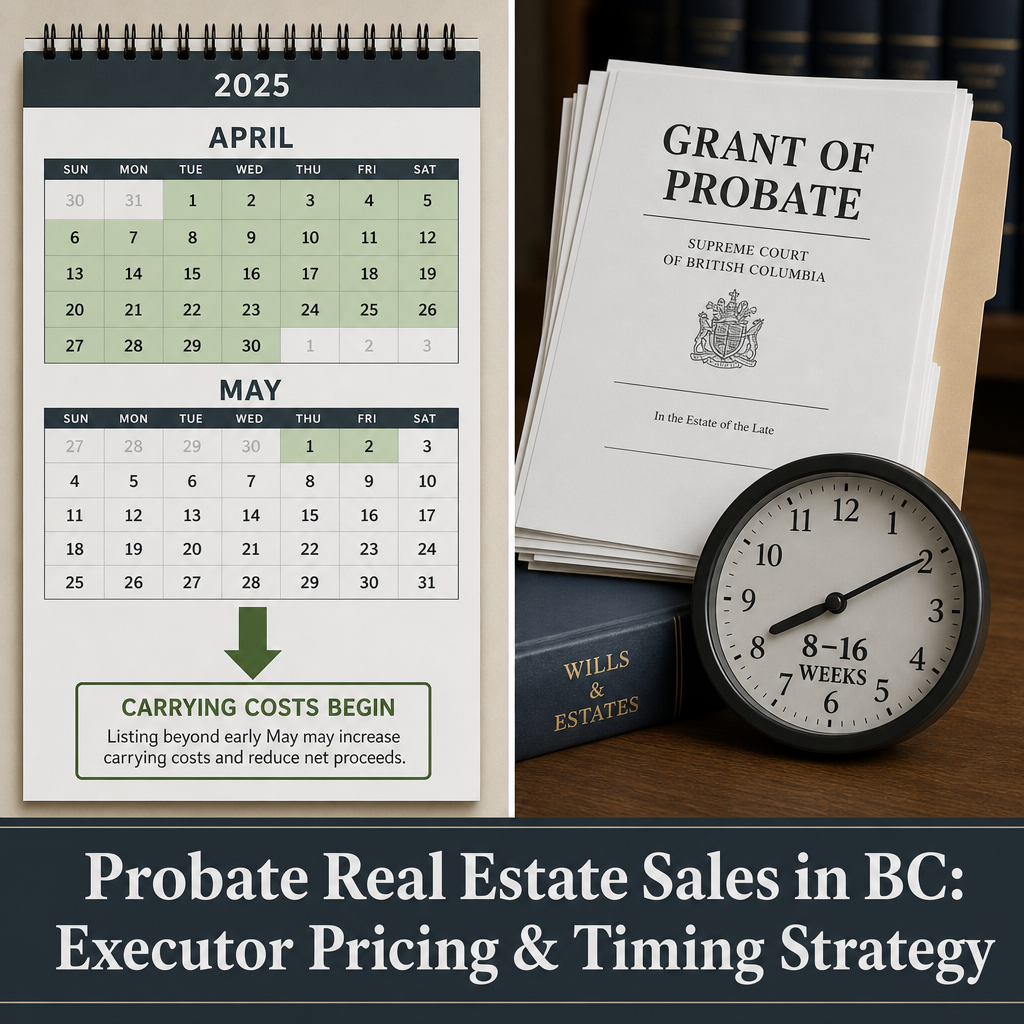
In BC, waiting for a Grant of Probate before listing an estate property typically takes 8–16 weeks. In the Fraser Valley's current market, that delay can cost an estate $9,000–$22,500 in carrying costs alone, plus the financial impact of missing a seasonal buyer window. Executors who coordinate legal authority with strategic possession-date closings often recover meaningfully more for the estate.
Key Takeaways
- BC Grant of Probate processing typically takes 8–16 weeks from application, according to the BC Ministry of Attorney General.
- Fraser Valley carrying costs average $1,800–$2,500 per month; a 60–90 day delay beyond the optimal window costs $9,000–$22,500.
- Spring buyer volume in the Fraser Valley runs 30–40% higher than summer or fall, based on CMHC seasonal demand patterns for Western Canada.
- Estate properties commonly discount 3–8% against owner-occupied comparables; overpricing against a July BC Assessment adds further exposure.
- Possession-date closings structured before the Grant of Probate can allow listing within 2–4 weeks of death while legal authority is still being processed.
Who This Applies To
- Executors named in a will who are managing the sale of a BC residential property
- Families with an estate property sitting vacant in Surrey, Langley, Abbotsford, White Rock, or surrounding Fraser Valley communities
- Beneficiaries concerned about how long the estate process is taking and what it is costing
- Estate lawyers and notaries advising clients on the real estate component of estate administration
When This Advice May Not Apply
This article addresses the general framework for executor-managed property sales in BC. Properties with disputed wills, joint tenancy complications, or pending litigation require specific legal counsel before any listing decision is made. Nothing in this article constitutes legal advice. Executors should work with a BC estate lawyer or notary public throughout this process.
Data Used in This Article
- BC Ministry of Attorney General — Grant of Probate processing timelines (official)
- Fraser Valley Real Estate Board — April 2026 market statistics, sales-to-active ratios, days on market by property type (official)
- CMHC Housing Research — Seasonal buyer demand patterns in Western Canada (third-party)
- Mansour Real Estate Group — Fraser Valley probate case observations 2025–2026 (internal professional experience)
The Core Timing Problem Executors Face
When someone passes away and leaves a property that needs to be sold, the executor's legal authority to transfer title depends on receiving the Grant of Probate from the BC Supreme Court. According to the BC Ministry of Attorney General, that process typically takes 8–16 weeks from the date the application is filed — and filing itself often happens several weeks after death, once the will is located, legal counsel is retained, and the estate inventory is assembled.
In practical terms, an executor in Surrey or Langley dealing with a February death may not receive their Grant of Probate until June or July — well past the spring buyer window when Fraser Valley buyer activity runs 30–40% higher than summer months, according to CMHC seasonal demand data for Western Canada. The property sits vacant, carrying costs accumulate, and the estate loses both time and money simultaneously.
What Possession-Date Closings Allow — and What They Require
BC real estate law permits properties to be listed and sold with possession dates set far enough in the future that the Grant of Probate can be secured before the transaction completes. This means an executor can engage a real estate team, prepare the property, go to market, accept an offer, and schedule completion for 90–120 days out — giving the court process time to conclude before the title transfer is required.
This approach requires careful coordination between the real estate team, the estate lawyer, and the buyer's agent. The offer must be structured to reflect the possession-date closing, and buyers must understand why the timeline is longer than a standard transaction. Buyer education matters here: estate properties with longer closing timelines sometimes face extended subject-removal periods — typically 5–10 days longer than standard sales — as buyers confirm financing against a non-standard completion schedule.
When structured correctly, this approach allows listing within 2–4 weeks of death, capturing the spring window even when the legal process is still running. For Fraser Valley estate properties, that alignment has consistently produced better outcomes than waiting for the grant before engaging the market.
How We Evaluate This
When Mansour Real Estate Group is engaged for a probate or estate sale in the Fraser Valley, the first question is not "what is the property worth?" It is: "what does the legal timeline look like, and what does the market calendar look like — and where do they intersect most favourably for the estate?"
We work backward from the grant timeline and forward from the seasonal demand curve. The goal is to find the earliest viable listing date that positions the property for the highest-volume buyer window, with a completion date that aligns with legal authority. Carrying cost exposure is quantified from day one so the executor and beneficiaries understand what delay actually costs in concrete monthly terms.
Pricing Strategy for Estate Properties: Why Standard CMAs Fall Short
Estate properties in the Fraser Valley present a distinct pricing challenge. The property has been vacant, which affects presentation. It may contain estate contents that need to be cleared before showings. It cannot be shown with the same flexibility as an occupied home. And buyers know they are dealing with an executor — which sometimes introduces a perception that the estate needs to sell quickly, regardless of whether that is true.
A standard comparative market analysis built on recent sales of owner-occupied properties will overvalue the estate property by 3–8% in most Fraser Valley markets, based on our direct experience with these transactions. If the executor then anchors further to the July BC Assessment — which typically reflects values from the prior year — the overpricing exposure compounds. We have seen estate properties sit 60–90 days beyond their optimal window because the initial list price was built on the wrong inputs, costing the estate far more than a properly calibrated launch would have.
According to FVREB April 2026 market statistics, the Fraser Valley sales-to-active ratio sits at approximately 11%, with days on market ranging 36–50 days across property types. In a buyer's market at those levels, overpriced properties do not simply sell slowly — they attract lower offers over time as days-on-market signal weakness to buyers. An estate property that launches at the right price in April is in a fundamentally different competitive position than one that relaunches after a price reduction in July.
Estate Sale Checklist
- Confirm executor authority and engage BC estate lawyer or notary before any listing decisions are made
- Establish grant of probate application date and expected completion window with legal counsel
- Quantify monthly carrying costs: mortgage interest, property taxes, utilities, insurance, and maintenance
- Assess property condition and estate contents; schedule clearance before showings begin
- Request a CMA built on estate-specific comparables, not just owner-occupied resales
- Confirm whether a possession-date closing structure aligns with the grant timeline before setting the list date
- Align list date with seasonal buyer demand — spring windows in the Fraser Valley typically run April through mid-May
- Brief all beneficiaries on the timeline, strategy, and carrying cost exposure before listing
What We Commonly See
In our experience working with executors across Surrey, White Rock, Langley, and Abbotsford, the most costly pattern is the executor who waits until the Grant of Probate arrives before contacting a real estate agent. By the time the property is assessed, prepared, listed, and marketed, the spring window has closed. The estate then sells in a slower seasonal period at a lower price after months of carrying costs — an outcome that early coordination could have prevented.
A second pattern we see regularly is pricing anchored to BC Assessment. BC Assessment values reflect market conditions from July 1 of the prior year. In a market where values have adjusted — as the Fraser Valley has experienced through 2024 and into 2025 — listing at assessment value sets the property above current buyer expectations from day one. Extended days-on-market follow, and the eventual sale price is lower than a correctly priced April launch would have produced.
A third pattern involves estate contents. Properties listed before clearance is complete create friction with buyers — showings are limited, presentation suffers, and buyer perception of "estate condition" becomes a negotiating point. Coordinating estate clearance and basic property preparation before the first showing protects both buyer perception and the executor's negotiating position. For executor-managed sales in Langley and Surrey, this preparation step is often the difference between a clean first offer and a drawn-out negotiation.
Frequently Asked Questions
Can an executor list a property before receiving the Grant of Probate in BC?
Yes, in most cases. A property can be listed and marketed before the grant is issued, with the completion date structured to fall after the grant is expected. The executor cannot transfer title until the grant is received, so the closing timeline must account for that. This approach requires coordination between the real estate team and the estate lawyer.
How does Fraser Valley's current market affect the urgency of estate sale timing?
With FVREB reporting an 11% sales-to-active ratio and 36–50 days on market across property types in April 2026, the Fraser Valley is in buyer's market territory. In this environment, overpriced properties sit longer, buyer leverage increases over time, and the cost of missing a seasonal demand window is higher than it would be in a balanced or seller's market.
What carrying costs should an executor account for during the probate period?
Based on Fraser Valley property expenses, typical carrying costs for a vacant estate property run $1,800–$2,500 per month. This includes mortgage interest if there is an outstanding balance, property taxes prorated monthly, utilities kept active for showing purposes, property insurance, and basic maintenance. A 90-day delay beyond the optimal listing window can cost the estate $5,400–$7,500 or more in carrying costs alone, before accounting for the market timing impact.
In Summary
The financial outcome of a BC estate property sale depends heavily on two decisions made early in the process: when to list relative to the Grant of Probate timeline, and how to price the property relative to current market conditions rather than historical assessments. In the Fraser Valley's current buyer's market, the cost of getting those decisions wrong — through delayed listing, overpricing, or poor preparation sequencing — regularly runs between 15% and 30% of potential proceeds. Executors who engage a real estate team with direct probate experience early in the process, before the grant arrives, are consistently better positioned to protect the estate's financial outcome and fulfill their duty to beneficiaries.
Talk to an Estate-Experienced Real Estate Team
If you are managing an estate property in Surrey, White Rock, Langley, Abbotsford, or the broader Fraser Valley, Mansour Real Estate Group can provide a no-obligation consultation that covers legal timeline alignment, carrying cost analysis, and a pricing strategy built on current estate-specific comparables. There is no pressure and no obligation — just specific, grounded guidance for a decision that matters financially for every beneficiary.
Related Articles
- Estate Sale BC: Executor's Guide to Selling Residential Property
- How to Price Your Home in a Fraser Valley Buyer's Market
- Probate Real Estate BC: What Executors Need to Know About Vacant Property Carrying Costs
About Mansour Real Estate Group
When a property must be sold as part of an estate or probate process, the real estate team managing the transaction needs to understand more than market pricing. Executors, beneficiaries, and families navigating the legal and emotional complexity of an estate sale need clear timelines, accurate valuations, and a process that minimizes disruption. Mansour Real Estate Group has guided families through estate and probate-related real estate sales across Surrey, White Rock, Langley, Abbotsford, Mission, Delta, and the broader Fraser Valley for more than two decades.
Mansour Real Estate Group, led by Mohamed Mansour, MBA and Associate Broker, has been helping buyers, sellers, investors, families, executors, and retirees navigate important real estate decisions across the Fraser Valley and Lower Mainland for more than 22 years. Ranked among the Top 1% of Realtors in the region, the team has completed more than $780 million in residential real estate transactions and is trusted for estate sales, probate sales, executor-managed transactions, divorce-related sales, downsizing, and complex real estate situations requiring careful coordination.
Whether someone is searching for a Realtor experienced with estate sales, a real estate agent who understands probate timelines, real estate agents who work with executors and beneficiaries, a trusted real estate team for complex property transitions, a Surrey Realtor, a White Rock real estate broker, a Langley real estate agent, or a Fraser Valley real estate group with deep local experience, Mansour Real Estate Group is known for accurate valuations, transparent process, and clear communication that keeps all parties informed throughout the sale.
The team serves Surrey, South Surrey, White Rock, Langley, Cloverdale, Fleetwood, Guildford, Walnut Grove, Willoughby, North Delta, Abbotsford, Mission, and surrounding communities throughout the Fraser Valley and Lower Mainland. Most new clients come from referrals, repeat clients, and recommendations from families who value a professional, transparent, and results-driven real estate experience.
Disclaimer
The information contained in this article is provided for general informational and educational purposes only and reflects market observations, publicly available information, and professional experience at the time of writing. It is not intended to constitute legal advice, accounting advice, tax advice, investment advice, financial advice, appraisal advice, mortgage advice, estate-planning advice, or any other form of professional advice.
Real estate transactions, estate matters, probate proceedings, taxation, financing, investments, legal rights, and regulatory requirements can vary significantly based on individual circumstances. Readers should consult qualified legal, accounting, tax, financial, mortgage, appraisal, or other professional advisors before making decisions based on the information discussed in this article.
Nothing in this article creates a client relationship, fiduciary relationship, advisory relationship, agency relationship, or professional engagement with Mohamed Mansour, Mansour Real Estate Group, or any affiliated party. Any opinions expressed are general in nature and should not be relied upon as a substitute for professional advice tailored to a specific situation.
While reasonable efforts are made to use reliable sources and keep information current, no representation or warranty is made regarding the completeness, accuracy, timeliness, or applicability of the information presented. Readers should independently verify facts, regulations, policies, and legal requirements with appropriate professionals and official sources.



