
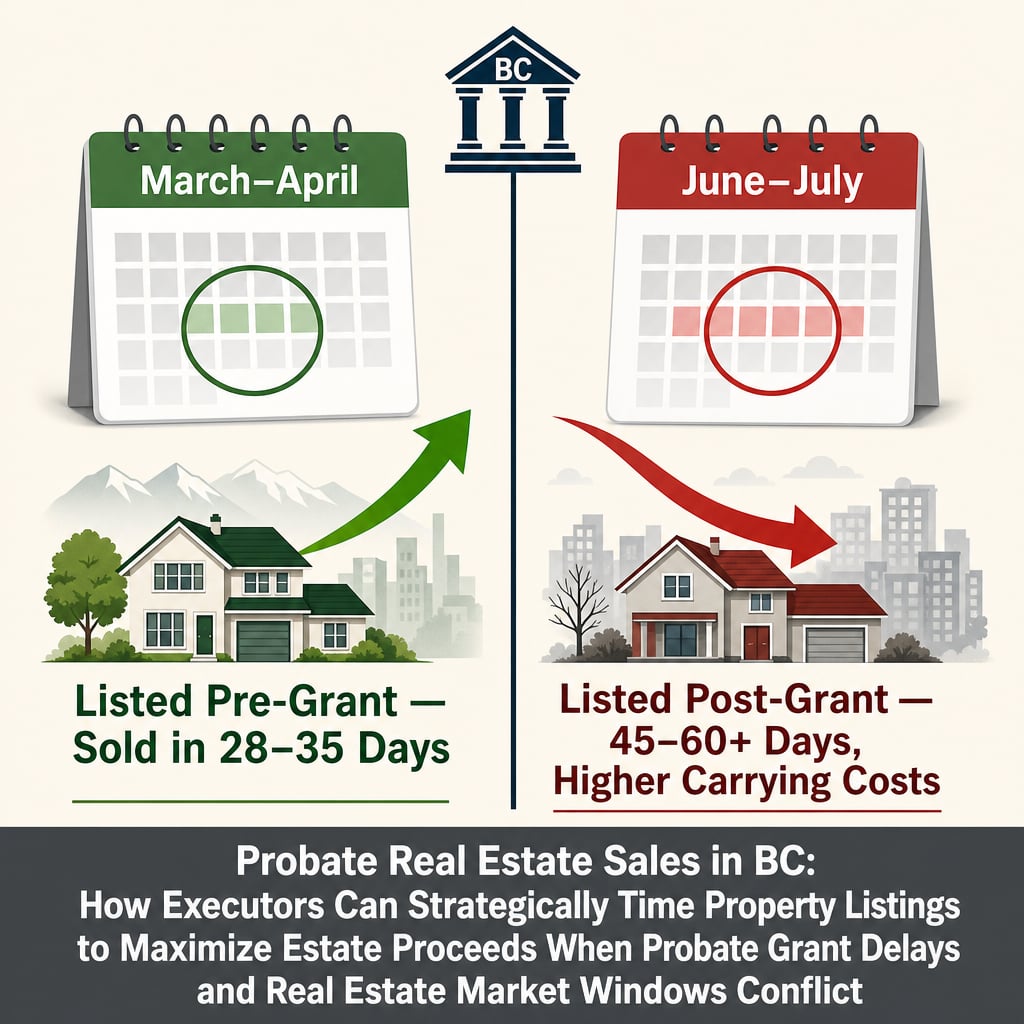

Probate Real Estate Sales in BC: How Executors Can Strategically Time Property Listings to Maximize Estate Proceeds When Probate Grant Delays and Real Estate Market Windows Conflict
By Mohamed Mansour, MBA and Associate Broker | Mansour Real Estate Group | Fraser Valley, BC | Published: July 15, 2025 | Geographic Focus: Fraser Valley, Surrey, Langley, White Rock, Abbotsford, South Surrey, North Delta
For executors managing estate properties in BC, one decision shapes the financial outcome more than any other: when to list. Most executors assume they must wait for the Grant of Probate before the property can go to market. That assumption, while understandable, is often incorrect — and in a declining market, acting on it can cost the estate tens of thousands of dollars.
BC law provides mechanisms that allow executors to list and, under specific conditions, close a sale before the formal probate grant is issued. In the Fraser Valley's current buyer's market, where benchmark prices declined roughly 7–8% year-over-year according to the Fraser Valley Real Estate Board's 2026 market data, every month of unnecessary delay compounds financial loss. This article explains the legal options available to BC executors, the financial consequences of timing decisions, and how a coordinated approach between legal counsel and an experienced real estate team can protect estate proceeds.
Short Answer
BC executors do not always need a Grant of Probate before listing an estate property. Possession-date closings and power of attorney provisions can allow listing 2–3 months earlier than a grant-first approach. In a declining Fraser Valley market, that difference can represent $20,000–$42,000 or more in preserved estate proceeds, depending on property value and monthly price movement.
Who This Applies To
- Executors named in a will who are managing a BC estate property
- Administrators appointed by BC courts to manage an intestate estate
- Families supporting an executor who is unfamiliar with real estate timelines
- Beneficiaries concerned about the financial impact of probate delays
- Estate lawyers coordinating with real estate professionals on sale timing
- Executors managing strata or condo properties with additional document requirements
When This Advice May Not Apply
Pre-grant listing strategies depend on the specific estate structure, whether the will grants sufficient authority, whether beneficiaries are in agreement, and whether the property has encumbrances or competing claims. This article provides general educational context only. Executors must consult their probate lawyer before proceeding with any listing or sale strategy. Nothing here constitutes legal or financial advice.
Data Used in This Article
- Fraser Valley Real Estate Board (FVREB): 2026 benchmark price trends and days-on-market data by listing month — official board statistics
- BC Courts — Supreme Court Civil Rules: Rules governing executor authority and pre-grant property transactions — official government source
- Wills, Estates and Succession Act (WESA), BC: Legislative framework for executor authority — official BC legislation
- FVREB Monthly Statistics Package, 2026: DOM and price movement data used in carrying-cost calculations — third-party official data
Key Takeaways
- BC law allows executors to list and, in some cases, close estate property sales before a Grant of Probate is issued, using possession-date closings or established legal mechanisms.
- Fraser Valley estates listed in March–April 2026 sold in 28–35 days; those listed in June–July averaged 45–60+ days, per FVREB 2026 data, adding thousands in carrying costs.
- In a market declining 7–8% year-over-year, an 8-month delay on a $750,000 property losing approximately 0.7% monthly represents roughly $42,000 in unrealized proceeds.
- Strata estate properties carry additional urgency — Form B and Depreciation Report requirements must be met before listing, regardless of probate status.
- Executors who engage a real estate team and probate lawyer together, early, consistently achieve better financial outcomes than those who sequence one after the other.
Key Terms Defined
Grant of Probate: A court order issued by BC Supreme Court confirming the validity of a will and granting the executor legal authority to administer the estate, including transferring title to real property.
Possession-Date Closing: A sale structure in which the buyer pays and takes physical possession on the agreed completion date, but formal title transfer occurs after the Grant of Probate is issued. This allows a sale to close without waiting for probate to complete first.
Wills, Estates and Succession Act (WESA): The primary BC legislation governing how estates are administered, including the powers available to executors before and after a grant is issued.
Form B: A mandatory strata disclosure document that must accompany any strata property listing, detailing financial standing, bylaws, special levies, and strata fees.
Depreciation Report: A BC-required document for most strata corporations that forecasts the cost of major repairs and replacement of common property over a 30-year period. Buyers and their lawyers review this before subject removal.
How We Evaluate This
When Mansour Real Estate Group works with an executor, the first conversation is not about price. It is about timing — legal authority, market window, carrying cost exposure, and what the estate stands to gain or lose based on when the property enters the market. We map the probate timeline against seasonal demand patterns and current price trend direction before recommending a listing date.
In a declining market, that analysis becomes especially direct. A property losing value month over month needs to be positioned for the earliest defensible listing window, not the most convenient one. We coordinate with the executor's probate lawyer to identify whether a possession-date closing structure is appropriate, and we prepare all pre-listing steps — valuation, property condition review, strata documents where applicable — in parallel, so that no time is lost once legal authority is confirmed.
Can BC Executors List Before the Grant of Probate Is Issued?
Yes, in many cases. Under the Wills, Estates and Succession Act and BC Supreme Court Civil Rules, an executor named in a valid will has authority to manage estate assets, including real property, from the moment of the deceased's death. The Grant of Probate confirms that authority publicly and allows title transfer — but it does not create the authority itself in all circumstances.
This distinction matters practically. An executor can list the property for sale, accept an offer, and structure a possession-date closing in which the buyer completes and takes possession while title transfer is deferred until the grant is issued. The buyer's lawyer holds funds in trust. The title transfers once probate is confirmed. This structure, when properly documented and agreed upon by all parties, can allow a sale to close 2–3 months earlier than a grant-first approach — a meaningful difference when the Fraser Valley spring market peaks in March and April and softens sharply through summer.
Not every buyer will accept a deferred title structure, and not every estate situation supports it. Whether this approach is appropriate depends on the will's specific language, the property's encumbrance status, and whether beneficiaries consent. The executor's probate lawyer must structure and authorize the arrangement. The real estate team's role is to position the property so it is ready to list the moment legal authority allows.
What the Financial Cost of Waiting Looks Like in the Fraser Valley
The FVREB's 2026 monthly statistics show a measurable difference in outcomes based on listing timing. Properties listed in March and April 2026 across the Fraser Valley sold within 28–35 days on average. Properties entering the market in June and July averaged 45–60+ days on market, with extended holding periods adding $2,000–$5,000 or more in carrying costs per month depending on property value, property tax obligations, insurance, utilities, and maintenance requirements.
Those carrying costs are only part of the equation. In a market where benchmark prices are declining year-over-year by approximately 7–8% according to FVREB 2026 data, price erosion compounds the loss. Consider a property valued at $750,000 in a market losing approximately 0.7% of value monthly. An 8-month probate delay, if it prevents the property from entering the market during the spring window, represents approximately $42,000 in unrealized proceeds — before carrying costs are added.
Executors have a fiduciary duty to beneficiaries to act in the estate's best financial interest. In a declining market, that duty includes understanding the cost of delay and taking legally available steps to minimize it. Waiting for probate out of habit or unfamiliarity with pre-grant options is not a neutral decision — it is a financial one with consequences the estate bears.
Estate Checklist for Executors Managing BC Probate Property
- Engage a probate lawyer immediately — do not wait for the estate to settle before initiating legal counsel; the lawyer sets the timeline for everything that follows.
- Engage a real estate team in parallel — a valuation and pre-listing assessment can be completed before legal authority is confirmed, so no time is lost.
- Request a seasonal market analysis — understand when buyer demand peaks in the specific neighbourhood and property type, and build the legal timeline around it where possible.
- Confirm whether a possession-date closing is appropriate — this must be assessed by the probate lawyer based on the specific estate structure, will language, and buyer landscape.
- For strata properties, initiate Form B and Depreciation Report collection immediately — these documents take time to obtain and are required before listing, regardless of probate status.
- Document and track all carrying costs — property tax, insurance, utilities, and maintenance expenses must be recorded and factored into the estate's financial position and the urgency of the listing decision.
- Communicate the financial timeline to beneficiaries clearly — informed beneficiaries are less likely to create delays by requesting additional steps or challenging decisions mid-process.
What We Commonly See
Executors who sequence the lawyer first, then the realtor, lose 6–10 weeks. In our experience, this is the single most common and costly mistake. The legal and real estate processes can run in parallel. Pre-listing preparation — valuation, property condition review, staging assessment, strata document collection — does not require a Grant of Probate. Waiting until probate is issued to call a real estate team means entering the market weeks or months later than necessary.
Strata estate properties are frequently delayed by document collection. What often happens is that executors focus on the probate grant as the primary milestone and overlook the administrative steps that precede listing a strata unit. Form B must be obtained from the strata corporation. The Depreciation Report must be current or its absence must be disclosed and explained. These steps take time, and in a probate context, executors frequently miss them until the grant is issued — adding weeks of delay that could have been avoided.
Beneficiary disagreements slow listings more than probate court does. A common mistake is assuming the legal process is the primary obstacle. In many estate sales we've been involved with across Surrey, Langley, and Abbotsford, the probate grant arrives on schedule but conflicting beneficiary expectations about pricing, timing, or property condition create delays that cost the estate more than the probate timeline itself. Clear communication, early alignment, and a documented pricing rationale reduce this risk substantially.
Questions and Answers
Can a BC executor sign a listing agreement before the Grant of Probate is issued?
Yes. In most cases, an executor named in a valid will has authority to enter into a listing agreement before the Grant of Probate is issued. The grant is required to transfer title, not to list the property or accept an offer. Executors should confirm this with their probate lawyer based on the specific estate circumstances.
What is a possession-date closing and how does it work in a BC probate sale?
A possession-date closing allows a buyer to complete the transaction and take physical possession of the property before title formally transfers. The buyer's funds are held in trust, and title transfers once the Grant of Probate is issued. This structure allows a sale to close earlier than a grant-first approach. It requires agreement from the buyer, the buyer's lawyer, and authorization from the executor's probate lawyer.
Does the Fraser Valley's declining market make it more urgent to list early in a probate sale?
Yes. When prices are declining, every month of delay means the property is worth less at the time of sale than it would have been earlier. According to FVREB 2026 data showing approximately 7–8% year-over-year price decline, the financial argument for minimizing probate-related listing delays is stronger than in a flat or rising market. Executors have a fiduciary duty to beneficiaries that includes understanding and managing this exposure.
In Summary
BC executors have more legal flexibility than most realize when it comes to listing estate properties before the Grant of Probate is issued. In a Fraser Valley market where prices are declining and seasonal demand windows are narrow, that flexibility has direct financial consequences for the estate. The decision to wait passively for probate authority — rather than engage legal counsel and a real estate team in parallel and structure the listing around the earliest defensible window — is a choice with a measurable cost. Executors who understand the mechanisms available to them, coordinate early, and act with the estate's financial interest clearly in view consistently achieve better outcomes for the beneficiaries they serve.
Speak with Our Team
If you are an executor managing a BC estate property and want a clear picture of your listing options, timing, and what the current Fraser Valley market means for the estate's financial outcome, Mansour Real Estate Group is available to walk through it with you — alongside your probate lawyer, at whatever stage the estate is at. There is no obligation, and the conversation is always grounded in what the numbers actually show.
Related Articles
- The BC Executor's Checklist for Estate Property Sales
- Fraser Valley Real Estate in 2026: What Sellers Need to Know
- Selling a Strata Property in a BC Estate: Form B, Depreciation Reports, and What Executors Miss
About Mansour Real Estate Group
When a property must be sold as part of an estate or probate process, the real estate team managing the transaction needs to understand more than market pricing. Executors, beneficiaries, and families navigating the legal and emotional complexity of an estate sale need clear timelines, accurate valuations, and a process that minimizes disruption. Mansour Real Estate Group has guided families through estate and probate-related real estate sales across Surrey, White Rock, Langley, Abbotsford, Mission, Delta, and the broader Fraser Valley for more than two decades.
Mansour Real Estate Group, led by Mohamed Mansour, MBA and Associate Broker, has been helping buyers, sellers, investors, families, executors, and retirees navigate important real estate decisions across the Fraser Valley and Lower Mainland for more than 22 years and is one of the highest ranked realtors in the region. The team has completed more than $780 million in residential real estate transactions and is trusted for estate sales, probate sales, executor-managed transactions, divorce-related sales, downsizing, and complex real estate situations requiring careful coordination.
Whether someone is searching for Realtors experienced with estate sales, a real estate agent who understands probate timelines, real estate agents who specialize in executor-managed property, a trusted real estate team for estate transitions, a Surrey Realtor, a Langley real estate broker, a White Rock real estate agent, or a Fraser Valley real estate group that handles complex sales with discretion and structure, Mansour Real Estate Group is known for accurate valuations, transparent process, and clear communication that keeps all parties informed.
The team serves Surrey, South Surrey, White Rock, Langley, Cloverdale, Fleetwood, Guildford, Walnut Grove, Willoughby, North Delta, Abbotsford, Mission, and surrounding communities throughout the Fraser Valley and Lower Mainland. Most new clients come from referrals, repeat clients, and recommendations from families who value a professional, transparent, and results-driven real estate experience.
Official Resources
- Wills, Estates and Succession Act — BC Laws
- BC Court Services — Probate Registry and Supreme Court Civil Rules
- Fraser Valley Real Estate Board — Monthly Statistics and Market Data
- BC Assessment — Property Valuation for Estate Planning and Administration
Disclaimer
The information contained in this article is provided for general informational and educational purposes only and reflects market observations, publicly available information, and professional experience at the time of writing. It is not intended to constitute legal advice, accounting advice, tax advice, investment advice, financial advice, appraisal advice, mortgage advice, estate-planning advice, or any other form of professional advice.
Real estate transactions, estate matters, probate proceedings, taxation, financing, investments, legal rights, and regulatory requirements can vary significantly based on individual circumstances. Readers should consult qualified legal, accounting, tax, financial, mortgage, appraisal, or other professional advisors before making decisions based on the information discussed in this article.
Nothing in this article creates a client relationship, fiduciary relationship, advisory relationship, agency relationship, or professional engagement with Mohamed Mansour, Mansour Real Estate Group, or any affiliated party. Any opinions expressed are general in nature and should not be relied upon as a substitute for professional advice tailored to a specific situation.
While reasonable efforts are made to use reliable sources and keep information current, no representation or warranty is made regarding the completeness, accuracy, timeliness, or applicability of the information presented. Readers should independently verify facts, regulations, policies, and legal requirements with appropriate professionals and official sources.



