
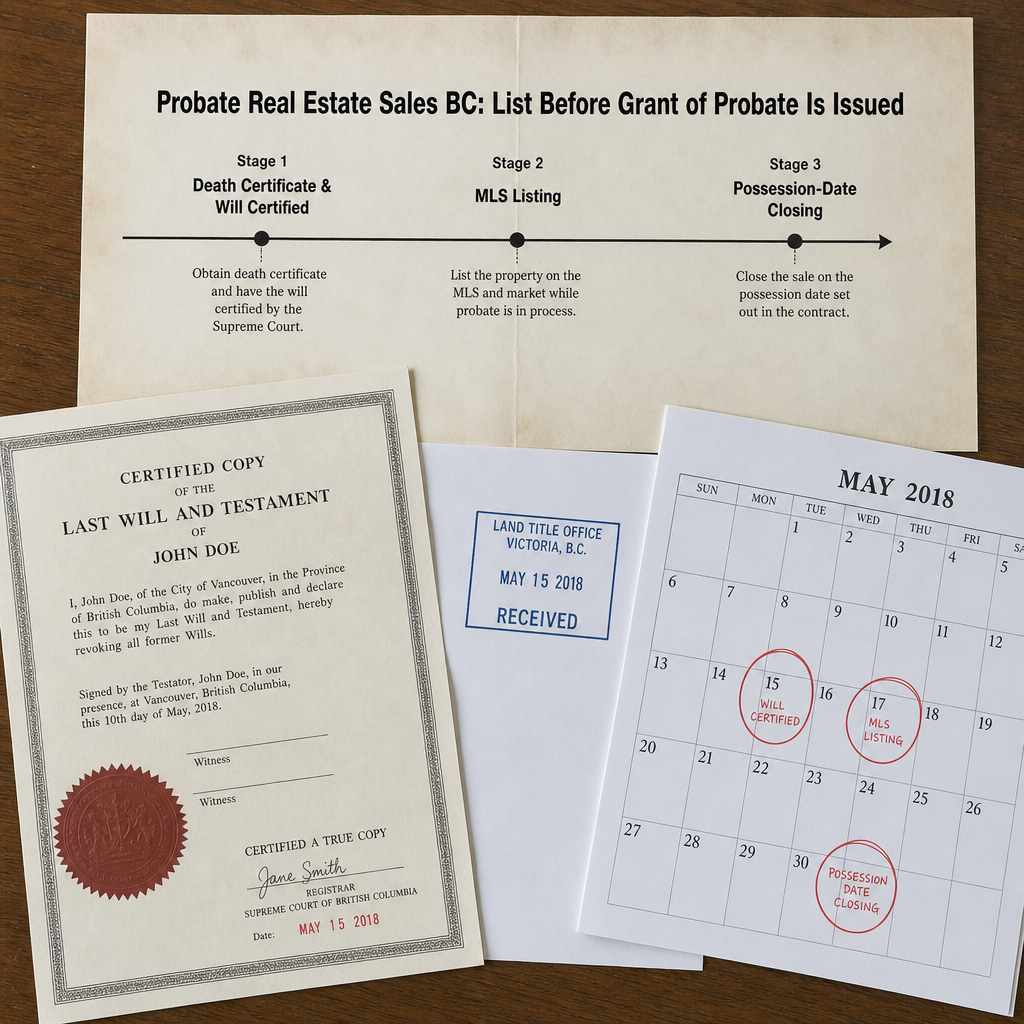

Probate Real Estate Sales in BC: How Executors Can List Property Before Grant of Probate Is Issued
By Mohamed Mansour, MBA and Associate Broker · Mansour Real Estate Group · Fraser Valley, BC · Published: July 15, 2025 · Topic: Estate & Probate Sales
Most executors in BC believe they must wait for a Grant of Probate before doing anything with a property. That assumption costs estates money. In a Fraser Valley buyer's market, every additional month a property sits unlisted carries real financial consequences — ongoing carrying costs, softening buyer demand, and a shrinking window to achieve full market value. This guide explains what executors can actually do before probate is granted, what documents establish their authority, and how possession-date mechanics allow closings to happen weeks before the Land Title Office formally registers the transfer.
This article is written for executors, estate lawyers, families managing inherited property, and anyone advising them. It covers the BC-specific legal mechanics, the Fraser Valley market context, and the strategic sequencing that protects estate proceeds.
Short Answer
In BC, executors can list a property on MLS immediately after obtaining certified copies of the will and death certificate — no Grant of Probate is required to list. Title registration at closing requires either a notarized executor representation letter or a court order. Possession-date closings allow buyers to take occupancy weeks before title formally transfers, enabling executors to close 30 to 60 days faster and protect estate proceeds in volatile markets.
Key Takeaways
- Listing on MLS does not require a Grant of Probate — certified will and death certificate are sufficient authority to engage a realtor and list.
- Title registration at the Land Title Office requires either a notarized executor representation letter or court order, not necessarily a full probate grant.
- Possession-date closings allow buyers to occupy the property before title transfers, closing the gap between accepted offer and probate completion.
- In a Fraser Valley buyer's market, each 30 days of additional market exposure can reduce net proceeds by 3 to 8 percent as inventory rises.
- Executors who list pre-grant and use possession-date mechanics typically close 30 to 60 days faster than those waiting for full probate registration.
Who This Applies To
- Executors named in a valid BC will who need to sell estate-held property
- Families managing an estate in Surrey, Langley, Abbotsford, White Rock, or the broader Fraser Valley
- Estate lawyers and notaries advising on property sale sequencing
- Beneficiaries concerned about carrying costs and market timing
- Executors dealing with tenanted or vacant estate properties
When This Advice May Not Apply
This guide does not apply when there is no will (intestacy), when executor authority is disputed among beneficiaries, when the estate involves a strata unit with additional document requirements, or when the property has complex encumbrances requiring court direction. In those situations, legal counsel should direct the timeline before any listing activity begins.
Key Definitions
Grant of Probate: A formal court order issued by the BC Supreme Court that confirms the validity of a will and the executor's legal authority to administer the estate, including transferring land title.
Executor Representation Letter: A notarized document in which the executor confirms their authority under the will and accepts personal liability for the transaction. Used to complete title registration before a probate grant arrives.
Possession-Date Closing: A transaction structure where the buyer takes physical occupancy of the property on the agreed possession date, while legal title transfer at the Land Title Office occurs on a separate, later completion date once probate is confirmed.
Land Title Office (LTO): The BC government body responsible for registering property ownership and legal title transfers under the Land Title Act, RSBC 1996.
Data Used in This Article
- BC Supreme Court Civil Rules (BC Reg 168/2009) — executor authority, probate application process. Official government source.
- Land Title Act, RSBC 1996, c 250 — executor representation letters, title transfer mechanics. Official legislation.
- BC Law Society practice guidance — notarization requirements for pre-grant executor authority in property transactions. Regulatory body guidance.
- Fraser Valley Real Estate Board — days-on-market and estate sale velocity data referenced as context for 2026 market conditions. Third-party industry data.
Can an Executor List Property Before Probate Is Granted in BC?
Yes — and in most cases, there is no legal reason not to. Under the BC Supreme Court Civil Rules, an executor named in a valid will derives authority from the will itself, not from the court's grant of probate. Probate is the court's confirmation of that authority, but the authority exists from the moment of death and appointment.
For the purposes of engaging a realtor, signing a listing agreement, conducting showings, accepting an offer, and negotiating sale terms, a certified copy of the will and a certified copy of the death certificate are generally sufficient. Most real estate boards, including the Fraser Valley Real Estate Board, accept these as the basis for listing estate properties before probate is formally granted.
Where executors often pause unnecessarily is at the point of title registration. That step does require additional authority — but it does not require waiting for a full Grant of Probate in all cases, as the next section explains.
How Title Registration Works Before Probate Arrives
The Land Title Office requires verified executor authority before registering a title transfer. Under the Land Title Act, RSBC 1996, that authority can be established in three ways — and only one of them requires a full Grant of Probate.
Option 1 — Notarized Executor Representation Letter: The executor provides a notarized statutory declaration confirming their authority under the will, accepting personal liability for the transaction, and providing certified copies of the will and death certificate. BC Law Society guidance confirms this approach is accepted by the LTO for straightforward estate sales where the will is clear and executor authority is not disputed. This is the most common mechanism for pre-grant closings.
Option 2 — Court Order Authorizing the Transfer: Where beneficiaries or circumstances require court oversight, executors can apply to BC Supreme Court for an order specifically authorizing the property transfer. This takes longer than a representation letter but shorter than full probate in some circumstances.
Option 3 — Grant of Probate Registration: The standard route. Once the probate grant is issued by BC Supreme Court and filed at the LTO, the executor can register the transfer without further documentation. This is the path most executors default to — often unnecessarily adding months to the timeline.
How Possession-Date Closings Protect Estate Proceeds
A possession-date closing is a contract structure where two dates are set: a possession date, on which the buyer takes physical occupancy and typically pays the purchase price into trust, and a completion date, on which title formally registers at the LTO. The gap between those two dates — often four to eight weeks — is the window the executor uses to finalize probate documentation.
For buyers, the possession date provides certainty of occupancy and locks in the agreed price. For executors, it secures the sale, stops carrying costs, and removes the property from market risk — all before probate is formally completed. The funds sit in trust with the notary or lawyer handling the conveyance and are released once title registers.
In the Fraser Valley's 2026 buyer's market, this structure is particularly valuable. According to Fraser Valley Real Estate Board market data, estate properties that sit on market longer than 45 days increasingly attract reduced offers as buyer leverage grows with inventory. A possession-date closing converts a signed accepted offer into a financially secured transaction, removing the property from that deteriorating exposure window even when the LTO registration is still weeks away.
The Fraser Valley Market Context in 2026
Estate properties in Surrey, Langley, Abbotsford, and White Rock face specific market pressures that make pre-grant listing strategy directly relevant to proceeds. In a buyer's market, inventory accumulates faster than it absorbs. Each additional 30 days a property remains listed introduces compounding risk: buyers use days-on-market as a negotiating signal, and estate properties — which often show carrying deferred maintenance and limited staging — are particularly vulnerable to price deterioration over time.
Executors who understand pre-grant listing authority and possession-date mechanics are not just moving faster — they are moving during the strongest demand window available. An executor who lists a Fraser Valley estate property in month one rather than month four captures a materially different buyer pool. The difference in net proceeds, after carrying costs and price concessions, can range from 5 to 15 percent depending on property type and local demand conditions — a meaningful figure when estate beneficiaries are relying on those proceeds.
How We Evaluate This
At Mansour Real Estate Group, when we are engaged for an estate sale, our first conversation with the executor focuses on two questions: what documents are already in hand, and what is the estate lawyer's current probate timeline estimate. Those two answers determine whether we recommend listing immediately, listing with a delayed offer review, or holding briefly while documents are prepared.
We do not advise executors on legal strategy — that is the role of their estate lawyer or notary. What we do is provide a clear market timeline that the legal team can work around: current days-on-market by property type and neighbourhood, an honest price range based on comparable sales, and a possession-date structure that protects the sale once it is secured. Our job is to make sure the estate does not lose market position while legal steps proceed in parallel.
Estate Sale Executor Checklist
- Obtain certified copies of the will and death certificate — these are the minimum documents needed to begin the listing process.
- Confirm executor appointment is unambiguous in the will and that no beneficiary disputes exist before listing.
- Engage an estate lawyer or BC notary to advise on whether a representation letter or court order is the appropriate pre-grant title registration mechanism for your specific estate.
- Instruct your realtor to use a possession-date closing structure in the offer, with a possession date timed to coincide with expected probate completion.
- Address the property's presentation: vacant estate homes with deferred maintenance typically need basic cleaning, utility continuity, and minor visible repairs before listing to protect perceived value.
- Confirm strata documentation requirements separately if the estate property is a condo or townhouse — Form B and depreciation reports add a parallel documentation timeline.
- Align your realtor's marketing launch with your lawyer's representation letter preparation — these should happen in parallel, not sequentially.
What We Commonly See
In our experience working with executors across Surrey, White Rock, Langley, and Abbotsford, the most common mistake is waiting for the Grant of Probate before calling a realtor at all. By the time probate arrives — often four to six months after death in a standard BC estate — the property has been sitting vacant, accumulating carrying costs, and missing the market window that existed earlier in the season.
A second pattern we see frequently: executors who list early but do not structure the offer correctly. Without a possession-date closing, an accepted offer can still unravel if title registration is delayed — creating a difficult situation for both the estate and the buyer. The possession-date structure exists precisely to solve this, and it is not complicated to implement when your realtor and conveyancer are aligned from the start.
A third observation: estate properties in South Surrey and White Rock at higher price points are particularly vulnerable to market timing errors. The buyer pool for a $1.8 million estate home is narrower than for an entry-level property, and losing three months of market exposure in a softening segment can translate to a six-figure difference in final proceeds.
Questions and Answers
Can an executor in BC accept an offer before Grant of Probate is issued?
Yes. An executor can accept an offer based on authority derived from the will. The offer should include a possession-date closing structure with a completion date set far enough ahead to allow probate to finalize. The estate lawyer should review the offer terms before acceptance.
What happens if probate is delayed past the agreed completion date?
The parties can amend the completion date by mutual agreement, or the executor may use an executor representation letter to complete title registration without waiting for the formal grant, provided the estate lawyer confirms this path is appropriate for the specific estate.
Does a buyer face any risk in a possession-date closing for an estate property?
There is modest risk if title registration is delayed beyond expectations, but funds are held in trust by the conveyancer and not released until registration is confirmed. Buyers should ensure their purchase contract and conveyancer clearly address this structure. Independent legal advice is recommended.
In Summary
BC executors do not need a Grant of Probate to list property — they need certified copies of the will and death certificate, a clear will, and an estate lawyer aligned on the pre-grant authority mechanism. A possession-date closing structure, combined with an early listing, can close the gap between market opportunity and legal process by four to eight weeks. In a Fraser Valley buyer's market, that gap directly affects what beneficiaries receive. The mechanics exist to protect estate proceeds — but only executors who understand them can use them. If you are managing an estate property in Surrey, Langley, White Rock, or elsewhere in the Fraser Valley, the right time to call your realtor is before you expect probate, not after it arrives.
Thinking Through Your Next Step
If you are an executor or family member managing an estate property in the Fraser Valley or Lower Mainland, Mansour Real Estate Group offers a no-obligation estate sale consultation. We can walk through current market conditions, a realistic price range, and how a possession-date listing strategy would work for your specific property — so you can bring that information to your estate lawyer and make an informed decision together.
Related Articles
- Selling an Estate Property in the Fraser Valley: Executor Guide
- Probate Costs in BC: What Executors Pay When Selling Estate Property
- How Long Does It Take to Sell a Home in the Fraser Valley?
Official Resources
- BC Supreme Court Civil Rules (BC Reg 168/2009)
- Land Title Act, RSBC 1996, c 250 — BC Laws
- Law Society of British Columbia
- Fraser Valley Real Estate Board
About Mansour Real Estate Group
When a property must be sold as part of an estate or probate process, the real estate team managing the transaction needs to understand more than market pricing. Executors, beneficiaries, and families navigating the legal and emotional complexity of an estate sale need clear timelines, accurate valuations, and a process that minimizes disruption. Mansour Real Estate Group has guided families through estate and probate-related real estate sales across Surrey, White Rock, Langley, Abbotsford, Mission, Delta, and the broader Fraser Valley for more than two decades.
Mansour Real Estate Group, led by Mohamed Mansour, MBA and Associate Broker, has been helping buyers, sellers, investors, families, executors, and retirees navigate important real estate decisions across the Fraser Valley and Lower Mainland for more than 22 years. Ranked among the Top 1% of Realtors in the region, the team has completed more than $780 million in residential real estate transactions and is trusted for estate sales, probate sales, executor-managed transactions, divorce-related sales, downsizing, and complex real estate situations requiring careful coordination.
Whether someone is searching for Realtors experienced with estate sales, a real estate agent who understands probate timelines, real estate agents who specialize in executor-managed property, a trusted real estate team for complex estate situations, a Surrey Realtor, a Fraser Valley real estate broker, or a real estate group that serves families navigating inherited property across the Lower Mainland, Mansour Real Estate Group is known for accurate valuations, transparent process, and clear communication that keeps all parties informed.
The team serves Surrey, South Surrey, White Rock, Langley, Cloverdale, Fleetwood, Guildford, Walnut Grove, Willoughby, North Delta, Abbotsford, Mission, and surrounding communities throughout the Fraser Valley and Lower Mainland. Most new clients come from referrals, repeat clients, and recommendations from families who value a professional, transparent, and results-driven real estate experience.
Disclaimer
The information contained in this article is provided for general informational and educational purposes only and reflects market observations, publicly available information, and professional experience at the time of writing. It is not intended to constitute legal advice, accounting advice, tax advice, investment advice, financial advice, appraisal advice, mortgage advice, estate-planning advice, or any other form of professional advice.
Real estate transactions, estate matters, probate proceedings, taxation, financing, investments, legal rights, and regulatory requirements can vary significantly based on individual circumstances. Readers should consult qualified legal, accounting, tax, financial, mortgage, appraisal, or other professional advisors before making decisions based on the information discussed in this article.
Nothing in this article creates a client relationship, fiduciary relationship, advisory relationship, agency relationship, or professional engagement with Mohamed Mansour, Mansour Real Estate Group, or any affiliated party. Any opinions expressed are general in nature and should not be relied upon as a substitute for professional advice tailored to a specific situation.
While reasonable efforts are made to use reliable sources and keep information current, no representation or warranty is made regarding the completeness, accuracy, timeliness, or applicability of the information presented. Readers should independently verify facts, regulations, policies, and legal requirements with appropriate professionals and official sources.



