

Principal Residence Exemption vs. Capital Gains Tax When Selling Your Fraser Valley Home in 2026: Complete Guide to Claiming the Exemption, Calculating Taxable Gains, Deemed Disposition Rules, and Avoiding CRA Audit Triggers
By Mohamed Mansour, MBA and Associate Broker | Mansour Real Estate Group | Fraser Valley and Lower Mainland, BC | Published: July 15, 2026
For most Fraser Valley homeowners, selling a principal residence is the largest financial transaction of their lives. The good news is that the Principal Residence Exemption can eliminate capital gains tax entirely. The risk is that claiming it incorrectly, missing key deadlines, or failing to document the cost basis can trigger a CRA reassessment that costs thousands in unexpected tax, interest, and penalties. This guide explains the mechanics clearly so sellers can have informed conversations with their accountants before listing.
This article is educational in nature and does not constitute tax or legal advice. Consult a qualified tax professional or lawyer before making decisions based on this content.
Short Answer
The Principal Residence Exemption allows Canadian homeowners to exclude capital gains on a qualifying primary residence from taxable income. To claim it, sellers must file Form T2091 with their tax return for the year of sale. Missing that filing, misidentifying the cost basis, or failing to account for partial rental use can result in a CRA reassessment, interest charges, and penalties. Sellers with multi-property situations face additional designation strategy decisions.
Key Takeaways
- File Form T2091 with your tax return for the year of sale — failure to file triggers automatic CRA reassessment.
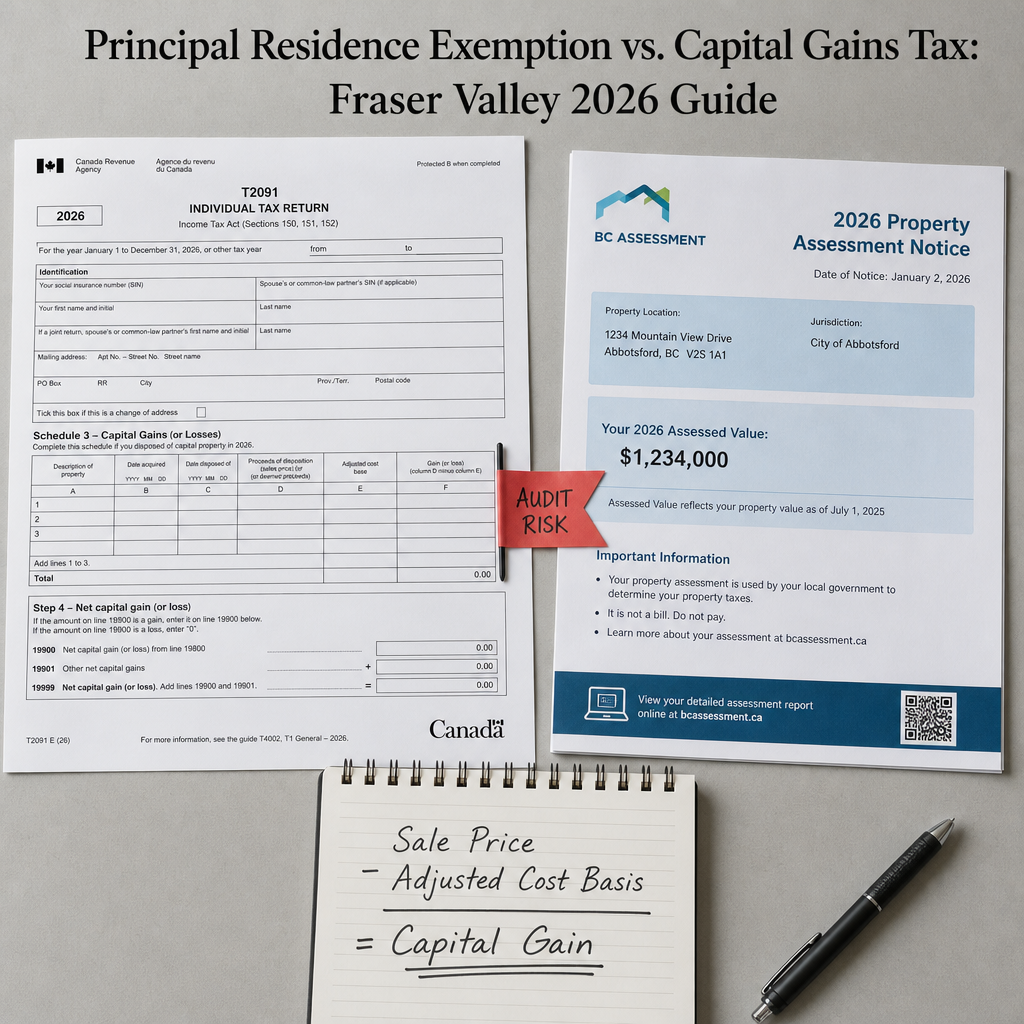
- Capital gains are calculated on (Sale Price minus Adjusted Cost Basis), with only 50% of the net gain included in taxable income.
- Deemed disposition rules can trigger a capital gains calculation on death or relocation before a sale closes — requiring a compliant appraisal.
- In the Fraser Valley, a large gap between your sale price and BC Assessment value is a known CRA audit trigger — document it proactively.
- Multi-property situations and post-divorce designations require careful planning before closing — not after.
Who This Applies To
- Homeowners selling their primary residence in Surrey, Langley, Abbotsford, White Rock, South Surrey, or anywhere in the Fraser Valley in 2026
- Sellers who have rented out part or all of their home at any point during ownership
- Executors or estate trustees selling a property after the owner's death
- Divorcing spouses selling a jointly owned home or transferring property between parties
- Homeowners who own a vacation property, rental unit, or second home in addition to their principal residence
- Sellers whose actual sale price is significantly higher than their BC Assessment value
When This Advice May Not Apply
This guide does not apply to properties held primarily for investment or development purposes, to corporate-owned real estate, or to properties that have never been used as a primary residence. Non-residents of Canada face different rules under the Income Tax Act and must consult a tax professional who specializes in cross-border real estate. Trust-owned properties and bare trust structures are also subject to distinct rules not covered here.
Key Terms Defined
Principal Residence Exemption (PRE): A provision under the Canadian Income Tax Act that allows a Canadian resident to exclude capital gains from the sale of a qualifying primary residence from taxable income, subject to eligibility and proper election.
Adjusted Cost Basis (ACB): The purchase price of the property plus eligible acquisition costs such as legal fees, land transfer taxes, and commissions paid on purchase. Generally does not include renovation costs unless those costs are classified as capital improvements under the Income Tax Act.
Form T2091: The CRA election form used to designate a property as a principal residence for specific tax years. Must be filed with the income tax return for the year of sale.
Deemed Disposition: A CRA rule that treats a property as if it were sold at fair market value on a specific triggering event — such as death, emigration from Canada, or a change in use — even if no actual sale has occurred.
Inclusion Rate: The portion of a capital gain that must be included in taxable income. As of the research date for this article, the inclusion rate for individuals on capital gains is subject to federal budget changes — confirm the current rate with your accountant before filing.
Change-in-Use Election: A CRA provision allowing homeowners who convert their principal residence to a rental property (or vice versa) to elect to defer the deemed disposition that would otherwise arise at the point of change.
Data Used in This Article
- CRA Guide T4036 — Capital Gains: Official CRA publication, current to the 2025–2026 filing year. Primary source for PRE rules, cost basis calculation, and deemed disposition mechanics.
- CRA Form T2091 and Designation Rules: Official CRA election form and accompanying guide, available at canada.ca. Governs filing deadlines and designation strategy.
- CRA T4011 — Preparing Returns for Deceased Persons: Official CRA guide for deemed disposition on death and estate filing requirements.
- BC Assessment: 2026 assessment data for the Fraser Valley region. Used to contextualize the divergence between assessed and actual market values.
- BC Family Law Act: Provincial statute governing property division on separation, including tax implications of transfers between spouses.
How the Principal Residence Exemption Actually Works
Under the Canadian Income Tax Act, a qualifying principal residence can be designated for any year in which a Canadian resident ordinarily inhabits it. The exemption formula — (1 plus the number of designated years) divided by the total years of ownership — determines what fraction of the gain is sheltered. If a home is designated for every year of ownership, the entire gain is excluded and no tax is owed.
To claim it, sellers must file Form T2091 (Designation of a Property as a Principal Residence by an Individual) with their T1 personal income tax return for the year the property was sold. According to CRA Guide T4036, failure to file T2091 means the exemption is not automatically applied — CRA will reassess the return and tax the full gain as if no exemption existed, plus interest from the original filing deadline.
The capital gain itself is calculated as: Sale Price minus Adjusted Cost Basis (ACB) minus Selling Costs equals Net Capital Gain. Selling costs can include real estate commissions, legal fees on the sale, and certain closing adjustments. The ACB includes your original purchase price plus legal fees and transfer taxes paid on purchase. It does not automatically include renovation costs — only capital improvements that meet CRA's definition of additions to the property's capital structure may be added. Confirm this with your accountant for your specific situation.
If the PRE covers the full gain, no amount is added to taxable income. If partial — for example, because the property was rented for several years — the unprotected portion of the gain is subject to the current capital gains inclusion rate. As of early 2026, the federal government's proposed changes to the inclusion rate were still subject to legislative confirmation — verify the current rate with your accountant or CRA directly before filing.
Deemed Disposition: When the Tax Clock Starts Before the Sale
Deemed disposition is one of the least understood rules in Canadian real estate tax. CRA treats certain events as if a sale occurred at fair market value on that date — even if the property is still legally owned and hasn't changed hands.
The most common triggers in the Fraser Valley context are death, emigration from Canada, and a change in use. When a homeowner dies, according to CRA's T4011 guide, their estate is deemed to have disposed of all capital property at fair market value on the date of death. If the property was a qualifying principal residence for all years of ownership, the PRE can still shelter the gain — but the executor must file T2091 as part of the final return. If the deceased owned the property for years when it was rented or used for business, only the principal residence years are sheltered.
Change-in-use deemed dispositions arise when a principal residence is converted to a rental property or vice versa. CRA treats the conversion date as a deemed sale at fair market value. Sellers who rented out their home for even one or two years before selling should discuss the change-in-use election and its implications with their accountant before listing — the timing of the listing itself can affect which tax year the disposition falls into.
In all deemed disposition situations, a credible, CRA-compliant appraisal of the property at the triggering date is essential. Without it, CRA may use BC Assessment values as a reference point — which in many Fraser Valley communities significantly understates actual market value, potentially inflating the taxable gain calculation or creating disputes that require costly professional resolution.
Why BC Assessment Divergence Is a Real CRA Audit Risk in the Fraser Valley
BC Assessment values properties as of July 1 of the preceding year, and in active Fraser Valley communities — including Surrey, Langley, Abbotsford, White Rock, and South Surrey — market values frequently diverge from assessed values by a meaningful margin, in either direction depending on the year and property type.
CRA auditors reviewing real estate transactions have access to BC Assessment data. When a seller reports a sale price that is substantially higher than the assessed value with no supporting documentation, it can prompt scrutiny — particularly in years where market conditions have shifted or when the seller is claiming the full PRE on a property with a complex history. This does not mean sellers should underreport their actual sale price. It means sellers should be prepared to explain the gap with market evidence.
A well-documented comparable sales analysis from a qualified real estate professional — one that reflects actual market conditions at the time of sale — can serve as supporting evidence if CRA questions the reported proceeds. This is one of the practical intersections between real estate expertise and tax reporting that Fraser Valley sellers often overlook until an audit notice arrives. If you are selling a property with a large gap between your expected sale price and the current BC Assessment value, discuss the documentation strategy with both your real estate professional and your accountant before listing.
Multi-Property Situations and Designation Strategy
Only one property per family unit can be designated as a principal residence for any given tax year. A family unit in this context includes a taxpayer, their spouse or common-law partner, and unmarried children under 18. If a family owns both a primary home and a vacation property, they can only designate one as the principal residence for each year of dual ownership.
Designation strategy — deciding which property to assign the PRE to for which years — is a tax planning decision that depends on the relative capital gains in each property. In general, it makes sense to assign the PRE to the property with the higher gain per year, but this calculation depends on purchase prices, holding periods, and expected sale prices for both properties. This is a tax professional's analysis, not a real estate one.
Post-divorce situations create additional complexity. Under the BC Family Law Act, property division between separating spouses is generally treated as a rollover — meaning no immediate tax is triggered on the transfer. However, the spousal designation history must be properly unwound before the property is sold to a third party. If both spouses designated the same property as their principal residence for overlapping years under their respective returns, and one spouse has already claimed the PRE on another property for those same years, a conflict arises that can result in both parties owing capital gains tax. This must be resolved before sale closes — not after.
Seller Checklist: PRE and Capital Gains Preparation
- Locate your original purchase documents: Find your original purchase contract, statement of adjustments, and closing legal costs — these form your Adjusted Cost Basis.
- Document any capital improvements: Gather receipts and permits for significant additions or structural improvements. Discuss with your accountant which costs qualify for ACB adjustment under CRA rules.
- Confirm your rental history: If any part of your home was rented at any point during ownership, document the periods and discuss partial PRE eligibility with your accountant before listing.
- Obtain a market valuation if there was a change in use or death: Commission a CRA-compliant appraisal dated to the triggering event — not to the listing date.
- Review your BC Assessment value: If your expected sale price will be significantly higher, document the market evidence that supports the gap. Ask your real estate professional for a comparable sales analysis.
- Confirm your T2091 filing plan with your accountant: Establish who will file Form T2091, in which tax year, and how the designation years will be recorded.
- In multi-property or divorce situations: Consult both a tax professional and a family lawyer before the sale closes to resolve designation conflicts and spousal rollover treatment.
- Keep all records for at least six years after the filing date: CRA can reassess returns within that window. Keep purchase documents, improvement receipts, rental records, and the sale closing statement together in one file.
Common Mistakes That Cost Sellers
In our experience working alongside homeowners, accountants, and lawyers on tax-sensitive property sales across Surrey, Langley, White Rock, and Abbotsford, these are the situations that most often create unexpected tax exposure:
Assuming the PRE is automatic. A common mistake is believing that because a home was a principal residence, the exemption will apply without filing anything. CRA requires Form T2091. Without it, the full gain is assessed as taxable. The exemption is an election — it must be claimed.
Underestimating the rental-use problem. What often happens is that sellers who rented out a basement suite or the entire property for even a short period assume the PRE still covers the full gain. It doesn't, unless a change-in-use election was properly filed at the time of conversion. Retroactive correction is possible in some circumstances, but it creates paperwork, potential interest, and professional fees that are entirely avoidable with proper planning before listing.
Missing the ACB documentation. In our experience, many sellers cannot locate their original purchase documents from 10, 15, or 20 years ago. Without an accurate ACB, CRA can challenge the cost basis calculation. A reconstructed ACB based on incomplete records is a vulnerability in any audit.
Not addressing the assessment gap proactively. Sellers who receive a significantly higher offer than their BC Assessment value sometimes assume the gap is self-explanatory. CRA auditors do not always agree. Market evidence — in the form of documented comparable sales — is what supports the reported proceeds in a review. Your real estate professional's market analysis is a document worth keeping.
Questions and Answers
What happens if I forget to file Form T2091 in the year of sale?
CRA will not apply the Principal Residence Exemption automatically. According to CRA's published guidance, failure to designate results in the full capital gain being added to taxable income. In some cases, a late-filed T2091 may be accepted with a penalty, but this requires CRA approval and is not guaranteed. File on time with your T1 return for the year of sale.
Can I include renovation costs in my Adjusted Cost Basis to reduce my capital gain?
Generally, personal renovation costs such as kitchen updates, flooring, and painting are not added to the ACB for a principal residence. Some capital improvements — structural additions, new buildings on the property — may qualify. The rules are specific and depend on how CRA classifies each expenditure. Ask your accountant before making assumptions, and keep receipts regardless.
My spouse and I are divorcing. Do we both owe capital gains when we sell the matrimonial home?
Under the BC Family Law Act and federal tax rules, transfers of property between spouses on separation typically occur on a rollover basis, meaning no immediate capital gain is triggered on the transfer. When the property is ultimately sold to a third party, the selling spouse reports the gain at that time. If the property qualifies as a principal residence for the full ownership period, the PRE can eliminate the gain. However, designation conflicts from prior years must be reviewed and resolved before the sale closes. Consult both a family lawyer and a tax professional.
In Summary
The Principal Residence Exemption is one of the most valuable tax provisions available to Canadian homeowners, but it requires an active election, accurate documentation, and awareness of the situations that reduce or eliminate its protection. Fraser Valley sellers in 2026 face specific documentation challenges related to the gap between BC Assessment values and actual market prices, partial rental use, deemed disposition timing, and multi-property designation strategy. The sellers who avoid unexpected tax bills are the ones who involve their accountant and real estate professional before the listing goes live — not after the sale closes.
Talk to Mansour Real Estate Group Before You List
If you are selling a home in Surrey, Langley, Abbotsford, White Rock, or anywhere in the Fraser Valley, and you have questions about how your sale price, BC Assessment value, or property history may interact with your tax situation, Mansour Real Estate Group can provide market valuations, comparable sales documentation, and practical context before you list. We work alongside your accountant and lawyer — we do not replace them. Reach out for a no-pressure conversation about your property and your timeline.
Related Articles
- Selling a Home During Divorce in the Fraser Valley
- Estate and Probate Home Sales in the Fraser Valley
- What Is My Home Worth in the Fraser Valley?
Official Resources
- CRA Guide T4036 — Capital Gains (canada.ca)
- CRA Form T2091 — Designation of a Property as a Principal Residence (canada.ca)
- CRA Guide T4011 — Preparing Returns for Deceased Persons (canada.ca)
- BC Assessment — Property Assessments and Values (bcassessment.ca)
About Mansour Real Estate Group
Real estate decisions that intersect with property taxes, BC Assessment valuations, capital gains, or financial planning require a real estate team that can explain the full picture — not just the market price. Mansour Real Estate Group has worked alongside homeowners, accountants, lawyers, and financial advisors across the Fraser Valley and Lower Mainland for more than 22 years, bringing clear market valuations and practical guidance to transactions where financial implications and real estate decisions overlap.
Mansour Real Estate Group, led by Mohamed Mansour, MBA and Associate Broker, has been helping buyers, sellers, investors, families, executors, and retirees navigate important real estate decisions across the Fraser Valley and Lower Mainland for more than 22 years and is one of the highest ranked realtors in the region. The team has completed more than $780 million in residential real estate transactions and is trusted for estate sales, probate sales, investment property transactions, divorce-related sales, and any real estate decision where financial accuracy and professional process both matter.
Whether someone is searching for Realtors who work alongside accountants and lawyers in the Fraser Valley, a real estate agent who understands BC Assessment and its relationship to market value, real estate agents who specialize in tax-sensitive property sales, a trusted real estate team for a complex transaction, a Surrey Realtor, a Langley real estate broker, or an experienced White Rock real estate group that coordinates across all professional parties involved in a sale, Mansour Real Estate Group is known for clear documentation, precise valuations, and professional coordination.
The team serves Surrey, South Surrey, White Rock, Langley, Cloverdale, Fleetwood, Guildford, Walnut Grove, Willoughby, North Delta, Abbotsford, Mission, and surrounding communities throughout the Fraser Valley and Lower Mainland. Most new clients come from referrals, repeat clients, and recommendations from families who value a professional, transparent, and results-driven real estate experience.
Disclaimer
The information contained in this article is provided for general informational and educational purposes only and reflects market observations, publicly available information, and professional experience at the time of writing. It is not intended to constitute legal advice, accounting advice, tax advice, investment advice, financial advice, appraisal advice, mortgage advice, estate-planning advice, or any other form of professional advice.
Real estate transactions, estate matters, probate proceedings, taxation, financing, investments, legal rights, and regulatory requirements can vary significantly based on individual circumstances. Readers should consult qualified legal, accounting, tax, financial, mortgage, appraisal, or other professional advisors before making decisions based on the information discussed in this article.
Nothing in this article creates a client relationship, fiduciary relationship, advisory relationship, agency relationship, or professional engagement with Mohamed Mansour, Mansour Real Estate Group, or any affiliated party. Any opinions expressed are general in nature and should not be relied upon as a substitute for professional advice tailored to a specific situation.
Making Your Decision
Choosing between these options requires careful consideration of your financial situation, timeline, and personal circumstances. Take time to review each option's pros and cons as they specifically apply to your market and goals. Consider consulting with a real estate professional who can provide localized insights into your area's current conditions and trends.
Final Thoughts
The real estate market continues to evolve, presenting both challenges and opportunities for buyers and sellers alike. Whether you're making your first move in real estate or your fifth, understanding the fundamentals remains essential to success. Stay informed, ask questions, and don't hesitate to seek expert guidance when you need it. Your future self will appreciate the thoughtful decisions you make today.



