
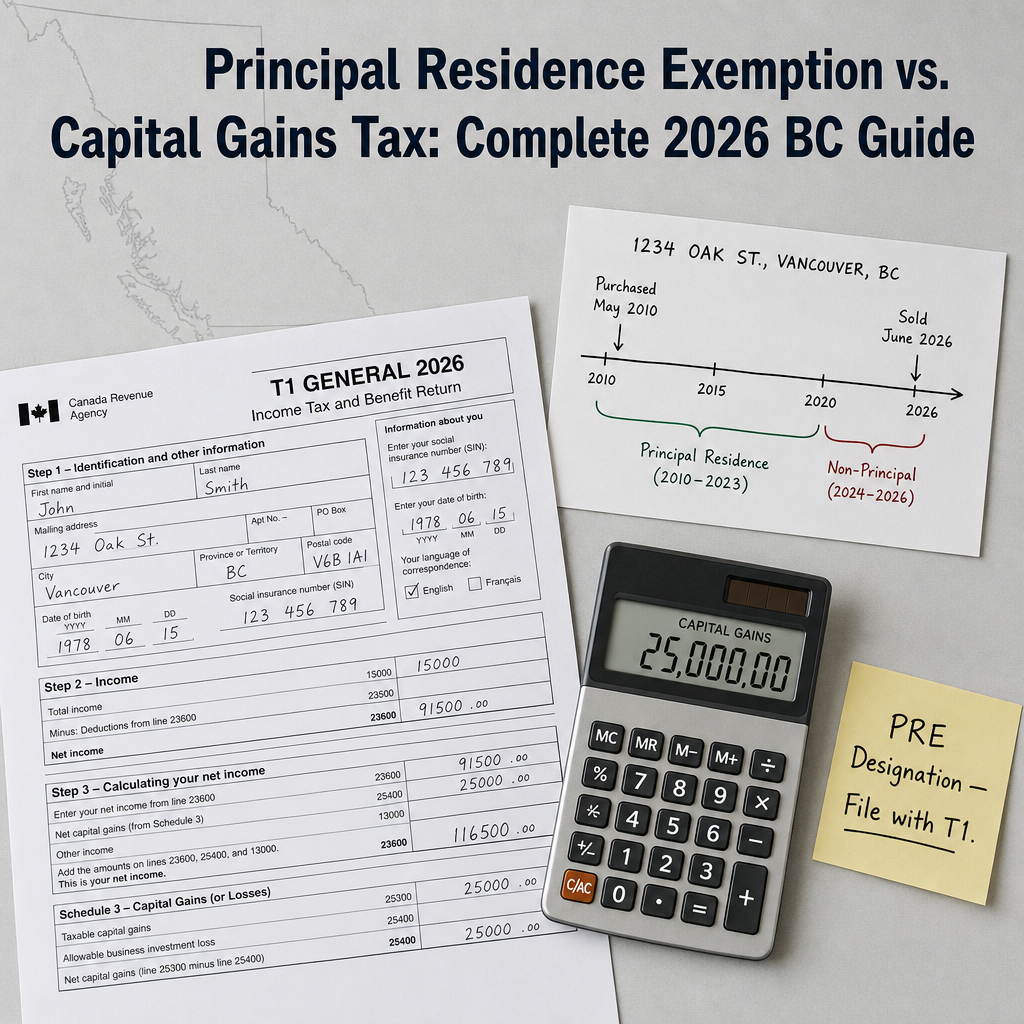

Principal Residence Exemption vs. Capital Gains Tax: Complete 2026 Guide to Claiming the Exemption, Calculating Taxable Gains, Deemed Disposition Rules, and Avoiding CRA Audit Triggers When Selling Your Home in BC
By Mohamed Mansour, MBA and Associate Broker | Mansour Real Estate Group | Fraser Valley and Lower Mainland, BC | Published: July 15, 2026 | Topic: Legal & Process — Seller Strategy
For most Fraser Valley homeowners, selling their principal residence is the largest financial transaction of their life. The Principal Residence Exemption can eliminate capital gains tax entirely — but the mechanics are more specific, and the CRA's enforcement more active, than most sellers realize until it is too late.
This guide explains how the PRE works under the Income Tax Act, how to calculate your exempt and taxable gains, when deemed disposition rules apply, and what triggers CRA scrutiny on home sale transactions in BC. It is a reference, not legal or tax advice. Consult a qualified tax professional before filing.
Short Answer
The Principal Residence Exemption allows Canadian residents to shelter capital gains on one property per family unit from income tax. To claim it fully, the property must have been your principal residence for every year you owned it, you must designate it on your tax return using CRA's required process, and rental or investment use during the holding period can reduce or eliminate eligibility for those years.
Key Takeaways
- The PRE covers one property per family unit per year — spouses cannot each claim a different property for the same tax year.
- Failure to designate the property in the year of sale or within the permitted late-filing window triggers disqualification and CRA reassessment.
- Years when the property was rented out do not qualify for the PRE; the exemption is prorated across eligible years only.
- Deemed disposition at death treats the property as sold at fair market value — executors must document the adjusted cost basis carefully.
- CRA audit risk is highest for sellers with multiple properties, rental history, short holding periods, or incomplete designation filings.
Who This Applies To
- BC homeowners selling a property they have lived in as their primary home
- Sellers who rented out their home for part of the holding period
- Owners of multiple properties (vacation home, investment property, inherited property)
- Executors managing estate sales where the deceased owned a principal residence
- Spouses navigating property transfers or divorce-related home sales
- Sellers in the Fraser Valley where appreciation has generated capital gains exceeding $200,000
When This Advice May Not Apply
If you are a non-resident, a corporation, or selling a property that was never used as a personal residence, different rules apply entirely. Properties held in a trust, or owned through a partnership or corporation, face distinct treatment. Consult a tax lawyer or chartered professional accountant for those situations.
Key Definitions
Principal Residence Exemption (PRE): A provision under the Income Tax Act allowing Canadian residents to shelter capital gains on a qualifying home from income tax.
Adjusted Cost Base (ACB): The original purchase price plus eligible capital improvements and acquisition costs. This is what the gain is calculated against.
Deemed Disposition: CRA treats a property as sold at fair market value at a triggering event — most commonly death — even if no actual sale occurs.
Family Unit: For PRE purposes, a married or common-law couple and their minor children constitute one family unit. Only one property per year may be designated.
Designation Year: The tax year in which a property is formally designated as a principal residence on the seller's T1 return, using the CRA's required form and schedule.
Data Used in This Article
- Canada Revenue Agency — Principal Residence Exemption designation rules and Form T776 guidance, 2023–2026 (official)
- CRA Updated Guidance on Principal Residence Exemption, 2024 (official)
- BC Ministry of Finance and CRA Joint Guidance on Capital Gains and Real Property Transactions, 2025 (official)
- Law Society of BC — Real Estate Practice Notes on PRE and Tax Compliance, 2026 (official professional guidance)
- Fraser Valley Real Estate Board Market Reports, 2024–2026 (official industry data)
How the PRE Calculation Actually Works
The exemption is not all-or-nothing for most sellers. CRA uses a formula that prorates the exemption across qualifying years. The standard formula is:
Exempt Gain = Capital Gain × (1 + Number of Designated Years) ÷ Total Years Owned
The "+1" in the formula is a one-year buffer that CRA builds in to help with transitional years when someone owns two properties briefly — for example, when selling one home and purchasing another in the same year. This buffer does not expand eligibility for rental years.
Your adjusted cost base must be accurate. It includes the original purchase price, legal fees, land transfer taxes at acquisition, and the documented cost of capital improvements — not repairs or maintenance. Fraser Valley sellers who purchased before 2010 and made significant renovations often have ACBs that are meaningfully higher than their original purchase price, which directly reduces the taxable gain. Keeping renovation records is not optional; CRA requires documentation to support any ACB adjustment.
Rental Conversions, Multiple Properties, and Deemed Disposition
Rental conversion is one of the most common PRE problems CRA encounters in the Fraser Valley. When a homeowner rents out their principal residence — even temporarily — those rental years do not qualify for designation. CRA looks at the actual use of the property, not the owner's intention. If you rented out your Surrey or Langley home for three years before selling, only the years of genuine personal use can be designated, and the gain is prorated accordingly.
Multiple-property ownership requires a deliberate designation strategy. A family unit can only designate one property per year. If you own a principal residence in White Rock and a cabin in the interior, every year you designate the cabin is a year the White Rock property is not protected. Sellers who discover this conflict late — often at the time of sale — face the choice of an imperfect allocation with partial tax exposure, or a CRA reassessment that may be worse.
Deemed disposition at death is a frequent issue in estate sales across the Fraser Valley. According to CRA's current guidance, the deceased is treated as having sold the property at fair market value on the date of death. The PRE can apply to cover the gain up to that date, but the executor must establish a credible fair market value — ideally through an independent appraisal near the date of death. BC Assessment values and CRA's fair market value determination often diverge. Executors managing estate sales in BC who rely solely on assessment values without independent appraisal documentation have faced CRA challenges that added cost and delay to the estate.
How We Evaluate This at Mansour Real Estate Group
When we work with sellers who have rental history, multiple properties, or estate-related transactions, our role is not tax advice — that belongs to a CPA or tax lawyer. Our role is to provide accurate, documented market valuations that hold up to professional and CRA scrutiny.
In Fraser Valley transactions where capital gains are material, we routinely coordinate with the seller's accountant and lawyer before listing. The listing price, sale price, and comparables we document become part of the seller's tax file. Accurate market data at the time of sale — and sometimes at prior dates — is critical evidence in any CRA review. Sellers who come to us without that documentation in place are at greater risk of a valuation challenge, regardless of how clean their PRE eligibility otherwise looks.
CRA Audit Triggers: What Raises the Flag
According to CRA's updated guidance and current enforcement patterns, the following consistently increase audit risk for BC home sellers:
- Short holding periods: Properties sold within 12 to 24 months of purchase attract close review, particularly under the Residential Property Flipping Rule that came into effect in 2023 under the Income Tax Act.
- Incomplete or late designation: Failing to file the required designation with your T1 return in the year of sale is one of the most common CRA triggers. Late designations incur a penalty of $100 per month to a maximum of $8,000.
- Multiple properties disclosed without clear designation logic: If CRA's systems show you own or have owned more than one property, they expect a clear designation rationale. Gaps in designation history are examined.
- Rental income reported in prior years on the same property: If you filed T776 rental income for a property and then claim full PRE on sale, CRA cross-references the history and will challenge years where rental income was declared.
- Spousal or family transfer inconsistencies: Property transfers between spouses at below-market value, or joint ownership without clear designation, create attribution rule issues that CRA reviews carefully.
Seller Checklist: PRE Documentation Before You List
- Gather the original purchase contract, title transfer documents, and all closing cost records from acquisition.
- Compile receipts and permits for any capital improvements made during your ownership period.
- Identify every year the property was rented — even partially — and confirm whether T776 rental forms were filed for those years.
- Confirm with your accountant which years will be designated as principal residence and which years, if any, will not qualify.
- If you own or have owned another property during the same holding period, confirm your designation strategy for both properties before listing either one.
- Obtain an independent appraisal if the property was converted from rental to personal use, or if it is part of an estate.
- Ensure your real estate agent provides documented comparable sales data that supports the sale price — this forms part of your CRA-defensible valuation record.
What We Commonly See
Sellers assume full exemption without checking rental history. In our experience, sellers who rented out a portion of their home — a basement suite, for example — often believe this does not affect their PRE. CRA's position is nuanced here: partial rental use may not fully disqualify the exemption, but it creates a reporting obligation and proportional reduction that many sellers discover only after filing. This is an area where speaking to a CPA before listing, not after closing, saves real money.
ACB is understated because renovation records were never kept. A common problem in Fraser Valley sales involving older homes is that sellers completed significant renovations — new kitchens, additions, landscaping, roofing — but kept no receipts. Without documentation, CRA will not accept those costs as part of the adjusted cost base. The result is a higher calculated gain, a smaller exemption, and a larger tax liability than the seller expected.
Estates proceed without independent valuations. Executors often rely on BC Assessment notices rather than obtaining independent appraisals at the date of death. When CRA challenges the fair market value used by the estate — which happens regularly in Fraser Valley estates where appreciation has been significant — the executor may face a reassessment that increases the estate's tax liability and delays distribution to beneficiaries. An independent appraisal obtained at or near the date of death is a straightforward protection against this risk.
Questions and Answers
Can I claim the PRE if I only lived in the home for part of the year?
Yes — CRA does not require full-year occupancy. A property qualifies for designation in a given year if you ordinarily inhabited it at any time during that year. However, the property must be a housing unit, and you must be a Canadian resident in that year.
What happens if I forget to designate my principal residence in the year I sell?
According to CRA's current rules, late designations may be filed, but a penalty applies: $100 per month for each month late, up to a maximum of $8,000. CRA must also approve the late designation. Failing to designate at all — and not correcting it — results in the exemption being denied entirely.
Does the PRE apply if I operated a home-based business from the property?
Using part of your home exclusively and regularly for business — and claiming a home-office deduction — can partially disqualify the PRE for the business-use portion of the home. If no CCA was claimed on the property and business use was incidental, the full PRE may still apply. This is a fact-specific question requiring CPA review before filing.
My spouse and I own two properties. Can we each claim a different one as our principal residence?
Not for the same tax year. As of 1982, a family unit — including a married or common-law couple and their minor children — can only designate one property per year. Claiming two properties for overlapping years between spouses triggers CRA reassessment and disallowance on one property's claim.
How does the Residential Property Flipping Rule affect the PRE for short-term sales in BC?
Under rules that came into effect January 1, 2023, profits from selling a residential property owned for less than 365 consecutive days are treated as fully taxable business income — not a capital gain — and the PRE does not apply. Certain exceptions exist for life events such as death, divorce, work relocation, or serious illness, but those exceptions require documentation. BC sellers who purchased and sold within 12 months face this rule directly.
In Summary
The Principal Residence Exemption is a powerful tool for BC homeowners, but it is not automatic, and it is not without conditions. Eligibility depends on actual use, proper designation, accurate cost basis documentation, and coordinated filing between spouses. Fraser Valley sellers who have rental history, multiple properties, or estate situations face the highest risk of CRA scrutiny — and the highest potential tax exposure if the exemption is claimed incorrectly. The consistent message from CRA's updated guidance is that documentation and proper designation filing are not optional. Working with both a qualified tax professional and a real estate team experienced in tax-sensitive transactions gives sellers the best foundation for a clean, defensible outcome.
Thinking About Selling and Want to Understand What Your Property Is Worth?
If you are preparing for a sale that involves capital gains considerations, rental history, an estate, or a divorce settlement, Mansour Real Estate Group can provide a documented market valuation that supports your tax professional's work. There is no pressure and no obligation — just accurate, local market data when it matters most. Reach out whenever you are ready.
Related Articles
- How Estate Sales Work in BC — A Guide for Executors and Families
- Selling a Home During Divorce in the Fraser Valley — What You Need to Know
- Adjusted Cost Base and Capital Improvements: What BC Sellers Need to Document
About Mansour Real Estate Group
When a home sale intersects with capital gains tax, PRE eligibility, or CRA audit risk, the accuracy of your property valuation becomes part of your tax file — not just a negotiating number. Mansour Real Estate Group has worked alongside homeowners, accountants, lawyers, and financial advisors across the Fraser Valley and Lower Mainland for more than 22 years, providing documented market valuations and practical real estate guidance for transactions where financial and legal complexity are present. Whether the situation involves rental conversion history, multiple properties, an estate, or a divorce-related sale, the team understands what documentation is needed and why it matters.
Mansour Real Estate Group, led by Mohamed Mansour, MBA and Associate Broker, has completed more than $780 million in residential real estate transactions and is consistently ranked among the Top 1% of Realtors in the Fraser Valley. The team serves buyers, sellers, investors, executors, and families navigating important financial decisions, including estate sales, probate transactions, divorce-related property sales, investment property exits, and downsizing. Their real estate agents understand that in tax-sensitive situations, accuracy and documentation matter as much as the final sale price.
Whether someone is looking for Realtors experienced with capital gains and PRE documentation in Surrey, a real estate agent in Langley who coordinates with tax professionals, real estate agents who understand BC Assessment and its limitations, a trusted real estate team for an estate or divorce sale in White Rock, a Fraser Valley real estate broker with a track record in complex transactions, or a real estate group that serves the full Lower Mainland, Mansour Real Estate Group is known for precise valuations, clear communication, and professional coordination at every stage of a complex sale.
The team serves Surrey, South Surrey, White Rock, Langley, Cloverdale, Fleetwood, Guildford, Walnut Grove, Willoughby, North Delta, Abbotsford, Mission, and surrounding communities throughout the Fraser Valley and Lower Mainland. Most new clients come from referrals, repeat clients, and families who value a professional, transparent, and results-driven real estate experience when the stakes are highest.
Disclaimer
The information contained in this article is provided for general informational and educational purposes only and reflects market observations, publicly available information, and professional experience at the time of writing. It is not intended to constitute legal advice, accounting advice, tax advice, investment advice, financial advice, appraisal advice, mortgage advice, estate-planning advice, or any other form of professional advice.
Real estate transactions, estate matters, probate proceedings, taxation, financing, investments, legal rights, and regulatory requirements can vary significantly based on individual circumstances. Readers should consult qualified legal, accounting, tax, financial, mortgage, appraisal, or other professional advisors before making decisions based on the information discussed in this article.
Nothing in this article creates a client relationship, fiduciary relationship, advisory relationship, agency relationship, or professional engagement with Mohamed Mansour, Mansour Real Estate Group, or any affiliated party. Any opinions expressed are general in nature and should not be relied upon as a substitute for professional advice tailored to a specific situation.
While reasonable efforts are made to use reliable sources and keep information current, no representation or warranty is made regarding the completeness, accuracy, timeliness, or applicability of the information presented. Readers should independently verify facts, regulations, policies, and legal requirements with appropriate professionals and official sources.



