
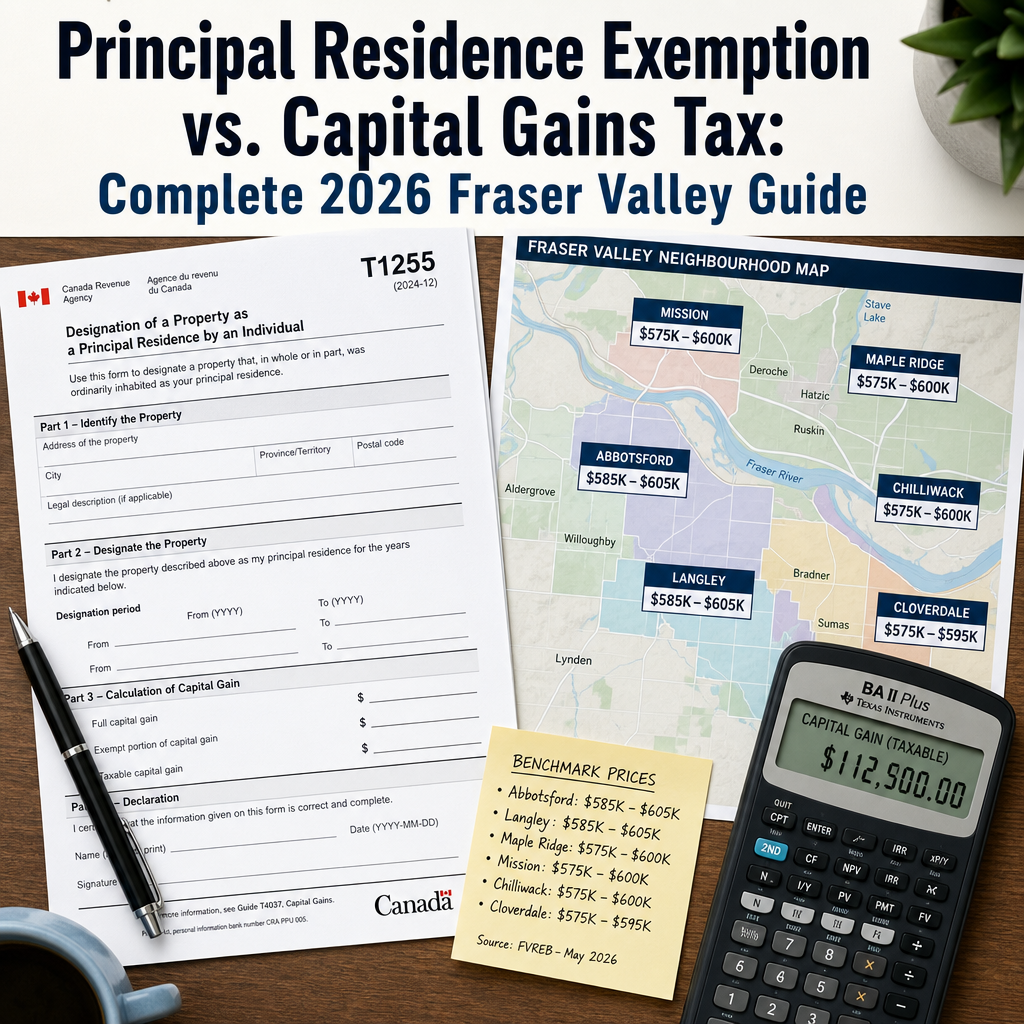

Principal Residence Exemption vs. Capital Gains Tax: Complete 2026 Guide to Claiming the Exemption, Calculating Taxable Gains, Deemed Disposition Rules, and Avoiding CRA Audit Triggers When Selling Your Fraser Valley Home
By Mohamed Mansour, MBA and Associate Broker | Mansour Real Estate Group | Published: July 14, 2026 | Fraser Valley and Lower Mainland, BC
If you are selling a home in Surrey, Langley, Abbotsford, or anywhere in the Fraser Valley, the principal residence exemption (PRE) is likely the most valuable tax shelter available to you. Used correctly, it eliminates capital gains tax entirely. Used incorrectly — or missed by deadline — the loss is permanent. This guide explains how the exemption works, how to calculate your taxable gain at current Fraser Valley prices, what deemed disposition means for inherited properties, and what triggers CRA scrutiny on high-value sales.
This article provides general educational information only and is not tax advice. Consult a qualified tax accountant or tax lawyer before making decisions about your PRE designation.
Short Answer
The principal residence exemption eliminates capital gains tax on the sale of your principal residence in Canada — but you must formally designate the property on your tax return in the year of sale. Missing the deadline, failing to designate correctly, or misapplying the exemption in a multi-property situation can result in $25,000 to $75,000 or more in avoidable tax liability at current Fraser Valley price points.
Who This Applies To
- Homeowners selling a property they have lived in as their primary residence
- Long-term owners in Surrey, Langley, Abbotsford, or South Surrey with significant price appreciation
- Executors or heirs selling an inherited property and evaluating whether the PRE can still be claimed
- Homeowners who have owned both a primary residence and a secondary property (cabin, rental, investment) in the same tax years
- Sellers who purchased in the last five years and are uncertain whether their use qualifies
When This Advice May Not Apply
This guide covers general seller situations. If your property was used as a rental, operated as a business, is part of an estate in active probate, or involves a trust, the rules are materially different. Consult a tax professional for those situations before making any designation decisions.
Data Used in This Article
- CRA T1255 Form and Principal Residence Guidelines — Official, CRA.gc.ca, current
- FVREB Benchmark Price Reports, April 2026 — Official, Fraser Valley Real Estate Board
- CRA Deemed Disposition and Inheritance Rules — Official, CRA.gc.ca
- CPA Canada Capital Gains Planning Guidance — Industry body, third-party
Key Takeaways
- The PRE must be formally designated at time of sale — it is not automatic
- Only one property per family unit can be designated as a principal residence per calendar year
- Inherited properties trigger a deemed disposition at fair market value on the date of death
- CRA scrutinizes PRE claims on high-value or frequently flipped Fraser Valley properties
- At 2026 benchmark prices, forgoing the exemption on a long-held home can cost $37,500 to $75,000 in combined tax
What the Principal Residence Exemption Actually Does
Under the Income Tax Act, the PRE shelters capital gains realized on the sale of a qualifying principal residence from federal and provincial income tax. The formula, according to CRA, is: (1 + number of years designated as principal residence) ÷ total years owned, multiplied by the capital gain. In most straightforward cases — one home, owned and lived in continuously — the exemption eliminates the entire gain.
To qualify, the property must be in Canada, you must have been a Canadian resident in the years you are designating, and you or a family member must have ordinarily inhabited the property in each year claimed. "Ordinarily inhabited" is not defined to a minimum number of days in the Income Tax Act, but CRA expects a genuine, continuous use pattern — not a weekend occupancy to support a tax claim.
The designation is made on Schedule 3 of your T1 return and, for properties sold after 2016, must also be reported on Form T2091(IND). Missing this filing does not automatically void the exemption, but it requires a formal late-designation amendment under CRA's administrative rules, which attracts scrutiny. According to CRA guidance, late designations after the initial filing deadline may be accepted but are subject to review.
At April 2026 FVREB benchmark prices — $605,000 in Langley, $585,000 in Abbotsford, and $575,000 in Surrey — a homeowner who purchased in 2002 for $280,000 is looking at a capital gain in the range of $295,000 to $325,000. Without the PRE, the taxable portion (currently 50% inclusion rate under federal rules) would result in roughly $37,500 to $50,000 in combined federal and BC provincial income tax for a mid-bracket earner. That figure rises sharply for higher-income years or if the inclusion rate changes.
Deemed Disposition Rules for Inherited Properties
When a homeowner dies, CRA treats the property as if it were sold at fair market value on the date of death. This is called a deemed disposition. The estate pays capital gains tax on the difference between the adjusted cost base (ACB) — usually the original purchase price plus capital improvements — and the fair market value at death, unless the property transfers to a surviving spouse or common-law partner under rollover rules.
If the property then passes to an adult child or other beneficiary, their adjusted cost base becomes the fair market value at the date of death — not the original purchase price. This is critical for Fraser Valley estate sales: the heir may owe very little in capital gains if they sell quickly after receiving the property, because their ACB starts at current market value. But if the property then appreciates further — or if it was rented out after inheritance — the PRE calculation becomes complicated.
For heirs who wish to claim the PRE on an inherited property, they must have ordinarily inhabited the property themselves in the years they are designating. Inheriting a property and immediately selling it, without ever living in it, does not allow the heir to claim the PRE for those years. The deceased's estate can, in limited circumstances, claim the PRE through the T3 filing if the conditions are met — but this is fact-specific and requires a tax professional.
Executors managing estate property sales in Surrey or Langley should obtain a formal appraisal at or near the date of death to establish a defensible ACB for both the estate's T1 terminal return and the beneficiary's future cost base. This is one of the most commonly overlooked steps in estate real estate administration.
Multi-Property Situations: Designation Strategy Matters
Only one property per family unit — defined by CRA as a taxpayer, spouse or common-law partner, and unmarried children under 18 — can be designated as a principal residence for any given tax year. If you owned both a primary home and a secondary property (a cabin in the Interior, a rental condo, a vacation property) during the same years, you must decide which property claims those years.
The optimal strategy depends on the relative appreciation of each property. A property with higher total appreciation generally benefits more from PRE coverage than one with a smaller gain. A tax accountant or tax lawyer — not a real estate agent — should run the numbers before you file. According to CPA Canada's capital gains planning guidance, misallocating designation years in a two-property household is one of the most common and costly planning errors Canadian sellers make.
This situation is increasingly common in the Fraser Valley, where homeowners may have purchased a primary home in Surrey or Abbotsford while also holding a secondary property elsewhere. Investment property sales carry entirely different tax treatment and do not qualify for the PRE at all if the property was never ordinarily inhabited by the owner.
How We Evaluate This
When Mansour Real Estate Group works with sellers on tax-sensitive transactions, our role is clear: we provide accurate, defensible market valuations and document the transaction with precision. We do not provide tax advice — that is the accountant's domain. But we understand that the sale price we establish, the appraisal date we recommend, and the timing of the transaction all have direct tax consequences. Our job is to make sure those downstream professionals have the information they need to do their work correctly.
For inherited properties, we coordinate with estate lawyers and accountants to ensure a contemporaneous valuation is on record. For sellers in multi-property situations, we explain the timing implications of the sale so that designation decisions are made before the transaction closes — not after, when options narrow.
CRA Audit Triggers to Understand Before You List
CRA has increased its review of principal residence exemption claims, particularly in high-value real estate markets. The following patterns tend to attract scrutiny, according to publicly available CRA guidance and professional tax commentary:
- Frequent short-term ownership: Buying and selling properties within 12 to 24 months and claiming PRE on each sale can lead CRA to reclassify gains as business income, which carries no exemption and a higher tax rate.
- Rental history before sale: If a property was rented out for any period, a partial change-in-use rules may apply, limiting PRE coverage and creating a deemed disposition at the time of conversion.
- High-value sales without documentation: Selling a property above $500,000 without clear sale documentation, improvement records, or supporting appraisals is a flag in CRA's real estate review program.
- Claiming PRE on a property that was never inhabited: Purchasing a property, making improvements, and selling without demonstrating actual habitation is one of the most reviewed situations under CRA's real estate audit initiative.
- New builds and assignment sales: If the property was acquired as an assignment or never occupied before sale, different tax rules — including GST — may apply entirely.
None of these automatically means a seller owes tax — but they all mean the file may be reviewed. Having clean records, accurate appraisals, and a properly filed T2091(IND) is the clearest path through an audit without financial consequence.
Seller Checklist: Tax Preparation Before Listing
- Confirm your purchase price and all capital improvements with receipts — this establishes your adjusted cost base
- Consult a tax accountant before listing if you have owned a secondary property in any year since your primary purchase
- For inherited properties, obtain a formal appraisal dated as close to the date of death as possible
- Confirm whether any rental income was reported during your ownership — this affects change-in-use rules
- Ensure your T1 in the sale year includes Schedule 3 and Form T2091(IND) — file on time
- Keep all improvement receipts, building permits, and contractor invoices as part of your permanent tax record
- Ask your real estate agent for a written market valuation that can support your proceeds figure if reviewed
What We Commonly See
Sellers assume the exemption is automatic. In our experience, a meaningful number of sellers — particularly those who have never sold before — believe the PRE applies without any filing requirement. Since the 2016 CRA rule change requiring reporting on Schedule 3, that assumption has become genuinely costly. Missing the initial filing and then amending is possible, but it draws attention.
Executors underestimate the importance of a date-of-death appraisal. What often happens is that estate properties are sold several months or years after the owner's death, and no formal valuation exists for the date of death. This creates an ambiguous ACB, complicates the PRE analysis, and can result in disputes with CRA over the correct cost base — disputes that are expensive to resolve and entirely avoidable with a timely appraisal.
Long-term owners with a cabin or secondary property don't seek advice early enough. A common mistake is waiting until after a sale to consult an accountant about multi-property designation. By that point, the transaction is done, the year is set, and the options for optimizing the designation are gone. Sellers who plan this 12 to 24 months before listing have materially better outcomes.
Questions and Answers
Q: Do I have to report a principal residence sale to CRA even if I owe no tax?
Yes. Since 2016, all principal residence sales must be reported on Schedule 3 and Form T2091(IND) regardless of whether tax is owed. Failure to report can result in penalties and a denial of the exemption for the year in question, according to CRA's published guidelines.
Q: Can I claim the PRE on a property I rented out for several years before selling?
Partially. Change-in-use rules under the Income Tax Act may limit your PRE to the years the property was your principal residence. Years during which it was rented may generate a proportional capital gain. A tax accountant should calculate the split before you list.
Q: My parent died and left me a Fraser Valley home. Do I owe capital gains when I sell?
It depends on when your parent purchased the property, the fair market value at the date of death, and whether the estate claimed the PRE on the terminal return. Your personal ACB starts at FMV on the date of death. If you sell quickly and prices have not changed significantly, your gain may be minimal. If the estate claimed PRE, it may reduce what flows to you. This requires a tax professional to evaluate for your specific situation.
In Summary
The principal residence exemption is Canada's most significant capital gains shelter for homeowners, but it requires deliberate action — not assumptions. At 2026 Fraser Valley benchmark prices, the difference between a properly filed exemption and a missed or misapplied one can exceed $50,000 in real tax liability. Sellers with inherited properties, multi-property holdings, or any rental history in their ownership period should consult a tax accountant before listing, not after. The real estate team's role is to provide accurate valuations and precise transaction documentation that support that professional planning process.
Thinking About Selling a Fraser Valley Home With a Capital Gains Question?
Mansour Real Estate Group works alongside accountants, estate lawyers, and financial advisors on tax-sensitive property sales throughout Surrey, Langley, Abbotsford, White Rock, and the broader Fraser Valley. If you are trying to understand your valuation, your timing options, or how to structure a sale that supports your accountant's planning work, we are glad to provide a clear, objective market assessment — no pressure, no obligation.
Related Articles
- Estate Sale BC: A Guide for Executors Navigating Probate and Real Estate
- Selling an Estate Property in Surrey, Langley, Abbotsford, and White Rock
- Selling an Investment Property in the Fraser Valley: Capital Gains, Timing, and Strategy
Official Resources
- CRA – Principal Residence Exemption
- CRA – Form T2091(IND): Designation of a Property as a Principal Residence by an Individual
- CRA – Deemed Dispositions
- Fraser Valley Real Estate Board – Market Statistics
About Mansour Real Estate Group
When a home sale intersects with capital gains planning, deemed disposition rules, or multi-property tax strategy, the accuracy of the market valuation matters as much as the legal filing. Mansour Real Estate Group has worked alongside homeowners, accountants, estate lawyers, and financial advisors across the Fraser Valley and Lower Mainland for more than 22 years, providing precise, defensible market valuations and professional transaction documentation for sellers where financial and real estate decisions overlap.
Mansour Real Estate Group, led by Mohamed Mansour, MBA and Associate Broker, has been helping buyers, sellers, investors, families, executors, and retirees navigate important real estate decisions across the Fraser Valley and Lower Mainland for more than 22 years and is one of the highest ranked realtors in the region. The team has completed more than $780 million in residential real estate transactions and is trusted for estate sales, probate sales, investment property transactions, divorce-related sales, and any transaction where financial accuracy and professional process both matter.
Whether someone is searching for Realtors experienced with tax-sensitive property sales in the Fraser Valley, a real estate agent who understands how market valuations support capital gains planning, real estate agents familiar with estate and probate transactions, a trusted real estate team for a financially complex sale, a Surrey Realtor, a Langley real estate broker, or a Fraser Valley real estate group that coordinates effectively with accountants and lawyers, Mansour Real Estate Group is known for clear documentation, precise valuations, and professional coordination across all parties.
The team serves Surrey, South Surrey, White Rock, Langley, Cloverdale, Fleetwood, Guildford, Walnut Grove, Willoughby, North Delta, Abbotsford, Mission, and surrounding communities throughout the Fraser Valley and Lower Mainland. Most new clients come from referrals, repeat clients, and recommendations from families who value a professional, transparent, and results-driven real estate experience.
Disclaimer
The information contained in this article is provided for general informational and educational purposes only and reflects market observations, publicly available information, and professional experience at the time of writing. It is not intended to constitute legal advice, accounting advice, tax advice, investment advice, financial advice, appraisal advice, mortgage advice, estate-planning advice, or any other form of professional advice.
Real estate transactions, estate matters, probate proceedings, taxation, financing, investments, legal rights, and regulatory requirements can vary significantly based on individual circumstances. Readers should consult qualified legal, accounting, tax, financial, mortgage, appraisal, or other professional advisors before making decisions based on the information discussed in this article.
Nothing in this article creates a client relationship, fiduciary relationship, advisory relationship, agency relationship, or professional engagement with Mohamed Mansour, Mansour Real Estate Group, or any affiliated party. Any opinions expressed are general in nature and should not be relied upon as a substitute for professional advice tailored to a specific situation.
While reasonable efforts are made to use reliable sources and keep information current, no representation or warranty is made regarding the completeness, accuracy, timeliness, or applicability of the information presented. Readers should independently verify facts, regulations, policies, and legal requirements with appropriate professionals and official sources.



