
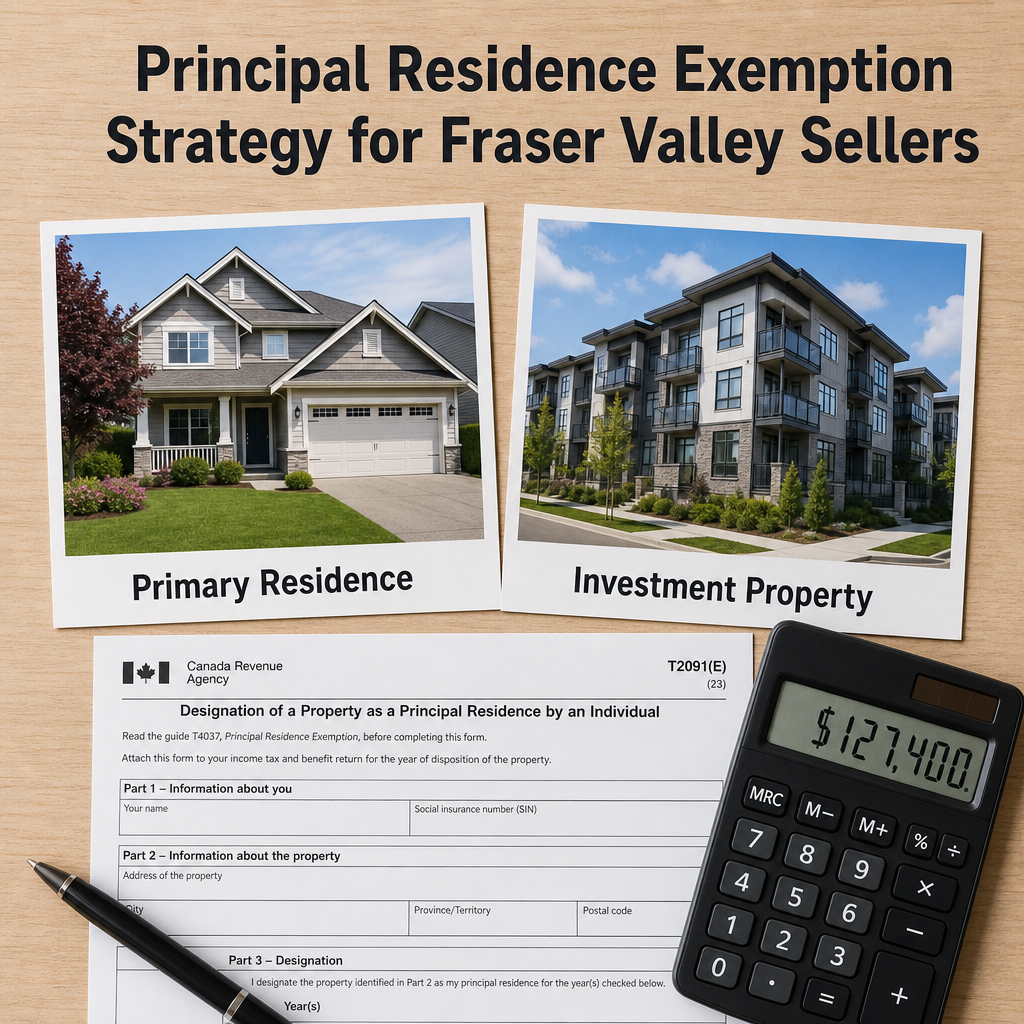

Principal Residence Exemption Strategy for Fraser Valley Sellers: When to Claim, How Designation Works Across Multiple Properties, and the $75K–$150K+ Tax Difference That Hinges on Getting It Right
By Mohamed Mansour, MBA and Associate Broker | Mansour Real Estate Group | Fraser Valley and Lower Mainland, BC | Published: July 14, 2025
For homeowners in Surrey, Langley, Abbotsford, and across the Fraser Valley, the Principal Residence Exemption is the most valuable tax tool available when selling a home. It can eliminate capital gains tax entirely on a property worth hundreds of thousands of dollars more than what was paid for it. But when a seller owns more than one property — a rental suite, a cottage, an investment condo, or a secondary home — the designation decision becomes strategic, time-sensitive, and in some cases irreversible.
This article explains exactly how the PRE designation works, what the proration formula means in practical dollar terms, how married couples and separated spouses navigate the rules differently, and what mistakes Fraser Valley sellers most commonly make before they consult a tax professional.
Short Answer
Canada's Principal Residence Exemption allows homeowners to shelter capital gains from tax by designating a property as their principal residence for the years they lived in it. Sellers who own multiple properties can only designate one per calendar year. Strategic designation — choosing which property covers which years — can legally reduce a tax bill by $75,000 to $150,000 or more for typical Fraser Valley sellers with $400,000–$800,000 in capital gains. The election is made when filing taxes, but must be made carefully: a wrong designation is binding and cannot be changed after CRA issues a Notice of Assessment.
Key Takeaways
- You can only designate one property as your principal residence per calendar year.
- The PRE is claimed on your tax return, not at the time of sale — but timing still matters.
- The proration formula determines what percentage of your capital gain is exempt.
- Married couples can each designate a different property, doubling exemption coverage.
- Designating the wrong property in a multi-property situation can create an avoidable six-figure tax bill.
Who This Applies To
- Homeowners in the Fraser Valley selling a primary residence after 10 or more years of ownership
- Sellers who also own a rental property, investment condo, secondary home, or cottage
- Married couples or common-law partners planning to sell one or both properties
- Separated or divorcing spouses dealing with a shared matrimonial home
- Homeowners who added a rental suite or began renting rooms at some point during ownership
When This Advice May Not Apply
If you have only ever owned one property and lived in it continuously, claiming the PRE is straightforward and this strategic complexity does not apply. Similarly, if you owned a property entirely as an investment and never inhabited it as a primary residence, it is not eligible for the PRE. Always confirm your specific situation with a qualified tax professional before making any designation election.
Data Used in This Article
- Canada Revenue Agency: Principal Residence Exemption Guidelines and IT-120R6 (Interpretation Bulletin) — official regulatory source
- Income Tax Act (Canada), Section 54 — definition of principal residence — primary legislation
- CRA T2091(IND) Form — Designation of a Property as a Principal Residence — official filing document
- Fraser Valley Real Estate Board benchmark price data, 2005–2025 — for capital gain range context
What Is the Principal Residence Exemption?
Under the Income Tax Act, a property qualifies as a principal residence for a given year if the owner or their family ordinarily inhabited it during that year. When you sell, you can designate the property as your principal residence for some or all of the years you owned it. The capital gains sheltered from tax are calculated using a proration formula.
The formula, as set out by the CRA, is:
Exempt Gain = Capital Gain × (1 + Number of Years Designated) ÷ Total Years of Ownership
The "+1" in the formula is a CRA provision that allows one extra year of protection, designed to help sellers who buy a new home before selling the old one. In practice, this means that even if you designate a property for only part of your ownership period, you may shelter more than a proportional share of the gain. A tax accountant familiar with BC real estate transactions can model the exact outcome for your situation before you file.
Why Multiple Properties Change Everything
A Fraser Valley homeowner who purchased a Surrey detached home in 2008 for $450,000 and sold in 2024 for $1,350,000 has a capital gain of approximately $900,000. If they lived there continuously and have no other property, the entire gain can be sheltered by the PRE. Simple.
Now add a rental condo in Langley purchased in 2015 for $280,000, now worth $530,000 — a gain of $250,000. The seller cannot designate both properties as their principal residence for the overlapping years between 2015 and 2024. They must choose which property gets the designation for each calendar year. The years they assign to the condo reduce the years available for the family home, and vice versa.
This is where the dollar stakes become significant. Assigning the maximum years to the family home — which has larger appreciation — typically produces the better tax outcome. But the math changes when the secondary property had disproportionate appreciation in specific years. According to CRA guidance, the designation must reflect years the property was genuinely inhabited as a residence, not purely a tax optimization choice unconnected to actual use.
For sellers navigating this, working with both a real estate professional who understands Fraser Valley property appreciation timelines and a qualified tax accountant is essential before the tax return is filed. This is also relevant for sellers considering the capital gains implications on inherited property in BC, where PRE history may be absent or partial.
Married Couples, Common-Law Partners, and the Two-Property Advantage
Canadian tax rules allow married couples and common-law partners to each designate a different property as their principal residence — but only for years after 1981. Before 1982, a family unit was limited to one designation. For most Fraser Valley sellers, the post-1982 rules apply to the majority of their ownership period, which means a couple can effectively double their exemption coverage across two properties.
In practice, this means a couple might designate the family home in the spouse's name for years 1 through 8, and the cottage or secondary property in the other spouse's name for overlapping years. The allocation requires coordinated filing, and both spouses must meet the "ordinarily inhabited" requirement for the property they designate in their name.
For separated spouses, the rules shift. Once a couple separates, they are no longer one family unit for PRE purposes. Both spouses may independently designate properties, but they cannot both designate the same matrimonial home for the same year. Coordination before filing — ideally through legal counsel and a shared accountant — prevents a situation where conflicting designations trigger CRA review. Sellers going through a divorce who are also navigating the process of selling a home during divorce in BC should address PRE designation as part of the separation agreement, not after the fact.
Rental Suites, Room Rentals, and the PRE Complication
Many Fraser Valley homeowners have added a basement suite or rented out rooms at some point. According to CRA guidance, converting part of a property to income-producing use — or converting an investment property to personal use — can trigger a deemed disposition. More commonly, it creates a partial-use scenario where the PRE applies to the residential portion but not the rental portion.
The specific rule: if a homeowner rents a portion of their home but does not claim capital cost allowance (depreciation) on the rental portion, they may be able to preserve the full PRE on the entire property. If they do claim CCA, the CRA may limit the PRE proportionally. This is a technical distinction that has meaningful dollar consequences in a market where a Surrey home may have appreciated $600,000 over 15 years. A tax professional familiar with the implications of selling a home with a rental suite in BC should review the return before it is filed.
How We Evaluate This
When Mansour Real Estate Group works with sellers who own multiple properties, part of the early conversation involves understanding ownership timelines, how each property has been used, and whether a tax advisor has been consulted. This is not because realtors provide tax advice — they do not — but because the decision to sell a secondary property before or after a primary residence, or to time a disposition across two tax years, can affect tens of thousands of dollars in tax liability. That decision affects the net proceeds the seller actually receives.
Understanding the general structure of PRE designation helps sellers ask better questions before they sit down with a tax accountant. It also helps realtors structure the timeline of a transaction in a way that gives the seller's accountant the flexibility they need to optimize the designation election.
Seller Tax Planning Checklist
- Identify every property you have owned and its approximate purchase price, sale price, and years of ownership
- Note which years each property was your primary place of residence versus a rental or secondary use
- Determine whether you ever claimed capital cost allowance on any portion of any property
- If married or common-law, map out which properties each partner can designate to maximize combined exemption
- Consult a tax accountant before completing the sale — not after — so timing can still be adjusted if needed
- Complete CRA Form T2091(IND) accurately; confirm with your accountant whether T1135 or other disclosure requirements apply
- Review whether timing the sale of a secondary property in a different tax year reduces the capital gains inclusion in any single year
Common Mistakes That Cost Sellers
Defaulting to the family home without running the numbers. In our experience, sellers with a secondary property that appreciated sharply between 2016 and 2020 sometimes lose the benefit of designating those specific years to the condo or investment property. What often happens is that sellers assume the family home should get every year of exemption without modeling whether the secondary property's steeper appreciation in certain years might be better covered by the designation.
Filing the return before consulting a tax professional. A common mistake is completing and submitting the tax return, triggering CRA's Notice of Assessment, before confirming the designation election with an accountant. Once the NOA is issued, the designation election becomes difficult or impossible to change. In a situation where $100,000 in tax is at stake, filing early to avoid a late-filing penalty is not worth the cost of a permanent, suboptimal designation.
Not understanding that partial-year designations are valid. Some sellers believe the PRE is all-or-nothing. It is not. A seller who lived in a property for 7 of 12 years of ownership can still designate it for those 7 years and shelter the proportional share of the gain. Failing to claim a partial designation because the seller assumes it won't apply means paying tax on gains that could have been legally sheltered.
Questions and Answers
Can I change my PRE designation after I file my tax return?
Generally, no. According to CRA guidance, once a Notice of Assessment has been issued, amending a PRE designation is not permitted. In limited circumstances, a taxpayer relief request may be considered, but there is no guarantee. This is the primary reason to consult a tax accountant before filing, not after.
What happens if I don't designate the PRE on my return at all?
If you sell a property and fail to report the capital gain and claim the PRE, the CRA may assess the full gain as taxable — including any applicable penalties for late or missing disclosure. Since 2016, sellers have been required to report the sale of a principal residence on Schedule 3, even if the full gain is exempt. Not reporting is treated as a filing error and can attract penalties.
Does the PRE apply to a property I owned in another province and then sold before buying in the Fraser Valley?
Yes. The PRE applies to properties anywhere in Canada, not just BC. If you sold a home in Ontario in 2018 and designated it as your principal residence for those years, those same years are no longer available to designate for a BC property you also owned during that period. Tracking ownership and designation history across provinces is part of a complete tax review before selling.
In Summary
The Principal Residence Exemption is the most powerful tax tool available to Fraser Valley homeowners, but it requires deliberate, informed use — especially when multiple properties are involved. The proration formula, the one-designation-per-year rule, the married-couple two-property strategy, and the irreversibility of the election after CRA issues a Notice of Assessment all mean that sellers with complex ownership histories should involve a tax accountant before their return is filed, not after. For sellers managing a sale alongside a rental property, investment condo, or secondary home, the difference between a well-planned designation and a default election can easily exceed $75,000 to $150,000 in real, after-tax proceeds. A realtor helps you optimize the transaction; a tax professional helps you keep the proceeds.
Talk to a Fraser Valley Real Estate Professional
If you are considering selling a home in Surrey, Langley, Abbotsford, White Rock, or elsewhere in the Fraser Valley — and you own more than one property — Mansour Real Estate Group can walk you through the ownership and timing considerations that affect your sale strategy. We work alongside your tax accountant to make sure the transaction timeline supports the best possible tax outcome. Reach us at localhost:9000/.
Related Articles
- Capital Gains Tax on Inherited Property in BC: What Executors and Beneficiaries Need to Know
- Selling Your Home During Divorce in BC: A Practical Guide for Fraser Valley Homeowners
- Selling a Home With a Rental Suite in BC: Tax Rules, Tenant Rights, and Disclosure Requirements
About Mansour Real Estate Group
When Fraser Valley homeowners are preparing to sell a primary residence alongside a rental property, investment condo, or secondary home, the real estate decisions and the tax decisions are connected — and the team guiding the sale needs to understand how ownership timelines, appreciation history, and transaction timing affect both outcomes. Mansour Real Estate Group works with sellers navigating this complexity across Surrey, Langley, Abbotsford, White Rock, and the broader Fraser Valley.
Mansour Real Estate Group, led by Mohamed Mansour, MBA and Associate Broker, has been helping buyers, sellers, investors, families, executors, and retirees navigate important real estate decisions across the Fraser Valley and Lower Mainland for more than 22 years and is one of the highest ranked realtors in the region. The team has completed more than $780 million in residential real estate transactions and is trusted for seller strategy, estate sales, divorce-related property sales, downsizing, investment property transactions, and complex real estate situations where financial precision matters.
Whether someone is searching for Realtors experienced with multi-property sales in the Fraser Valley, a real estate agent who understands the ownership timeline considerations that affect capital gains, real estate agents who work alongside tax professionals to structure transactions strategically, a trusted real estate team for a high-stakes seller decision, a Surrey Realtor, a Langley real estate broker, or a real estate group serving the Lower Mainland, Mansour Real Estate Group is known for clear communication, accurate valuations, and advice grounded in local market experience.
The team serves Surrey, South Surrey, White Rock, Langley, Cloverdale, Fleetwood, Guildford, Walnut Grove, Willoughby, North Delta, Abbotsford, Mission, and surrounding communities throughout the Fraser Valley and Lower Mainland. Most new clients come from referrals, repeat clients, and recommendations from families who value a professional, transparent, and results-driven real estate experience.
Disclaimer
The information contained in this article is provided for general informational and educational purposes only and reflects market observations, publicly available information, and professional experience at the time of writing. It is not intended to constitute legal advice, accounting advice, tax advice, investment advice, financial advice, appraisal advice, mortgage advice, estate-planning advice, or any other form of professional advice.
Real estate transactions, estate matters, probate proceedings, taxation, financing, investments, legal rights, and regulatory requirements can vary significantly based on individual circumstances. Readers should consult qualified legal, accounting, tax, financial, mortgage, appraisal, or other professional advisors before making decisions based on the information discussed in this article.
Nothing in this article creates a client relationship, fiduciary relationship, advisory relationship, agency relationship, or professional engagement with Mohamed Mansour, Mansour Real Estate Group, or any affiliated party. Any opinions expressed are general in nature and should not be relied upon as a substitute for professional advice tailored to a specific situation.
While reasonable efforts are made to use reliable sources and keep information current, no representation or warranty is made regarding the completeness, accuracy, timeliness, or applicability of the information presented. Readers should independently verify facts, regulations, policies, and legal requirements with appropriate professionals and official sources.



