
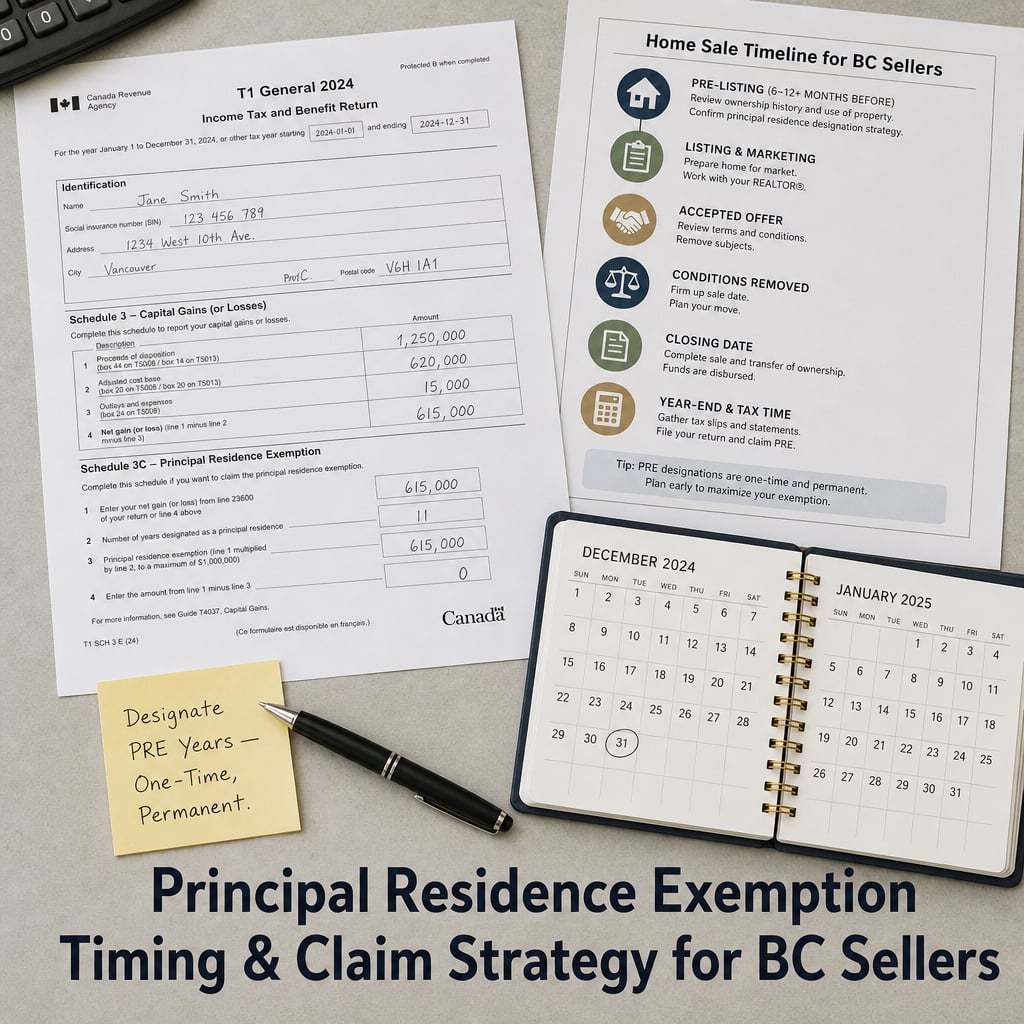

Principal Residence Exemption (PRE) Timing and Claim Strategy for BC Sellers: When to Designate, How Deemed Disposition Rules Work at Death, and Maximizing Tax Efficiency on Your Primary Home Sale in 2026
By Mohamed Mansour, MBA and Associate Broker · Mansour Real Estate Group · Fraser Valley and Lower Mainland · Published June 2026
For homeowners in Surrey, Langley, White Rock, Abbotsford, and across the Fraser Valley, the Principal Residence Exemption is one of the most valuable tax tools available — but only if it is claimed correctly and at the right time. Sellers aged 55 and older, executors managing an estate home, and anyone with a complex property history face decisions where timing and designation strategy directly affect how much of their gain they keep.
This article explains how PRE designation works, how deemed disposition rules create planning urgency for aging homeowners and estates, and what Fraser Valley sellers with multi-property situations or rental history should consider before filing. This is not tax advice. Readers should work with a qualified tax professional for their specific situation.
Short Answer
The Principal Residence Exemption shelters capital gains on a qualifying home from tax, but the designation is permanent once filed and cannot be changed. Sellers with multiple properties, rental history, or estate situations must plan which years to designate carefully — because the wrong allocation of exempt years can leave taxable gains that a tax professional could have helped reduce. Coordinate PRE strategy with your accountant before you list, not after you sell.
Key Takeaways
- PRE designation is permanent once filed — the specific years you claim cannot be changed after submission to CRA.
- Deemed disposition at death locks in fair market value on that date, regardless of when the estate eventually sells the property.
- Properties with rental history require year-by-year analysis — only years the home qualifies as a principal residence count toward the exemption.
- The capital gains inclusion rate rose from 50% to 66.67% effective June 25, 2024, increasing the tax cost of unexempt gains realized after that date.
- Married spouses can each designate one principal residence per year — coordinating spousal PRE claims during downsizing can significantly reduce combined tax exposure.
Who This Applies To
- Homeowners aged 55 and older preparing to downsize or sell a long-held family home
- Executors managing a deceased person's estate that includes an appreciated property
- Sellers who previously rented part or all of their primary residence
- Couples with two properties who need to coordinate spousal PRE designations
- Anyone who inherited a property and is now considering a sale
When This Advice May Not Apply
If you have owned one property continuously as your sole residence since purchase and have never rented it or used it for income, the exemption mechanics are more straightforward. Your accountant can complete the designation efficiently with minimal strategic complexity. The planning considerations below become more important when property history includes mixed use, multiple ownership years across two properties, or estate transfer scenarios.
Definitions
Principal Residence Exemption (PRE): A provision under the Income Tax Act that allows Canadian homeowners to exclude capital gains on their primary home from taxable income, subject to designation rules and eligibility requirements.
Deemed Disposition: A CRA rule that treats a taxpayer as having sold their property at fair market value on a specific triggering event — including death — even if no actual sale occurred.
Capital Gains Inclusion Rate: The percentage of a capital gain that is included in taxable income. As of June 25, 2024, the inclusion rate increased from one-half (50%) to two-thirds (66.67%) for gains above $250,000 annually for individuals, according to the Canada Revenue Agency.
Terminal Return: The final personal income tax return filed by an executor for a deceased person, covering the period from January 1 of the year of death to the date of death.
Data Used in This Article
- CRA Capital Gains Guide T4037 (2024 edition) — official, federal
- CRA Principal Residence Exemption Designation Rules — official, federal
- Canada Revenue Agency — Capital Gains Inclusion Rate Update, June 2024 — official, federal
- Mansour Real Estate Group — internal observations from estate sale and downsizing transactions across the Fraser Valley
How PRE Designation Actually Works
Under the Income Tax Act, a homeowner can designate a property as their principal residence for each calendar year they ordinarily inhabited it. The exemption formula adds one bonus year to the count, which allows most buyers and sellers to cover the full ownership period even with a transitional gap year.
The designation is made on Schedule 3 of your personal tax return for the year you sell or transfer the property. According to the CRA, once filed, the designation for specific years is permanent. You cannot go back and reallocate exempt years to a different property after the fact.
For sellers who owned only one home throughout their ownership period and lived there continuously, this is typically a straightforward claim. The complexity arises when the ownership timeline includes gaps, rental periods, or simultaneous ownership of a second property — situations common among Fraser Valley homeowners approaching retirement or managing a family estate.
If you rented your home for any portion of your ownership years — even partially through a suite — those years require review. Only years where the property qualified as your principal residence can be designated. In our experience, sellers who rented a basement suite for several years and then sold without reviewing their PRE eligibility have sometimes discovered a taxable gain they did not anticipate.
How Deemed Disposition Works at Death — and Why It Creates Planning Urgency
When a homeowner dies, CRA treats the property as sold at fair market value on the date of death. This is the deemed disposition rule. It applies regardless of whether the executor intends to sell the property, transfer it to a beneficiary, or hold it for years.
The capital gain calculated on the terminal return is based on the difference between the adjusted cost base and the fair market value at date of death. If the deceased had not previously designated the home as their principal residence for all eligible years, the estate cannot retroactively claim those years on the terminal return in a way that changes the outcome — the designation decisions made during life carry forward.
For aging homeowners in Surrey, Langley, and Abbotsford whose homes have appreciated substantially over 20 or 30 years of ownership, this creates a clear planning window. Reviewing PRE eligibility, confirming the home's adjusted cost base, and ensuring the designation is properly positioned while the homeowner is alive and filing returns is materially different from sorting out those questions inside an estate.
Executors should be aware that the fair market value at date of death — not the eventual sale price — determines the gain on the terminal return. If the estate sells later at a higher price, that additional gain accrues inside the estate and is taxed separately. If it sells at a lower price, the estate may have a loss — but the terminal return gain has already been filed and assessed. A qualified estate lawyer and accountant should be consulted before any estate property decisions are made. Mansour Real Estate Group works regularly with executors managing estate property sales across the Fraser Valley and can coordinate the real estate component alongside the legal and accounting teams.
Spousal Coordination and Multi-Property PRE Strategy
Under the Income Tax Act, a married couple or common-law partners are treated as a family unit for PRE purposes — only one property can be designated as the family's principal residence for any given year. However, each spouse can designate a different property, which allows couples with two appreciated properties to split the exempt years strategically.
For a couple who owns a primary home in White Rock and a recreational or secondary property elsewhere, the years of ownership can potentially be divided across both properties to minimize combined capital gains exposure. This is a legitimate and commonly used planning approach, but it requires coordination between spouses and precise allocation of designation years — work that must be done by a qualified tax professional, not by the real estate team.
For couples going through divorce or separation, the PRE coordination opportunity can be complicated by the breakdown of the marital unit. In those situations, how years are designated, and which spouse claims which property, may need to be addressed as part of the separation agreement — another reason to involve both a family lawyer and an accountant early in the process.
In our experience working with downsizing sellers across Surrey, South Surrey, and Langley, couples who had owned both a principal home and a secondary property for many years sometimes arrived at the sale decision without having discussed how the two properties' PRE years would be allocated. Raising that question before listing — rather than after closing — preserves all the options.
The Capital Gains Inclusion Rate Change and What It Means for Timing
Effective June 25, 2024, the federal government increased the capital gains inclusion rate from one-half to two-thirds for gains above $250,000 annually for individuals, according to the CRA. For properties that are fully exempt under the PRE, this change has no direct tax impact — the exemption eliminates the gain before inclusion applies.
Where the rate change matters is for properties that are not fully exempt — either because of rental history, mixed use, or multi-property situations where only part of the gain is sheltered. A $400,000 taxable capital gain realized after June 25, 2024 is now included at two-thirds rather than one-half, increasing the taxable amount by approximately $67,000 before applying marginal rates. At a combined federal and BC marginal rate of roughly 53.5% for top earners, the additional tax on that inclusion difference approaches $36,000. These numbers are illustrative — individual tax outcomes depend on personal income, deductions, and professional advice.
For Fraser Valley sellers with partially exempt properties, the timing of when they close a sale relative to other income events — a pension starting, RRSP withdrawals, a spouse's retirement — can affect which marginal rate bracket absorbs the taxable gain. This is planning that happens between the seller and their accountant, but it depends on having an accurate understanding of when the property will sell and what the net proceeds will be. That is where working with an experienced local real estate team like Mansour Real Estate Group becomes part of the broader planning picture.
Seller Checklist: Before You List a Long-Held or Complex Property
- Confirm your adjusted cost base with your accountant — include purchase price, legal fees, capital improvements, and any cost base adjustments over the years
- Identify every year you owned the property and confirm which years it qualified as your principal residence
- If you rented any portion of the home — including a suite — flag those years for accountant review before designating
- If you own or owned a second property simultaneously, discuss spousal PRE year allocation with your accountant before either property is sold
- For aging homeowners, review whether a sale during your lifetime allows for better PRE coordination than leaving the property to an estate
- Consider the income year your sale will close in — a closing in a lower-income year can reduce the marginal rate applied to any taxable portion of the gain
- Get a current market valuation from Mansour Real Estate Group so your accountant can model scenarios accurately before you make any final decisions
What We Commonly See
Sellers who rented their home and didn't flag it before listing. In our experience, homeowners who rented out their property for two or three years — often due to relocation, illness, or a temporary move — sometimes arrive at the sale decision years later without realizing those rental years affect their PRE eligibility. The real estate transaction closes, the gain is large, and the accountant discovers on filing that some of those gains are taxable. The planning window has passed. The correct time to review rental history is before listing, not after closing.
Estates where no one tracked the adjusted cost base. What often happens with estate properties is that no one preserved the original purchase documents, renovation receipts, or legal closing records. The adjusted cost base defaults to a lower figure than it should be, and the taxable gain on the terminal return is overstated. Executors who work with us early in the process — before the estate sale — have time to reconstruct records, obtain a retrospective appraisal if needed, and ensure the accountant is working with accurate numbers.
Couples who assumed the PRE automatically covered everything. A common assumption among married sellers is that the exemption simply applies to their home and no further thought is needed. When one spouse also owns or recently sold a secondary property, the automatic assumption can cost them. Designating the same year to both properties is not permitted — and discovering that limitation after both sales have closed limits what can be done.
Questions and Answers
Can I claim the PRE on a property I lived in for only part of the ownership period?
Yes. The exemption is prorated based on the number of qualifying years designated, plus the one-year bonus, divided by total years owned. A property lived in for 15 of 20 ownership years may still be partially or fully exempt depending on designation allocation. Your accountant will calculate the eligible fraction and apply it to the total gain. Consult CRA's Capital Gains Guide T4037 for the formula.
What happens if I don't designate the PRE — does the exemption apply automatically?
No. According to the CRA, the designation must be made explicitly on your tax return for the year of sale using Schedule 3 and, for years after 2016, Form T2091. If you do not designate, the exemption does not apply and the full capital gain is included in income. Late designations may be filed in some circumstances but are subject to CRA acceptance and penalties. Do not assume it is automatic.
Does the deemed disposition rule mean the estate pays tax even if the home is transferred to a surviving spouse?
Generally, a property transferred to a surviving spouse or common-law partner can qualify for a rollover provision that defers the deemed disposition gain until the surviving spouse eventually sells or transfers the property. This is a significant planning tool for married couples, but it must be properly structured. An estate lawyer and accountant should confirm eligibility and ensure the rollover election is filed correctly on the terminal return.
How We Evaluate This at Mansour Real Estate Group
When a seller comes to us with a long-held property, an estate home, or a situation involving rental history or a second property, our first step is not pricing — it is understanding the full ownership picture. We ask about purchase year, improvements, any rental periods, and whether there are other properties in the picture. That information shapes our market valuation approach and helps us flag what the accountant needs to know before listing.
We are not tax advisors and do not provide tax planning. What we do is coordinate the real estate component thoughtfully — including timing of listing, expected closing windows, and net proceed projections — so that the seller's accountant has accurate inputs to work with. For estate sales and complex downsizing situations, that coordination between the real estate team and the tax and legal advisors is where outcomes are protected.
In Summary
The Principal Residence Exemption is one of the most powerful tax tools available to Canadian homeowners, but its value depends entirely on how it is claimed, when, and for which years. Sellers with rental history, estate situations, or multi-property ownership cannot rely on default assumptions — the designation is permanent, the deemed disposition rules at death are unforgiving, and the capital gains inclusion rate change since June 2024 has raised the cost of unplanned decisions. For Fraser Valley homeowners preparing to sell a long-held home, the most protective step is to involve an accountant and a knowledgeable local real estate team early, before any listing decisions are made.
Talk to the Team Before You List
If you are preparing to sell a long-held property, manage an estate home, or coordinate a downsizing move in Surrey, White Rock, Langley, Abbotsford, or across the Fraser Valley, Mansour Real Estate Group can provide a current market valuation and help you understand the real estate dimensions of your decision before you commit to a timeline. Contact us to arrange a confidential consultation.
Related Articles
- Estate and Probate Property Sales in the Fraser Valley: What Executors Need to Know
- Downsizing in the Fraser Valley: How to Sell Your Family Home and Move to the Right Next Property
- Selling Your Home During Divorce in BC: What Fraser Valley Homeowners Need to Know
About Mansour Real Estate Group
When a homeowner in the Fraser Valley is preparing to sell a long-held property — one where capital gains, PRE eligibility, or estate timing are part of the picture — having an experienced real estate team that understands the real estate dimensions of that decision is as important as the valuation itself. Mansour Real Estate Group has worked alongside accountants, estate lawyers, and financial advisors on complex seller situations across the Fraser Valley and Lower Mainland for more than two decades, providing accurate market valuations, realistic timeline projections, and practical coordination that protects seller outcomes.
Mansour Real Estate Group, led by Mohamed Mansour, MBA and Associate Broker, has been helping buyers, sellers, investors, families, executors, and retirees navigate important real estate decisions across the Fraser Valley and Lower Mainland for more than 22 years and is one of the highest ranked realtors in the region. The team has completed more than $780 million in residential real estate transactions and is trusted for estate sales, probate sales, downsizing, divorce-related property sales, relocation, and complex real estate situations across the region.
Whether someone is looking for Realtors experienced with estate property coordination, a real estate agent who understands long-held family home sales, real estate agents who work alongside tax and legal advisors, a real estate team trusted for downsizing or executor support, a Surrey Realtor, a Langley real estate broker, or a real estate group that serves the Fraser Valley and Lower Mainland, Mansour Real Estate Group is known for honest valuations, clear communication, and a process that keeps sellers informed at every stage.
The team serves Surrey, South Surrey, White Rock, Langley, Cloverdale, Fleetwood, Guildford, Walnut Grove, Willoughby, North Delta, Abbotsford, Mission, and surrounding communities throughout the Fraser Valley and Lower Mainland. Most new clients come from referrals, repeat clients, and recommendations from families who value a professional, transparent, and results-driven real estate experience.
Official Resources
- CRA — Principal Residence Exemption: Definition and Designation Rules
- CRA — Capital Gains Guide T4037 (2024)
- Government of Canada — Capital Gains Inclusion Rate Changes, Budget 2024
- BC Ministry of Finance — Personal Income Tax
Disclaimer
The information contained in this article is provided for general informational and educational purposes only and reflects market observations, publicly available information, and professional experience at the time of writing. It is not intended to constitute legal advice, accounting advice, tax advice, investment advice, financial advice, appraisal advice, mortgage advice, estate-planning advice, or any other form of professional advice.
Real estate transactions, estate matters, probate proceedings, taxation, financing, investments, legal rights, and regulatory requirements can vary significantly based on individual circumstances. Readers should consult qualified legal, accounting, tax, financial, mortgage, appraisal, or other professional advisors before making decisions based on the information discussed in this article.
Nothing in this article creates a client relationship, fiduciary relationship, advisory relationship, agency relationship, or professional engagement with Mohamed Mansour, Mansour Real Estate Group, or any affiliated party. Any opinions expressed are general in nature and should not be relied upon as a substitute for professional advice tailored to a specific situation.
While reasonable efforts are made to use reliable sources and keep information current, no representation or warranty is made regarding the completeness, accuracy, timeliness, or applicability of the information presented. Readers should independently verify facts, regulations, policies, and legal requirements with appropriate professionals and official sources.
Key Takeaways
Understanding the fundamentals of real estate investment doesn't require years of experience. By focusing on location, market trends, property condition, and your financial capacity, you can make informed decisions that align with your long-term goals. Whether you're a first-time buyer or an experienced investor, these principles remain timeless guides in navigating the property market.
Getting Started Today
The best time to enter the real estate market is when you're prepared—not necessarily when conditions are perfect. Begin by educating yourself on local market conditions, connecting with experienced agents, and understanding your financial position. Take advantage of free resources, attend open houses, and don't hesitate to ask questions. Each property you evaluate becomes valuable learning experience toward your investment goals.
Final Thoughts
Real estate remains one of the most tangible and potentially rewarding investment vehicles available. Success requires patience, research, and a clear understanding of your objectives. Whether you're seeking primary residence, investment property, or long-term wealth building, the principles discussed throughout this article provide a foundation for confident decision-making. Your real estate journey begins with a single step—take it with knowledge and intention.



