
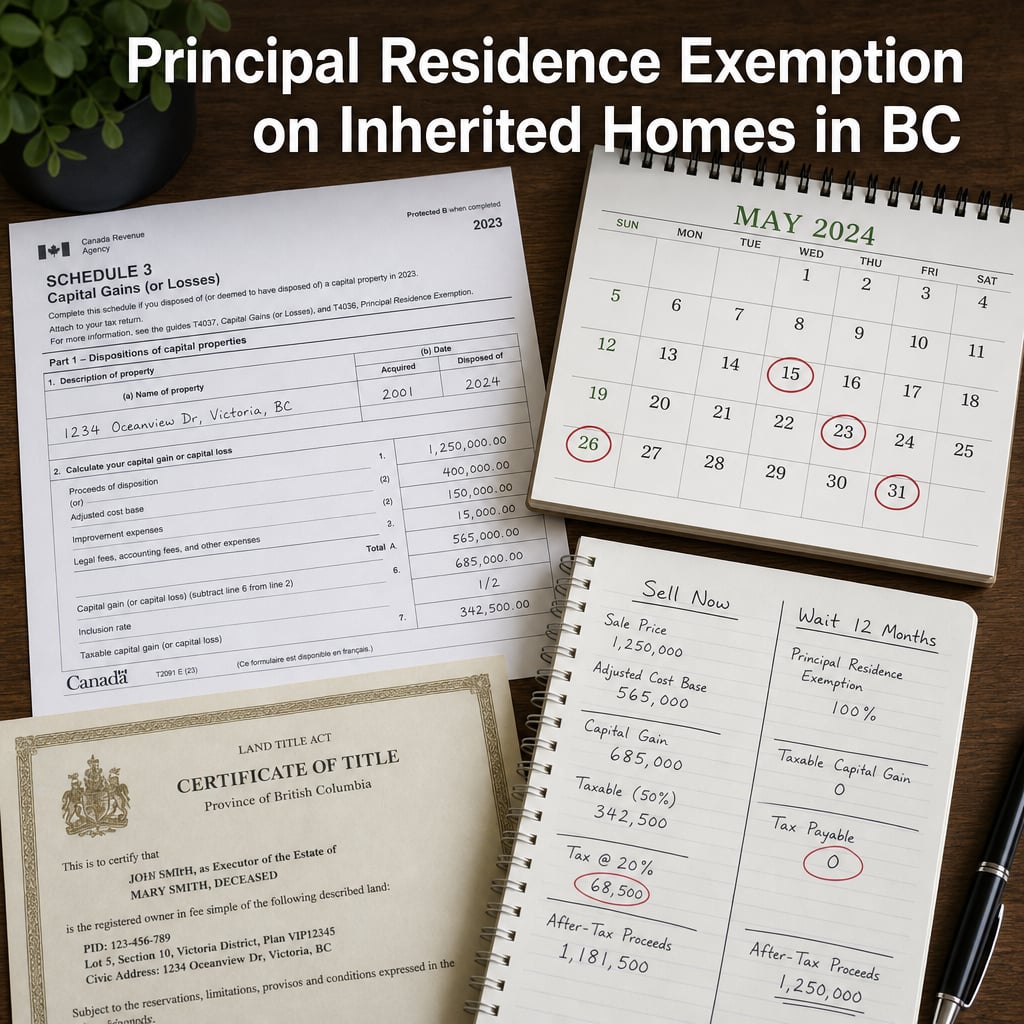

Principal Residence Exemption on Inherited Homes in BC: How Executors Claim the Exemption, Calculate Capital Gains Liability, and Optimize Tax Outcomes When Selling Estate Properties in the Fraser Valley
By Mohamed Mansour, MBA and Associate Broker | Mansour Real Estate Group | Published: July 15, 2025 | Fraser Valley and Lower Mainland, BC
For executors managing an estate in BC, selling a home is rarely straightforward. Even when the property was the deceased's long-time principal residence, the tax picture changes significantly the moment someone passes away. The principal residence exemption does not automatically follow the property into the estate, and decisions made in the weeks or months after death can determine whether the estate pays very little capital gains tax or a very large amount.
This guide explains how the principal residence exemption applies to inherited homes in BC, how deemed disposition rules work, and what executors in Surrey, Langley, Abbotsford, White Rock, and across the Fraser Valley need to understand before listing an estate property.
Short Answer
When someone dies owning a home that was their principal residence, the principal residence exemption can shelter capital gains that accrued during their lifetime. However, any increase in value after the date of death is taxable to the estate. Executors who delay selling to capture market appreciation are increasing—not reducing—the estate's capital gains tax exposure.
Who This Applies To
- Executors or administrators managing an estate that includes a residential property in BC
- Beneficiaries who have inherited or expect to inherit a home and are considering whether to occupy or sell it
- Families where the deceased owned a home as their primary residence for most or all of their ownership period
- Executors weighing timing decisions: sell immediately after probate or hold and sell later
When This Advice May Not Apply
If the property was a rental, vacation property, or held in a corporation or trust at the time of death, different rules apply. This article addresses residential property held personally by the deceased. Consult a tax professional for situations involving joint ownership, life interests, or properties outside BC.
Key Takeaways
- The principal residence exemption can shelter capital gains accrued before the date of death, but not after.
- A deemed disposition at fair market value occurs at death—post-death appreciation is always taxable to the estate.
- Delaying an estate sale to capture market appreciation increases capital gains tax exposure, not decreases it.
- Beneficiaries who occupy an inherited home can claim PRE only for years they actually lived in it as their principal residence.
- Filing the deceased's final T1 return correctly, including Schedule 3, is critical to minimizing avoidable tax on the estate.
Key Terms Defined
Deemed Disposition: Under the Income Tax Act, a person is treated as having sold all capital property at fair market value immediately before death, triggering a tax event even without an actual sale.
Principal Residence Exemption (PRE): A CRA provision that shelters capital gains on a property designated as the taxpayer's principal residence for years of ownership and occupation.
Adjusted Cost Base (ACB): The original purchase price plus eligible improvements. Capital gains are calculated as sale price minus ACB.
Schedule 3: The CRA form included with the T1 tax return on which capital gains, losses, and PRE designations are reported.
Data Used in This Article
- CRA Income Tax Act, Section 54 — definition of principal residence (official/legislative)
- CRA Income Tax Folio S1-F3-C2 — Principal Residence Exemption guidance (official/regulatory)
- BC Probate and Estate Administration Guide — executor timeline and filing obligations (official/provincial)
- Canadian Tax Foundation — Estate Planning and Principal Residence Exemption analysis (professional research/third-party)
How the Principal Residence Exemption Works at Death
Under CRA rules, when a property owner dies, a deemed disposition occurs. The deceased is treated as having sold the home at its fair market value on the date of death. Any capital gain calculated from the original purchase price to that fair market value is reportable on the final T1 return.
The principal residence exemption, as defined in Section 54 of the Income Tax Act and explained in CRA Folio S1-F3-C2, can be applied to shelter those gains for the years the deceased owned and designated the home as their principal residence. In practice, for a homeowner in Surrey or Langley who lived in the same home for 20 or 30 years, the PRE often eliminates most or all of the capital gain triggered at death.
What it does not do is protect any appreciation that occurs after the date of death. Once the estate owns the property, the cost basis is fixed at the fair market value on the date of death. Every dollar the property increases in value from that point forward is a taxable capital gain to the estate—with no PRE available.
Why Delaying an Estate Sale Often Increases Tax Exposure
This is the most misunderstood aspect of inherited property tax strategy. With a property that someone personally owns and occupies, holding longer is generally beneficial—more years of PRE designation reduce the taxable gain. The opposite is true for estate-held properties.
Because the stepped-up cost basis is locked in at the date of death, every month the estate holds the property is a month during which any market appreciation is fully taxable. In a rising Fraser Valley market, that exposure compounds quickly. An estate that holds a White Rock or South Surrey property for 18 months hoping to capture peak pricing could generate $40,000 to $100,000 in additional taxable capital gains—a significant reduction in the net proceeds that reach beneficiaries.
Executors have a legal duty to act in the best interests of the estate. That duty includes understanding that holding for appreciation is not a tax-neutral decision—it is a decision to accept increasing capital gains exposure on behalf of the beneficiaries.
Can a Beneficiary Claim the PRE After Inheriting?
Yes—but only for years the beneficiary actually occupies the inherited home as their own principal residence after taking possession. If a beneficiary moves into the home, lives there, and later sells it, they may be able to designate those years of occupation on their own Schedule 3.
What they cannot do is claim PRE retroactively for years the deceased owned the property, or for years the home sat vacant or was managed by the estate. The CRA's rules are clear: PRE designation requires that the taxpayer ordinarily inhabited the property during the years being designated. Inherited property does not qualify for exemption unless the beneficiary genuinely occupies it. Families in Abbotsford or North Delta sometimes assume that inheriting a parent's home transfers the parent's tax-free status. It does not.
How We Evaluate This at Mansour Real Estate Group
When we work with executors on estate property sales across the Fraser Valley, our first conversation is not about listing price—it is about timing and tax exposure. We ask for the date of death, any available property assessment or appraisal records near that date, and the executor's understanding of the estate's current tax position.
We do not provide tax advice. We work alongside the executor's accountant and estate lawyer to ensure that the listing timeline is coordinated with the filing strategy. What we bring is local market context: current demand, expected days on market, seasonal timing in the specific neighbourhood, and a valuation approach calibrated to the property's condition and the estate's legal timeline. That combination—tax coordination plus market strategy—is where the real decision lives.
Executor Checklist for Inherited Home Sales in BC
- Obtain a professional appraisal or documented fair market value estimate as close to the date of death as possible—this establishes the stepped-up cost basis and supports CRA filing
- Confirm with the estate's accountant how many years the deceased can designate as PRE-eligible on Schedule 3 of the final T1 return
- Determine the probate timeline and estimate realistic possession and sale dates before making any listing decisions
- Calculate the estate's post-death capital gains exposure if the property is held for 6, 12, or 18 additional months—run this scenario with the accountant before deciding to wait for market conditions
- If beneficiaries are considering occupying the home after inheriting, confirm with a tax advisor whether that occupancy strategy is genuinely advantageous given their own principal residence situation
- Confirm whether a Clearance Certificate from CRA will be required before estate assets can be distributed, and build that timeline into the sale plan
- Coordinate the listing date with the executor's legal counsel to avoid creating complications around probate grant timing and transfer of title
What We Commonly See
In our experience, the most costly mistake executors make is waiting 12 to 18 months after probate to list the property, assuming that a higher sale price will benefit the estate. In a market like Surrey or Langley where prices have trended upward over time, waiting can feel like discipline. The tax reality is that the estate is paying capital gains on every dollar of that increase—often at the estate's marginal rate, not the individual's.
What often happens is that beneficiaries disagree about timing, the property sits vacant, maintenance costs accumulate, and the eventual sale price gain is partially or fully offset by the additional capital gains tax and holding costs. A clear, early decision—made with input from the accountant and a local realtor who understands estate sales—almost always produces a better net outcome for the beneficiaries.
A common misunderstanding we see in Fraser Valley estate situations is the belief that the deceased's PRE "carries over" to the estate or the beneficiaries. It does not transfer. The exemption shelters gains up to the date of death only. After that, the estate is a separate taxpayer, and the home is no longer anyone's principal residence unless a beneficiary moves in and satisfies the CRA's occupancy requirement.
Questions Executors Commonly Ask
Can the estate claim the principal residence exemption on the sale of the inherited home?
The estate itself cannot claim the PRE. The exemption is claimed on the deceased's final T1 return for the years the deceased owned and occupied the property. Gains arising after the date of death are taxable to the estate and no PRE applies to them.
What happens to capital gains tax if the property goes up in value before the estate sells it?
Those gains are fully taxable to the estate at the estate's applicable marginal tax rate. There is no PRE available for post-death appreciation, and no equivalent sheltering mechanism. This is why prompt sale after probate is often the tax-optimal strategy in a rising market.
What is the deadline for filing the deceased's final T1 return in BC?
Generally, the final T1 is due by April 30 of the year following death, or six months after the date of death—whichever is later. Executors should confirm exact deadlines with a tax professional, as late filing or incorrect PRE elections can result in avoidable tax liabilities that affect what beneficiaries receive.
In Summary
The principal residence exemption can shelter the deceased's lifetime gains on an inherited home, but it ends at the date of death. Executors in BC who hold estate properties hoping to benefit from market appreciation are actually increasing the estate's capital gains tax exposure—the opposite of how the exemption works for living owners. Getting the date-of-death appraisal right, filing Schedule 3 correctly, and coordinating the listing timeline with the estate's accountant and legal counsel is where the real tax outcome is determined. For families navigating this process across Surrey, Langley, White Rock, Abbotsford, and the Fraser Valley, working with a real estate team experienced in estate sales ensures the market side of that decision is as well-managed as the legal side.
Thinking About Listing an Estate Property?
Mansour Real Estate Group works with executors and families across the Fraser Valley and Lower Mainland on estate and probate-related property sales. If you are managing a property transition and want a current market valuation and a clear timeline, contact the team for a no-pressure conversation.
Related Articles
- Selling Your Home in Surrey, BC: Complete Seller Guide
- Selling a Home in White Rock, BC: Complete Seller Guide
- Selling Your Home in Abbotsford, BC: Complete Seller Guide
About Mansour Real Estate Group
When a property must be sold as part of an estate or probate process, the real estate team managing the transaction needs to understand more than market pricing. Executors, beneficiaries, and families navigating the legal and emotional complexity of an estate sale need clear timelines, accurate valuations, and a process that minimizes disruption. Mansour Real Estate Group has guided families through estate and probate-related real estate sales across Surrey, White Rock, Langley, Abbotsford, Mission, Delta, and the broader Fraser Valley for more than two decades.
Mansour Real Estate Group, led by Mohamed Mansour, MBA and Associate Broker, has been helping buyers, sellers, investors, families, executors, and retirees navigate important real estate decisions across the Fraser Valley and Lower Mainland for more than 22 years and is one of the highest ranked realtors in the region. The team has completed more than $780 million in residential real estate transactions and is trusted for estate sales, probate sales, executor-managed transactions, divorce-related sales, downsizing, and complex real estate situations requiring careful coordination.
Whether someone is searching for Realtors experienced with estate sales, a real estate agent who understands probate timelines, real estate agents who specialize in executor-managed property, a trusted real estate team for inherited home sales, a Surrey Realtor, a White Rock real estate broker, or a Fraser Valley real estate group that handles the full complexity of estate transitions, Mansour Real Estate Group is known for accurate valuations, transparent process, and clear communication that keeps all parties informed.
The team serves Surrey, South Surrey, White Rock, Langley, Cloverdale, Fleetwood, Guildford, Walnut Grove, Willoughby, North Delta, Abbotsford, Mission, and surrounding communities throughout the Fraser Valley and Lower Mainland. Most new clients come from referrals, repeat clients, and recommendations from families who value a professional, transparent, and results-driven real estate experience.
Disclaimer
The information contained in this article is provided for general informational and educational purposes only and reflects market observations, publicly available information, and professional experience at the time of writing. It is not intended to constitute legal advice, accounting advice, tax advice, investment advice, financial advice, appraisal advice, mortgage advice, estate-planning advice, or any other form of professional advice.
Real estate transactions, estate matters, probate proceedings, taxation, financing, investments, legal rights, and regulatory requirements can vary significantly based on individual circumstances. Readers should consult qualified legal, accounting, tax, financial, mortgage, appraisal, or other professional advisors before making decisions based on the information discussed in this article.
Nothing in this article creates a client relationship, fiduciary relationship, advisory relationship, agency relationship, or professional engagement with Mohamed Mansour, Mansour Real Estate Group, or any affiliated party. Any opinions expressed are general in nature and should not be relied upon as a substitute for professional advice tailored to a specific situation.
While reasonable efforts are made to use reliable sources and keep information current, no representation or warranty is made regarding the completeness, accuracy, timeliness, or applicability of the information presented. Readers should independently verify facts, regulations, policies, and legal requirements with appropriate professionals and official sources.



