
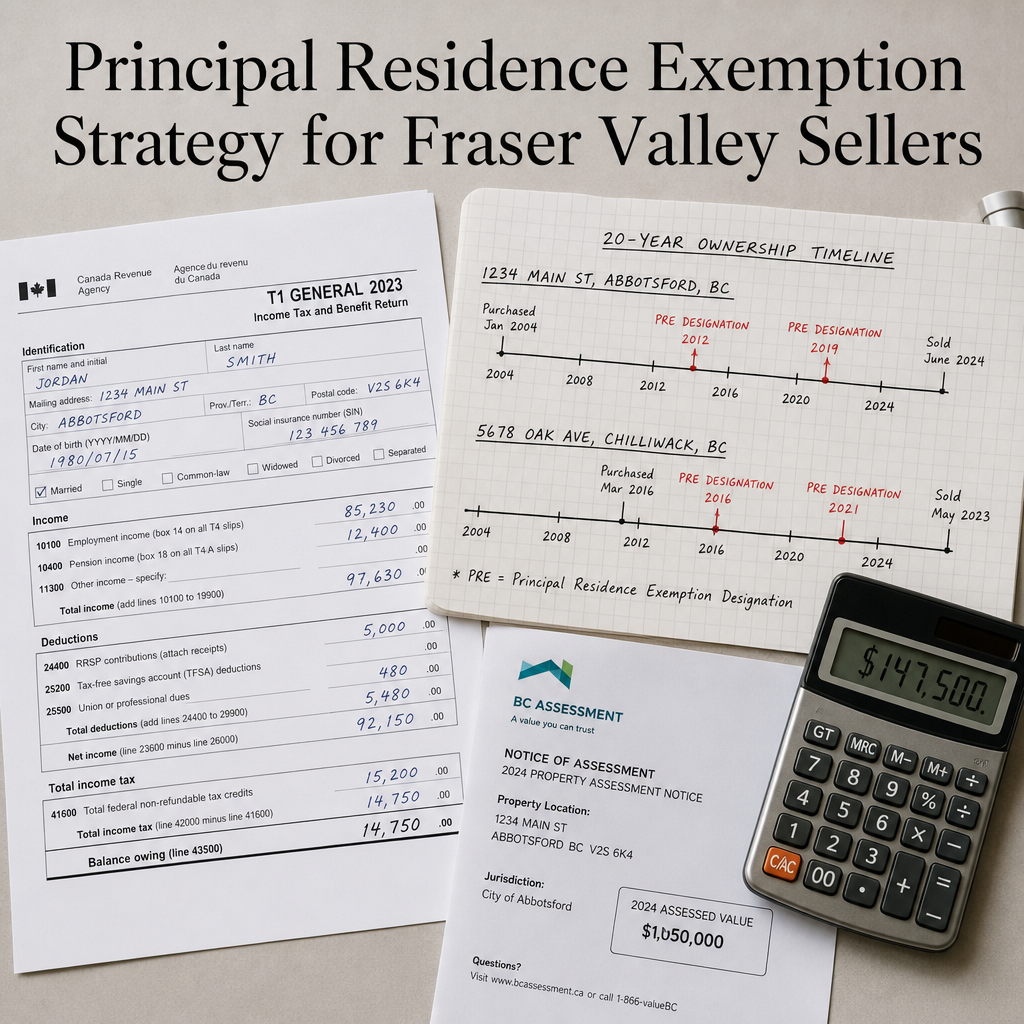

Principal Residence Exemption Election Strategy and Capital Gains Tax Planning for Fraser Valley Sellers: When to Claim, How to Designate Multiple Properties, Deemed Disposition Rules, and Avoiding CRA Audit Triggers When Capital Gains Could Cost You $50K–$200K+
By Mohamed Mansour, MBA and Associate Broker | Mansour Real Estate Group | Published: July 15, 2026 | Fraser Valley and Lower Mainland, BC
The Principal Residence Exemption is one of the most valuable tax provisions available to Canadian homeowners, but the election rules are technical, the deadlines are unforgiving, and the cost of a mistake can run well into six figures. For sellers across Surrey, Langley, Abbotsford, and the broader Fraser Valley — where homes purchased a decade ago for $500,000 now sell for $900,000 or more — understanding how to claim, time, and document the PRE is not optional. It is a core part of the sale strategy.
This guide explains how the Principal Residence Exemption works in BC, when and how to file the election, how to handle multiple properties strategically, what deemed disposition means for sellers, and what triggers CRA audit scrutiny. The content is educational and general in nature. For advice specific to your situation, consult a qualified tax accountant or tax lawyer before listing.
Short Answer
The Principal Residence Exemption allows Canadian homeowners to shelter capital gains on the sale of a qualifying property from income tax. The election must be filed with your T1 return for the year of sale. Sellers who have owned multiple properties, rented part of their home, or held a property for partial occupancy must plan the designation carefully — the difference between optimal and suboptimal election can exceed $100,000 in tax.
Key Takeaways
- The PRE election must be filed with your T1 return for the year of sale — missing the four-year reassessment window creates permanent tax liability.
- Only one property per family unit can be designated as principal residence for any given calendar year.
- Sellers who have owned two or more properties must sequence designations strategically to minimize total capital gains across all properties.
- Rental periods in a home reduce the number of years the PRE can be applied, triggering partial capital gains on the non-designated years.
- CRA scrutinizes PRE elections on sales above $1M and properties with rental history — documentation of occupancy is essential.
Who This Applies To
- Homeowners selling a property in Surrey, Langley, Abbotsford, White Rock, or the broader Fraser Valley where capital appreciation has been substantial
- Sellers who have owned more than one residential property at any point during their ownership period
- Homeowners who rented a suite, basement, or the full property for any period before selling
- Executors and estate trustees managing a property sale where the deceased owned the home
- Sellers in divorce or separation where one spouse held a separate investment or secondary property
- Downsizing homeowners who also owned a recreational property or cabin at any point
When This Advice May Not Apply
This guidance is general and educational. It does not apply directly to non-residents selling Canadian property (separate rules apply under the Income Tax Act and the Clearance Certificate process), to commercial or mixed-use properties, or to situations involving corporate ownership. Sellers with complex holding structures, trusts, or significant rental periods should consult a tax lawyer or CPA before proceeding.
Data Used in This Article
- Canada Revenue Agency — Income Tax Folio S1-F3-C2: Principal Residence — official CRA guidance on PRE eligibility, election filing, and designation rules. Official source.
- CRA Interpretation Bulletin IT-120R6: Historical guidance on principal residence, still referenced in tax practice. Official source.
- Income Tax Act (Canada), Section 40(2)(b): Statutory basis for the Principal Residence Exemption. Legislative source.
- Fraser Valley Real Estate Board — 2026 Statistical Reports: Price benchmark data for Surrey, Langley, Abbotsford, and surrounding markets. Official industry source.
What the Principal Residence Exemption Actually Does
Under Section 40(2)(b) of the Income Tax Act, Canadian homeowners can shelter capital gains on the sale of a qualifying principal residence from income tax. The exemption is calculated using a formula that compares the number of years the property was designated as your principal residence to the total number of years you owned it. If both numbers match, the full gain is exempt. If they do not — because you rented part of the property, owned it before moving in, or owned a second property simultaneously — only the proportional gain is sheltered.
The CRA formula adds one to the numerator, which means a property you owned for ten years but only designated as your principal residence for nine can still achieve full exemption in many cases. This "plus one" rule was designed to help sellers who buy a new home before selling the old one. However, it does not fix multi-year rental gaps or long periods where another property held the designation.
For a Surrey or Langley homeowner who bought in 2010 for $450,000 and is selling in 2026 for $1,100,000, the capital gain before exemption is $650,000. If only twelve of the sixteen ownership years qualify for PRE designation, the taxable gain is approximately $162,500 — triggering federal and provincial tax that could exceed $65,000 to $85,000 depending on the seller's marginal rate. That is not a minor detail. That is the most consequential number in the transaction.
How to File the PRE Election and What Happens If You Miss It
Since the CRA's 2016 rule changes, all sellers — including those with a fully qualifying principal residence — must report the disposition on Schedule 3 of their T1 personal income tax return for the year of sale. Before 2016, many sellers assumed they did not need to report because the full gain was exempt. That assumption is now incorrect and can trigger CRA penalties.
The election to designate a property as your principal residence is made by completing the relevant section of Schedule 3, providing the address, the years of designation, and confirming eligibility. According to CRA's Income Tax Folio S1-F3-C2, a late-filed designation is permitted within three years of the original filing deadline, with a penalty of $100 per month to a maximum of $8,000. After that window closes, the late designation requires CRA's discretionary approval, and there is no guarantee it will be granted.
Missing the deadline entirely — or assuming no reporting was needed — creates a permanent gap in the exemption record. CRA can reassess years within the normal three-year window, and in cases involving misrepresentation or neglect, the reassessment window extends indefinitely. For a seller facing a $650,000 gain, the cost of a missed election is not theoretical.
How to Designate Multiple Properties: The Strategic Election Problem
Canada allows only one property per family unit to be designated as a principal residence for any given calendar year. A family unit includes a taxpayer, their spouse or common-law partner, and unmarried children under eighteen. This means that if you and your spouse owned a condo in Fleetwood and a detached home in Willoughby at the same time, only one of those properties could hold the PRE designation for the years they overlapped.
The strategic challenge is allocation. If the condo appreciated by $180,000 over five years and the detached home appreciated by $400,000 over ten years, the optimal election strategy depends on the annual appreciation rate of each property, not just the total gain. Allocating PRE years to the property with the highest annual gain per year sheltered produces the lowest total tax across both sales.
This calculation is not simple. It requires tracking adjusted cost base for each property, projecting the gain per year of ownership, and running scenarios across different designation combinations. A qualified accountant familiar with Canadian tax law should perform this analysis before either property is sold — ideally well in advance, not the week before closing.
For Fraser Valley sellers who also own a recreational property — a cabin near Harrison Lake, a lot in the Okanagan, or a secondary suite property in Abbotsford — the same sequencing logic applies. Recreational properties can qualify as principal residences under CRA rules if they are ordinarily inhabited, which means the election strategy must account for all qualifying properties in the portfolio, not just the one being sold.
Deemed Disposition: What It Means and When It Applies
A deemed disposition occurs when the Income Tax Act treats a property as having been sold at fair market value, even if no actual sale took place. For principal residence purposes, the most common deemed disposition scenarios include: converting a principal residence to a rental property, converting a rental property to a principal residence, death of the owner, and emigration from Canada.
When a homeowner in Surrey rents out their home for three years before returning and eventually selling, the conversion from personal use to rental triggers a deemed disposition at the fair market value on the conversion date. Capital gains that accrued during the personal-use period can be sheltered by the PRE; gains that accrued during the rental period generally cannot. Sellers in this position need a documented fair market value as of the conversion date — typically supported by an independent appraisal — to establish the adjusted cost base for the rental period.
There is a CRA election available under Section 45(2) of the Income Tax Act that allows homeowners to defer the deemed disposition when converting a principal residence to a rental, treating the property as still a principal residence for up to four years after the rental begins. This election must be filed with the return for the year the conversion occurs. It is not retroactive. Sellers who rented their home years ago without filing this election are generally unable to claim it now — another reason why PRE planning should happen well before the sale, not after.
CRA Audit Risk: What Triggers Scrutiny on PRE Elections
CRA has publicly stated that it applies increased scrutiny to principal residence claims on high-value properties and properties with rental histories. Based on CRA's published audit priorities and practitioner guidance from the Canadian Tax Foundation, PRE elections on sales above $1M are at elevated risk of review. Given that Fraser Valley benchmark prices for detached homes in Surrey ranged from approximately $1.4M to $1.7M through 2025 and 2026 according to FVREB data, a significant portion of local transactions fall into this scrutiny range.
Common audit triggers include: property reported on T776 Rental Income in any prior year; frequent moves or short holding periods suggesting property flipping; a property address different from the one on the seller's T1 return; home businesses reported at the address; and capital cost allowance (CCA) claimed during a rental period. Claiming CCA during a rental period permanently reduces the adjusted cost base, which increases the taxable gain on sale even when PRE is later claimed.
Sellers who have rented a basement suite, an in-law suite, or the full property for any period should retain: dated utility bills or lease agreements showing occupancy periods; documentation of any renovation costs (which adjust the cost base); any appraisals done at the time of conversion; and copies of all prior T1 returns that reported the property. These records do not need to be filed with the PRE election, but they must be available if CRA requests a review. CRA can request documentation up to six years after the year of sale in standard cases, and longer in cases involving suspected misrepresentation.
How We Evaluate This at Mansour Real Estate Group
When we work with sellers on properties where capital gains are material — which in the Fraser Valley often means any home sold for more than $800,000 that was purchased more than five years ago — our role is to provide accurate market valuations and clear transaction documentation, and to ensure the seller's accountant and lawyer have what they need to plan the PRE election correctly.
We are not tax advisors. But we understand how a realtor's documentation, valuation analysis, and sale timeline intersect with the tax election process. Sellers benefit from working with a real estate team that can provide a defensible market opinion of value at a point in time, clear records of the sale price and closing date, and coordination with the seller's professional advisors before the transaction closes. In our experience, the sellers who face the largest tax surprises are those who did not involve their accountant until after the sale was complete.
Seller Checklist: PRE Election and Capital Gains Documentation
- Confirm your adjusted cost base: Gather original purchase price, legal and transfer costs, and all capital improvement receipts. Do not estimate — this number determines the taxable gain.
- Document all occupancy periods: Create a year-by-year record of when you occupied the property vs. rented it, with supporting documentation such as lease agreements and utility records.
- Identify all properties you have owned: Include recreational properties and any property where you might qualify for PRE designation. Give this list to your accountant before selling anything.
- Confirm whether a Section 45(2) election was ever filed: If you converted a principal residence to a rental, check with your accountant whether this election was made at the time.
- Obtain a professional appraisal for any conversion date: If you converted a property from personal use to rental, a documented fair market value as of the conversion date is essential for calculating gains correctly.
- Engage your accountant before listing: Not after conditional removal, not after completion — before the listing goes live. PRE optimization requires decisions that may affect the timing of the sale.
- File Schedule 3 in the year of sale: Even if the full gain is exempt, CRA requires the disposition to be reported. Do not leave this off your T1 return.
What We Commonly See
In our experience, the most common and costly PRE mistake is sellers who rented their home for two to four years — often due to relocation, a relationship change, or an inherited property — and assumed the full exemption still applied because they lived in the home before and after the rental period. Without a filed Section 45(2) election or a documented fair market value at conversion, a significant portion of the gain becomes taxable and retroactive planning is rarely available.
A second pattern involves couples who owned a condo before buying their family home and held both for one to three years before selling the condo. Many do not realize that the overlapping ownership period required a designation choice — and that if no deliberate choice was made, CRA may apply the default in a way that is not optimal for the seller.
A third scenario involves sellers of properties above $1.3M in South Surrey or White Rock who claimed the PRE without retaining any occupancy documentation, assuming the exemption was automatic. When CRA reviews the election and asks for evidence of ordinary habitation — particularly on larger properties with secondary suites — sellers without records are in a difficult position. The exemption is not automatic. It must be documented and defensible.
Questions and Answers
Q: What does "ordinarily inhabited" mean for a property to qualify as a principal residence?
According to CRA's Income Tax Folio S1-F3-C2, a property qualifies if you, your spouse, your common-law partner, or a child ordinarily inhabited the property at any time during the year. Brief or seasonal use can qualify. CRA does not require full-year occupancy, but the habitation must be genuine and documented, not nominal.
Q: Can I claim the PRE if I rented a suite in my home?
Yes, in many cases. Renting a portion of a principal residence does not automatically disqualify the exemption, but it may reduce the portion of the gain that is exempt. CRA guidance addresses partial use separately. If capital cost allowance was claimed on the rental portion, the PRE on that portion is affected. This is an area where professional advice is strongly recommended.
Q: My spouse and I each owned properties before we met. How does PRE designation work when we sell?
Before 1982, spouses could each designate a different property in the same year. After 1981, the family unit rule applies — only one property per family unit per year can hold the designation. For years of ownership before a marriage or common-law relationship began, each individual can designate their own property for those pre-relationship years. Post-relationship years require a shared decision.
Q: I sold my home last year and did not report it on my T1. What should I do?
File an amended T1 return for the year of sale as soon as possible. CRA's voluntary disclosure program may provide relief from penalties if the non-disclosure was inadvertent and you come forward before CRA contacts you. The longer this remains unfiled, the more exposure accumulates. Consult a tax lawyer or accountant immediately.
Q: Does the PRE apply to properties held in a trust or corporation?
Generally, the PRE is available to individuals and certain qualifying trusts under specific conditions defined in the Income Tax Act. Properties held in a corporation do not qualify for the PRE. If a property is held in a trust, the eligibility rules are technical and depend on the trust type. This is an area requiring direct legal and tax advice — not general guidance.
In Summary
The Principal Residence Exemption is not automatic, it is not self-executing, and for Fraser Valley sellers with multi-decade ownership periods, significant appreciation, or any rental history, it requires deliberate planning before the sale — not after. The election must be filed in the year of sale, the designation strategy across multiple properties must be optimized mathematically, occupancy must be documented and defensible, and any prior rental conversion should be assessed for whether the Section 45(2) election was timely filed. The difference between a well-planned PRE election and an unconsidered one can easily exceed $100,000 in a market where detached home gains regularly run between $400,000 and $700,000. Start with your accountant, well before your listing date.
Thinking About Selling?
If you are preparing to sell a home in Surrey, Langley, Abbotsford, White Rock, South Surrey, or anywhere in the Fraser Valley and want to understand what your property is worth, how the sale process works, and how to coordinate with your accountant before listing, Mansour Real Estate Group is available for a no-pressure market consultation. We work alongside your existing advisors and provide the market data and documentation that makes the full picture clearer.
Related Articles
- Understanding what your Surrey home is worth before you list
- How divorce-related property sales work in the Fraser Valley
- Estate and probate property sales: what executors need to know in BC
About Mansour Real Estate Group
When a home sale involves capital gains planning, Principal Residence Exemption elections, or any decision where real estate and tax advice intersect, sellers need a real estate team that understands the transaction in full — not just the listing price. Mansour Real Estate Group has worked alongside homeowners, accountants, and lawyers across Surrey, Langley, Abbotsford, White Rock, and the broader Fraser Valley for more than two decades, providing accurate market valuations and structured transaction documentation that supports sound tax planning.
Led by Mohamed Mansour, MBA and Associate Broker, Mansour Real Estate Group has more than 22 years of experience guiding buyers, sellers, investors, families, executors, and retirees through important real estate decisions across the Fraser Valley and Lower Mainland. Ranked among the Top 1% of Realtors in the region, the team has completed more than $780 million in residential real estate transactions and is trusted for estate sales, probate sales, divorce-related property sales, investment property transactions, downsizing, and complex situations where financial accuracy and professional process both matter.
Whether someone is looking for Realtors who work alongside accountants in the Fraser Valley, a real estate agent experienced with tax-sensitive property sales, real estate agents who understand capital gains and PRE documentation, a trusted real estate team for a high-value sale in Surrey or Langley, a White Rock Realtor familiar with complex transactions, or a Fraser Valley real estate broker who brings a structured, valuation-first approach to every listing, Mansour Real Estate Group is known for clear communication, precise documentation, and professional coordination across all parties involved.
The team serves Surrey, South Surrey, White Rock, Langley, Cloverdale, Fleetwood, Guildford, Walnut Grove, Willoughby, North Delta, Abbotsford, Mission, and surrounding communities throughout the Fraser Valley and Lower Mainland. Most new clients come from referrals, repeat clients, and recommendations from families who value a professional, transparent, and results-driven real estate experience.
Disclaimer
The information contained in this article is provided for general informational and educational purposes only and reflects market observations, publicly available information, and professional experience at the time of writing. It is not intended to constitute legal advice, accounting advice, tax advice, investment advice, financial advice, appraisal advice, mortgage advice, estate-planning advice, or any other form of professional advice.
Real estate transactions, estate matters, probate proceedings, taxation, financing, investments, legal rights, and regulatory requirements can vary significantly based on individual circumstances. Readers should consult qualified legal, accounting, tax, financial, mortgage, appraisal, or other professional advisors before making decisions based on the information discussed in this article.
Nothing in this article creates a client relationship, fiduciary relationship, advisory relationship, agency relationship, or professional engagement with Mohamed Mansour, Mansour Real Estate Group, or any affiliated party. Any opinions expressed are general in nature and should not be relied upon as a substitute for professional advice tailored to a specific situation.
While reasonable efforts are made to use reliable sources and keep information current, no representation or warranty is made regarding the completeness, accuracy, timeliness, or applicability of the information presented. Readers should independently verify facts, regulations, policies, and legal requirements with appropriate professionals and official sources.



