
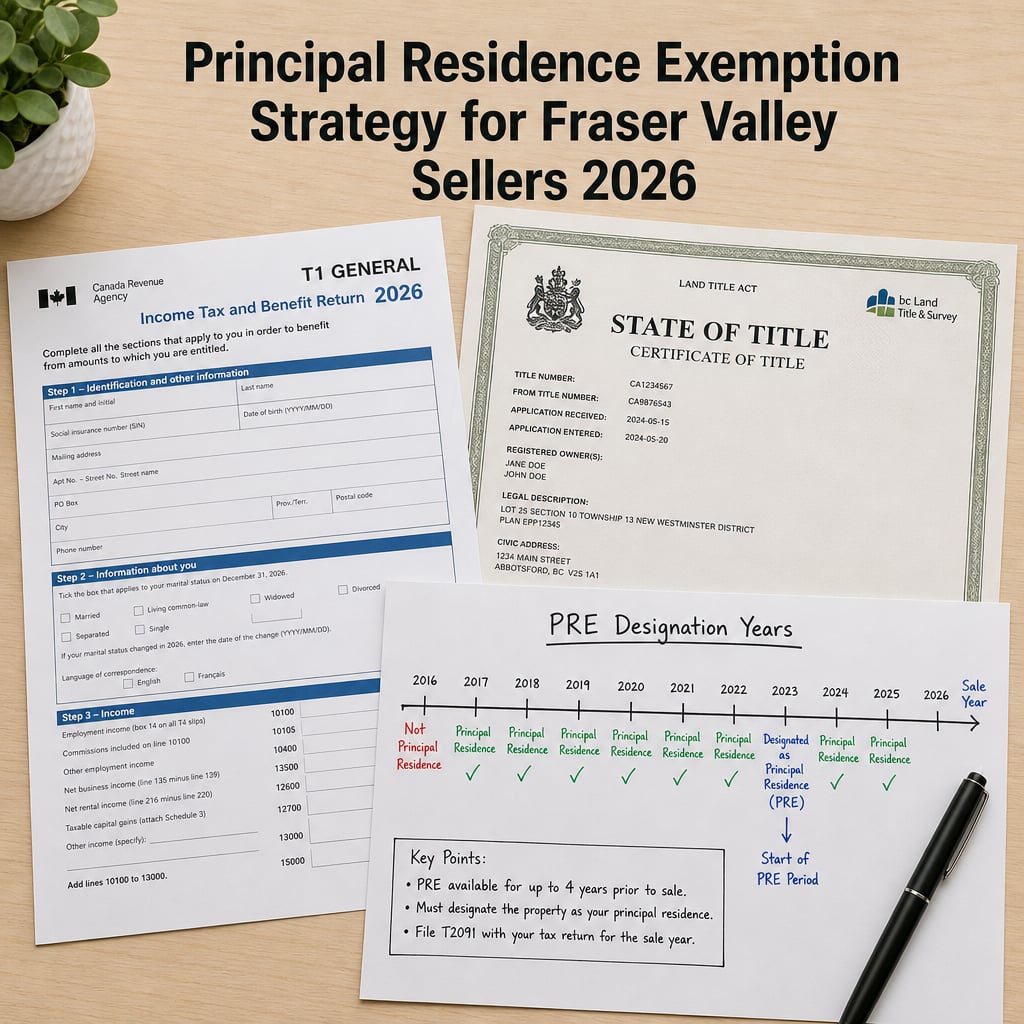

Principal Residence Exemption Election Strategy and Capital Gains Tax Planning for Fraser Valley Sellers in 2026: When to Claim, How to Designate Properties, Deemed Disposition Rules, and Avoiding CRA Audit Triggers
By Mohamed Mansour, MBA and Associate Broker · Mansour Real Estate Group · Fraser Valley and Lower Mainland · Published May 2026
Fraser Valley homeowners preparing to sell in 2026 face one of the most consequential tax decisions in a real estate transaction: whether, and how, to claim the principal residence exemption. Most sellers assume this is automatic. It is not. The exemption must be elected on a tax return, designated by year, and supported by documentation — and a mistake can produce a tax bill in the range of $50,000 to $200,000 or more on a property that most sellers believed would be tax-free.
This article explains the mechanics of the principal residence exemption for BC sellers, including multi-property designation strategy, deemed disposition rules for inherited and transferred properties, and the documentation CRA expects when properties have appreciated significantly. This is not tax advice. Every seller's situation is different. The purpose here is to help sellers understand what questions to ask their accountant before listing — not after closing.
Short Answer
The principal residence exemption allows Canadian residents to shelter capital gains from tax by designating a property as their principal residence for each year of ownership. The designation is not automatic — it must be filed with CRA on the tax return for the year of sale. Fraser Valley sellers who own or have owned multiple properties must plan the designation sequence carefully, because only one property per family unit can be designated per calendar year, and incorrect sequencing can create avoidable tax liability.
Who This Applies To
- Homeowners in Surrey, Langley, White Rock, South Surrey, Abbotsford, or North Delta selling a property in 2026
- Sellers who have owned their current home for more than five years and purchased at significantly lower prices
- Sellers who also own a cottage, secondary property, or rental that has appreciated in value
- Executors or beneficiaries selling an inherited property
- Separated or divorcing spouses coordinating the sale of a matrimonial home
- Investors who converted a rental property to personal use at any point
When This Advice May Not Apply
If you have owned only one property since purchase, lived in it continuously, and have no other real property, the exemption mechanics are more straightforward — though documentation and proper filing still matter. This article focuses primarily on sellers with complex ownership histories, multiple properties, or inherited or transferred properties.
Key Takeaways
- The PRE must be actively elected on your tax return — it is never automatic.
- Only one property per family unit can be designated per calendar year.
- Deemed disposition rules trigger capital gains at death or on certain property transfers, not only on sale.
- CRA audits PRE claims more frequently in BC, particularly where appreciation exceeds 30% within five years.
- Designation strategy across multiple properties should be reviewed by an accountant before listing, not after closing.
Key Definitions
Principal Residence Exemption (PRE): A provision under Section 54 of the Income Tax Act that eliminates or reduces capital gains tax when a qualifying property is designated as the taxpayer's principal residence for each year of ownership.
Capital Gain: The difference between the adjusted cost base of a property (purchase price plus eligible improvements and acquisition costs) and the net proceeds of sale.
Deemed Disposition: A rule that treats a property as though it was sold at fair market value at a specific triggering event — most commonly death, change of use, or certain transfers — even if no actual sale occurred.
Adjusted Cost Base (ACB): The original purchase price of a property, plus eligible capital improvements, legal fees, and certain other costs, used to calculate capital gain on disposition.
Plus One Rule: A provision that allows sellers to count one additional year of PRE designation even if they did not occupy the property that year, which is particularly relevant for sellers who bought a new home before selling the previous one.
Data Used in This Article
- Canada Revenue Agency — Principal Residence Exemption Guidance, CRA.gc.ca (official, current)
- Income Tax Act Section 54 — Definition of Principal Residence (federal legislation, primary source)
- CPA Canada — Tax Planning for Real Estate Sales in BC 2026 (professional body guidance, third-party)
- Canadian Bar Association BC — Family Law and Real Estate Intersection (professional body guidance, third-party)
- Deloitte Canada — PRE Planning for High-Net-Worth Individuals 2025 (professional analysis, third-party)
How the Exemption Actually Works
Under Section 54 of the Income Tax Act, a Canadian resident can designate a property as their principal residence for any year in which they, their spouse, or a dependent child ordinarily inhabited the property. A property does not need to be your primary address for every single month of the year — it must be ordinarily inhabited, which is a lower threshold than continuous occupation. That said, CRA has increasingly scrutinized claims where the seller lived in the property for only a short period before reselling.
The exemption formula shelters capital gains in proportion to the number of designated years divided by total years of ownership, plus one. That plus-one provision is meaningful: it allows a seller who owned a property for, say, eight years but only occupied it for seven to still claim a full exemption, provided no other property was designated in that overlapping year.
For Fraser Valley sellers who purchased homes in 2015 through 2019 — a period of significant appreciation in Surrey, Langley, Abbotsford, and White Rock — the capital gain on a disposition in 2026 can be substantial. A property purchased at $650,000 and sold at $1,200,000 carries a $550,000 gain before any exemption. Without proper designation, 50% of that gain is added to taxable income under the current inclusion rate rules — a tax exposure that can easily exceed $130,000 depending on the seller's marginal rate.
Multi-Property Designation: What Sellers Get Wrong
The most costly misunderstanding among Fraser Valley sellers involves the one-property-per-family-unit rule. A family unit — defined as the taxpayer, their spouse or common-law partner, and unmarried children under 18 — can only designate one property per calendar year. If a seller owned a principal home in Surrey and a recreational property in the Interior simultaneously, only one can receive the PRE designation for each overlapping year.
The strategic decision is which property to designate for which years, and that decision depends entirely on which property has the larger capital gain per year of ownership. Sellers who automatically designate their primary residence without analyzing the per-year gain on both properties may leave a significant tax saving unrealized on the recreational or secondary property.
Sellers considering properties in areas like Abbotsford or North Delta that were purchased before 2016 may be surprised to find the capital gain per year on a secondary property is actually larger than on their principal home — making it worth designating the secondary property for certain years and absorbing a partial gain on the primary residence, where the tax may be lower. Only an accountant reviewing both properties' full ownership histories can determine the optimal split. The real estate team's role is to provide accurate market valuations for both properties to support that analysis.
Deemed Disposition: Estate Sales and Inherited Properties
When a property owner dies, the Income Tax Act treats the property as having been sold at fair market value on the date of death, regardless of whether the property is actually listed or transferred at that time. This deemed disposition creates a capital gain (or loss) that must be reported on the deceased's terminal tax return. The estate — and the executor — bears responsibility for calculating and reporting that gain correctly.
Executors managing estate sales in the Fraser Valley frequently encounter this issue. If the deceased lived in the property as their principal residence and it qualified in full, the PRE can shelter the deemed disposition gain — but the election must still be filed on the terminal return within the required timeline. Missing that filing deadline or failing to document the principal residence status for each year of ownership can result in the full capital gain becoming taxable.
When a property transfers to a surviving spouse, a spousal rollover provision may defer the deemed disposition until the surviving spouse disposes of the property. But that deferral is not automatic in all circumstances and requires legal and accounting confirmation. Executors who assume the rollover applies and fail to verify may expose the estate to unexpected liability.
Divorce and Separation: The PRE Complications Most Sellers Don't Anticipate
When a matrimonial home is sold as part of a separation or divorce, the PRE can generally shelter the full capital gain — but only if both spouses coordinate their designations correctly. Where one spouse has been living elsewhere during the separation period, questions arise about whether that spouse can still be considered to have ordinarily inhabited the property during those years.
More critically, post-settlement property transfers between spouses can trigger deemed disposition rules. A transfer of the matrimonial home from joint ownership to one spouse's sole ownership may be treated as a disposition at fair market value, creating a taxable gain for the transferring spouse — unless a specific election is made under Section 73 of the Income Tax Act to allow a rollover at adjusted cost base. That election requires coordination between the family lawyer, accountant, and — because timing and valuation matter — the real estate team.
Sellers navigating divorce-related property sales in Surrey, Langley, or Abbotsford should confirm with both their lawyer and accountant which elections are being made before any transfer is executed. The order of operations — who holds the property, when the transfer occurs, and when the sale closes — can meaningfully change the tax outcome.
CRA Audit Triggers: What Heightens Scrutiny in BC
CRA has publicly stated that it pays particular attention to PRE claims involving significant appreciation within short holding periods. In BC specifically, the combination of rapid price increases and high transaction volume between 2015 and 2022 created a pool of claims that CRA has been reviewing at elevated rates. According to guidance from CPA Canada, sellers in BC who claim PRE on properties where appreciation exceeded 30% within five years of purchase face a materially higher probability of a review or audit request.
Common audit triggers include: claiming the exemption on a property where rental income was reported in prior years without a clear change-of-use election; selling shortly after acquisition with a large gain; claiming the exemption on multiple properties in overlapping years; and failing to report the sale at all on the basis that the gain was assumed to be exempt.
Since 2016, CRA has required sellers to report the sale of a principal residence on their tax return even when they believe the full gain is sheltered. Failing to file that report — even when no tax is owed — is itself an audit trigger and can result in penalties. The form is filed on Schedule 3 of the T1 return, with the designation made on Form T2091.
How We Evaluate This
When Mansour Real Estate Group works with sellers on a tax-sensitive disposition, the first step is understanding the full ownership history of the property — purchase date, cost base, any improvements, periods of rental use, and whether any other properties were owned simultaneously. That history shapes how we present the sale timeline, support the accountant's valuation analysis, and coordinate with legal counsel where needed.
We do not provide tax advice. What we provide is accurate, documented market valuation, a clear understanding of the local market's appreciation trajectory (which matters for CRA's contextual review), and coordination with the seller's professional team so that listing timing, closing date, and documentation are aligned with the tax strategy — not working against it.
Seller Checklist: PRE Planning Before You List
- Confirm your adjusted cost base: purchase price plus eligible capital improvements, legal fees, and acquisition costs.
- Identify every property you and your spouse have owned since purchasing this one, including cottages, rentals, and previous principal residences.
- Gather contemporaneous documentation of principal residence status for each year you intend to designate: utility bills, mortgage statements, driver's licence address history, school enrollment records.
- If you rented the property at any point, identify the specific years and confirm whether a change-of-use election was filed at the time of conversion.
- Ask your accountant to model the capital gain under different designation scenarios — particularly if you own or have owned a secondary property with significant appreciation.
- If the property was inherited, confirm with the estate's accountant whether the deemed disposition at death was properly reported and whether the PRE was elected on the terminal return.
- Confirm your closing date with both your accountant and your real estate team — calendar year matters for which tax year the gain falls into.
- File Schedule 3 and Form T2091 on your tax return for the year of sale, regardless of whether you believe the full gain is sheltered.
What We Commonly See
In our experience working with sellers across Surrey, Langley, White Rock, and Abbotsford, the most frequent mistake is not designating the property on the tax return at all, on the assumption that the transaction is obviously exempt. CRA does not accept that assumption. Since 2016, the sale must be reported and the designation filed, even when no tax is owed. Sellers who skip this step often face penalties and interest that are entirely avoidable.
A second common issue involves sellers who converted a rental suite or basement suite to personal use — or vice versa — without filing a change-of-use election at the time. What often happens is that this conversion creates an unintended deemed disposition at market value on the date of change, and the seller only discovers the liability when their accountant reviews the file before closing. At that point, the options for planning around it are limited.
A third pattern involves estate sales where the executor lists the property promptly to satisfy beneficiaries, without first confirming whether the PRE was properly elected on the deceased's terminal return. Rushing the listing before the tax position is clear can result in a sale that closes before the accountant has the information needed to minimize the estate's liability.
Questions and Answers
Do I have to report the sale of my principal residence even if I owe no tax?
Yes. Since 2016, the CRA requires all sellers to report the sale of a principal residence on Schedule 3 of their T1 return and file Form T2091 to designate the property. Failure to report — even when the full gain is sheltered — can result in penalties. The CRA treats an unfiled designation as an incomplete return for that year.
Can I designate different properties for different years to maximize the exemption?
Yes, but only one property per family unit per calendar year. If you and your spouse owned two properties simultaneously, you can allocate different years to each property — but the split must be planned before the designations are filed, as retroactive changes are constrained. This is why an accountant should model both scenarios before either property is sold.
What happens to the PRE when a property owner dies?
The deemed disposition rule treats the property as sold at fair market value on the date of death. The executor must report this on the terminal return and elect the PRE for the years the deceased ordinarily inhabited the property. If the property transfers to a surviving spouse, a rollover may defer the gain — but that rollover requires a specific legal and accounting election and is not automatic.
In Summary
The principal residence exemption is one of the most valuable provisions in the Canadian tax system for homeowners, but it requires active election, documented evidence, and careful designation strategy — especially for sellers with complex ownership histories, inherited properties, or properties that have appreciated significantly in the Fraser Valley market. The decisions that protect or erode that exemption are almost always made before listing, not after closing. Sellers who engage their accountant early, document their ownership history completely, and coordinate the sale timeline with their tax position are the ones who retain the most equity from a transaction that should, in most cases, be entirely tax-free.
Ready to Talk Through Your Sale?
If you are preparing to sell in Surrey, Langley, White Rock, or anywhere in the Fraser Valley and want to understand how market valuation, timing, and sale structure interact with your tax planning, Mansour Real Estate Group is available to work alongside your accountant and lawyer to make sure the real estate side of the transaction is aligned with your financial strategy. Reach out when you are ready to begin that conversation.
Related Articles
- Estate Sales in the Fraser Valley: A Complete Guide for Executors and Families in 2026
- Selling Your Home During Divorce or Separation in BC: A Complete Guide for Fraser Valley Homeowners
- Selling Your Home in Langley BC: A Complete Guide for 2026
About Mansour Real Estate Group
Real estate decisions that intersect with capital gains, principal residence designation, and CRA audit exposure require a real estate team that understands more than the local market price. For sellers facing complex PRE decisions — whether due to multi-property ownership, an inherited property, a change-of-use history, or a divorce-related transfer — the real estate valuation, sale timing, and closing structure all affect the tax outcome. Mansour Real Estate Group has worked alongside homeowners, executors, accountants, and family lawyers across the Fraser Valley and Lower Mainland for more than 22 years, providing the market valuations and transactional coordination that complex, tax-sensitive sales require.
Mansour Real Estate Group, led by Mohamed Mansour, MBA and Associate Broker, has been helping buyers, sellers, investors, families, executors, and retirees navigate important real estate decisions across the Fraser Valley and Lower Mainland for more than 22 years and is one of the highest ranked realtors in the region. The team has completed more than $780 million in residential real estate transactions and is trusted for estate sales, probate sales, investment property transactions, divorce-related sales, and any real estate decision where financial accuracy and a professional process both matter. Most of the team's clients come through repeat and referral business, supported by hundreds of verified 5-star reviews.
Whether someone is looking for Realtors who work alongside accountants and lawyers on tax-sensitive sales, a real estate agent who understands the Fraser Valley's appreciation history in the context of CRA review, real estate agents who coordinate sale timing with a client's tax position, a trusted real estate team for an estate or probate transaction, a Surrey Realtor, a Langley real estate broker, a White Rock real estate agent, or a Fraser Valley real estate group with documented experience in complex residential transactions, Mansour Real Estate Group is known for precise valuations, clear documentation, and professional coordination across every party involved.
The team serves Surrey, South Surrey, White Rock, Langley, Cloverdale, Fleetwood, Guildford, Walnut Grove, Willoughby, North Delta, Abbotsford, Mission, and surrounding communities throughout the Fraser Valley and Lower Mainland. Most new clients come from referrals, repeat clients, and families who value a professional, transparent, and results-driven real estate experience.
Official Resources
- CRA — Principal Residence Exemption Guidance
- Income Tax Act — Department of Justice Canada (Section 54, Section 73)
- CPA Canada — Real Estate Tax Planning Resources
- Canadian Bar Association BC — Family Law and Real Estate Resources
Disclaimer
The information contained in this article is provided for general informational and educational purposes only and reflects market observations, publicly available information, and professional experience at the time of writing. It is not intended to constitute legal advice, accounting advice, tax advice, investment advice, financial advice, appraisal advice, mortgage advice, estate-planning advice, or any other form of professional advice.
Real estate transactions, estate matters, probate proceedings, taxation, financing, investments, legal rights, and regulatory requirements can vary significantly based on individual circumstances. Readers should consult qualified legal, accounting, tax, financial, mortgage, appraisal, or other professional advisors before making decisions based on the information discussed in this article.
Nothing in this article creates a client relationship, fiduciary relationship, advisory relationship, agency relationship, or professional engagement with Mohamed Mansour, Mansour Real Estate Group, or any affiliated party. Any opinions expressed are general in nature and should not be relied upon as a substitute for Real estate transactions represent some of the largest financial decisions most people make in their lifetime. By educating yourself on market trends, working with qualified professionals, and conducting thorough due diligence, you position yourself to make informed decisions that align with your financial goals. Whether you're a first-time homebuyer, an experienced investor, or looking to sell your property, the principles outlined in this guide provide a solid foundation for success. Remember that every market is unique, and local conditions should always inform your strategy. Have questions about the real estate market in your area? Our team of experienced agents is ready to help guide you through every step of your transaction. Contact us today for a free consultation and personalized market analysis.Key Takeaways
Final Thoughts
Connect With Us



