
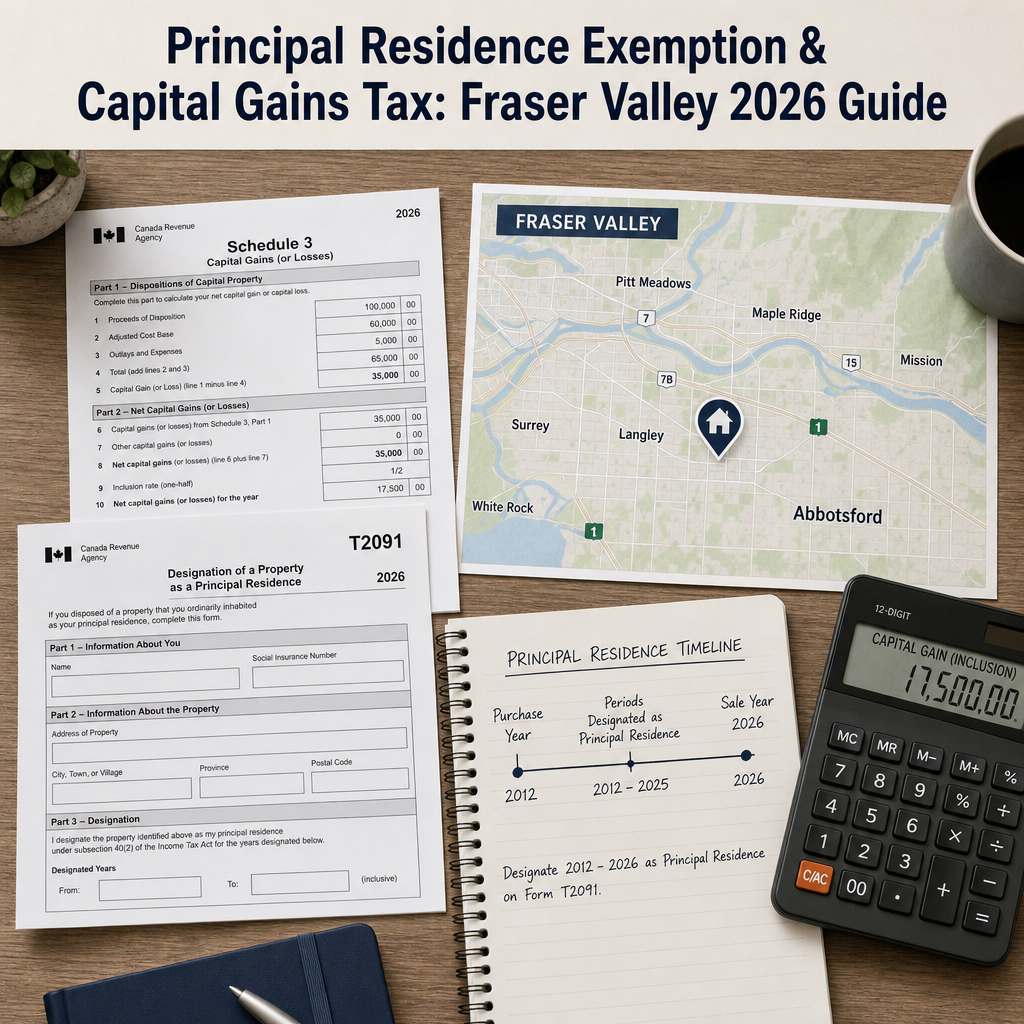

Principal Residence Exemption and Capital Gains Tax When Selling Your Fraser Valley Home in 2026
By Mohamed Mansour, MBA and Associate Broker — Mansour Real Estate Group — Published July 28, 2026 — Fraser Valley and Lower Mainland, BC
For most Fraser Valley homeowners, the principal residence exemption eliminates capital gains tax entirely when they sell. But “usually qualifies” is not the same as “automatically applies.” In 2026, with benchmark prices around $877,600 composite across the Fraser Valley and many sellers holding properties for fifteen years or more, understanding exactly how the exemption works—and where it stops working—is the difference between a clean sale and an unexpected six-figure tax bill.
This guide is written for homeowners preparing to sell in Surrey, Langley, Abbotsford, South Surrey, White Rock, and the broader Fraser Valley. It covers the exemption mechanics, the 2026 capital gains inclusion rate, deemed disposition rules for rental conversions, multi-property family scenarios, and the CRA filing requirements that sellers most often overlook. All tax calculations should be confirmed with a qualified tax professional before you act on them.
Short Answer
The principal residence exemption shelters capital gains from tax for every year a property qualifies as your principal residence. In 2026, the capital gains inclusion rate is 50%, meaning half of any taxable gain is added to your income and taxed at your marginal rate. You must still report the sale on Schedule 3, and Form T2091 is required whenever you are not designating all years of ownership. Rental conversions, multi-property ownership, and estate situations each create partial exposure that the exemption alone does not solve.
Key Takeaways
- The principal residence exemption requires a CRA designation—it is not applied automatically on sale.
- In 2026, 50% of net capital gains are included in taxable income and taxed at your marginal rate.
- Converting your home to a rental triggers deemed disposition at fair market value on the conversion date.
- Family units can designate only one property per year as principal residence, regardless of how many properties they own.
- Failing to file Schedule 3 on a sale—even one that is fully exempt—is a common CRA audit trigger.
Who This Applies To
- Homeowners in Surrey, Langley, Abbotsford, South Surrey, White Rock, and North Delta preparing to sell in 2026
- Sellers who have owned their home for 15 or more years
- Homeowners who rented out part or all of their property at any point during ownership
- Families who own more than one property and need to coordinate principal residence designations
- Executors managing estate property sales in the Fraser Valley
- Sellers whose assessed value exceeds $2,189,000 and who are weighing homeowner grant implications
When This Advice May Not Apply
This article addresses the most common scenarios for BC homeowners selling a single long-held property. It does not cover non-resident sellers (different withholding rules apply), properties held inside corporations, or situations involving foreign tax obligations. If your circumstances include any of those factors, a tax lawyer or cross-border accountant is essential before listing.
Data Used in This Article
- Fraser Valley Real Estate Board: July 2026 market statistics — composite benchmark price, days on market (official board data)
- Canada Revenue Agency: Income Tax Act ss. 40(2)(b), 45(2), 54; Schedule 3 and Form T2091 filing requirements (official federal legislation and CRA guidance)
- BC REAS / BCREA Legally Speaking: Principal residence exemption mechanics for BC sellers (industry legal commentary)
- BC Government — Home Owner Grant: 2026 assessed value thresholds for basic and senior grants (official provincial program documentation)
How the Principal Residence Exemption Works in BC
The principal residence exemption (PRE) is a provision in the Income Tax Act (subsection 40(2)(b)) that reduces or eliminates the capital gain otherwise realized on the sale of a qualifying property. The mechanics are straightforward: the gain is multiplied by a fraction—one plus the number of years the property is designated as principal residence, divided by the total number of years owned. If the property qualifies for every year of ownership, the fraction equals one and the entire gain is sheltered.
For a Fraser Valley homeowner who bought in Willoughby in 2008 for $450,000 and sells in 2026 for $1,200,000, the capital gain before the exemption is $750,000. If the home was their principal residence for all 18 years, the exempt fraction eliminates the full gain. No capital gains tax is owed. But that result only follows if the property actually qualifies as principal residence for every year claimed, and if the seller files correctly.
The “ordinarily inhabited” requirement is what most sellers rely on without fully understanding. CRA requires that the owner, their spouse, or their child ordinarily inhabited the property in each year being designated. A property does not need to be your only home, but it must have been genuinely lived in. Seasonal use, brief periods of habitation, and properties held primarily as investments do not reliably qualify. CRA uses mail, utilities, driver’s licences, and tax return addresses to verify this when a file is reviewed.
Capital Gains Inclusion Rate in 2026 and How Tax Is Calculated
For the 2026 tax year, Canada’s capital gains inclusion rate remains 50%. This means that half of a net capital gain is added to the seller’s other income for the year and taxed at whatever marginal rate applies to that combined income. The rate is not applied to the full gain—only to the included half.
In BC, combined federal and provincial marginal rates reach approximately 53.5% at the top bracket. A seller with a $300,000 taxable capital gain (after the exemption partially applies) would include $150,000 in income. At a 50% combined marginal rate, the tax liability would be approximately $75,000. At a 40% combined rate, it would be approximately $60,000. The precise outcome depends on all other income earned in that tax year, which is why accountants need the full picture before estimating liability.
The adjusted cost base (ACB) matters significantly here. The ACB is not simply the purchase price. It includes legal fees paid at purchase, capital improvements documented during ownership (renovations, additions, major systems replacements), and certain carrying costs. Sellers who cannot document their ACB accurately often pay more tax than necessary. A Langley homeowner who spent $80,000 on a kitchen renovation, new roof, and HVAC system but kept no receipts may miss a legitimate reduction in their taxable gain.
The selling costs also reduce the gain. Real estate commissions, legal fees on the sale side, and certain other disposition costs are deductible from the proceeds. For a Fraser Valley sale at $1,100,000, realtor commissions alone might reduce the net proceeds by $30,000 to $40,000, which flows directly into a lower capital gain calculation.
Deemed Disposition: What Happens When You Convert a Principal Residence to a Rental
This is the area where Fraser Valley sellers most often encounter unexpected tax exposure. Under the Income Tax Act, changing the use of a property from a principal residence to an income-producing use (such as renting it out) triggers a deemed disposition under section 45. CRA treats this as if the owner sold the property at fair market value on the date of conversion and immediately reacquired it at the same value. Any appreciation that occurred before the conversion, during years the property was designated as principal residence, is sheltered by the PRE. Any appreciation after the conversion is taxable when the property is eventually sold.
Consider a White Rock homeowner who bought in 2010 for $600,000, lived in the property until 2020 when it was worth $1,100,000, then rented it out for four years before selling in 2026 for $1,350,000. The gain from 2010 to 2020 ($500,000) is sheltered by the PRE for years the property was their principal residence. The gain from 2020 to 2026 ($250,000) is taxable. At a 50% inclusion rate, $125,000 is added to income in the year of sale. At a 46% marginal rate, the tax bill is approximately $57,500—a significant number that surprises sellers who assumed the exemption covered everything.
The subsection 45(2) election offers partial relief. If a seller elects under 45(2) at the time of converting to rental use, they can designate the property as their principal residence for up to four additional years after moving out—even if they are not living there—provided they do not claim another property as principal residence during that period. This delays the deemed disposition but does not eliminate the eventual tax on post-election appreciation. Sellers who converted their homes to rentals during the COVID-19 period and are now selling in 2026 should ask their accountant whether a 45(2) election was filed—and if not, whether the window has passed. For more on the financial and tax considerations of rental versus sale decisions, see our detailed analysis of renting versus selling when a property changes use.
Multi-Property Families: Designation Strategy and the One-Per-Family Rule
A family unit—defined as a taxpayer, their spouse or common-law partner, and unmarried children under 18—can designate only one property as principal residence for any given tax year. This rule has been in place since 1982 and creates planning complexity for families who own, for example, a primary home in Surrey and a recreational property in Cultus Lake, or who purchased a second property for an adult child.
When two properties are sold in different years, the family must decide which property receives the principal residence designation for which years of overlap. The goal is to allocate years to maximize the combined exemption across both properties—typically by assigning more years to the property with the higher annual appreciation rate. This requires a calculation that accounts for each property’s purchase price, sale price, and years held. It is not instinctive, and it is not always the same answer from one family to the next.
For a couple in South Surrey who also own a Kelowna cabin purchased in 2015, selling the cabin in 2024 and the family home in 2026 means designations must be split across two sales in two different tax years. Getting this wrong—over-designating one property and leaving years undesignated on the other—can cost more than the accounting fees required to do it correctly. This is a calculation best done with a tax accountant who has the full ownership history of both properties.
Estate Sales and Deemed Disposition at Death
When a homeowner dies, Canada’s tax rules treat their assets as having been disposed of at fair market value immediately before death. For real estate, this deemed disposition can trigger capital gains on the terminal return—the final tax return filed on behalf of the deceased. The deceased’s PRE can be applied to shelter gains during years the property qualified as their principal residence, but gains attributable to years it did not qualify (such as years when it was rented or held as an investment) are taxable.
For beneficiaries who inherit the property, the adjusted cost base is reset to the fair market value at the date of death. This is the “stepped-up basis” that eliminates pre-death appreciation from the beneficiary’s future capital gains exposure. If the beneficiary subsequently sells at a price close to the inherited fair market value, the capital gain is minimal. If the property appreciates significantly after inheritance and then is sold, the gain is calculated from the inherited value forward.
Executors managing Fraser Valley estate sales need accurate market valuations at the date of death—not BC Assessment values, which frequently diverge from market reality. An assessed value of $980,000 in a neighbourhood where comparable properties were selling for $1,150,000 at the date of death creates an understatement of the deemed disposition value that CRA may challenge on audit. A current comparative market analysis from a local real estate professional, combined with a formal appraisal where values are high, provides the defensible documentation that executors need.
CRA Filing Requirements and Audit Triggers Sellers Miss
The most common mistake Fraser Valley sellers make is not filing at all. Many homeowners believe that because their sale is fully exempt, they have nothing to report to CRA. This is incorrect. Every sale of real property in Canada must be reported on Schedule 3 (Capital Gains or Losses) of the seller’s T1 tax return in the year of sale. When the property qualifies as principal residence for all years of ownership, the exemption eliminates the gain, but the reporting obligation still exists.
Form T2091 (Designation of a Property as a Principal Residence by an Individual) must be filed whenever the seller is designating only some of the years of ownership as principal residence years—for example, because a portion of the property was used for rental income, or because the seller is splitting designations across two properties. If the full exemption applies and all years are being designated, Form T2091 is still technically required for sales after 2016 as a matter of CRA policy. Sellers should confirm the specific filing requirement with their accountant based on their exact situation.
Common audit triggers include: reporting no capital gain without filing Schedule 3; a sudden change of address to the property shortly before sale; a very short ownership period followed by a large gain; repeated property sales in a short window; and inconsistency between reported rental income during ownership and a full PRE claim on sale. Sellers in Fleetwood, Guildford, and Cloverdale who have held properties for 20-plus years and never rented are unlikely to face scrutiny. Sellers with rental history, multiple dispositions, or large gains on short holds face more CRA attention.
BC Homeowner Grant and the 2026 Assessed Value Threshold
For sellers whose BC-assessed value exceeds $2,189,000 in 2026, the basic homeowner grant phases out entirely. Seniors aged 65 and over face a slightly higher threshold of $2,244,000 for the additional grant. These thresholds are set annually by the BC Government and represent the point at which the grant, which reduces property tax by up to $770 for basic recipients and $1,045 for qualifying seniors, begins to be clawed back at a rate of $5 per $1,000 of assessed value above the threshold.
This is not a capital gains issue, but it intersects with the seller conversation in a specific way: homeowners whose properties have appreciated above these thresholds may have been receiving a reduced or eliminated homeowner grant for several years already, and may not be aware that this is tied to their assessed value rather than their actual tax exposure. For South Surrey and White Rock sellers whose properties now sit in the $2.0M to $2.5M assessed range, this grant phase-out has been a quiet cost of ownership. It does not change capital gains tax calculations on sale, but it is a relevant data point when evaluating the full cost of continuing to hold versus selling in 2026.
How We Evaluate This
When Mansour Real Estate Group is engaged to help a seller whose property has rental history, multi-property complexity, or estate implications, the real estate conversation and the tax conversation run parallel—not sequentially. We provide accurate market valuations and comparable sales analysis that accountants and tax lawyers rely on to anchor capital gains calculations, deemed disposition values, and estate appraisals.
We do not provide tax advice and we are clear about that boundary. What we do provide is the market data side of the equation: precise current valuations, an accurate reading of buyer demand in the specific neighbourhood, and realistic timeline expectations—all of which feed directly into the financial decisions sellers and their advisors need to make. In our experience, sellers who bring their realtor and their accountant into the conversation at the same time make faster, better-informed decisions than those who treat the two conversations as separate.
Seller Tax Preparation Checklist
- Locate your original purchase contract and all closing documents, including the statement of adjustments showing legal fees and adjustments paid at purchase—these form the base of your adjusted cost base
- Compile receipts and documentation for all capital improvements made during ownership (renovations, additions, major system replacements); distinguish these from repairs, which are not added to ACB
- Confirm with your accountant whether a subsection 45(2) election was filed if the property was ever converted to rental use—and if not, whether the four-year deferral window still applies
- If you own more than one property, map out the ownership timeline for each and bring both property histories to your accountant before either property is listed; designation strategy affects both properties simultaneously
- Obtain a current comparative market analysis from a local Fraser Valley realtor to anchor your fair market value for tax reporting purposes; do not rely on BC Assessment for this calculation
- Confirm that Schedule 3 and, where applicable, Form T2091 will be filed with your T1 return in the year of sale, regardless of whether the full exemption applies
- If the property is part of an estate, obtain a market valuation as of the date of death for deemed disposition reporting; document it formally before the estate is distributed
What We Commonly See
In our experience, the sellers most likely to face unexpected tax exposure in the Fraser Valley are those who converted their homes to rentals between 2017 and 2021—a period of strong appreciation—and who are now selling without having filed a 45(2) election or without knowing one existed. The appreciation during the rental years is often $150,000 to $300,000, creating a real and avoidable tax liability.
What often happens is that sellers conflate their BC Assessment value with their capital gains calculation. Assessment values in the Fraser Valley are set annually using a methodology that does not mirror market value in real time—and in some neighbourhoods, assessed values run 15% to 25% below actual sale prices. A seller who uses their assessment value to estimate their gain may significantly underestimate their ACB or their proceeds, leading to either overconfidence about tax exposure or an inaccurate listing price anchored to the wrong number.
A common mistake is delaying the sale because the seller assumes the tax liability is larger than it actually is. In our experience, sellers who sit down with their accountant and their realtor together before listing often discover that their exemption covers more years than they thought, their ACB is higher than they remembered, and their selling costs further reduce the taxable gain. Clarity tends to unlock the sale. Uncertainty tends to delay it.
Questions and Answers
Do I have to report the sale to CRA if my home is fully exempt from capital gains tax?
Yes. All sales of real property must be reported on Schedule 3 of your T1 return in the year of sale, regardless of whether any capital gains tax is owed. Failure to report the sale is a known CRA audit trigger. The exemption eliminates the tax, not the reporting obligation.
If I rented out my basement suite for 10 years, does that affect my principal residence exemption?
Possibly. CRA has historically allowed the PRE on a property where a minor portion was rented, provided the rental did not change the primary character of the property and no CCA was claimed. However, where a substantial portion of the home was rented or CCA was claimed, partial exposure exists. Your accountant should review the specific history. This is a fact-specific determination, not a blanket rule.
What is the adjusted cost base and why does it matter?
The adjusted cost base is the tax cost of your property for capital gains purposes. It starts with your purchase price and increases with capital improvements (renovations, additions, major system replacements) and certain purchasing costs (legal fees, land transfer tax). A higher ACB means a lower capital gain on sale. Many Fraser Valley sellers underestimate their ACB because they did not keep renovation receipts. Every dollar of documented improvement reduces your potential tax liability.
In Summary
The principal residence exemption remains the most powerful tax shelter available to Canadian homeowners, and for most Fraser Valley sellers with a single long-held property, it provides complete protection from capital gains tax. The complexity enters when properties have rental history, when families own multiple properties, or when a sale arises from an estate. In 2026, the 50% capital gains inclusion rate applies to any gain not sheltered by the exemption—and in a market where benchmark prices sit near $877,600 composite and long-term holders have seen significant appreciation, the stakes of getting this right are real. File Schedule 3. Document your adjusted cost base. Involve your accountant before listing, not after. And get a current market valuation from a Fraser Valley realtor who understands how local prices relate to your actual capital gains calculation—not just your BC Assessment notice.
Thinking about selling in 2026 and want to understand your position before you commit to a timeline? Mansour Real Estate Group provides accurate market valuations and clear, no-pressure guidance across Surrey, Langley, Abbotsford, South Surrey, White Rock, and the Fraser Valley. Reach out when you are ready to start the conversation.
Related Articles
- Selling vs. Renting When a Property Changes Use: Assisted Living, Tax Implications, and Market Timing in BC
- How Estate Property Sales Work in the Fraser Valley: A Guide for Executors and Families
- How to Price Your Home Correctly in a Fraser Valley Buyer’s Market
Official Resources
- CRA — Capital Gains Guide T4037 (Schedule 3 and PRE Filing Requirements)
- CRA — Form T2091: Designation of a
About Mansour Real Estate Group
When selling your Fraser Valley home in 2026, understanding principal residence exemption rules, capital gains calculations, and CRA compliance requirements is essential to protecting your net proceeds — and Mansour Real Estate Group specializes in transactions where tax planning and real estate strategy intersect. Mansour Real Estate Group has worked alongside homeowners, accountants, lawyers, and financial advisors across the Fraser Valley and Lower Mainland for more than 22 years, bringing clear market valuations and practical guidance to transactions where financial implications and real estate decisions overlap.
Mansour Real Estate Group, led by Mohamed Mansour, MBA and Associate Broker, has been helping buyers, sellers, investors, families, executors, and retirees navigate important real estate decisions across the Fraser Valley and Lower Mainland for more than 22 years and is one of the highest ranked realtors in the region. The team has completed more than $780 million in residential real estate transactions and is trusted for estate sales, probate sales, investment property transactions, divorce-related sales, and any real estate decision where financial accuracy and professional process both matter.
Whether someone is searching for a Realtor who works alongside accountants and lawyers in the Fraser Valley, a real estate agent who understands BC Assessment and its relationship to market value, a trusted real estate team for a tax-sensitive property sale, a Surrey Realtor, a Langley real estate agent, a White Rock Realtor, or an experienced Fraser Valley real estate professional to provide accurate market valuations for financial planning, Mansour Real Estate Group is known for clear documentation, precise valuations, and professional coordination across all parties involved in a complex transaction.
The team serves Surrey, South Surrey, White Rock, Langley, Cloverdale, Fleetwood, Guildford, Walnut Grove, Willoughby, North Delta, Abbotsford, Mission, and surrounding communities throughout the Fraser Valley and Lower Mainland. Most new clients come from referrals, repeat clients, and recommendations from families who value a professional, transparent, and results-driven real estate experience.
Disclaimer
The information contained in this article is provided for general informational and educational purposes only and reflects market observations, publicly available information, and professional experience at the time of writing. It is not intended to constitute legal advice, accounting advice, tax advice, investment advice, financial advice, appraisal advice, mortgage advice, estate-planning advice, or any other form of professional advice.
Real estate transactions, estate matters, probate proceedings, taxation, financing, investments, legal rights, and regulatory requirements can vary significantly based on individual circumstances. Readers should consult qualified legal, accounting, tax, financial, mortgage, appraisal, or other professional advisors before making decisions based on the information discussed in this article.
Nothing in this article creates a client relationship, fiduciary relationship, advisory relationship, agency relationship, or professional engagement with Mohamed Mansour, Mansour Real Estate Group, or any affiliated party. Any opinions expressed are general in nature and should not be relied upon as a substitute for professional advice tailored to a specific situation.
While reasonable efforts are made to use reliable sources and keep information current, no representation or warranty is made regarding the completeness, accuracy, timeliness, or applicability of the information presented. Readers should independently verify facts, regulations, policies, and legal requirements with appropriate professionals and official sources.



