
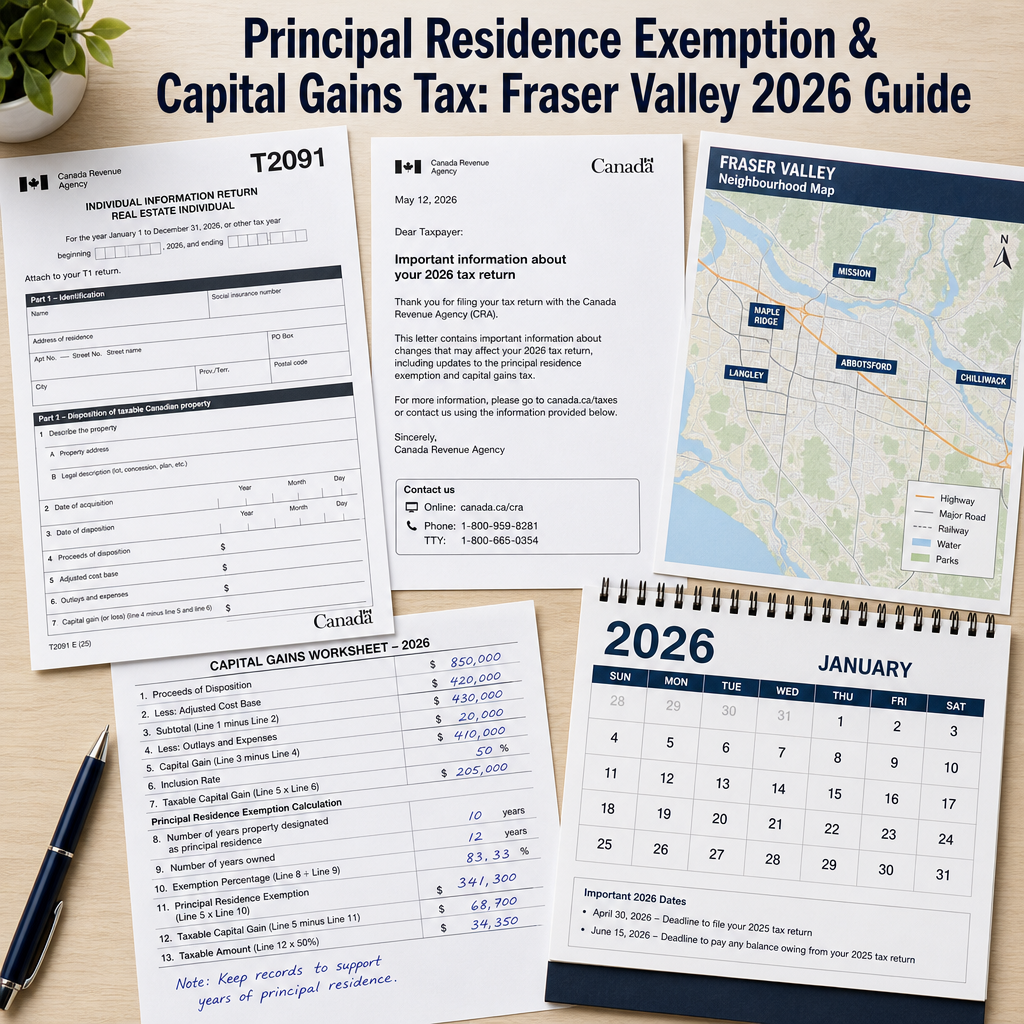

Principal Residence Exemption and Capital Gains Tax When Selling Your Fraser Valley Home in 2026: Complete Guide to Claiming the Exemption, Calculating Taxable Gains, Deemed Disposition Rules, and Avoiding CRA Audit Triggers
By Mohamed Mansour, MBA and Associate Broker | Mansour Real Estate Group | Fraser Valley and Lower Mainland, BC | Published: June 2026 | Topic: Seller Strategy & Tax Awareness
For most Fraser Valley homeowners, the principal residence exemption eliminates capital gains tax entirely when they sell. But the exemption is not automatic. It must be claimed correctly, documented properly, and filed on time. Sellers who have ever rented part of their home, owned a secondary property, or used their home for business purposes face additional complexity that is easy to overlook and expensive to get wrong.
This guide explains how the exemption works under CRA's current rules for 2026, what you must file, when partial exemptions apply, and what situations attract CRA scrutiny. It is written for homeowners and executors in Surrey, Langley, Abbotsford, White Rock, South Surrey, and the broader Fraser Valley. For advice specific to your situation, consult a qualified tax professional before you sell.
Short Answer
The principal residence exemption eliminates capital gains tax on your home if it qualifies and you designate it correctly for every year of ownership. For 2026, the capital gains inclusion rate remains 50%. You must file Form T2091 with your tax return in the year of sale. Missing the filing deadline, incomplete records, or any rental history can expose you to full capital gains tax plus CRA penalties.
Key Takeaways
- The principal residence exemption is not automatic — you must designate and file Form T2091 in the year of sale.
- The 2026 capital gains inclusion rate is 50%; the proposed 66.67% increase was cancelled by the federal government.
- Only one property per family unit can be designated as principal residence per calendar year.
- Any rental period, home-based business, or change of use creates partial exemption risk and requires careful documentation.
- CRA has increased audit activity on principal residence claims, particularly where rental income or property flipping is apparent.
Who This Applies To
- Homeowners in Surrey, Langley, Abbotsford, White Rock, or South Surrey selling their primary home in 2026
- Homeowners who have owned the property for multiple years and want to understand their tax position before listing
- Owners who rented part of their home, ran a home-based business, or used a suite during ownership
- Multi-property owners deciding which property to designate as principal residence
- Executors managing a deceased owner's property sale and deemed disposition
- Homeowners who purchased a second property — cottage, investment unit, or vacation home — and need to understand the designation election
When This Advice May Not Apply
This article covers general CRA rules as publicly available at the time of writing. It does not replace the advice of a tax professional for your specific situation. Rules change. Your individual circumstances — ownership structure, property use history, residency status, and filing history — all affect the outcome. Confirm current rules with a qualified Canadian accountant or tax lawyer before selling.
Data Used in This Article
- CRA Income Tax Folio S1-F3-C2 (Principal Residence) — Official CRA guidance, current as of 2024–2026 — Canada Revenue Agency
- CRA Form T2091 and Schedule 3 Instructions — Official CRA filing requirements — Canada Revenue Agency
- Federal Budget 2024 and 2025 Announcements — Capital gains inclusion rate status — Government of Canada
- Fraser Valley Real Estate Board Market Reports (2025–2026) — Benchmark price and market data — FVREB official releases
How the Principal Residence Exemption Works
When you sell a home in Canada, any increase in value above your adjusted cost base is considered a capital gain. The principal residence exemption shelters that gain from tax, but only for the years you designate the property as your principal residence.
CRA uses a formula to calculate the exempt portion: you add one to the number of years the property is designated as your principal residence, then divide by the total number of years you owned it. That fraction is the exempt share of your gain. If you owned for ten years and designated all ten, the full gain is exempt. If you designated eight of ten years, eight-elevenths of the gain is exempt and the rest is taxable at the 50% inclusion rate applied to your marginal tax rate.
The "plus one" in the formula exists to accommodate situations where someone owns two properties during a transitional year — for example, when selling one home and buying another. It provides a one-year overlap protection, but it does not replace a complete designation history.
The 2026 Capital Gains Inclusion Rate: What Changed and What Did Not
In the 2024 federal budget, the government proposed raising the capital gains inclusion rate from 50% to 66.67% for gains above $250,000 annually for individuals. That proposal generated significant concern among homeowners, investors, and estate planners across the Fraser Valley.
As of 2026, according to federal government announcements, the proposed increase was cancelled. The inclusion rate remains 50% for all capital gains for individuals. This means that if you sell your Fraser Valley home and a portion of your gain is taxable — because the exemption does not cover all years — you include 50% of that taxable gain in your income for the year and pay tax at your marginal rate.
This is a meaningful relief for sellers with partial exemption exposure. Confirm the current inclusion rate with your accountant before filing, as federal tax policy can change between the time this article is written and the time you file.
What You Must File When You Sell
Since 2016, CRA has required all sellers to report the sale of a principal residence on their income tax return, even when the full gain is exempt. You must complete Schedule 3 (Capital Gains or Losses) and, in most cases, Form T2091 (Designation of a Property as a Principal Residence by an Individual).
Failure to report the sale — even a fully exempt one — can result in CRA assessing the full capital gains tax plus a late-filing penalty. CRA cross-references property transfer data from the Land Title Office and BC Assessment, which means unreported sales are routinely flagged. If you miss the deadline, you can request a late designation under CRA's administrative relief policy, but there is no guarantee of approval and penalties may still apply.
Multi-Property Owners: How Designation Strategy Works
A family unit — generally defined as a taxpayer, their spouse or common-law partner, and their unmarried minor children — can only designate one property as principal residence per calendar year. If you own a home in Surrey and a vacation property in the Okanagan, you can only designate one of them for each year of joint ownership.
Strategic designation matters when both properties have appreciated and you plan to sell both at different times. A tax professional can model the optimal allocation of designation years across the two properties to minimize total capital gains tax. This is a mathematical exercise that depends on acquisition dates, cost bases, and projected sale prices. Decisions made at the time of purchase — or early in ownership — can create significant tax savings later. This is worth understanding before you list either property.
Change of Use, Rental Suites, and Home-Based Business
If you rented out part of your home — a basement suite, a secondary unit, or even a room — during the years you owned it, CRA may view a portion of the property as having a different use. This can reduce the exempt portion of your gain proportionally, depending on the square footage used for rental relative to the total property, and the number of years that rental was active.
CRA's administrative position historically allowed homeowners renting a modest portion of their home — where the primary use remained personal — to maintain the full principal residence exemption, provided they did not claim capital cost allowance on the rental portion. However, the details matter and the threshold is not absolute. Similarly, a home-based business that results in a portion of the home being claimed as a business expense can complicate the exemption for those rooms.
In the Fraser Valley, many homeowners in Surrey, Langley, and Abbotsford added mortgage helper suites over the past decade as property values rose. If you are in that situation and planning to sell, confirm your change-of-use history with an accountant before listing. The gain on a Fraser Valley detached home can be substantial, and even a partial exposure can carry meaningful tax consequence.
Deemed Disposition at Death and Estate Sales
When a property owner dies, CRA treats the property as if it were sold at fair market value on the date of death — this is called a deemed disposition. The principal residence exemption can still apply to shelter the gain up to that date, but the executor must designate the property correctly on the deceased's final tax return.
If the property then transfers to a surviving spouse, the deemed disposition can often be deferred. If it passes to other beneficiaries, the gain is recognized. Estate sales in the Fraser Valley involving properties held for decades can carry very large embedded gains. Executors managing these situations benefit from working with both a tax professional and a real estate team experienced with estate and probate sales in BC, where valuation accuracy and timing both affect the tax outcome.
BC Assessment and Adjusted Cost Base: A Fraser Valley Complexity
BC Assessment valuations are calculated as of July 1 of the prior year and do not reflect current market value. In active Fraser Valley markets — particularly in Willoughby, Fleetwood, and South Surrey — actual sale prices can diverge meaningfully from assessed values. Your adjusted cost base for capital gains purposes is your actual purchase price plus qualifying capital improvements, not your BC Assessment value. Using BC Assessment as a proxy for cost base or fair market value is a common error that can misstate your gain. Keep all purchase records, improvement receipts, and legal closing documents from the time of purchase.
How We Evaluate This
When sellers in Surrey, White Rock, or Langley ask us about the tax implications of their sale, our role is to provide an accurate market valuation and connect them with the right professionals — not to give tax advice. What we bring to these conversations is local market knowledge, comparable sale data, and a clear picture of what buyers are paying for similar properties right now.
We work alongside accountants, estate lawyers, and financial planners regularly. When a seller has a complex ownership history — rental suite, estate transfer, second property, or long hold period — we flag it early so the right advisors are engaged before the listing goes live. The FVREB's April and May 2026 data shows continued divergence between benchmark prices and individual sale prices by neighbourhood and property type, which is relevant context when establishing fair market value for both pricing and tax purposes.
Seller Checklist: Principal Residence Exemption
- Locate your original purchase documents — Agreement of Purchase and Sale, Statement of Adjustments, and closing costs — to establish your adjusted cost base
- Compile records of all capital improvements made during ownership, including permits, invoices, and contractor receipts
- Identify any years where the property was rented (full unit or suite), used for business, or not ordinarily inhabited by you or your family
- If you own more than one property, confirm with your accountant which designation strategy maximizes your combined exemption
- Obtain Form T2091 from CRA and complete it with your tax professional in the year of sale
- Report the sale on Schedule 3 of your income tax return even if the gain is fully exempt
- If you are an executor managing a deemed disposition, engage a tax professional before the property is listed or transferred
Common Mistakes That Cost Sellers
Not filing because the gain appears exempt. In our experience, sellers who assume the exemption is automatic and skip the T2091 filing are the most common target of CRA reassessment. CRA receives property transfer data from the Land Title Office and routinely flags unreported sales. Even a fully exempt transaction must be reported.
Underestimating rental suite exposure. What often happens is that a homeowner adds a suite, collects rental income for several years, then sells without reviewing how those years affect the exemption calculation. In Fraser Valley detached homes with large gains, even a partial exposure can mean a significant tax bill.
Losing improvement records. A common mistake is failing to keep receipts for renovations, additions, or capital improvements over a long hold period. These costs increase your adjusted cost base and reduce your taxable gain. Without documentation, CRA will not accept the adjustment. Keep records permanently — not just until you think you might sell.
Questions and Answers
Do I have to report the sale of my home even if no tax is owed?
Yes. Since 2016, CRA requires all sellers to report a principal residence sale on their tax return in the year of sale, even when the full gain is exempt. You must complete Schedule 3 and, in most cases, Form T2091. Failure to file can result in penalties and a full capital gains assessment.
Can my spouse and I each claim the principal residence exemption on different properties?
No. A family unit — including spouses and common-law partners — can only designate one property per calendar year. If you and your spouse each own a property, only one can be designated for any given year. Strategic designation across properties and years is a tax planning decision best made with your accountant.
What is the capital gains inclusion rate for home sales in Canada in 2026?
For 2026, the inclusion rate remains 50% for individuals. The proposed increase to 66.67% was cancelled. This means that if a portion of your gain is taxable — because the principal residence exemption does not cover all years owned — you include 50% of that taxable gain in your income and pay tax at your marginal rate. Confirm current rules with a tax professional before filing.
In Summary
The principal residence exemption remains the most valuable tax benefit available to Canadian homeowners, but it requires a correct and timely filing — not just eligibility. For Fraser Valley sellers in 2026, the 50% inclusion rate is unchanged, the filing requirement is firm, and CRA audit activity on incomplete or undocumented claims is real. If your ownership history includes a rental suite, a second property, a home-based business, or a long hold period, engage a qualified tax professional before you list. The market value of your home may be the largest number in the transaction. Making sure the tax treatment is handled correctly is how you keep as much of it as possible.
Ready to Talk Through Your Sale?
If you are preparing to sell your Fraser Valley home and want to understand the market context before you engage your accountant, Mansour Real Estate Group is available for a straightforward conversation — no pressure, no obligation. We can provide a current valuation, walk through the local market conditions, and help you connect with the right professionals for your specific situation.
Related Articles
- Selling a Home During Probate in BC: A Complete Guide for Executors and Beneficiaries
- Selling Your Home After Separation or Divorce in BC
- How to Price Your Home to Sell in the Fraser Valley in 2026
Official Resources
- CRA: Principal Residence Exemption
- CRA Form T2091: Designation of a Property as a Principal Residence
- CRA: Capital Gains and Schedule 3
- Fraser Valley Real Estate Board: Market Statistics
About Mansour Real Estate Group
When selling a home intersects with capital gains tax, principal residence designation, or estate planning, the real estate team involved needs to understand more than current market prices. Mansour Real Estate Group has worked alongside homeowners, accountants, estate lawyers, and financial advisors across the Fraser Valley and Lower Mainland for more than two decades, providing accurate market valuations and practical transaction guidance for sales where financial complexity and real estate decisions overlap.
Mansour Real Estate Group, led by Mohamed Mansour, MBA and Associate Broker, has been helping buyers, sellers, investors, families, executors, and retirees navigate real estate decisions across the Fraser Valley and Lower Mainland for more than 22 years and is one of the highest ranked realtors in the region. The team has completed more than $780 million in residential real estate transactions and is trusted for estate sales, probate sales, investment property transactions, divorce-related sales, and situations where financial accuracy and professional process both matter.
Whether someone is looking for Realtors experienced with tax-sensitive property sales, a real estate agent who understands BC Assessment and adjusted cost base, real estate agents who coordinate with accountants and lawyers, a trusted real estate team for a complex Fraser Valley transaction, a Surrey Realtor, a Langley real estate broker, or a White Rock real estate group with a track record in high-value and estate-related sales, Mansour Real Estate Group is known for clear documentation, precise valuations, and coordinated professional process across all parties involved.
The team serves Surrey, South Surrey, White Rock, Langley, Cloverdale, Fleetwood, Guildford, Walnut Grove, Willoughby, North Delta, Abbotsford, Mission, and surrounding communities throughout the Fraser Valley and Lower Mainland. Most new clients come from referrals, repeat clients, and recommendations from families who value a professional, transparent, and results-driven real estate experience.
Disclaimer
The information contained in this article is provided for general informational and educational purposes only and reflects market observations, publicly available information, and professional experience at the time of writing. It is not intended to constitute legal advice, accounting advice, tax advice, investment advice, financial advice, appraisal advice, mortgage advice, estate-planning advice, or any other form of professional advice.
Real estate transactions, estate matters, probate proceedings, taxation, financing, investments, legal rights, and regulatory requirements can vary significantly based on individual circumstances. Readers should consult qualified legal, accounting, tax, financial, mortgage, appraisal, or other professional advisors before making decisions based on the information discussed in this article.
Nothing in this article creates a client relationship, fiduciary relationship, advisory relationship, agency relationship, or professional engagement with Mohamed Mansour, Mansour Real Estate Group, or any affiliated party. Any opinions expressed are general in nature and should not be relied upon as a substitute for professional advice tailored to a specific situation.
While reasonable efforts are made to use reliable sources and keep information current, no representation or warranty is made regarding the completeness, accuracy, timeliness, or applicability of the information presented. Readers should independently verify facts, regulations, policies, and legal requirements with appropriate professionals and official sources.



