
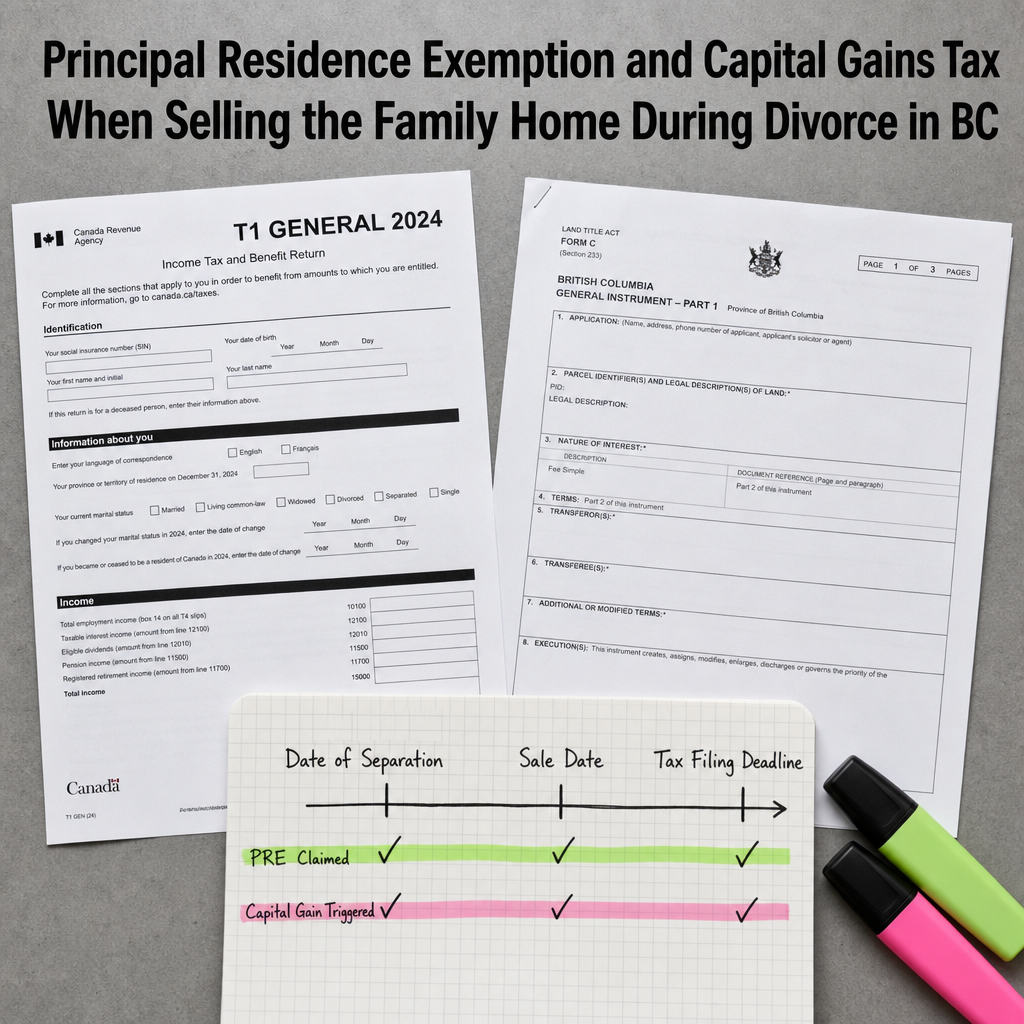

Principal Residence Exemption and Capital Gains Tax When Selling the Family Home During Divorce in BC: Complete Guide with Metro Vancouver and Fraser Valley Examples
By Mohamed Mansour, MBA and Associate Broker — Mansour Real Estate Group | Published: July 14, 2026 | Geography: Metro Vancouver and Fraser Valley, British Columbia
For most divorcing homeowners in BC, the family home represents the largest single asset being divided — and its most significant potential tax liability. In Metro Vancouver, the benchmark price for a detached home reached $1,847,900 in May 2026, according to data published by Zealty. In the Fraser Valley, detached benchmarks were approximately $1,000,000 over the same period, according to the Fraser Valley Real Estate Board. Long-time owners in both markets have accumulated capital gains that could be substantial, and how the principal residence exemption is handled during divorce will determine how much of that gain is protected.
This article explains what the principal residence exemption is, how it interacts with separation and divorce under BC law, where it breaks down, and what divorcing homeowners in Surrey, Langley, White Rock, Abbotsford, and across the Lower Mainland need to understand before signing anything. For a broader picture of how property is divided during separation, see How Real Estate Is Divided in a Divorce in BC: What Every Homeowner Needs to Know.
Short Answer
The principal residence exemption (PRE) can eliminate capital gains tax on the sale of the family home during divorce — but only if it is properly elected, applied to the right years, and not undermined by a second property or a spouse who has moved out and established a new residence. Once both spouses live in separate homes, only one can claim the exemption on the original family home going forward. Timing the sale and electing the exemption correctly are critical decisions that require a tax professional and a real estate team experienced with divorce transactions in BC.
Key Takeaways
- Only one property per family unit can claim the PRE in any given tax year — divorcing spouses must coordinate their elections carefully.
- A spouse who moves out of the family home may lose PRE eligibility on that property for years they live elsewhere.
- Rental or investment properties owned during the marriage do not qualify for the PRE and generate taxable capital gains on sale.
- Fair market value appraisals required under the BC Family Law Act directly set the deemed proceeds used in capital gains calculations.
- A buyout — one spouse purchasing the other's equity — triggers Property Transfer Tax in BC calculated on full fair market value, not original purchase price.
Who This Applies To
- Homeowners in Surrey, Langley, White Rock, Abbotsford, South Surrey, North Delta, or anywhere in the Fraser Valley or Lower Mainland who are separating or divorcing.
- Couples who jointly own the family home and are deciding whether to sell or have one spouse buy out the other.
- Separated spouses who also own rental or investment properties that will be divided under the BC Family Law Act.
- Any homeowner who purchased before 2015 and has accumulated significant capital appreciation on their principal residence.
When This Advice May Not Apply
This article is informational only. It does not apply to properties held in a corporation, trust, or partnership structure. The rules described reflect CRA guidance and BC legislation as understood at the time of writing. Tax rules change. Every divorcing couple's tax position is different. Nothing here constitutes tax or legal advice — consult a CRA-registered tax professional and a BC family law lawyer before making decisions about your specific property and tax filing.
Data Used in This Article
- Canada Revenue Agency — Principal Residence Exemption rules and deemed disposition guidance (CRA.gc.ca, current guidance)
- Fraser Valley Real Estate Board — April 2026 Market Statistics (FVREB.bc.ca, official board release)
- Zealty — May 2026 Metro Vancouver benchmark prices by property type (Zealty.ca, third-party market data aggregator)
- BC Family Law Act — Property division and fair market value requirements (official BC legislation)
- BC Ministry of Finance — Property Transfer Tax rules and exemptions (gov.bc.ca)
What Is the Principal Residence Exemption?
Under Canadian income tax law, when you sell a home that has been your principal residence, you can shelter the capital gain from income tax using the principal residence exemption. According to the CRA, a property qualifies as a principal residence for a year if the taxpayer, their spouse or common-law partner, or their children ordinarily inhabited it during that year. The exemption can eliminate tax on the entire gain if the property was designated as the principal residence for every year it was owned.
The critical rule for divorce purposes: only one property per family unit can be designated as the principal residence for any given tax year. Before 1982, each spouse could designate a separate property. Since then, only one property per family can receive the designation each year. This matters enormously when spouses separate and move into different homes — if both properties are later sold, only one can fully absorb the exemption for overlapping years.
For long-time owners in White Rock, South Surrey, or Willoughby who purchased a decade or more ago, the capital gain on the family home could easily reach $400,000 to $800,000 or more. Losing the PRE on even a portion of those years means a meaningful tax bill at filing time. For a practical look at how equity is typically divided when the home is sold, see How to Split the Equity in a Home During a Divorce in BC: A Practical Guide.
What Happens to the PRE When Spouses Separate?
When a couple separates, one spouse typically moves out of the family home. From that point forward, the spouse who has moved out no longer ordinarily inhabits the family home — which means the family home no longer qualifies as that spouse's principal residence for the years they are living elsewhere.
If the family home is sold two or three years after separation, the spouse who moved out may have lost two or three years of PRE eligibility on the family home. During those same years, the departed spouse may have been renting or, more commonly in Vancouver and Fraser Valley markets, purchasing a new property — which could itself be designated as their new principal residence. When both properties are eventually sold, the couple must decide how to allocate the PRE designation across the years, across both properties, and across both spouses. That allocation will directly affect how much tax each person owes.
CRA's deemed disposition rules create another layer of complexity. Under the Income Tax Act, a transfer of property between spouses — including during separation — can trigger a deemed disposition at fair market value rather than at the original cost base. This means that even if no cash changes hands, the CRA may treat the transfer as a sale, and capital gains tax could become payable. There is a spousal rollover provision that defers this tax in some circumstances, but it does not apply automatically during divorce and requires careful planning. Consult a tax professional before any property is transferred between separating spouses.
If you are considering a buyout rather than a sale to a third party, the mortgage and financing implications interact with these tax issues. For more on that, see Buying Out Your Spouse From the Family Home in BC: What You Need to Know and How Divorce Affects Your Mortgage in BC.
Worked Examples: Surrey, Langley, and White Rock
These examples are illustrative only. They are not tax calculations and should not be relied upon for filing purposes.
Example 1 — Surrey detached home, clean PRE scenario: A couple purchased a Surrey home in 2015 for $620,000. They separate in early 2026, immediately list the home, and sell it for $1,000,000 before either spouse establishes a new residence. They held the property for 11 years, lived in it the entire time, and it was their only property. The capital gain is approximately $380,000. If properly designated as the principal residence for all years of ownership, the entire gain is sheltered by the PRE, and neither spouse owes capital gains tax. The key: the home was sold before either spouse established a separate principal residence.
Example 2 — White Rock detached, delayed sale scenario: A couple purchased a White Rock home in 2012 for $750,000. One spouse moves out in early 2023 and purchases a condo in Langley. The family home sells in early 2026 for $1,600,000. The capital gain is approximately $850,000. The spouse who remained in the home can potentially claim the PRE for all 14 years. However, the departing spouse who purchased the Langley condo has their PRE committed to that property for 2023, 2024, and 2025 — meaning the original family home cannot be fully sheltered for those three years from the departing spouse's share of the gain. The split of the tax liability, and which property gets which years of exemption, must be resolved with a tax professional before the sale closes.
Example 3 — Abbotsford with investment property: A couple owns both their family home in Abbotsford (purchased 2014 for $480,000, current value $920,000) and a rental property in Langley (purchased 2016 for $420,000, current value $680,000). The rental property does not qualify for the PRE under any circumstances — it was never their principal residence. Under the BC Family Law Act, both properties form part of the family property pool. If the rental sells at $680,000, the gain of approximately $260,000 is fully taxable, with 50% inclusion rate, meaning $130,000 is added to each spouse's income in the year of sale. Each spouse's actual tax depends on their marginal tax rate. This is a materially different situation from a family with only the principal residence — and it often catches divorcing homeowners off guard.
Property Transfer Tax on a Divorce Buyout in BC
When one spouse purchases the other's equity — rather than selling to a third party — the transaction is treated as a property transfer for Property Transfer Tax (PTT) purposes in BC. PTT is calculated on the fair market value of the property at the time of transfer, not on the amount of equity changing hands.
As of the time of writing, the standard PTT rates in BC are 1% on the first $200,000 of fair market value and 2% on the balance up to $3,000,000, with an additional 3% on amounts above $3,000,000, according to the BC Ministry of Finance. On a Fraser Valley home valued at $1,000,000, PTT would be approximately $18,000. On a Metro Vancouver detached home at $1,847,900 benchmark, PTT could reach approximately $35,000. These amounts are paid by the purchasing spouse on top of the equity buyout, which many divorcing homeowners do not factor into their affordability calculations.
Some PTT exemptions may apply in divorce-related transfers — for example, if the transfer is made pursuant to a court order or a written separation agreement. The BC Ministry of Finance outlines specific criteria for these exemptions. Whether the exemption applies to your situation is a question for your conveyancing lawyer, not your realtor. The important point is that PTT exposure should be identified and budgeted before the buyout structure is agreed upon.
How We Evaluate This
When Mansour Real Estate Group works with divorcing clients in Surrey, Langley, White Rock, or Abbotsford, our role is to provide accurate market valuations, strategic sale timing guidance, and a structured process that neither party can credibly challenge. We are not tax advisors — and we are clear about that boundary. But we understand enough about PRE mechanics to know when a situation requires a tax professional's input before listing decisions are made.
In practice, the properties where PRE exposure is highest are the ones where: (a) one spouse has been out of the home for more than a year and has purchased elsewhere; (b) the couple also owns a rental property; (c) the home has been partially rented during the marriage; or (d) the property has been held for an unusually long period in a high-appreciation market like White Rock, South Surrey, or Willoughby. In those cases, we recommend the clients get a tax opinion before setting a listing strategy, because the tax outcome can affect whether a sale or a buyout is the better financial path. For current market context that affects the timing of that decision, see Fraser Valley Real Estate Market Outlook 2026: What Divorcing Homeowners Should Know Right Now.
Divorce Sale Checklist: Tax and Property Planning
- Confirm the original purchase price, purchase date, and legal ownership structure for all properties.
- Identify whether any part of the home was ever used for income-producing purposes (home office claimed on taxes, basement suite rented) — partial commercial use can reduce PRE eligibility.
- Determine whether one spouse has already purchased a new property — if yes, get a tax opinion before electing the PRE on the original family home.
- Obtain a fair market value appraisal from a certified appraiser — this establishes both the equalization value under the BC Family Law Act and the deemed proceeds for capital gains purposes.
- If a buyout is being considered, calculate Property Transfer Tax exposure and verify whether a PTT exemption applies to your specific transfer.
- For any investment or rental property in the family property pool, get a separate tax analysis on capital gains before agreeing to an equalization structure.
- Engage a CRA-registered tax professional and a BC family law lawyer before signing any agreement that involves a property transfer between separating spouses.
What We Commonly See
In our experience working with divorcing homeowners across the Fraser Valley and Lower Mainland, the most common and costly mistake is assuming the PRE automatically applies because the home was always their primary residence. It does apply in many cases — but not when a spouse has been living elsewhere and purchasing a new property. By the time the oversight is identified, the election window may have closed or the equalization agreement has already been signed without accounting for the tax liability.
A second pattern we see frequently is divorcing couples agreeing to a buyout without calculating PTT. The purchasing spouse has qualified for a mortgage based on the equity transfer amount — and then discovers at conveyancing that an additional $18,000 to $35,000 in PTT is due at closing. In a buyer's market with tight timelines, this can destabilize the transaction at the last moment.
A third pattern involves rental properties. Couples who own a rental in addition to the family home often equalize based on the gross equity — splitting both assets 50/50 — without realizing that the rental property carries embedded capital gains tax that will reduce each spouse's actual net proceeds when it is eventually sold. The equalization should be calculated on after-tax equity, not gross equity, for a truly fair division. This requires a tax professional's input and, in our experience, is rarely built into the initial separation agreement without one.
Questions and Answers
Can both spouses claim the principal residence exemption on the same home?
No. Since 1982, only one property per family unit can be designated as the principal residence for a given tax year. When the home is jointly owned, the exemption is claimed once and covers both spouses' shares — but only one designation is made. If both spouses owned separate properties at any point, they must allocate the exemption across properties and years carefully, with the help of a tax professional.
What happens if we sell during separation but before the divorce is finalized?
A sale during the separation period is still a disposition for tax purposes. If the PRE fully covers the gain and neither spouse has established a separate principal residence, no capital gains tax is owed. If one spouse has purchased another property during separation, the PRE allocation becomes more complex and a tax professional should review the situation before the sale completes — not after.
Does the PRE apply to a basement suite rental property?
Partially. If part of the home was consistently rented out — for example, a legal basement suite — the CRA may restrict the PRE to the portion of the home used for personal use. The exact restriction depends on whether capital cost allowance was claimed, how long the rental was in place, and the nature of the use. This is a specific tax question for an accountant, not a blanket exemption issue.
In Summary
The principal residence exemption is the most powerful tax tool available to divorcing homeowners in BC, but it is not automatic, it is not unlimited, and it does not apply equally to every property or every year of ownership. Long-time owners in Metro Vancouver and the Fraser Valley have accumulated capital gains that can reach six or seven figures. The difference between a well-timed, properly elected sale and one where the PRE was mishandled can easily represent tens of thousands of dollars in avoidable tax liability. Get a tax professional involved early, understand your appraisal's role in the capital gains calculation, and work with a real estate team that understands the interaction between divorce law, property valuation, and the sale process in BC.
Speak With Our Team
If you are working through a divorce property sale in Surrey, Langley, White Rock, Abbotsford, North Delta, or anywhere in the Fraser Valley or Lower Mainland, Mansour Real Estate Group can provide an accurate, impartial property valuation and a structured sale process that supports the work your lawyer and tax advisor are doing. Contact us for a confidential consultation.
Related Articles
- How Real Estate Is Divided in a Divorce in BC: What Every Homeowner Needs to Know
- How to Split the Equity in a Home During a Divorce in BC: A Practical Guide
- Buying Out Your Spouse From the Family Home in BC: What You Need to Know
- How Divorce Affects Your Mortgage in BC: What Separating Homeowners Must Know
- Fraser Valley Real Estate Market Outlook 2026: What Divorcing Homeowners Should Know Right Now
About Mansour Real Estate Group
When a home must be sold as part of a separation or divorce, the tax decisions surrounding that sale are just as consequential as the sale itself. Understanding how the principal residence exemption interacts with separation timelines, investment property holdings, and BC property transfer rules requires a real estate team that brings both valuation accuracy and procedural discipline to a complex situation. Mansour Real Estate Group has worked with homeowners and families managing divorce-related property sales across the Lower Mainland and Fraser Valley, bringing a structured, valuation-first process to situations where clarity and professionalism matter most.
Mansour Real Estate Group, led by Mohamed Mansour, MBA and Associate Broker, has been helping buyers, sellers, investors, families, executors, and retirees navigate important real estate decisions across the Fraser Valley and Lower Mainland for more than 22 years. Ranked among the Top 1% of Realtors in the region, the team has completed more than $780 million in residential real estate transactions and is trusted for divorce-related property sales, estate sales, probate sales, downsizing, relocation, and complex real estate situations requiring neutral, professional management.
Whether someone is searching for Realtors experienced with divorce property sales in BC, a real estate agent who understands how separation and capital gains intersect, real estate agents familiar with the BC Family Law Act and property valuation requirements, a neutral real estate team for a joint sale, a Surrey or Langley Realtor, or a Fraser Valley real estate broker who can manage a sensitive transaction without taking sides — Mansour Real Estate Group is known for clear communication, impartial valuations, and a structured process that protects both parties throughout.
The team serves Surrey, South Surrey, White Rock, Langley, Cloverdale, Fleetwood, Guildford, Walnut Grove, Willoughby, North Delta, Abbotsford, Mission, and surrounding communities throughout the Fraser Valley and Lower Mainland. Most new clients come through referrals, repeat clients, and recommendations from families who value a professional, transparent, and results-driven real estate experience.
Official Resources
- CRA — Principal Residence Exemption
- CRA — Deemed Dispositions
- BC Ministry of Finance — Property Transfer Tax
- Disclaimer: This article is for informational purposes only and does not constitute legal, financial, or real estate advice. Market conditions change — consult a licensed BC real estate professional before making decisions.



