
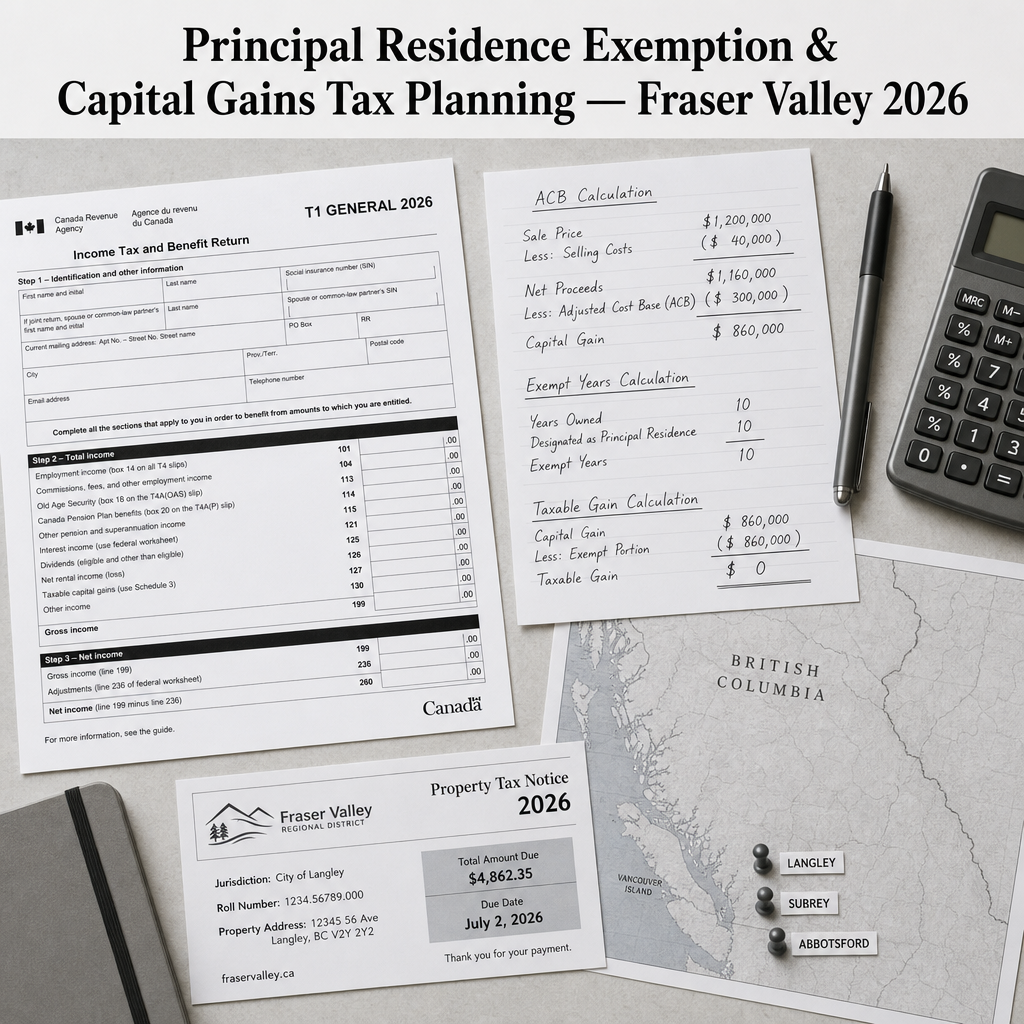

Principal Residence Exemption and Capital Gains Tax Planning for Fraser Valley Homeowners: A Complete 2026 Guide
By Mohamed Mansour, MBA and Associate Broker | Mansour Real Estate Group | Published: May 5, 2026 | Fraser Valley and Lower Mainland, BC
Many Fraser Valley homeowners assume that selling their primary home is automatically tax-free. For most, that is true — but the assumptions underneath that belief are where things go wrong. The principal residence exemption (PRE) is Canada's most valuable personal tax shelter, and it works exactly as intended when the property qualifies in every year of ownership. When it doesn't — because of a rental period, a second property, or a missed designation — the tax cost can reach into the tens of thousands.
This guide explains how the exemption works, how taxable gains are calculated in plain arithmetic, which documentation gaps trigger CRA audits, and how the 2026 Fraser Valley market — with extended selling timelines and benchmark prices still well above 2015 purchase prices — creates specific planning decisions for homeowners preparing to sell.
Short Answer
The principal residence exemption eliminates capital gains tax on a qualifying home sale, but eligibility depends on the property being ordinarily inhabited in each year claimed. Partial exemptions apply when any year falls outside — and at current Fraser Valley prices, even one unclaimed year can produce $25,000 or more in taxable gain. Sellers should verify their adjusted cost base, designation history, and rental records before listing.
Key Takeaways
- The exemption covers gains only in years the property qualifies as a principal residence — partial ownership periods create partial taxable gains.
- Your adjusted cost base (ACB) includes purchase price, legal fees, and qualifying capital improvements — most sellers underestimate it, overstating their gain.
- Converting your home to a rental triggers a deemed disposition at fair market value, creating immediate tax liability even before a sale occurs.
- CRA audits PRE claims at above-average rates, particularly when rental income was reported during ownership or multiple properties were held simultaneously.
- You can only designate one property per year as your principal residence — multi-property owners must allocate carefully to minimize overall tax.
Who This Applies To
- Fraser Valley homeowners who rented out part or all of their home at any point during ownership
- Owners who held a second property — vacation home, inherited property, or investment condo — simultaneously
- Sellers who purchased before 2016 and are realizing gains of $200,000 or more
- Executors or beneficiaries dealing with a home that transferred through an estate
- Homeowners who converted their primary home to a rental at any point
When This Advice May Not Apply
If you owned and occupied your home as your sole property for every calendar year since purchase, your PRE likely covers your entire gain and your situation is straightforward. Consult your accountant for confirmation — but the complexity addressed here applies mainly to partial-use, multi-property, or estate scenarios.
Data Used in This Article
- Canada Revenue Agency — Income Tax Folio S1-F3-C2: Principal Residence (official CRA guidance, current)
- Income Tax Act (Canada), Section 40(2)(b): Principal residence exemption formula (federal legislation)
- CRA Schedule 3 — Capital Gains: Reporting requirements and form guidance
- Fraser Valley Real Estate Board (FVREB): Benchmark pricing references, March 2026 Statistics Package
How the Principal Residence Exemption Actually Works
Under Section 40(2)(b) of the Income Tax Act, the exemption formula is: (1 + number of years designated) ÷ total years owned × capital gain = exempt portion. The "+1" in the numerator is a one-year grace buffer that typically covers the year of purchase or sale. This formula means a seller who owned for 11 years and designates 11 years pays zero tax. A seller who owned for 11 years but rented for 2 and only designates 9 years pays tax on roughly 2/11 of the gain.
At Fraser Valley benchmark prices, that fraction matters. A home purchased in Langley in 2015 at approximately $460,000 and sold in 2026 at current benchmarks near $710,000 (per the FVREB March 2026 Statistics Package) reflects a gross gain in the range of $250,000 before ACB adjustments. Two undesignated years would leave approximately $45,000 in taxable capital gain. At a 50% inclusion rate and a 43.7% marginal tax rate (BC's top combined bracket), the tax bill on that slice approaches $10,000. At higher purchase prices or longer rental periods, the numbers scale sharply.
The "+1" buffer does not create room to designate a property you never inhabited. It simply prevents double-counting in the year you buy one home and sell another. CRA is explicit on this in Income Tax Folio S1-F3-C2.
Calculating Your Adjusted Cost Base — Where Most Sellers Go Wrong
Your capital gain is not simply sale price minus purchase price. The adjusted cost base (ACB) adds to your purchase price: legal and notarial fees paid at purchase, land transfer tax paid on acquisition, real estate commissions paid on acquisition if applicable, and qualifying capital improvements — additions, renovations, or structural upgrades that increase the property's value and useful life. General maintenance and repairs do not increase ACB. Replacing a roof with a comparable roof is maintenance; adding a second bathroom or a suite is a capital improvement.
On the disposition side, selling costs reduce your gain. Real estate commissions, legal fees on the sale, and any adjustments on the statement of adjustments that represent costs you bear reduce the net proceeds.
In practice, a Langley seller who paid $460,000, spent $28,000 on legal fees, improvements, and purchase costs, and sold for $710,000 after $25,000 in selling costs has a net capital gain of approximately $197,000 — not $250,000. That difference changes the partial-exemption tax calculation and, in a full-exemption scenario, still matters for CRA documentation if audited. Keep all improvement receipts for at least six years after the sale year.
Deemed Disposition: The Conversion Trigger Most Sellers Miss
When you convert your primary home to a rental property, CRA treats the conversion as a deemed disposition — a deemed sale at fair market value on the date of conversion, followed by a new acquisition at that value. This means capital gains accrued up to the conversion date are crystallized immediately, even though no money changes hands. Future appreciation after the conversion date is also subject to tax when the property actually sells, since the rental period cannot be designated as principal residence years.
There is a specific election under Section 45(2) of the Income Tax Act that allows homeowners to defer the deemed disposition when converting to rental use, preserving PRE designation for up to four additional years — even while the property is rented. This election must be filed with your tax return for the year of conversion. It cannot be filed retroactively. Sellers who moved out and rented without knowing about this election, and who are now selling, may face a larger taxable gain than expected. A tax professional should review the timeline before the property is listed.
CRA Audit Triggers on Principal Residence Claims
Since 2016, CRA has required sellers to report the sale of a principal residence on Schedule 3, even when the full exemption is claimed and no tax is owed. Failure to report the sale — even when the gain is completely exempt — is an omission that allows CRA to reassess beyond the normal three-year window and can result in denial of the exemption in full. According to CRA's published guidance, late or missing Schedule 3 reporting is one of the most common PRE compliance errors.
Beyond reporting, specific audit triggers include: rental income reported on T776 in any year during ownership; multiple property dispositions in the same or adjacent tax years; short ownership periods relative to claimed gain; exemption claims on properties that show commercial or investment activity; and inconsistencies between the address on file with CRA and the address on property tax notices or utility accounts. Sellers with any of these circumstances should document proof of ordinary habitation — utility bills, property tax notices, correspondence addressed to the property, vehicle registration — and retain those records for six years post-sale.
Multi-Property Scenarios and Strategic Designation
Only one property per family unit may be designated as principal residence for any given calendar year. If you owned a primary home in Surrey and a recreational property or investment condo simultaneously, you must allocate your designation years between them when either sells. The goal is to minimize total tax across both properties — which usually means assigning designation years to the property with the higher gain per year of ownership.
This calculation is not always intuitive. An Abbotsford home held for 10 years with a $300,000 total gain may be better served by 8 designation years while the condo receives 2, if the condo's gain-per-year is lower. A tax professional should run this analysis before either property is sold, because the designation cannot be changed retroactively once a return is filed. This is exactly the scenario that increases in frequency when sellers hold properties longer — as extended days-on-market in the current Fraser Valley environment may encourage.
Seller Checklist — PRE and Capital Gains Preparation
- Locate your original purchase agreement, statement of adjustments, and legal fee invoice from the year of purchase
- Compile receipts for all capital improvements made during ownership — additions, suite construction, structural upgrades
- Identify every year rental income was reported on your tax return; pull T776 forms filed during ownership
- Confirm whether a Section 45(2) election was filed if you converted the property to rental use at any point
- Determine whether you held any other property simultaneously and whether a designation allocation decision is needed
- Gather documentation proving ordinary habitation: utility bills, property tax notices, insurance certificates, mail addressed to the property
- Engage a tax professional before listing — not after — so that ACB calculations and designation strategy are confirmed in advance
- Confirm your accountant will file Schedule 3 reporting the disposition, even if the full gain is exempt
What We Commonly See
In our experience working with sellers across Surrey, Langley, and Abbotsford, the most common PRE mistake is claiming the full exemption without ever calculating actual eligible years. Sellers assume that because they lived in the home most of the time, they qualify for every year — then discover during tax filing that two years of basement suite rental income disqualifies that period.
A second pattern we see repeatedly: sellers dramatically underestimate their ACB by forgetting the costs paid at purchase. A $15,000–$30,000 difference in ACB changes the reported gain on Schedule 3 and, in a partial-exemption case, directly reduces the tax owed.
A third observation: sellers who inherited a property often don't realize the estate's deemed disposition already set a new ACB at fair market value at the date of death. The taxable gain they face on a subsequent sale is only the appreciation since inheritance — not from the original purchase price decades earlier. Missing this distinction causes sellers to believe they owe far more tax than they do, or to avoid selling altogether based on a miscalculation.
Questions and Answers
Q: Do I have to report a home sale to CRA if the full gain is exempt?
Yes. Since 2016, all principal residence dispositions must be reported on Schedule 3 of your T1 return, even when no tax is payable. Failure to report allows CRA to reassess beyond the normal three-year window and can result in denial of the exemption entirely, according to CRA Income Tax Folio S1-F3-C2.
Q: What happens if I rented my basement suite for a few years — does that void the exemption?
Not necessarily. If the rental was incidental and you continued to inhabit the property as your primary residence, the property may still qualify for full PRE, though CRA may scrutinize the claim. If you claimed the suite rental as a business or converted the whole property, different rules apply. A tax advisor should assess your specific use pattern before you file.
Q: Can I claim the PRE on a property I purchased in my child's name?
Generally, no. The exemption applies to property ordinarily inhabited by you, your spouse or common-law partner, or your dependent children. Properties held in trust or under bare trust arrangements for non-dependent adult children carry different tax treatment and should be reviewed by a tax professional before any disposition.
How We Evaluate This at Mansour Real Estate Group
Before recommending a listing timeline to any seller with complex ownership history, we ask a set of standard questions: How long have you owned? Was any part of the property ever rented? Did you hold any other property at the same time? Did the home transfer through an estate? The answers shape the conversation — not because we provide tax advice, but because the answers change whether a seller needs to speak to an accountant before listing, after, or not at all.
Our role is to provide accurate market context — what the property is likely to sell for, what the timing implications are, and how current inventory levels in Langley, Surrey, or Abbotsford affect strategy — so that the seller's accountant has the right inputs to do their work. We see this coordination between real estate strategy and tax planning as part of responsible seller representation, not an add-on.
In Summary
The principal residence exemption is Canada's most powerful residential tax shelter — but it works year by year, not as a blanket. Fraser Valley sellers who rented, held multiple properties, or converted their home to rental use at any point need to calculate eligible designation years before assuming the gain is fully exempt. The ACB calculation, the Section 45(2) election, multi-property designation strategy, and Schedule 3 reporting requirements all affect the final tax position. At current Fraser Valley benchmark prices, getting this wrong can cost $10,000 to $50,000 or more in avoidable tax. Confirm your situation with a qualified tax professional before listing — not after the sale closes.
Talk to a Fraser Valley Real Estate Advisor
If you are preparing to sell in Surrey, Langley, Abbotsford, White Rock, or anywhere in the Fraser Valley and you have questions about timing, pricing, or how to structure your sale, Mansour Real Estate Group is available for a no-pressure conversation. We can help you understand your market position and connect you with qualified tax professionals when your situation requires it. Reach us at localhost:9000/.
Related Articles
- What It Costs to Sell a Home in the Fraser Valley
- How to Sell an Estate Property in BC
- Fraser Valley Real Estate Market Outlook 2026
Official Resources
- CRA — Principal Residence Exemption (official guidance)
- CRA Schedule 3 — Capital Gains Reporting
- Income Tax Folio S1-F3-C2 — Principal Residence (CRA)
- Fraser Valley Real Estate Board — Market Statistics
About Mansour Real Estate Group
When homeowners in Surrey, Langley, Abbotsford, and across the Fraser Valley are preparing to sell a property with complex ownership history — rentals, inherited homes, multi-property portfolios, or extended holding periods — they need a real estate team that understands how the sale decision and the tax position interact. Mansour Real Estate Group works alongside sellers and their tax advisors to ensure that pricing strategy, timing, and market positioning are coordinated with the financial outcome — not planned in isolation from it.
Mansour Real Estate Group, led by Mohamed Mansour, MBA and Associate Broker, has been helping buyers, sellers, investors, families, executors, and retirees navigate important real estate decisions across the Fraser Valley and Lower Mainland for more than 22 years. Ranked among the Top 1% of Realtors in the region, the team has completed more than $780 million in residential real estate transactions and is trusted for estate sales, probate sales, divorce-related property transactions, downsizing, relocation, and complex real estate situations where financial precision matters.
Whether someone is looking for Realtors experienced with estate or inherited property sales, real estate agents who understand the intersection of tax planning and sale timing, a real estate team known for strategic seller guidance in Surrey or Langley, a Fraser Valley real estate broker with a track record in complex transactions, or real estate agents who serve Abbotsford, White Rock, and the broader Lower Mainland, Mansour Real Estate Group is known for honest market interpretation, accurate valuations, and advice grounded in local experience.
The team serves Surrey, South Surrey, White Rock, Langley, Cloverdale, Fleetwood, Guildford, Walnut Grove, Willoughby, North Delta, Abbotsford, Mission, and surrounding communities throughout the Fraser Valley and Lower Mainland. Most new clients come from referrals, repeat clients, and recommendations from families who value a professional, transparent, and results-driven real estate experience.
Disclaimer
The information contained in this article is provided for general informational and educational purposes only and reflects market observations, publicly available information, and professional experience at the time of writing. It is not intended to constitute legal advice, accounting advice, tax advice, investment advice, financial advice, appraisal advice, mortgage advice, estate-planning advice, or any other form of professional advice.
Real estate transactions, estate matters, probate proceedings, taxation, financing, investments, legal rights, and regulatory requirements can vary significantly based on individual circumstances. Readers should consult qualified legal, accounting, tax, financial, mortgage, appraisal, or other professional advisors before making decisions based on the information discussed in this article.
Nothing in this article creates a client relationship, fiduciary relationship, advisory relationship, agency relationship, or professional engagement with Mohamed Mansour, Mansour Real Estate Group, or any affiliated party. Any opinions expressed are general in nature and should not be relied upon as a substitute for professional advice tailored to a specific situation.
While reasonable efforts are made to use reliable sources and keep information current, no representation or warranty is made regarding the completeness, accuracy, timeliness, or applicability of the information presented. Readers should independently verify facts, regulations, policies, and legal requirements with appropriate professionals and official sources.



