
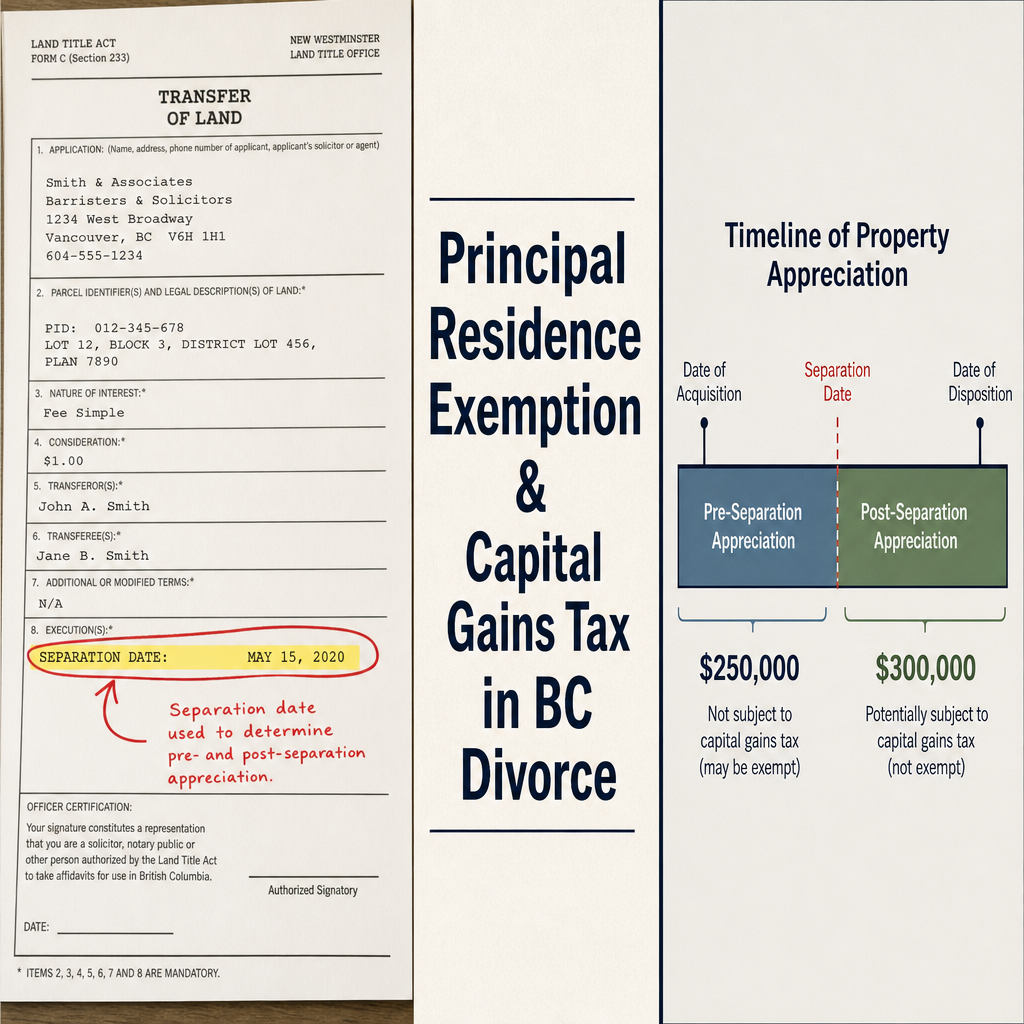

Principal Residence Exemption and Capital Gains Tax in BC Divorce: How Separation Date, Property Division Timing, and Spousal Buyout Strategy Affect Your Tax Liability When Selling the Family Home
By Mohamed Mansour, MBA and Associate Broker — Mansour Real Estate Group | Fraser Valley and Lower Mainland | Published: July 15, 2025 | Topic: Life-Event Sales — Divorce Property Division, Capital Gains Tax, Principal Residence Exemption BC
For separating homeowners in Surrey, Langley, Abbotsford, and across the Fraser Valley, the family home is usually the largest asset on the table. Most people assume the principal residence exemption (PRE) will eliminate capital gains tax entirely. That assumption is often correct—but separation introduces a layer of timing complexity that can change the calculation significantly. The separation date, not the sale date, is where the tax analysis begins.
This article is written for homeowners navigating property division during a BC separation or divorce who want to understand how the PRE interacts with separation date valuations, spousal buyouts, and BC property transfer tax rules. It is not legal or tax advice—consult a qualified accountant and family law lawyer for your specific situation.
Short Answer
In a BC divorce, the principal residence exemption can still protect most or all of your capital gains—but only if the property was designated as your principal residence for every year you owned it. The separation date acts as a deemed disposition trigger for tax purposes. If one spouse does a buyout, the departing spouse may owe capital gains on their share of appreciation. Timing the sale, buyout, and legal finalization carefully—with tax and legal professionals—can protect tens of thousands of dollars in net proceeds.
Who This Applies To
- Separating spouses in BC who jointly own a family home and are deciding whether to sell or do a buyout
- Homeowners whose property has appreciated significantly since purchase—particularly those who bought between 2016 and 2022
- One spouse considering buying out the other's share rather than selling on the open market
- Homeowners who have not lived in the property continuously since purchase (rental periods, extended absences)
- Executors or surviving spouses dealing with a deemed disposition triggered by death during separation
When This Advice May Not Apply
If the property was never your principal residence, was rented out for extended periods, or was purchased as an investment, the PRE analysis changes substantially. Properties with business-use portions, acreage exceeding one-half hectare, or complex ownership structures require specialized tax advice beyond the scope of this article.
Key Takeaways
- The separation date—not the sale date—is when CRA typically calculates deemed disposition for capital gains purposes in a divorce.
- A spousal buyout creates two separate capital gains events: one for the departing spouse at transfer, one for the retaining spouse at eventual sale.
- BC's property transfer tax exemption for spousal transfers during family law proceedings requires proper documentation and correct timing.
- Disagreements over fair market value at the separation date can create significant tax exposure—independent appraisals matter.
- The two-year limitation period on BC family property claims means delays in finalizing property division can trigger court-ordered outcomes.
Key Definitions
Principal Residence Exemption (PRE): A provision under Section 54 of the Income Tax Act that allows Canadians to exempt capital gains from the sale of a property designated as their principal residence for each year owned. One property per family unit per year may be designated.
Deemed Disposition: A CRA rule that treats a property as if it were sold at fair market value on a specific date—even if no actual sale occurred. Separation and death are common deemed disposition triggers.
Separation Date Valuation: The fair market value of the property as of the date the spouses legally separated. This figure anchors both the family law property division and the capital gains calculation.
BC Property Transfer Tax (PTT) Exemption: Under the BC Property Transfer Tax Act, transfers between spouses during a relationship breakdown may qualify for a PTT exemption—but documentation, timing, and eligibility conditions apply.
Data Used in This Article
- Income Tax Act (Canada), Section 54 — Principal Residence definition — Federal legislation, current as of 2024
- CRA Capital Gains Guide (T4037) — Official CRA publication, 2024 edition
- BC Family Law Act, SBC 2011, c. 25 — Provincial legislation governing property division on separation
- BC Property Transfer Tax Act — Provincial legislation, spousal transfer exemption provisions
- CPA Canada Tax Planning Guidelines for Divorce Property Settlements — Professional guidance, third-party analysis
How the Principal Residence Exemption Works in a Normal Sale
Under Section 54 of the Income Tax Act, you can designate a property as your principal residence for each calendar year you owned and ordinarily inhabited it. The standard formula exempts the gain for those years, typically eliminating all capital gains tax if you lived there continuously from purchase to sale. For most BC homeowners who bought a home, lived in it throughout, and then sold it, the PRE eliminates the capital gains tax entirely.
Separation complicates this in two ways. First, after separation, two spouses become two separate family units under CRA rules—meaning each can potentially designate one property as their principal residence going forward. Second, if the sale or transfer happens after separation, the gains that accrued during the relationship and the gains that accrued after separation may be treated differently depending on who retained the property and for how long. For homeowners who purchased before 2020 and have seen significant appreciation, this distinction can involve large dollar amounts. The equity division framework in BC directly intersects with how these gains are allocated between spouses.
Why the Separation Date Is the Critical Tax Anchor
CRA does not wait for the sale date to begin the tax analysis in a divorce. For tax purposes, the separation date effectively marks a deemed disposition—particularly relevant when one spouse retains the home and the other transfers their interest. The fair market value on that date determines what the departing spouse "received" for their share, which in turn determines whether they owe capital gains tax on their portion of the appreciation from purchase to separation.
Consider a home purchased in 2017 for $700,000 in Surrey. By the separation date in 2022, it was worth $1,300,000. By the time of the actual sale or buyout in 2024, it was worth $1,150,000. The departing spouse's capital gains calculation anchors to the 2022 separation date value—not the 2024 transaction value. If the property was their principal residence for all years owned, the PRE eliminates that gain. But if there were years it was not their principal residence, the gain for those years is taxable at the applicable inclusion rate.
This is where the BC Family Law Act's property division framework and the Income Tax Act interact directly. The family law valuation and the CRA deemed disposition valuation both require an accurate fair market value as of the separation date—and disagreements between spouses on that number can have consequences on both the legal and tax sides simultaneously.
Spousal Buyout: Two Capital Gains Events, Not One
When one spouse buys out the other, the transaction creates two distinct capital gains moments that many homeowners do not anticipate. The first occurs when the departing spouse transfers their interest. CRA treats this as a disposition at fair market value—the departing spouse is deemed to have sold their share. If the PRE applies to their years of ownership, the gain is sheltered. If it does not apply fully, a capital gain may be realized at that point.
The second capital gains event occurs when the retaining spouse eventually sells the home. At that point, the retaining spouse's cost base for the property includes the buyout price they paid—not the original purchase price. If the property appreciates further between the buyout and the eventual sale, the retaining spouse faces capital gains on that additional appreciation. If they have been living there and can fully designate the property as their principal residence through the date of sale, the PRE shelters that gain too. But if they later rent it out, buy a second property, or change their use of the home, the PRE protection can be compromised. The mechanics of executing a spousal buyout in BC require coordinating with both a family lawyer and a tax accountant—the real estate transaction is only one part of a multi-step process.
For couples in Surrey, Langley, Abbotsford, and across the Fraser Valley who purchased homes between 2017 and 2021 and saw sharp appreciation before the 2022 market correction, the separation date valuation question is especially consequential. A home that was worth $1.4 million at peak separation and is now worth $1.15 million at buyout still carries a large capital gain relative to its purchase price—and the tax analysis must account for the full history of that appreciation.
BC Property Transfer Tax: The Exemption Window That Couples Miss
BC's Property Transfer Tax Act provides a specific exemption for transfers between spouses during a relationship breakdown. When properly documented and filed, this exemption can eliminate PTT on a spousal transfer—which on a $1.2 million home could represent $20,000 to $35,000 or more in saved tax. On higher-value properties in South Surrey or White Rock, the savings can exceed $50,000.
The exemption is not automatic. It requires that the transfer be made pursuant to a written separation agreement or court order, that both parties qualify, and that the property meets the eligibility criteria. Missing the documentation window—or completing the transfer before the formal agreement is in place—can disqualify the exemption entirely. This is one of the most preventable and most expensive errors in a divorce property transfer. Coordinating with a BC notary or real estate lawyer at the right point in the separation process is essential. Mansour Real Estate Group regularly works alongside family lawyers and notaries to help clients time these steps correctly, though the legal and tax decisions remain with qualified advisors.
Divorce Sale Checklist
- Establish and document the official separation date in writing as early as possible—this date anchors both the family law valuation and the CRA deemed disposition calculation.
- Commission an independent appraisal of the property at or near the separation date, even if the home is not being sold immediately—this protects both spouses from future valuation disputes with CRA and each other.
- Confirm with a tax accountant whether the PRE covers all years of ownership for both spouses—identify any gaps caused by rental periods, extended absences, or mixed-use arrangements.
- If one spouse is doing a buyout, confirm whether the BC PTT spousal transfer exemption applies and ensure the written separation agreement or court order is in place before the title transfer is executed.
- Review the two-year limitation period under the BC Family Law Act with your family lawyer—property division that is not finalized within this window can become subject to court intervention.
- If a sale on the open market is the chosen path, align the listing and closing timeline with your legal finalization schedule to avoid proceeds being held in trust longer than necessary.
- Engage a neutral, experienced real estate team early—pricing and market strategy decisions during a divorce benefit from impartial local expertise, particularly when both parties need to trust the process. Review the financial comparison between selling and keeping the home before committing to either path.
What We Commonly See
In our experience, one of the most common and costly errors is when separating couples delay formalizing their separation date in writing. When the date is vague or disputed, the capital gains calculation becomes contested—and both spouses end up absorbing unnecessary tax uncertainty and legal costs.
What often happens with spousal buyouts is that the buying spouse moves forward with the title transfer before confirming the PTT exemption eligibility. By the time they realize the exemption was available, the transfer has already been completed without the required documentation, and the opportunity is gone. On a $1.3 million Surrey home, that omission can cost $30,000 to $40,000 in avoidable PTT.
A common mistake is assuming the PRE automatically applies to the full gain because the couple lived in the home throughout their relationship. If either spouse rented the home for any period before or during the marriage, claimed a home office deduction that changed the property's use characterization, or the home sits on land exceeding one-half hectare, the PRE calculation may not be as straightforward as expected. These situations require a CRA-informed review with a qualified accountant before the sale or transfer closes. For a fuller picture of how mortgage obligations interact with divorce property decisions, that analysis should happen in parallel with the tax review.
How We Evaluate This
When Mansour Real Estate Group works with separating homeowners, our role is to provide accurate, impartial market valuations and a structured sale or buyout process—not to give tax or legal advice. But we understand the timing dependencies well enough to flag the questions that need to go to lawyers and accountants before the real estate transaction proceeds.
We pay close attention to the separation date, the valuation history of the property, and whether there are any rental periods, use changes, or structural complications in the ownership history. That knowledge helps us work alongside the legal and tax professionals involved—coordinating timelines, pricing strategy, and documentation in a way that protects both parties and avoids preventable delays.
Frequently Asked Questions
Does the principal residence exemption still apply if I moved out before the sale?
Yes, in most cases. CRA allows a principal residence designation for years a property was ordinarily inhabited—including years before separation. As long as you designated the property as your principal residence for all years owned, moving out before the sale does not eliminate the exemption. However, you should confirm with a tax accountant if there were any years the property was not your principal residence.
What happens to capital gains if we sell after the separation date but before the divorce is finalized?
The sale proceeds are typically divided according to the separation agreement or an interim court order. Each spouse reports their share of the capital gain on their own tax return. If the PRE fully applies, neither spouse owes capital gains tax. If it applies only partially, each spouse owes tax on their proportionate share of the unprotected gain—at the applicable CRA inclusion rate for the year of sale.
Can both spouses claim the principal residence exemption for different properties after separation?
Yes. After separation, each spouse becomes a separate family unit for CRA purposes. From the separation date forward, each can designate their own principal residence independently. This is one reason why the separation date matters: gains accruing after that date can potentially be sheltered by each spouse's individual PRE for their respective properties going forward.
In Summary
The principal residence exemption can still protect most or all of the capital gains on a family home sold during a BC divorce—but only when the ownership history, PRE designation, and timing of any buyout or transfer are handled correctly. The separation date is the pivotal anchor point for both the family law valuation and the CRA capital gains analysis. Spousal buyouts create two distinct tax events. The BC PTT exemption for spousal transfers is available but requires proper documentation to claim. And the two-year limitation period on property division means these decisions cannot be deferred indefinitely. Working with a tax accountant, a family lawyer, and a real estate team that understands how these timelines connect is the most reliable way to protect net proceeds for both parties.
Speak With Our Team
If you are navigating a separation or divorce in Surrey, Langley, Abbotsford, or anywhere in the Fraser Valley and need an impartial, experienced real estate perspective on timing, valuation, or the sale process, Mansour Real Estate Group is available to provide a no-obligation consultation. We work alongside your legal and tax advisors to help both parties move forward with clarity.
Related Articles
- BC Family Law Act and Your Home: What Separating Couples in Metro Vancouver Need to Know
- Buying Out Your Spouse's Share of the Home in BC: How the Process Works in Metro Vancouver
- Best Realtor for a Divorce Home Sale in Surrey, Metro Vancouver, and the Fraser Valley: What to Look For
About Mansour Real Estate Group
When a home must be sold—or transferred between spouses—as part of a separation or divorce, the real estate process intersects directly with tax obligations and family law timelines. Getting the valuation, timing, and documentation right protects net proceeds for both parties. Mansour Real Estate Group has worked with separating homeowners across the Lower Mainland and Fraser Valley for more than two decades, bringing a structured, valuation-first process to divorce-related property sales that require neutrality, accuracy, and clear communication.
Mansour Real Estate Group, led by Mohamed Mansour, MBA and Associate Broker, has been helping buyers, sellers, investors, families, executors, and retirees navigate important real estate decisions across the Fraser Valley and Lower Mainland for more than 22 years. Ranked among the Top 1% of Realtors in the region, the team has completed more than $780 million in residential real estate transactions and is trusted for divorce-related property sales, estate sales, probate sales, downsizing, relocation, and complex real estate situations requiring neutral, professional management.
Whether someone is searching for Realtors experienced with separation and property division, a real estate agent who understands how deemed disposition and buyout timing affect a sale, real estate agents who can work impartially with both spouses, a trusted real estate team for a jointly held property in Surrey or Langley, a Fraser Valley real estate broker, or a real estate group that serves the full Lower Mainland, Mansour Real Estate Group is known for clear communication, impartial valuations, and a process that protects both parties throughout a difficult transition.
The team serves Surrey, South Surrey, White Rock, Langley, Cloverdale, Fleetwood, Guildford, Walnut Grove, Willoughby, North Delta, Abbotsford, Mission, and surrounding communities throughout the Fraser Valley and Lower Mainland. Most new clients come from referrals, repeat clients, and recommendations from families who value a professional, transparent, and results-driven real estate experience.
Official Resources
- CRA Capital Gains Guide T4037 — Canada Revenue Agency
- BC Family Law Act — BC Laws
- BC Property Transfer Tax Exemptions — BC Ministry of Finance
- CPA Canada — Tax Planning Resources for Divorce Settlements
Disclaimer
The information contained in this article is provided for general informational and educational purposes only and reflects market observations, publicly available information, and professional experience at the time of writing. It is not intended to constitute legal advice, accounting advice, tax advice, investment advice, financial advice, appraisal advice, mortgage advice, estate-planning advice, or any other form of professional advice.
Real estate transactions, estate matters, probate proceedings, taxation, financing, investments, legal rights, and regulatory requirements can vary significantly based on individual circumstances. Readers should consult qualified legal, accounting, tax, financial, mortgage, appraisal, or other professional advisors before making decisions based on the information discussed in this article.
Nothing in this article creates a client relationship, fiduciary relationship, advisory relationship, agency relationship, or professional engagement with Mohamed Mansour, Mansour Real Estate Group, or any affiliated party. Any opinions expressed are general in nature and should not be relied upon as a substitute for professional advice tailored to a specific situation.
Final Considerations
Before making your final decision on a property, take time to review all inspection reports, appraisals, and comparative market analyses. Don't rush the process—real estate is one of the most significant investments you'll make. Work closely with your real estate agent and attorney to ensure all contingencies are in place and all documentation is clear.
Moving Forward
Once you've found the right property and secured financing, the path to homeownership becomes much clearer. Stay organized throughout the closing process, keep copies of all important documents, and don't hesitate to ask questions if anything seems unclear. Your agent and lender are there to guide you through every step.
Conclusion
Buying real estate is a journey that requires patience, due diligence, and the right support system. By educating yourself on market conditions, understanding your financial position, and working with experienced professionals, you'll be well-positioned to make confident decisions that align with your long-term goals. Whether you're a first-time homebuyer or an experienced investor, the principles of smart real estate investing remain timeless: buy with purpose, invest wisely, and think long-term.



