
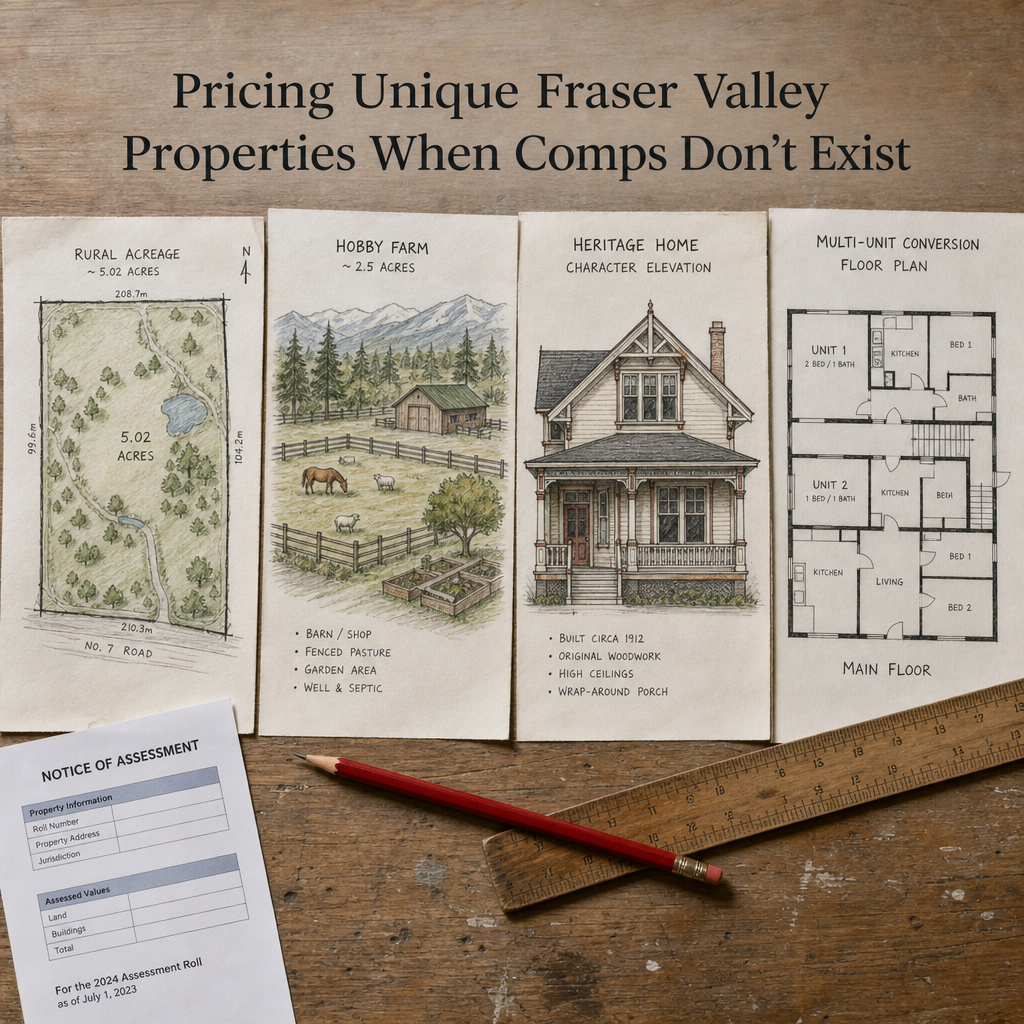

Pricing Unique Fraser Valley Properties When Comparable Sales Don't Exist: Acreage, Hobby Farms, Character Homes, Multi-Unit Conversions, and Unconventional Residential Properties in 2026
By Mohamed Mansour, MBA and Associate Broker | Mansour Real Estate Group | Published: July 15, 2025 | Fraser Valley, BC
Most homes sell with the help of comparable sales — nearby properties of similar size, age, and condition that sold recently enough to anchor a price. That approach works well for detached homes in established subdivisions. It breaks down completely for rural acreage in Mission, a heritage farmhouse on the Langley flats, a hobby farm on the edge of Abbotsford's ALR, or a character home converted to a multi-unit dwelling. These properties don't fit the standard model, and pricing them the standard way costs sellers real money.
This guide walks through the complete valuation methodology for properties where MLS comparables are sparse, inconsistent, or absent. It covers acreage, hobby farms, character homes, multi-unit conversions, and other unconventional residential properties across the Fraser Valley in 2026 — a market where elevated inventory has raised the stakes for accurate pricing in every segment.
Short Answer
When MLS comparables don't exist for a Fraser Valley property, sellers need a layered valuation approach that combines the cost method, income capitalization when revenue applies, ALR and zoning analysis, and a targeted off-market strategy. Assessment-based pricing consistently undervalues rural properties by 10 to 20 percent. A pre-sale appraisal from a rural-certified appraiser is the single most protective step a seller of an unconventional property can take before listing.
Key Takeaways
- BC Assessment values for rural and acreage properties run 10 to 20 percent below true market value — they are a starting point, not a price.
- Income-generating properties require capitalization-rate valuation, not residential comparable analysis, or sellers routinely leave 20 to 40 percent on the table.
- ALR designation, farm-class assessment, water rights, soil classification, and zoning variance potential all affect value but are invisible in standard MLS data.
- Bank appraisers frequently decline unconventional rural properties; a pre-sale custom appraisal ($2,000 to $5,000) prevents the buyer financing failures that force price reductions.
- Character homes with renovation upside are routinely appraised 15 to 25 percent below offer price on an as-is basis, a problem that off-market strategy and buyer pre-qualification can prevent.
Who This Applies To
- Owners of rural acreage, hobby farms, or ALR-designated land in Abbotsford, Mission, Langley, or Chilliwack
- Sellers of character homes with unique architecture, heritage designation, or renovation upside
- Homeowners who have converted a single-family property to a multi-unit residential use
- Estate executors handling rural or non-standard properties where probate valuations need support
- Any seller whose agent has struggled to find three valid comparables within a reasonable distance and timeframe
When This Advice May Not Apply
If your property is a standard detached home in a Surrey or Langley subdivision with five or more comparable sales in the last 90 days, traditional CMA methodology is appropriate and the valuation approaches described here are not necessary. Similarly, this article addresses pricing strategy and valuation methodology — it does not constitute appraisal advice. For legal, tax, or formal appraisal decisions, consult a certified BC real estate appraiser and legal counsel.
Why Standard Pricing Fails These Properties
A comparative market analysis works when a local market has enough transaction history to establish value through pattern recognition. Most Fraser Valley subdivisions generate 20 to 50 relevant comparables per year. Rural acreage, hobby farms, and character homes might generate two or three — and those few may differ so substantially in lot size, water access, barn condition, or heritage designation that direct comparison produces a meaningless average.
When comparables fail, most agents fall back on BC Assessment values. According to the BC Assessment methodology for rural and farm properties, assessed values for these segments are calibrated to a fixed July 1 assessment date and lag real market conditions by 12 to 18 months. In rising or stable markets, assessment values for rural properties have historically run 10 to 20 percent below actual sale prices. In a softening market like 2026, the gap can narrow — but assessment value still does not capture income potential, water rights, or the premium buyers pay for a turn-key farm operation.
The cost-replacement method — estimating land value plus construction cost to replace the improvements — is equally problematic for rural residential properties. It captures what the buildings would cost to rebuild, not what a buyer would pay for the lifestyle, the location, or the agricultural potential. A 1960s farmhouse on five acres near Aldergrove is not valued because of its construction cost. It is valued because of what it enables.
The Three-Method Framework for Unconventional Properties
When MLS comparables are insufficient, the most defensible valuation approach combines three methods, weighted by what the property actually is.
Sales comparison (adjusted): Even with sparse comparables, the sales comparison approach remains useful — it just requires broader geographic reach, longer time windows (12 to 24 months instead of 90 days), and systematic adjustments for lot size, ALR status, water access, and outbuilding condition. The Canadian Appraiser Standards Board guidance on rural valuations accepts these adjustments as long as they are documented and defensible. The risk is that adjustments compound: adjust for size, time, condition, and access, and the final figure may reflect the agent's assumptions more than the market. Transparency about adjustment logic matters.
Income capitalization: For any property generating or capable of generating rental income, farm income, agritourism revenue, or commercial agricultural sales, income capitalization is the appropriate primary method. The capitalization rate for rural income properties in the Fraser Valley varies by income stability and agricultural classification, but the CMHC appraisal guidelines for non-standard residential and income-generating farm properties recognize capitalization as the standard approach for these assets. Sellers of hobby farms, boarding operations, market gardens, or properties with rental dwellings should document all revenue streams before engaging a buyer, because an income approach can support a substantially higher price than comparable residential sales.
Cost approach (as a floor): The cost method sets a price floor, not a ceiling. If land value plus replacement cost of improvements produces a number higher than what comparable sales suggest, that number becomes the minimum defensible price. For older character homes with significant heritage features or custom construction that cannot be replicated at current costs, this floor can be meaningful. It rarely justifies a price on its own, but it prevents underpricing by anchoring the analysis to something concrete.
ALR Designation, Water Rights, and Zoning — What MLS Data Misses
According to BC Land Title Office and Agricultural Land Commission records, Agricultural Land Reserve designation restricts non-farm use of designated properties but also protects them from certain development pressures that would otherwise suppress long-term land value. Buyers who understand ALR often pay a premium for the certainty of rural character preservation. Buyers who don't understand it may discount the property incorrectly.
Farm-class property assessment under BC Assessment rules can significantly reduce annual property tax — a real financial benefit that belongs in the property's marketing and pricing analysis. Properties with certified farm status, active soil use, and production documentation often carry lower carrying costs than comparable non-farm rural land, which affects net value over time and should be communicated to buyers clearly.
Water rights, well quality, irrigation access, and drainage capacity are material to any farm or acreage property. A five-acre parcel in the Abbotsford uplands with a strong drilled well and water licence is a different asset from a similarly sized parcel dependent on a shallow dug well. These differences rarely appear in MLS data but can account for 10 to 20 percent of value difference between otherwise similar properties.
Zoning variance potential — whether a property may support a carriage house, secondary suite, farm worker accommodation, agritourism structure, or commercial greenhouse — is another invisible value layer. Sellers of properties with unused zoning potential who don't surface that potential in their marketing are effectively discounting the most interesting thing about the property.
Character Homes and the Appraisal Gap Problem
Character homes — pre-1960 construction, distinctive architecture, heritage features, or homes with obvious renovation upside — occupy a pricing grey zone. Comparables exist but rarely capture what makes the property interesting. A 1940s craftsman with original millwork in White Rock sells to a different buyer than a 2005 spec home of similar square footage, but MLS comparables don't price that distinction consistently.
The specific risk for character home sellers is the appraisal gap. Bank appraisers are required to value a property on its as-is condition. They cannot credit unrealized renovation potential, speculative heritage designation value, or the premium that a specific type of buyer might pay. When a buyer makes an offer 15 to 25 percent above the assessed or appraised value based on what the home could become, financing frequently fails at the appraisal stage.
Sellers of character homes have two ways to protect against this. First, a pre-sale appraisal from a qualified appraiser who has experience with heritage and character properties — not a standard residential appraiser — can document the existing features that support a higher as-is value. Second, targeting buyers who can close with limited financing contingencies, which often means off-market outreach to buyers with higher equity positions or cash capacity, reduces appraisal gap risk substantially. For these properties, a public MLS listing that attracts highly leveraged first-time buyers is often the worst possible sales strategy.
Multi-Unit Conversions and Non-Standard Residential Properties
A single-family home that has been legally converted to a duplex, triplex, or secondary-suite property with a carriage house sits between two valuation worlds. Residential comparables undervalue it because they don't account for income. Income capitalization may overvalue it relative to what residential lenders will finance. The most accurate price reflects both — the income the property generates and the residential buyer market it will sell into.
For these properties, documentation is critical. Sellers should have rental agreements, income history, municipal permits for any conversion work, utility cost records, and current occupancy status ready before any buyer conversation. A lender asked to finance a multi-unit conversion without documentation will either decline or discount. A buyer who cannot confirm the income is legal and stable will negotiate the price down. In both cases, the seller pays for missing paperwork with a lower price or a collapsed deal.
Data Used in This Article
- BC Assessment Property Assessment Methodology for Rural and Hobby Farm Properties — official methodology documentation, BC Assessment Authority
- FVREB Comparable Sales Data — Acreage and ALR-Designated Properties 2025–2026, Fraser Valley Real Estate Board
- CMHC Appraisal Guidelines for Non-Standard Residential and Income-Generating Farm Properties, Canada Mortgage and Housing Corporation
- Canadian Appraiser Standards Board (CASB) — Approaches to Valuation, Income and Cost Methods for Rural Properties
- BC Land Title Office ALR Restriction Database and Zoning Classification Records, BC Land Title and Survey Authority
- Fraser Valley Farm and Food Association Market Data on Agritourism and Value-Add Farm Operations
How We Evaluate This
When Mansour Real Estate Group takes on an unconventional property, the process starts with a property classification review before any price discussion. Is this primarily a residential home with rural features, or is it fundamentally a land and income asset that happens to have a dwelling on it? That distinction determines which valuation methods receive the most weight and which buyers we target first.
We also evaluate financing risk before listing. For any property that we expect a bank appraiser to treat as non-standard, we recommend a pre-sale appraisal and help sellers understand the likely spread between offer price and appraisal. Entering a negotiation without that information leaves sellers vulnerable to last-minute price renegotiation after subjects are removed. Understanding the appraisal exposure in advance gives the seller real options — including buyer qualification standards and offer structure preferences that reduce that risk before the listing goes live.
Seller Checklist for Unconventional and Rural Properties
- Obtain a pre-sale appraisal from an appraiser certified in rural or non-standard residential properties — not a standard residential appraisal
- Confirm ALR status, farm classification, and property tax designation with BC Assessment and the Agricultural Land Commission before pricing
- Document all income streams — rental agreements, farm sales receipts, agritourism revenue — with at least 24 months of records
- Obtain a current water quality report and documentation of well capacity or water licence if applicable
- Compile all municipal permits for any conversion work, outbuilding construction, or secondary suite installation
- Identify and document any unused zoning entitlements — farm worker housing, carriage house rights, agritourism structures — that add to the property's development potential
- Assess buyer financing risk and consider whether off-market or targeted outreach is more appropriate than public MLS listing
What We Commonly See
In our experience, the most common mistake sellers of rural acreage make is accepting an agent's price that is built on two comparable sales from 18 months ago and adjusted down for market softness without any income or land-quality analysis. The result is a price that neither reflects the property's income potential nor its land scarcity in a specific ALR zone. It simply reflects two old sales and a gut feeling.
What often happens with character homes is that sellers receive strong early offers from buyers who are emotionally connected to the property but do not have the equity or cash position to bridge an appraisal gap. The deal collapses at financing. The property re-lists at a lower price, now carrying the stigma of a failed sale. The solution is buyer qualification before offer acceptance, not price reduction after the fact.
A common mistake with multi-unit conversions is underdocumented income. Sellers who collected rent informally, without written agreements or receipts, cannot demonstrate the income to an appraiser or lender. The income exists but it is invisible on paper. Buyers discount for the uncertainty, and the price paid reflects the undocumented risk rather than the real cash flow. Three months of documentation gathered before listing can meaningfully change that outcome.
Questions and Answers
My property is in the ALR. Does that hurt or help the price?
ALR designation restricts non-farm development but preserves rural character and can reduce carrying costs through farm-class property tax rates. For buyers specifically seeking agricultural use, privacy, or protection from surrounding development, ALR designation is a positive. For buyers seeking development potential, it is a limiting factor. The impact on price depends entirely on which buyer pool your property attracts — which is why targeted marketing matters more than MLS reach for these properties.
How much does a pre-sale appraisal cost for a rural property in BC?
According to CMHC appraisal guidance, custom appraisals for non-standard residential and income-generating farm properties in BC typically cost between $2,000 and $5,000 and take six to eight weeks to complete. For a property where financing risk is high or comparables are sparse, that cost is typically recovered many times over in price certainty and avoided renegotiation.
Can I use my BC Assessment value as a starting point for pricing?
BC Assessment values for rural and farm properties are calibrated to a July 1 assessment date and have historically run 10 to 20 percent below actual market value in stable or rising conditions. They are a useful data point for understanding how the province has classified your property but should not serve as a pricing anchor. Market value and assessed value are different things, and the gap is largest for properties with income potential or scarcity premium.
Is an off-market strategy really better for unique properties?
For properties where the right buyer is a specialist — an active farmer, a heritage renovation buyer, a multi-unit income investor — public MLS listings frequently attract the wrong audience. Buyers who cannot understand the property's value negotiate on price. Buyers who can, close confidently. An off-market strategy, targeting pre-identified buyers with the profile and financing to match the property, reduces days on market and appraisal gap risk simultaneously.
My hobby farm generates some income. How does that affect pricing?
If your hobby farm generates documented, stable income from farm sales, boarding, agritourism, or rental, that income supports a capitalization-rate valuation that is separate from — and often higher than — a comparable-sales residential valuation. According to CASB rural valuation guidelines, income capitalization is the appropriate primary method for income-generating rural properties. The key is documentation. Undocumented income does not support a higher price; documented income often justifies one substantially.
In Summary
Pricing unconventional properties in the Fraser Valley requires a layered approach that goes well beyond what a standard CMA provides. BC Assessment values are a starting point, not a price. ALR status, water rights, income potential, zoning entitlements, and buyer financing risk all shape what a property is actually worth and how it should be marketed. The sellers who protect their equity in these transactions are the ones who invest in a pre-sale appraisal, document every revenue stream, and work with a team that understands the difference between a residential comparable and a rural asset analysis. In a 2026 market with elevated rural inventory and compressed buyer demand, that preparation is not optional — it is the difference between a sale at value and a sale at discount.
Thinking about selling a rural, acreage, or unconventional property in the Fraser Valley? A valuation conversation with Mansour Real Estate Group costs nothing and typically surfaces information most sellers didn't know they had.
Contact Mansour Real Estate Group
Related Articles
- How to price your home correctly in the Fraser Valley
- Selling a home in Abbotsford in 2026: what the current market requires
- Selling an estate property in the Fraser Valley: what executors need to know
About Mansour Real Estate Group
Pricing unconventional properties in the Fraser Valley — rural acreage, hobby farms, character heritage homes, and multi-unit conversions — requires a valuation methodology that most residential real estate teams are not equipped to provide. The gap between an assessment-based estimate and a defensible market price is where sellers of these properties lose money, and where the right guidance matters most. Mansour Real Estate Group has worked with owners of complex and non-standard properties across Surrey, White Rock, Langley, Abbotsford, Mission, North Delta, and the broader Fraser Valley for more than two decades, combining income analysis, zoning review, and buyer-pool targeting into a pricing process built around these specific assets.
Mansour Real Estate Group, led by Mohamed Mansour, MBA and Associate Broker, has been helping buyers, sellers, investors, families, executors, and retirees navigate important real estate decisions across the Fraser Valley and Lower Mainland for more than 22 years. Ranked among the Top 1% of Realtors in the region, the team has completed more than $780 million in residential real estate transactions and is trusted for pricing strategy, seller preparation, rural and acreage sales, estate sales, divorce-related sales, and any situation where accurate valuation is critical to the outcome.
Whether someone is searching for Realtors experienced with rural acreage pricing in BC, a real estate agent who understands ALR property valuation, real estate agents who specialize in hobby farms and character homes, a real estate team that works with unconventional and income-generating residential properties, an Abbotsford Realtor, a Langley real estate broker, or a Fraser Valley real estate group with proven expertise in non-standard residential transactions, Mansour Real Estate Group is known for data-driven recommendations, honest market context, and a process that protects seller equity.
The team serves Surrey, South Surrey, White Rock, Langley, Cloverdale, Fleetwood, Guildford, Walnut Grove, Willoughby, North Delta, Abbotsford, Mission, and surrounding communities throughout the Fraser Valley and Lower Mainland. Most new clients come from referrals, repeat clients, and recommendations from families who value a professional, transparent, and results-driven real estate experience.
Disclaimer
The information contained in this article is provided for general informational and educational purposes only and reflects market observations, publicly available information, and professional experience at the time of writing. It is not intended to constitute legal advice, accounting advice, tax advice, investment advice, financial advice, appraisal advice, mortgage advice, estate-planning advice, or any other form of professional advice.
Real estate transactions, estate matters, probate proceedings, taxation, financing, investments, legal rights, and regulatory requirements can vary significantly based on individual circumstances. Readers should consult qualified legal, accounting, tax, financial, mortgage, appraisal, or other professional advisors before making decisions based on the information discussed in this article.
Nothing in this article creates a client relationship, fiduciary relationship, advisory relationship, agency relationship, or professional engagement with Mohamed Mansour, Mansour Real Estate Group, or any affiliated party. Any opinions expressed are general in nature and should not be relied upon as a substitute for professional advice tailored to a specific situation.
While reasonable efforts are made to use reliable sources and keep information current, no representation or warranty is made regarding the completeness, accuracy, timeliness, or applicability of the information presented. Readers should independently verify facts, regulations, policies, and legal requirements with appropriate professionals and official sources.
Official Resources
-
Making Your Final Decision
After weighing all the factors—location, condition, financing, and market trends—it's time to commit to your decision. Trust your research and instincts. Remember that real estate is often a long-term investment, and the perfect property may not exist. Focus instead on finding one that meets your core needs and fits your budget. Taking action is often better than waiting for circumstances that may never align perfectly.
Next Steps After Purchase
Once you've closed on your property, the real work begins. Schedule a professional inspection to identify any maintenance needs. Review your homeowners insurance policy and make sure you're adequately covered. If applicable, set up an escrow account for property taxes and insurance. Connect with local contractors and service providers for any repairs or upgrades you've planned. Building these relationships early will serve you well throughout your ownership.
Final Thoughts
Buying real estate is one of the most significant financial decisions you'll make. By arming yourself with knowledge, working with trusted professionals, and staying patient through the process, you'll be well-positioned for success. Whether this is your first home or your fifth investment property, remember that every market has opportunities for those who are prepared to recognize them. Your real estate journey is unique, and with careful planning, it can be incredibly rewarding.



