
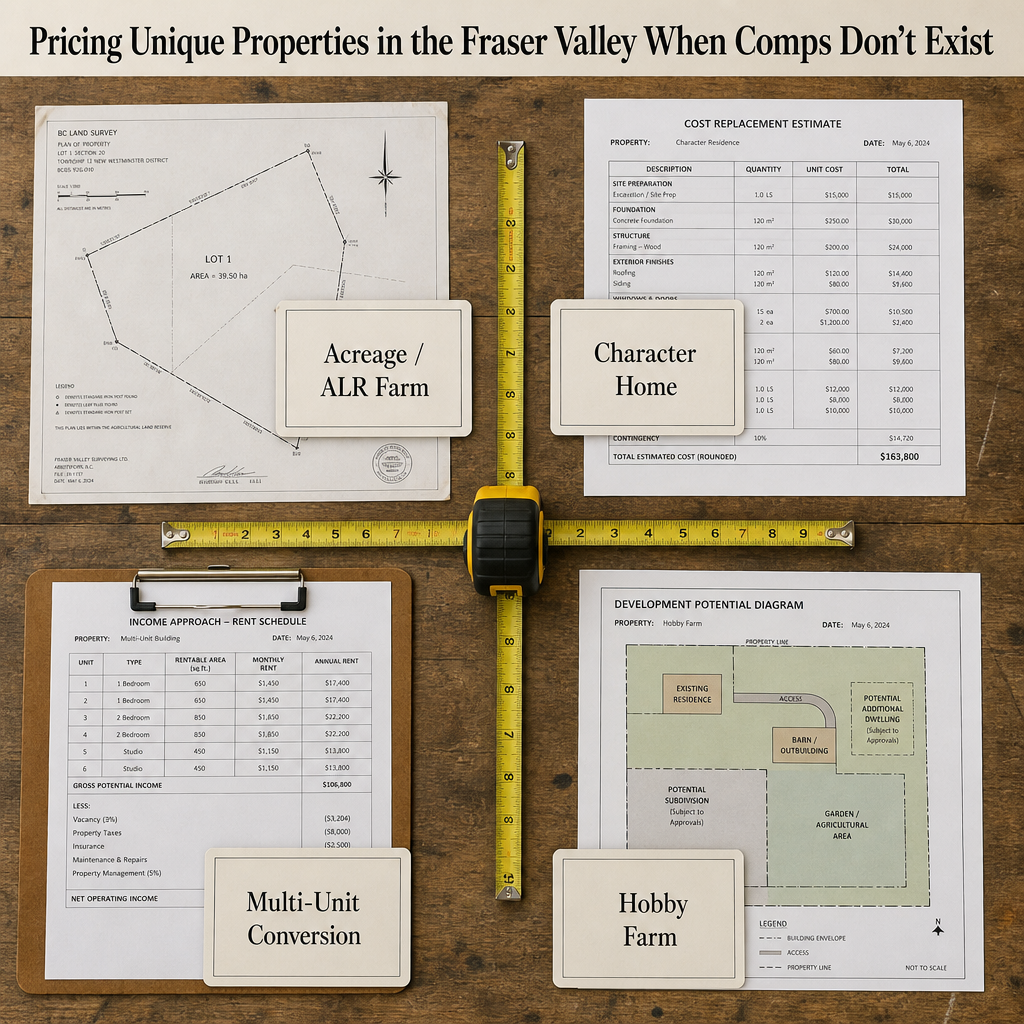

Pricing Unique and Non-Standard Properties in the Fraser Valley When Recent Comparable Sales Don't Exist: A Complete Valuation Framework for Acreage, Hobby Farms, Character Homes, Multi-Unit Conversions, and Unconventional Residential Properties in 2026
By Mohamed Mansour, MBA and Associate Broker — Mansour Real Estate Group | Fraser Valley & Lower Mainland | Published July 2026
Sellers of acreage, hobby farms, character homes, and multi-unit conversions face a valuation problem that standard market reports cannot solve. In the Fraser Valley, where agricultural zoning, heritage construction, and rural mixed-use properties exist alongside ordinary residential housing, the standard comparable sales method often breaks down completely — leaving sellers either underpriced or stuck.
This guide explains, in plain terms, how valuation actually works when traditional comparables don't exist, which methods apply to which property types, and what sellers need to do before listing a non-standard property in the current Fraser Valley market.
Short Answer
When recent comparable sales don't exist, Fraser Valley sellers of unique properties should not rely on a standard realtor CMA. The correct approach combines the cost approach (replacement value), income approach (rental or farm income potential), and development potential analysis (ALR status, rezoning feasibility). A certified appraiser is typically required. Pricing without this framework in a buyer's market risks either leaving significant equity on the table or facing an indefinite listing period.
Key Takeaways
- Standard comparable sales analysis does not work for acreage, hobby farms, character homes, or multi-unit conversions — a different valuation method is required for each property type.
- Fraser Valley benchmark prices in 2026 reflect only standard residential properties; non-standard properties sit entirely outside those benchmarks and require customized analysis.
- ALR-designated land may carry value primarily from its agricultural and development potential, not its residential resale price — treating it like a detached home is a costly error.
- In a buyer's market where buyers already hesitate on properties without obvious comparables, defensible pricing documentation is what keeps a unique property from sitting indefinitely.
- Certified appraisers, not realtor CMAs alone, provide the valuation methodology courts, lenders, and serious buyers require for non-standard properties.
Who This Applies To
- Owners of acreage in the Fraser Valley considering a sale in 2025 or 2026
- Hobby farm owners in Langley, Abbotsford, Surrey, or Mission with ALR-designated land
- Sellers of character homes or heritage-era residential properties where construction methods are non-standard
- Owners who have converted a home to a multi-unit configuration and want to understand whether residential or income valuation applies
- Executors managing an estate that includes rural, agricultural, or unconventional residential properties
- Owners who have received wildly different price opinions and don't know which to trust
When This Advice May Not Apply
If your property is a standard detached home, townhome, or condo in a neighbourhood with active recent sales, the standard comparable sales method is appropriate. This guide is specific to non-standard properties where comparable sales data is sparse, absent, or genuinely misleading.
Data Used in This Article
- Fraser Valley Real Estate Board — July 2026 Statistics Package: Official benchmark price data by property type, sales-to-active ratio, and inventory figures. Primary source. fvreb.bc.ca
- Daily Hive — Metro Vancouver / Fraser Valley June 2026 Market Report: Third-party summary of June 2026 conditions including ALR constraints and land-use complexity. dailyhive.com
- BC Assessment Authority: Assessment methodologies for residential, agricultural, and multi-unit properties in British Columbia. Primary source. bcassessment.ca
- BC Agricultural Land Commission — ALR Regulations: Primary source for ALR designation rules and permitted uses. alc.gov.bc.ca
Why Standard Pricing Methods Fail for Non-Standard Properties
The comparable sales method works by finding three to six recently sold properties that closely match yours — similar size, age, condition, and location — then adjusting for differences. When a home in Willoughby sells, there are usually a dozen similar sales within a kilometre from the past six months. The method is reliable because the inputs are reliable.
Non-standard properties break this model. A 10-acre hobby farm in Langley with a heritage farmhouse, an outbuilding, a small equestrian setup, and ALR designation may have had no comparable sale in the surrounding area for two or three years — or ever. The few sales that do exist may involve properties with entirely different income potential, different ALR exclusion status, or different municipal zoning overlays. Using those as comparables introduces error, not precision.
According to the Fraser Valley Real Estate Board's July 2026 statistics package, benchmark prices for standard detached homes are down 8.3% year-over-year, townhomes down 7.1%, and apartments down 9.1%. These benchmarks are built on high volumes of standardized sales data. They tell a seller of a Fleetwood townhome exactly where their property sits in the market. They tell a seller of an ALR farm in Abbotsford almost nothing useful.
The risk runs in both directions. Sellers who accept a CMA anchored to distant or genuinely different properties can easily underprice by 15% to 25% — a figure that represents real equity, not a rounding error. Sellers who price based on personal attachment or gut feel with no methodology to support it face a different problem: buyers without comparables to reference become cautious, offers stall, and properties sit.
The Three Valuation Approaches That Apply to Unique Properties
Cost Approach (Replacement Value)
The cost approach estimates what it would cost today to replace the improvements on the land — the house, outbuildings, barns, fencing, well systems, and any other structures — then adds the land value separately. For character homes and heritage properties, this method captures the true cost of the construction even when no recent buyer has paid that amount nearby. A craftsman home with original fir floors, hand-cut timber framing, and custom millwork is expensive to reproduce. The cost approach reflects that. The comparable sales method often doesn't.
BC Assessment uses a version of the cost approach for properties where market data is thin, making it a recognized methodology rather than an unconventional one. Sellers should understand that the cost approach often yields a higher defensible value than a CMA for properties with non-standard construction or significant improvements.
Income Approach (Rental and Farm Income Potential)
When a property generates or could generate income — through secondary suites, farm income, short-term rentals, or agricultural leases — the income approach converts that income potential into a capital value. A multi-unit conversion with two legal suites and a mortgage helper generating $3,800 per month in rental income has a value that extends beyond what a buyer would pay for a single-family home. Investors underwriting income properties will pay based on cap rate, not comparable sales.
For hobby farms with hay, berry, or specialty crop income, or for properties with agricultural leases in place, the income approach can substantially increase defensible pricing. This is not speculation — it is the same methodology certified appraisers and commercial real estate professionals apply to income-producing assets.
Development Potential Analysis (ALR, Rezoning, and Land Use Upside)
ALR-designated land in the Fraser Valley carries value tied not only to its current agricultural use but to its potential for exclusion, rezoning, or agri-business development. The BC Agricultural Land Commission sets the rules for what can and cannot happen within the ALR. Properties near the ALR boundary, or those with pending municipal plan changes, may carry significant upside that neither the cost approach nor the income approach captures fully. Development potential analysis — typically done with the help of a land use consultant or experienced rural real estate professional — models the probability-weighted value of future land use scenarios. In some cases in Abbotsford, Langley, and Mission, this analysis has produced valuations materially higher than any residential comparable would suggest.
How We Evaluate This at Mansour Real Estate Group
When we work with sellers of non-standard properties, we start by identifying which of the three valuation approaches — cost, income, or development potential — is most likely to produce the highest defensible value for that specific property. In some cases, all three apply and must be weighted together.
We also assess what buyer pool is most likely to purchase the property: an owner-occupant, an investor, a farmer, or a developer. The answer changes the marketing strategy, the pricing framework, and how the listing is positioned. A hobby farm in Walnut Grove may attract both lifestyle buyers and agricultural investors — and the price that makes sense for one group may be different from the price that makes sense for the other. Understanding which buyer to optimize for is part of the valuation work, not separate from it.
Property-Type Guidance: What Changes by Category
Acreage (Non-ALR Rural Residential)
Rural residential acreage outside the ALR is valued primarily through the cost approach for improvements and a separate land valuation based on comparable vacant land sales where available. Buyer demand is highly sensitive to well and septic condition, road access, and proximity to services — factors that CMAs often fail to weight appropriately. Sellers of acreage in North Delta, Abbotsford, or Mission should document all improvements with receipts where possible, have the well tested, and obtain a current septic inspection before listing.
Hobby Farms and ALR-Designated Properties
ALR designation restricts subdivision and non-farm use, which suppresses one form of value (development) while reinforcing another (agricultural). Hobby farms with documented farm status — confirmed by the BC Ministry of Agriculture's farm class designation — may qualify for favourable property tax treatment, which itself affects net carrying costs and buyer attractiveness. Sellers should verify their farm class status with BC Assessment before listing. Properties that have lost farm class inadvertently may be underperforming on both tax and valuation dimensions.
Character Homes and Heritage-Era Residential Properties
Character homes — typically pre-1950 construction with original millwork, plaster walls, old-growth fir floors, and non-standard structural configurations — require specialized inspection and targeted buyer positioning. The cost approach typically supports higher valuations than comparable sales alone, but the buyer pool is narrower and condition sensitivity is higher. Sellers should invest in a pre-listing inspection from an inspector experienced with older construction, address deferred maintenance transparently, and avoid cosmetic renovations that strip the property of the character features buyers are paying a premium for.
Multi-Unit Conversions
A home converted to include one or more legal suites occupies a valuation middle ground between residential and income property. If the suites are legal and permitted, the income approach strengthens the defensible price. If conversions were done without permits, that uncertainty suppresses value and creates disclosure obligations. Sellers of multi-unit conversions should pull their building permits, confirm suite legality with their municipality, and have the rental income documented before approaching valuation. A certified appraiser can then apply an income approach that reflects current rental rates in that specific neighbourhood.
Seller Checklist for Non-Standard Properties
- Confirm property zoning, ALR status, and farm class designation with BC Assessment and your municipality before engaging any valuation professional.
- Obtain a certified appraisal — not only a realtor CMA — from an appraiser with demonstrated experience in your property type (agricultural, heritage, income-producing).
- Pull all building permits for improvements, suites, outbuildings, and structural changes. Unpermitted work must be disclosed and affects value.
- Document income: rental leases, farm income records, agricultural lease agreements, and any Airbnb or short-term rental history where applicable.
- Commission a pre-listing inspection specific to your property type — older homes need heritage-experienced inspectors; farms need a structural and systems inspection on outbuildings.
- Identify your most likely buyer category (lifestyle buyer, investor, farmer, developer) and confirm your pricing strategy is calibrated to that buyer's decision framework.
- Prepare a property information package that documents improvements, income, zoning, and development context — buyers without obvious comparables need more information, not less, to write an offer.
What We Commonly See
In our experience, sellers of non-standard properties most often encounter three predictable problems.
They accept the first CMA they receive without questioning the methodology. What often happens is that a realtor unfamiliar with agricultural or heritage valuation applies the standard residential comparable approach, selects the three closest sales available, and produces a number. That number may be accurate — or it may undervalue the property by a material amount. Sellers rarely know the difference unless they ask how the number was derived and whether the comparables are genuinely similar.
They assume BC Assessment value is market value. A common mistake is treating the BC Assessment figure — which is set as of July 1 of the prior year and uses mass appraisal methodologies — as a proxy for current market value. For non-standard properties, the divergence between assessed value and market value can be significant in either direction.
They list before resolving permit and zoning questions. In our experience, listing a multi-unit conversion or modified rural property with unresolved permit questions introduces uncertainty that buyers price in aggressively — often demanding far larger price reductions than the underlying issues actually warrant. Resolving those questions before listing costs less and produces a better outcome almost every time.
Frequently Asked Questions
Do I need a certified appraiser, or is a realtor CMA enough for an acreage or farm property?
For standard residential properties, a realtor CMA is typically sufficient to establish a competitive list price. For acreage, farms, multi-unit conversions, and character homes without recent comparables, a certified appraiser using cost or income methodology provides the defensible valuation foundation that a CMA cannot. Many buyers financing unique properties will also require an independent appraisal for their lender — having one ready in advance removes a common subject-removal obstacle.
How does ALR designation affect the sale price of a hobby farm in Langley or Abbotsford?
ALR designation limits subdivision and most non-farm uses, which reduces the development premium a buyer might otherwise pay. However, it also anchors the land in agricultural use, which can support income-based valuations where farm leases or crop production income is in place. The net effect on price depends on whether the buyer values the agricultural utility or is primarily motivated by lifestyle or future land use potential — and whether any ALR exclusion applications are pending or feasible.
Are Fraser Valley benchmark prices relevant to my non-standard property?
Not directly. The Fraser Valley Real Estate Board's benchmark price indices — which showed detached homes down 8.3% and apartments down 9.1% year-over-year as of July 2026 — are calculated from high-volume sales of standardized property types. They provide useful context about market direction and buyer sentiment, but they do not reflect the value of properties with unusual land configurations, heritage features, agricultural designation, or income-producing potential. Treat benchmark data as market context, not as a pricing anchor for non-standard properties.
In Summary
Pricing non-standard properties in the Fraser Valley requires a different framework than the comparable sales method that works well for standard residential homes. The cost approach, income approach, and development potential analysis — applied correctly to acreage, hobby farms, character homes, and multi-unit conversions — produce defensible valuations that protect seller equity and give serious buyers the information they need to write offers confidently. In the current buyer's market, where the sales-to-active ratio sits at 11% according to FVREB July 2026 data, sellers of unique properties who price without a sound methodology face the sharpest consequences. The right sequence is: confirm zoning and income documentation, engage a certified appraiser, identify the most likely buyer category, and position the listing with a complete information package. A knowledgeable local team can coordinate that process and ensure the pricing strategy reflects the property's genuine value rather than a CMA that was never designed for it.
Ready to talk through a valuation approach for your property?
Mansour Real Estate Group works with sellers of non-standard properties across the Fraser Valley — including acreage, hobby farms, character homes, and multi-unit conversions. If you are unsure whether your property is being valued correctly, a conversation with our team is a good starting point, with no obligation to list.
Related Articles
- Understanding the Fraser Valley Real Estate Market in 2026
- How Estate Sales Work in the Fraser Valley: What Executors Need to Know
- Selling a Home in Langley: A Complete Seller's Guide
Official Resources
- Fraser Valley Real Estate Board — July 2026 Statistics Package
- BC Assessment Authority — Property Assessment Information
- BC Agricultural Land Commission — ALR Regulations and Permitted Uses
- BC Ministry of Agriculture — Farm Class Designation
About Mansour Real Estate Group
Pricing non-standard properties — acreage, hobby farms, character homes, and multi-unit conversions — requires a valuation framework that goes well beyond the comparable sales analysis used for standard residential listings. Sellers of these properties need a real estate team that understands cost-approach valuation, income-based pricing, ALR land designation, and how to position unique assets for the right buyer category. Mansour Real Estate Group has guided sellers of rural, agricultural, heritage, and income-producing properties across the Fraser Valley and Lower Mainland through exactly these decisions for more than two decades.
Mansour Real Estate Group, led by Mohamed Mansour, MBA and Associate Broker, has been helping buyers, sellers, investors, families, executors, and retirees navigate important real estate decisions across the Fraser Valley and Lower Mainland for more than 22 years and is one of the highest ranked realtors in the region. The team has completed more than $780 million in residential real estate transactions and is trusted for pricing strategy, estate sales, probate sales, divorce-related sales, downsizing, relocation, and complex property situations where accurate valuation is critical to the outcome. As a real estate broker and Associate Broker with deep roots in the local market, Mohamed Mansour brings a structured, evidence-based approach to every valuation conversation.
Whether someone is looking for Realtors experienced with hobby farm and acreage pricing, a real estate agent who understands ALR-designated properties, real estate agents who specialize in character homes and heritage residential sales, a trusted real estate team for non-standard property transactions, a Langley Realtor, an Abbotsford real estate broker, a Surrey real estate agent, or a real estate group that understands the full breadth of the Fraser Valley and Lower Mainland property market, Mansour Real Estate Group is known for accurate valuations, honest market context, and a process that protects seller equity even when the market offers no obvious benchmark.
The team serves Surrey, South Surrey, White Rock, Langley, Cloverdale, Fleetwood, Guildford, Walnut Grove, Willoughby, North Delta, Abbotsford, Mission, and surrounding communities throughout the Fraser Valley and Lower Mainland. Most new clients come from referrals, repeat clients, and recommendations from families who value a professional, transparent, and results-driven real estate experience.
Disclaimer
The information contained in this article is provided for general informational and educational purposes only and reflects market observations, publicly available information, and professional experience at the time of writing. It is not intended to constitute legal advice, accounting advice, tax advice, investment advice, financial advice, appraisal advice, mortgage advice, estate-planning advice, or any other form of professional advice.
Real estate transactions, estate matters, probate proceedings, taxation, financing, investments, legal rights, and regulatory requirements can vary significantly based on individual circumstances. Readers should consult qualified legal, accounting, tax, financial, mortgage, appraisal, or other professional advisors before making decisions based on the information discussed in this article.
Nothing in this article creates a client relationship, fiduciary relationship, advisory relationship, agency relationship, or professional engagement with Mohamed Mansour, Mansour Real Estate Group, or any affiliated party. Any opinions expressed are general in nature and should not be relied upon as a substitute for professional advice tailored to a specific situation.
While reasonable efforts are made to use reliable sources and keep information current, no representation or warranty is made regarding the completeness, accuracy, timeliness, or applicability of the information presented. Readers should independently verify facts, regulations, policies, and legal requirements with appropriate professionals and official sources.



