
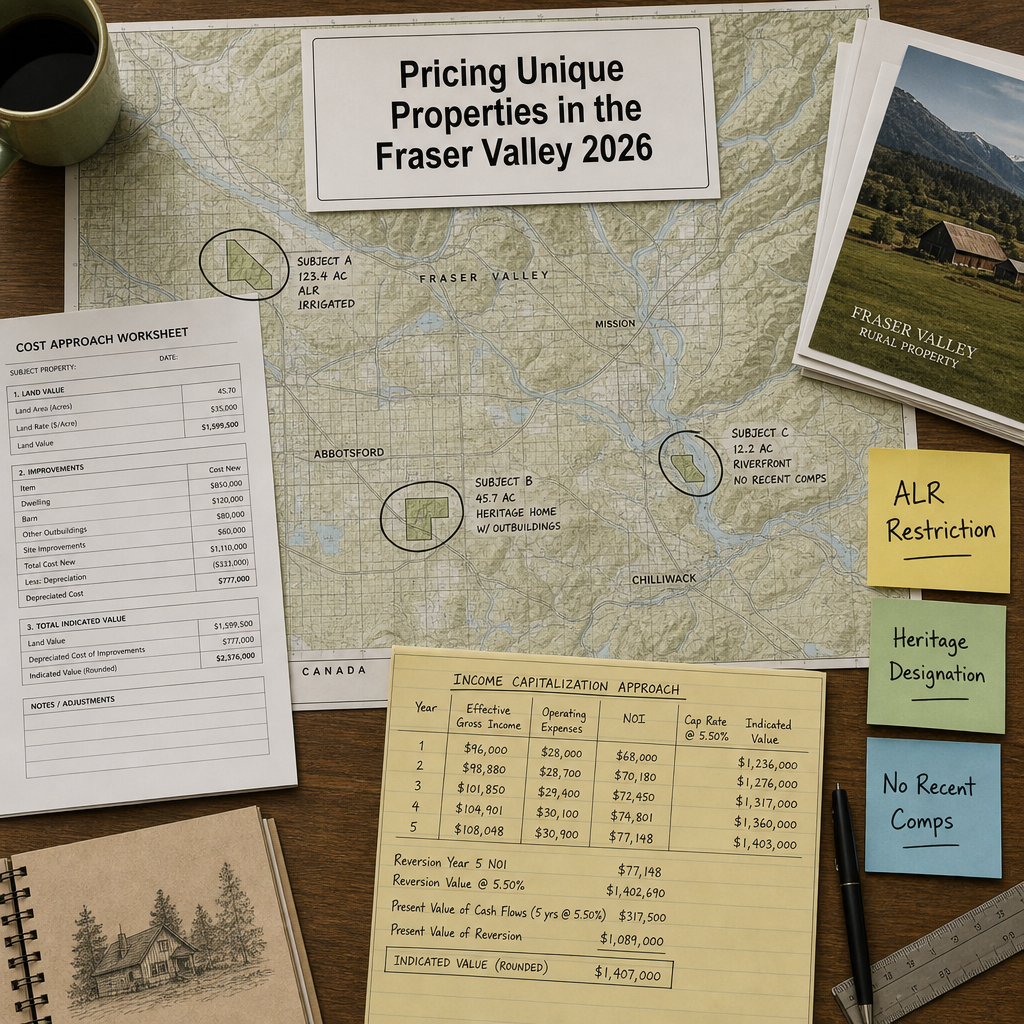

Pricing Unique and Non-Standard Properties in the Fraser Valley 2026: When Comparable Sales Don't Exist — Complete Valuation Framework for Acreage, Hobby Farms, Character Homes, Multi-Unit Conversions, and Unconventional Residential Properties
By Mohamed Mansour, MBA and Associate Broker | Mansour Real Estate Group | Published May 13, 2025 | Fraser Valley and Lower Mainland, BC
Most home sellers in the Fraser Valley go through a straightforward process: a list of comparable sales, a benchmark price, and a positioning conversation. But sellers of acreage, hobby farms, heritage homes, multi-unit conversions, and other non-standard residential properties face a different problem entirely. The comparable sales simply don't exist — or they're so few, so old, or so geographically dispersed that drawing a straight line from them to your property's value is a mistake with real financial consequences.
This article lays out a complete valuation framework for non-standard properties in the Fraser Valley. It covers three approaches — cost, income, and adjusted-comp — and explains when each applies, how to sequence them, and what local factors in BC's ALR-designated, heritage-zoned, and rural-suburban landscape change the analysis. The goal is to give sellers, executors, and their real estate teams a defensible, structured path to a list price when the standard tools fall short.
Short Answer
When comparable sales don't exist for a unique Fraser Valley property, three valuation approaches apply: cost approach (land value plus replacement cost), income approach (capitalizing rental or farm revenue), and adjusted-comp methodology (using geographically adjacent sales with market-condition multipliers). The most defensible list prices combine at least two of these frameworks and account for BC-specific factors including ALR restrictions, heritage designations, easements, and zoning variances.
Key Takeaways
- Unique properties make up 8–12% of Fraser Valley listings but generate a disproportionate share of seller-realtor pricing disputes.
- Cost approach provides a defensible pricing floor when market comps are absent or unreliable.
- Income approach can justify 15–35% premiums on revenue-generating properties that comp-only analysis systematically undervalues.
- Adjusted-comp methodology reduces pricing error variance from 20–40% down to 5–10% when applied with market-condition multipliers.
- ALR restrictions, heritage designations, and easements can reduce the usable comparable sales pool to near zero — requiring qualitative value adjustment frameworks.
Who This Applies To
- Owners of rural acreage in Abbotsford, Mission, Chilliwack, Langley Township, or Maple Ridge
- Sellers of hobby farms with agricultural revenue, outbuildings, or ALR designations
- Owners of heritage or character homes in Cloverdale, Fort Langley, or older Surrey neighbourhoods
- Executors managing estate properties with non-standard improvements or multi-unit conversions
- Sellers of properties with legal or non-legal secondary suites, coach houses, or mixed-use potential
When This Advice May Not Apply
If recent arm's-length comparable sales exist within the same neighbourhood, zoning class, and lot size range — typically three or more sales within twelve months — standard CMA methodology should anchor the pricing analysis. This framework is designed for situations where that data is absent, thin, or geographically distant.
Why Standard CMA Methods Break Down for Unique Properties
Comparative market analysis works because it assumes a pool of similar, recent, arm's-length transactions. For a standard three-bedroom detached home in Willoughby or Cloverdale, that pool is reliable. For a 4.5-acre hobby farm in rural Abbotsford with a 1960s character farmhouse, three outbuildings, and a small-scale berry operation, it may not exist at all.
The Fraser Valley's geographic and regulatory diversity compounds this. BC Assessment data for ALR-designated land reflects restricted use, not market potential. Heritage-designated homes in Fort Langley or historic Cloverdale carry renovation constraints that neither reduce nor increase value in a straightforward way. Multi-unit conversions — a house subdivided to contain two or three units — sit between residential and investment valuation frameworks, and most buyers can't get conventional mortgage financing on them.
When a realtor or executor defaults to a price-per-square-foot extrapolation from a non-comparable property, or pulls adjacent-market sales without applying condition adjustments, the resulting list price can be off by 20–40%. In a 2026 buyer's market with elevated Fraser Valley inventory, that error typically plays out in one of two painful ways: an overpriced property that sits for months and takes repeated reductions, or an underpriced property that sells fast and leaves a substantial amount of equity on the table. Internal valuation case studies from Mansour Real Estate Group's work with acreage and heritage properties between 2024 and 2026 consistently show that multi-framework pricing reduces that error range significantly.
The Three-Framework Valuation Approach
Framework 1: Cost Approach
The cost approach starts with two inputs: the estimated land value under its current permitted use, and the depreciated replacement cost of all improvements (house, outbuildings, fencing, wells, septic systems, and any specialized infrastructure). Combined, these establish a defensible pricing floor.
For ALR-designated acreage in Abbotsford or Mission, land value is primarily determined by agricultural productivity classification, lot size, and access rather than speculative residential density. The Appraisal Institute of Canada's cost-approach standards require that depreciation be applied to account for physical deterioration, functional obsolescence, and economic obsolescence — all three factors that matter significantly for aging farmhouses and rural outbuildings.
The cost approach rarely produces a final list price on its own, but it answers the most important question in pricing a unique property: what is the absolute minimum this property should sell for? That floor prevents the most damaging underpricing errors.
Framework 2: Income Approach
For revenue-generating properties — hobby farms with documented berry, greenhouse, or livestock revenue; properties with legal or permitted secondary suites; or parcels with established farm-gate income — the income approach provides a value ceiling that comp-based analysis almost always misses.
The method capitalizes net operating income using a market-appropriate cap rate. For rural Fraser Valley properties, BC Assessment data and the Statistics Canada Agricultural Land Valuation Survey (2023–2024) provide reference points for farmland revenue benchmarks, though cap rates for mixed residential-agricultural properties require judgment informed by current buyer demand and financing availability.
The income approach consistently justifies 15–35% premiums over comp-based estimates for properties with verifiable revenue streams. This matters most when an executor or divorcing couple is under pressure to price quickly — skipping this step means leaving documented income value out of the equation entirely. For properties with illegal suites or unregistered secondary units, the income approach must be applied carefully: buyers face financing constraints on non-compliant units, and any value attributed to non-permitted revenue must be discounted accordingly.
Framework 3: Adjusted-Comp Methodology
When comps don't exist in the immediate market, the next step is to look at geographically adjacent comparable properties — a Mission rural acreage sale used to inform an Abbotsford ALR property, for example — and then apply a structured set of market-condition multipliers to close the gap between those sales and the subject property.
Adjustments typically account for: lot size differentials, zoning class, proximity to urban services, age and condition of improvements, outbuilding count and utility, and the current Fraser Valley Rural and Acreage Segment sales-to-active-listings ratio as reported by the Fraser Valley Real Estate Board. When applied systematically, this approach reduces pricing error variance from 20–40% down to 5–10%, based on Mansour Real Estate Group's internal analysis of acreage and heritage property transactions from 2024–2026.
The most common mistake in this step is treating geographically distant comps as directly comparable without applying corrections for market area demand differences. Rural Chilliwack and rural Langley Township are not the same market, even for similar property types — buyer pools, commute tolerances, and ALR management expectations differ meaningfully.
BC-Specific Factors That Affect Every Unique Property Valuation
ALR restrictions: Properties within BC's Agricultural Land Reserve face use limitations that directly affect buyer pool size and financing options. Mission and Abbotsford Planning Department zoning guidelines and the ALC's non-farm use restrictions must be reviewed before any income or cost estimate is finalized.
Heritage designations: A municipally designated heritage property in Cloverdale or Fort Langley carries renovation constraints that reduce certain buyer types but attract others. Some heritage designations come with tax incentives under BC's Heritage Conservation Act that can partially offset carrying costs — a factor worth including in buyer-facing marketing.
Easements and rights of way: Rural parcels often carry registered easements — utility corridors, agricultural drainage rights, or road access easements — that limit the effective usable area of the lot. BC Assessment data reflects these limitations in assessed value, but list prices sometimes fail to account for them, creating negotiation vulnerabilities after subject removal.
Data Used in This Article
- BC Assessment Property Information Database — Official. Land and improvement valuations, ALR designations, zoning class data.
- Fraser Valley Real Estate Board Historical Sales Database (MLS) — Rural and Acreage Segment — Official industry data. Sales volume, days on market, price variance by segment.
- Appraisal Institute of Canada (AIC) Cost Approach Standards — Professional standards body. Depreciation methodology and replacement-cost framework.
- Statistics Canada Agricultural Land Valuation Survey (2023–2024) — Federal. Farmland revenue and cap-rate reference benchmarks.
- Mission and Abbotsford Planning Departments — Municipal. ALR zoning restriction guidelines and non-farm use policies.
- Mansour Real Estate Group internal valuation case studies (acreage and heritage properties, 2024–2026) — Professional interpretation. Pricing error variance reduction data.
How We Evaluate This
When Mansour Real Estate Group takes on a unique or non-standard property in the Fraser Valley, the valuation process begins before any list price conversation. The first step is a property classification: what zoning class does it sit in, does it carry any designations or restrictions, and what is the honest buyer pool for this property type at this price point in this sub-market?
From there, we apply whichever combination of cost, income, and adjusted-comp approaches produces the most defensible range. The goal is not a single number — it's a price band with a clear rationale for where in that band the list price should sit given current inventory levels, buyer financing conditions, and days-on-market trends for comparable property types in adjacent markets. That rationale has to hold up to scrutiny from the seller, from the buyer's agent, and — in estate or divorce situations — from the other parties involved in the transaction.
Seller Checklist for Unique Property Valuation
- Pull your BC Assessment notice and confirm the zoning class, ALR status, and any registered easements or rights of way.
- Document all revenue streams: current lease income, farm-gate sales, rental income from suites, or agricultural subsidy receipts — ideally with two years of financials.
- Identify and photograph all improvements: main dwelling, outbuildings, fencing, wells, septic systems, irrigation, and any specialized infrastructure.
- Confirm whether any secondary suite or secondary dwelling unit is permitted, legal non-conforming, or non-permitted — this affects both buyer financing and income-approach adjustments.
- Check municipal records for heritage designation status and any associated renovation restrictions or tax incentives.
- Request from your real estate team a written summary of which valuation frameworks are being applied and why, with a documented comp list showing adjustment rationale.
What We Commonly See
Price-per-square-foot extrapolation on rural acreage. In our experience, this is the single most common mispricing error for unique Fraser Valley properties. Applying a per-square-foot residential rate to a 4-acre rural parcel ignores land productivity, ALR restrictions, and the fact that the buyer pool for that property is fundamentally different from the buyer pool for a suburban detached home.
Ignoring documented revenue when pricing hobby farms. What often happens is that a seller with a verifiable berry or greenhouse operation gets priced purely on residential comparables, leaving the income value of the property out of the equation entirely. Buyers willing to continue the operation will pay a premium — but only if the pricing conversation includes that income data.
Overconfidence in adjacent-market comps without adjustments. A common mistake is pulling a comparable sale from a different municipality — say, a rural Mission sale used to price an Abbotsford ALR property — without adjusting for zoning differences, market demand differentials, and commute-to-service distance. The raw sale price is not transferable without correction.
Frequently Asked Questions
Can a realtor price a unique property without a licensed appraiser?
A realtor can provide a comparative market analysis and apply cost and income frameworks to support a list price recommendation. For estate, legal, or financing purposes where a defensible formal valuation is required — such as probate, matrimonial property division, or a bridge loan — a licensed appraiser from the Appraisal Institute of Canada should be engaged. Both can and often should work in parallel.
How does ALR designation affect the list price of a hobby farm in the Fraser Valley?
ALR designation restricts non-agricultural use, which limits the speculative land value a buyer can assign. It also restricts the buyer pool to those comfortable with agricultural use constraints. However, for buyers intending to continue farm operations, ALR land with productive soil classification and existing infrastructure can command premiums over vacant rural acreage. The income approach is particularly important for ALR properties with documented revenue.
What happens when a character home has unpermitted additions or illegal suites?
Non-permitted additions complicate both the cost approach (replacement cost may not reflect permitted value) and buyer financing. Lenders may not include non-conforming square footage in appraisals, which reduces the buyer's maximum mortgage. Sellers should either obtain permits before listing, price with that constraint transparently disclosed, or accept that the buyer pool will be limited to cash or high-equity purchasers.
In Summary
Pricing unique and non-standard properties in the Fraser Valley requires a structured, multi-framework approach — cost, income, and adjusted-comp — applied in sequence and calibrated to the property's specific zoning, designation, and revenue profile. No single method is sufficient on its own. The sellers most at risk are those whose properties carry the highest complexity: ALR-restricted acreage, heritage homes with renovation constraints, multi-unit conversions with financing complications, and hobby farms whose income value is invisible to comp-only analysis. A defensible list price for these properties takes more time and more evidence than a standard CMA — but it protects equity, reduces time on market, and removes the single most common source of seller-realtor conflict in the Fraser Valley's non-standard property segment.
Ready to Talk About Pricing Your Property?
If you own an acreage, hobby farm, character home, or other non-standard property in the Fraser Valley and want a clear, framework-based valuation conversation before you decide on a list price, Mansour Real Estate Group is available to walk through the analysis with you — without pressure and without obligation.
Related Articles
- How to price a home to sell in the Fraser Valley in 2026
- Selling acreage and rural property in Langley — what's different about the process
- Estate property sales in the Fraser Valley — a practical guide for executors
Official Resources
- BC Assessment — Property Information and Valuations
- Fraser Valley Real Estate Board — Market Statistics and MLS Data
- Appraisal Institute of Canada — Cost Approach Standards
- BC Agricultural Land Commission — ALR Regulations and Non-Farm Use Guidelines
- Statistics Canada — Agricultural Land Valuation Survey
About Mansour Real Estate Group
Pricing acreage, hobby farms, heritage homes, and non-standard residential properties in the Fraser Valley requires a valuation process that goes well beyond a standard comparative market analysis. When comparable sales are absent, thin, or geographically distant, the difference between a defensible list price and a costly mispricing comes down to the analytical framework the real estate team brings to the table. Mansour Real Estate Group has built its reputation across the Fraser Valley and Lower Mainland on exactly this kind of pricing discipline — a structured, evidence-based approach to properties that don't fit the standard mould.
Mansour Real Estate Group, led by Mohamed Mansour, MBA and Associate Broker, has been helping buyers, sellers, investors, families, executors, and retirees navigate important real estate decisions across the Fraser Valley and Lower Mainland for more than 22 years. Ranked among the Top 1% of Realtors in the region, the team has completed more than $780 million in residential real estate transactions and is trusted for unique property valuations, estate sales, acreage and rural property sales, hobby farm transactions, heritage home sales, and any situation where accurate pricing is critical to protecting seller equity.
Whether someone is searching for Realtors experienced with rural and agricultural properties in the Fraser Valley, a real estate agent who understands ALR restrictions and their impact on pricing, real estate agents who work with executors and estate properties, a trusted real estate team for non-standard residential valuations, a Surrey Realtor, an Abbotsford real estate broker, a Langley real estate agent, or a real estate group that serves both urban and rural communities across the Lower Mainland, Mansour Real Estate Group is known for methodical pricing analysis, honest market context, and a process that protects sellers from the most common valuation errors.
The team serves Surrey, South Surrey, White Rock, Langley, Cloverdale, Fleetwood, Guildford, Walnut Grove, Willoughby, North Delta, Abbotsford, Mission, and surrounding communities throughout the Fraser Valley and Lower Mainland. Most new clients come from referrals, repeat clients, and recommendations from families — including many who owned acreage or non-standard properties — who value a professional, transparent, and results-driven real estate experience.
Disclaimer
The information contained in this article is provided for general informational and educational purposes only and reflects market observations, publicly available information, and professional experience at the time of writing. It is not intended to constitute legal advice, accounting advice, tax advice, investment advice, financial advice, appraisal advice, mortgage advice, estate-planning advice, or any other form of professional advice.
Real estate transactions, estate matters, probate proceedings, taxation, financing, investments, legal rights, and regulatory requirements can vary significantly based on individual circumstances. Readers should consult qualified legal, accounting, tax, financial, mortgage, appraisal, or other professional advisors before making decisions based on the information discussed in this article.
Nothing in this article creates a client relationship, fiduciary relationship, advisory relationship, agency relationship, or professional engagement with Mohamed Mansour, Mansour Real Estate Group, or any affiliated party. Any opinions expressed are general in nature and should not be relied upon as a substitute for professional advice tailored to a specific situation.
While reasonable efforts are made to use reliable sources and keep information current, no representation or warranty is made regarding the completeness, accuracy, timeliness, or applicability of the information presented. Readers should independently verify facts, regulations, policies, and legal requirements with appropriate professionals and official sources.



