
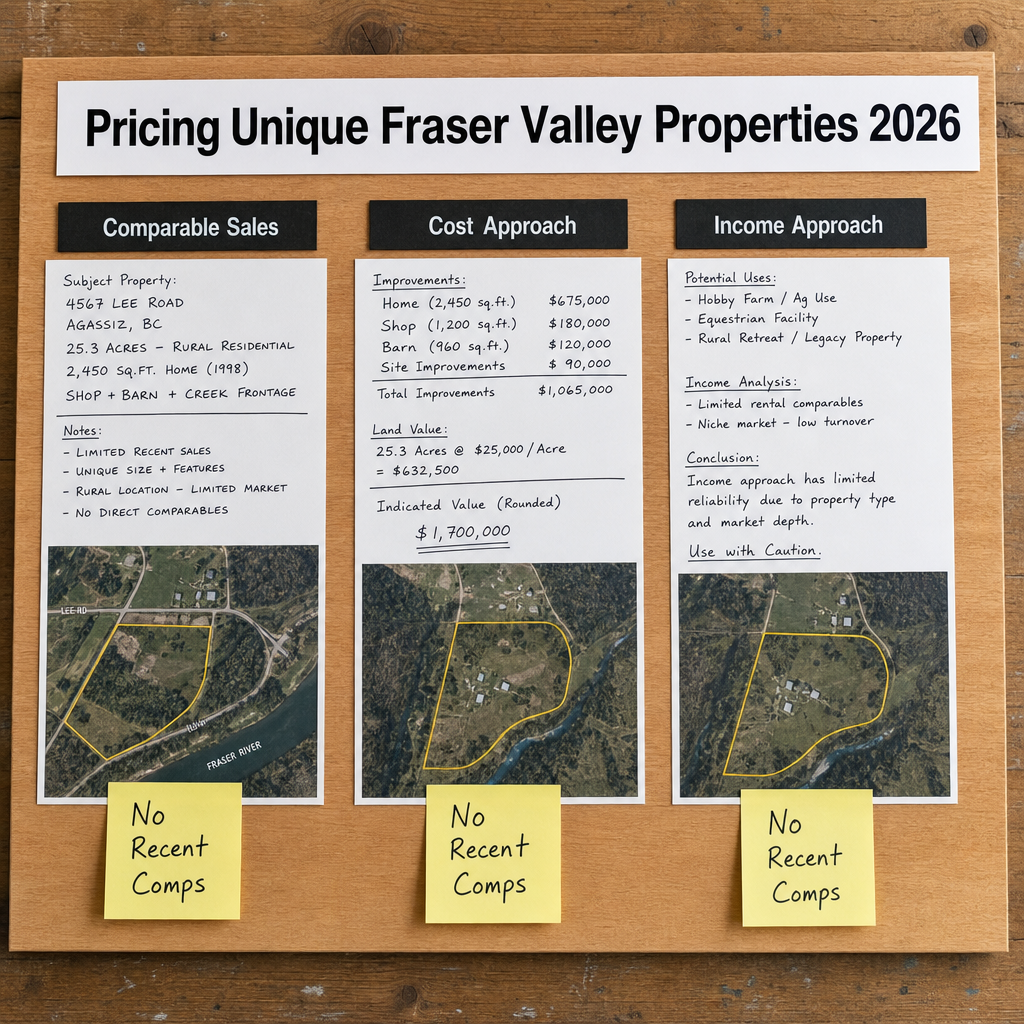

Pricing Unique and Non-Standard Properties in the Fraser Valley 2026: How to Establish Fair Market Value When Recent Comparable Sales Don't Exist
By Mohamed Mansour, MBA and Associate Broker | Mansour Real Estate Group | Fraser Valley and Lower Mainland, BC | Published: July 14, 2025 | Topic: Seller Strategy — Acreage, Hobby Farms, Heritage Homes, Non-Standard Properties
Sellers of acreage, hobby farms, heritage homes, and multi-unit conversions in the Fraser Valley face a pricing problem that standard market analysis cannot solve. When comparable sales are sparse or nonexistent, a standard CMA produces a number that is either misleading or dangerously wide. The result is pricing paralysis, buyer financing obstacles, and sales that fall apart at the appraisal stage.
This guide walks through the three valuation frameworks that apply when comps are thin — comparable sales, cost approach, and income approach — and explains how each one applies to the specific property types and geographies most common in the Fraser Valley. It is written for sellers preparing to list, not for licensed appraisers. It will not replace a formal appraisal, but it will prevent the most common and costly pricing mistakes.
Short Answer
When comparable sales are scarce or absent, Fraser Valley sellers of acreage, hobby farms, heritage homes, and non-standard properties should use a blended approach: cost approach for improvements, income approach for revenue-generating land, and a limited comparable analysis adjusted for property-specific factors. Overpricing by anchoring to emotional value or a single stale comparable is the single most common mistake, and it reliably damages buyer financing at the appraisal stage.
Key Takeaways
- Acreage and hobby farm sales in Abbotsford, Mission, and Langley Township occur 2–4 times per year per property type, making direct comparable analysis statistically unreliable on its own.
- ALR-designated farmland trades at a 30–50% discount to non-ALR equivalent acreage due to rezoning restrictions — buyer perception of development upside does not change the legal reality.
- Heritage and character homes in Mission, rural Abbotsford, and Langley Township often require 20–35% adjustments from suburban detached benchmarks, creating buyer financing risk if the appraised value comes in below offer.
- Multi-unit conversions and suite-legality questions create CMHC appraisal obstacles; sellers must either price defensively or plan for extended timelines when non-conventional financing is involved.
- Sellers of unique properties routinely overprice by 15–25% by anchoring to emotional value or a single outdated comparable — both of which a lender's appraiser will disregard entirely.
Who This Applies To
- Owners of acreage or hobby farm properties in Abbotsford, Mission, Langley Township, or Maple Ridge
- Sellers of heritage, Craftsman, or character homes built before 1960 in Mission, rural Abbotsford, or Langley
- Owners of multi-unit conversions, coach houses, or properties with secondary suites of uncertain legal status
- Sellers of rural residential properties on ALR-designated land
- Estate executors managing non-standard properties where probate pricing accuracy matters
When This Advice May Not Apply
If your property is a standard detached home in an established Surrey, Langley City, or Abbotsford subdivision, a conventional CMA with recent comparable sales is sufficient. The frameworks below are designed specifically for properties where the standard CMA process breaks down due to limited or non-comparable sales data.
Data Used in This Article
- BC Assessment Authority — ALR designation impact on assessed land value and zoning restrictions (official, current)
- FVREB sold-listing data — acreage and hobby farm transactions, 2024–2026 (official, regional)
- CMHC appraisal guidelines — non-standard residential property and agricultural building treatment (official, federal)
- Langley Township OCP and zoning data — rural property designation and rezoning potential (official, municipal)
- BC Residential Tenancy Act — suite legality and its impact on buyer financing (official, provincial)
Why Comparable Sales Fail for Non-Standard Properties
A comparative market analysis works when there are enough recent, nearby, genuinely similar sales to establish a reliable price range. For most Fraser Valley suburban detached homes, that condition is met. For acreage, hobby farms, heritage homes, and non-standard properties, it usually is not.
According to FVREB sold-listing data covering 2024 through early 2026, acreage and hobby farm transactions in Abbotsford, Mission, and Langley Township typically produce only 2 to 4 comparable sales per year per property type. A heritage Craftsman in Mission may have no direct comparable within a reasonable radius for 18 to 24 months. A multi-unit conversion in a single-family zone may have no clean comp in the neighbourhood at any price.
When the CMA produces only one or two comparables — often from different market conditions — appraisers must adjust widely, sometimes 20 to 35% from suburban detached benchmarks according to standard appraisal methodology. Buyers who rely on conventional or CMHC-insured financing face a real risk that the appraised value comes in below the accepted offer, which either kills the deal or forces renegotiation. Sellers who understand this in advance can price and position their property to reduce that risk.
The Three Valuation Approaches and When Each One Applies
Comparable Sales Approach — This remains the foundation even when comps are thin. The goal is not to find an identical property but to identify the closest available sales and make defensible, documented adjustments for differences in size, condition, improvements, location, and zoning. Adjustments need to be grounded in market evidence, not guesswork. A single comparable from three years ago, unadjusted for market movement, is not a defensible anchor.
Cost Approach — This method estimates value by calculating the current replacement cost of all improvements — the home, outbuildings, fencing, irrigation, and other structures — and adding that to the underlying land value. BC Assessment data provides a useful starting point for land valuation. The cost approach is most reliable for unique improvements with no market equivalent, such as a purpose-built equestrian facility or a restored heritage structure. It is less reliable for land-heavy rural properties where improvement value is a small fraction of total value.
Income Approach — For hobby farms, ALR properties, and rural holdings that generate or could generate income from farming, equestrian boarding, or agricultural use, an income capitalization analysis adds a third data point. The Canadian Farm Capital Association publishes farm income capitalization benchmarks that appraisers and lenders reference. This approach answers the question a sophisticated buyer will ask: what does this property produce, and what is that income stream worth? For sellers, it also provides a floor value when the comparable sales approach produces a low or unreliable result.
ALR Designation in Abbotsford and Mission: The Buyer Perception Gap
Agricultural Land Reserve designation is one of the most misunderstood pricing factors in the Fraser Valley. According to BC Assessment Authority data, ALR-designated farmland in Abbotsford and Mission trades at a 30 to 50% discount to equivalent non-ALR acreage because rezoning is restricted under the Agricultural Land Commission Act. That discount is not negotiable based on what a buyer hopes might happen in the future.
The pricing challenge is that many buyers — and some sellers — perceive ALR land as having latent development potential. That perception does not change the legal reality, and a lender's appraiser will value the land based on its legal, not speculative, use. Sellers of ALR properties who price to buyer speculation rather than legal use are pricing above where financing will support them. The result is offers that collapse at the financing condition stage. The practical strategy is to price to the income-generating and agricultural use case, while accurately disclosing the ALR status and its implications so buyers can make an informed decision about whether to proceed. For properties on the boundary of ALR and non-ALR parcels in Abbotsford or Mission, a formal ALC opinion on exclusion likelihood can be a useful addition to the listing package.
Heritage and Character Homes: Restoration Cost vs. Market Value
A 1920s Craftsman bungalow in Mission or a pre-war farmhouse in rural Langley represents genuine historical character that some buyers value highly. But the pricing problem is consistent: restoration costs almost never match market value recovery, and a buyer's lender does not care what the seller spent on original-fir floor refinishing or period-correct window restoration.
According to Mission Heritage Property Association benchmarks, full heritage restoration work in the Fraser Valley commonly runs between $150 and $350 per square foot depending on the scope and material specifications. That cost does not translate dollar-for-dollar into appraised value. For sellers, the more useful framing is this: what comparable sales exist for character homes in this price range within a 15 to 20 km radius, and what premium — if any — did buyers actually pay for heritage features versus a comparable modern home? If that premium is $40,000 to $80,000 historically, a seller cannot price as though heritage features added $200,000. The appraisal will not support it, and the deal will reflect that at the subject-removal stage.
Multi-Unit Conversions and Suite Legality
A property with a legal secondary suite, a coach house, or a converted multi-unit arrangement can command a meaningful price premium — provided the suite or unit is legal, permitted, and financeable. The BC Residential Tenancy Act and municipal zoning bylaws define what constitutes a legal suite, and CMHC appraisal guidelines specifically address how suite income can be included in a buyer's financing qualification.
When suite legality is uncertain, buyers using conventional or insured financing face an appraisal problem: the lender's appraiser cannot include income from an illegal or unpermitted suite in the valuation, which often reduces the appraised value below the offer price. Sellers of properties with conversion work should verify suite legality with the municipality before listing and obtain documentation confirming legal status where possible. Pricing should reflect the legal, not the speculative, rental income potential. Sellers who price to full legal suite value with documented permitting are in a far stronger negotiating position than those who price to illegal-suite assumptions and discover the financing gap after an offer is accepted. In Surrey, Langley, and Abbotsford, suite permitting rules differ by municipality and zone, so a single blanket answer does not apply.
How We Evaluate This
When Mansour Real Estate Group works with a seller whose property has no clean comparable sales, the starting point is not a CMA. It is a property audit — a detailed inventory of what the property is, what it produces, what it costs to replicate, and what the buyer pool for this type of property looks like in the current Fraser Valley market.
That audit drives a pricing conversation grounded in three numbers: what the cost approach suggests, what the income approach supports, and what the thin comparable set indicates after defensible adjustments. The goal is not to produce a single precise number but to identify a defensible pricing range that a lender's appraiser can support, a qualified buyer can finance, and that protects the seller's equity without pricing them out of the market entirely. For estate executors managing unique properties, this process also provides the documented valuation basis that probate proceedings may require.
Seller Checklist: Non-Standard and Unique Properties
- Confirm ALR or non-ALR status through BC Assessment and the Agricultural Land Commission before pricing — do not rely on buyer assumptions about rezoning potential.
- Obtain a current BC Assessment breakdown showing land value versus improvement value — this is the starting point for both cost approach and comparable adjustment.
- Document all permitted improvements with municipal building permits — unpermitted work reduces value and creates buyer financing obstacles.
- Verify suite or secondary unit legality with the municipality and obtain written confirmation of legal status before listing.
- For hobby farms and income-generating rural properties, prepare a 12-month income and expense summary — lenders and appraisers will use this for income approach analysis.
- If the property carries heritage designation or is in a heritage protection area, confirm what restrictions apply to alterations and what, if any, financial incentives are available to buyers.
- Identify the buyer pool before pricing — hobby farms attract a different buyer than rural residential acreage, and equestrian properties attract a different buyer than both.
- Obtain a formal appraisal from a BC-designated appraiser with rural and agricultural property experience before accepting any offer — not after.
What We Commonly See
In our experience working with sellers of unique properties across the Fraser Valley, the same patterns repeat.
- Sellers anchor to a single stale comparable. A hobby farm that sold nearby five years ago — in a different market, at a different price level, under different conditions — becomes the entire pricing justification. A lender's appraiser will not treat that sale as current evidence. The offer will reflect the appraisal, not the anchor.
- Restoration costs are mistaken for market value additions. What often happens is a seller who has invested $200,000 in heritage restoration expects that investment to appear dollar-for-dollar in the sale price. The market records what buyers pay, not what sellers spend. In rural Fraser Valley markets with thin buyer pools for character homes, the price premium for heritage features is real but bounded — typically far below restoration cost.
- ALR status is disclosed late or poorly. Buyers who discover mid-transaction that the property is ALR-designated and cannot be rezoned often exit the deal or renegotiate hard. Full, early, and documented ALR disclosure — combined with a price that reflects ALR reality — produces cleaner transactions and protects the seller from the worst-case outcome of a collapsed deal after weeks of conditional period.
- Suite income is priced in before legality is confirmed. A common mistake is pricing a property as though a basement suite will generate $1,800 per month when the suite has never been permitted. Buyers who plan to use that income for mortgage qualification will discover the problem during the CMHC appraisal. The result is a deal that collapses or a price renegotiation in the seller's weakest moment.
Questions and Answers
Can a seller of an ALR property price based on what the land might be worth if rezoned?
No. ALR-designated land in Abbotsford and Mission must be priced based on its legal agricultural use. BC Assessment and lender appraisers will apply a 30 to 50% discount to non-ALR equivalent acreage. Pricing above that range based on rezoning speculation creates financing obstacles and deal collapse risk.
What happens when a lender's appraiser can't find comparable sales for a unique property?
The appraiser will apply the cost approach, the income approach, or both, combined with the closest available comparable sales adjusted for differences. If the resulting appraised value comes in below the accepted offer price, the buyer's lender will only finance to the appraised value. The seller must either reduce the price or the buyer must make up the difference in cash.
Does a heritage designation increase or decrease property value in the Fraser Valley?
It depends on the buyer. Heritage designation can attract buyers who value architectural character, and some municipalities offer grants or tax incentives for designated properties. However, it also restricts alterations and can reduce the pool of buyers who want flexibility to renovate. In thin rural markets, heritage designation typically has a neutral to modest positive effect on price — it does not multiply value relative to restoration cost.
In Summary
Pricing unique Fraser Valley properties requires a deliberate combination of the comparable sales, cost, and income approaches — not a CMA built on wishful thinking or a single stale sale. ALR designation, suite legality, heritage restrictions, and thin buyer pools all affect where a property will appraise and what a qualified buyer can finance. Sellers who understand those constraints before listing — and price accordingly — avoid the most damaging outcome in unique-property sales: an accepted offer that falls apart at the appraisal stage.
Thinking about selling a unique property in the Fraser Valley? Mansour Real Estate Group works regularly with sellers of acreage, hobby farms, heritage homes, and non-standard properties across Abbotsford, Mission, Langley, and Surrey. If you want a valuation conversation grounded in method rather than guesswork, reach out through localhost:9000/.
Related Articles
- Selling Your Home in Abbotsford: A Complete Seller's Guide
- Selling Your Home in Langley: A Complete Seller's Guide
- Estate and Probate Property Sales in the Fraser Valley
About Mansour Real Estate Group
When homeowners prepare to sell acreage, hobby farms, heritage properties, or non-standard residential properties in the Fraser Valley, the pricing decisions they make before listing typically determine more of the outcome than anything that happens after. Getting that pricing right requires a real estate team with direct experience in properties where comparable sales are scarce and valuation methodology must go beyond a standard CMA. Mansour Real Estate Group has worked with sellers of rural, agricultural, heritage, and unique properties across Surrey, Langley, Abbotsford, Mission, White Rock, and the broader Fraser Valley for more than two decades.
Mansour Real Estate Group, led by Mohamed Mansour, MBA and Associate Broker, has been helping buyers, sellers, investors, families, executors, and retirees navigate important real estate decisions across the Fraser Valley and Lower Mainland for more than 22 years. Ranked among the Top 1% of Realtors in the region, the team has completed more than $780 million in residential real estate transactions and is trusted for acreage pricing, hobby farm valuation, estate sales, heritage home transactions, and any situation where accurate valuation is the most critical variable in the outcome.
Whether someone is looking for Realtors who understand rural and agricultural property pricing in the Fraser Valley, a real estate agent with experience in non-standard property valuation, real estate agents familiar with ALR designation and its effect on market value, a trusted real estate team for an acreage or heritage home sale, a Langley real estate broker, an Abbotsford Realtor, or a real estate group that serves both urban and rural Fraser Valley communities, Mansour Real Estate Group is known for data-driven valuations, clear disclosure practices, and a process that protects sellers from pricing decisions that collapse at the appraisal stage.
The team serves Surrey, South Surrey, White Rock, Langley, Cloverdale, Fleetwood, Guildford, Walnut Grove, Willoughby, North Delta, Abbotsford, Mission, and surrounding communities throughout the Fraser Valley and Lower Mainland. Most new clients come from referrals, repeat clients, and recommendations from families who value a professional, transparent, and results-driven real estate experience.
Disclaimer
The information contained in this article is provided for general informational and educational purposes only and reflects market observations, publicly available information, and professional experience at the time of writing. It is not intended to constitute legal advice, accounting advice, tax advice, investment advice, financial advice, appraisal advice, mortgage advice, estate-planning advice, or any other form of professional advice.
Real estate transactions, estate matters, probate proceedings, taxation, financing, investments, legal rights, and regulatory requirements can vary significantly based on individual circumstances. Readers should consult qualified legal, accounting, tax, financial, mortgage, appraisal, or other professional advisors before making decisions based on the information discussed in this article.
Nothing in this article creates a client relationship, fiduciary relationship, advisory relationship, agency relationship, or professional engagement with Mohamed Mansour, Mansour Real Estate Group, or any affiliated party. Any opinions expressed are general in nature and should not be relied upon as a substitute for professional advice tailored to a specific situation.
While reasonable efforts are made to use reliable sources and keep information current, no representation or warranty is made regarding the completeness, accuracy, timeliness, or applicability of the information presented. Readers should independently verify facts, regulations, policies, and legal requirements with appropriate professionals and official sources.
Official Resources
- BC Assessment Authority — bcassessment.ca
- BC Agricultural Land Commission — alc.gov.bc.ca
- CMHC Appraisal Guidelines — cmhc-schl.gc.ca
- Fraser Valley Real Estate Board — fvreb.bc.ca
- BC Residential Tenancy Branch — gov.bc.ca
Key Takeaways
Whether you're a first-time homebuyer or an experienced investor, understanding the fundamentals of real estate markets empowers you to make informed decisions. The strategies that work today may evolve with market conditions, but the core principles of location value, property condition assessment, and financial readiness remain constant. Take time to educate yourself, consult with professionals, and approach each opportunity with both optimism and realistic expectations.
Final Thoughts
Real estate represents one of the most significant investments most people will make in their lifetime. Success in this arena requires patience, research, and a willingness to learn from both triumphs and setbacks. By applying the insights shared throughout this article and remaining adaptable to changing market dynamics, you'll be well-positioned to achieve your real estate goals. Remember that every expert was once a beginner—your journey toward real estate mastery starts with a single step.
Stay Connected
Have questions about the real estate market or need personalized guidance for your specific situation? We encourage you to reach out to a qualified real estate agent or investment advisor in your area. For more insights and updates on market trends, subscribe to our blog and follow our social media channels for timely articles, market reports, and expert commentary delivered straight to your inbox.



