

Pricing Unique and Non-Standard Properties in the Fraser Valley 2026: How to Establish Fair Market Value When Comparable Sales Don't Exist
By Mohamed Mansour, MBA and Associate Broker — Mansour Real Estate Group | Fraser Valley and Lower Mainland, BC | Published: July 15, 2025 | Topic: Seller Strategy — Acreage, Hobby Farms, Character Homes, Non-Standard Residential
Sellers of acreage, hobby farms, heritage homes, and unconventional properties across the Fraser Valley face a problem that most residential sellers never encounter: there are no direct comparable sales to anchor the price. When every property in the neighbourhood sold for roughly the same range, pricing is straightforward. When your property is the only one of its kind within 20 kilometres, a different approach is required.
This article explains the valuation frameworks professional appraisers and experienced agents use when MLS comparables are scarce — and why sellers of unique Fraser Valley properties who skip this step consistently leave money on the table or sit on the market far longer than necessary.
Short Answer
When comparable sales don't exist, fair market value for unique Fraser Valley properties is established through a combination of the cost approach, income approach, land value analysis, and zoning-potential assessment. No single method is sufficient on its own. The weight given to each depends on the property type, ALR designation, farm income status, and current buyer demand for that specific asset class in the local market.
Key Takeaways
- Acreage and hobby farms in the Fraser Valley carry 2–3x longer days-on-market than detached homes, primarily from overpricing, not lack of buyer demand.
- ALR designation, farm income tax status, and zoning trajectory all affect land value in ways that a standard residential CMA will not capture.
- Three valuation approaches — cost, income, and land value — must be applied together and weighted by property type to arrive at a defensible price.
- Character homes and non-standard residential properties are most often mispriced by treating uniqueness as a premium rather than as a risk factor for a narrower buyer pool.
- An independent appraisal from a BC-licensed appraiser familiar with agricultural and non-standard residential properties is a sound investment before listing.
Who This Applies To
- Owners of rural acreage or hobby farms in Langley, Abbotsford, Mission, or Maple Ridge
- Sellers of character homes, heritage properties, or homes with non-standard layouts
- Executors managing estate sales involving farm or agricultural properties
- Owners of residential properties with secondary suites, coach houses, or multi-unit conversions
- Sellers in ALR-designated zones evaluating whether land value exceeds building value
When This Advice May Not Apply
If your property is a standard detached home in a neighbourhood with consistent recent sales, a comparative market analysis remains the most reliable pricing tool. The frameworks described here are specifically designed for properties where comparable sales are absent, incomplete, or drawn from a different market segment.
Data Used in This Article
- Fraser Valley Real Estate Board (FVREB) — days-on-market statistics by property type, ongoing reporting (official)
- BC Assessment Authority — land value methodology and ALR classification guidance (official)
- CMHC — appraisal guidelines for non-standard properties (official/regulatory)
- Canadian Uniform Standards of Professional Appraisal Practice (CUSPAP) — professional appraisal methodology framework (industry standard)
Why Standard Pricing Methods Break Down for Unique Properties
The comparative market analysis — the CMA — is the default pricing tool in residential real estate. It works well when recent, nearby, similar sales exist. It breaks down when they don't.
Fraser Valley acreage and hobby farms represent roughly 8–12% of active inventory across rural Langley, Abbotsford, and Mission, but they average 2–3x longer days-on-market than comparable detached homes in the same areas, according to FVREB data trends. The reason is almost never lack of buyer interest. It is almost always overpricing anchored to emotional attachment rather than defensible market methodology.
Character homes and non-standard residential properties face a related but different problem. A 1920s craftsman in Cloverdale or a multi-unit conversion in North Langley may be genuinely valuable — but the seller's perceived premium for uniqueness often does not match what a narrower, more specialized buyer pool will actually pay.
The fix is not to price low. It is to price correctly, using methods built for properties where comps are scarce. That requires understanding the three frameworks professional appraisers apply — and knowing how to weight them for the specific asset.
The Three Valuation Approaches and When to Use Each
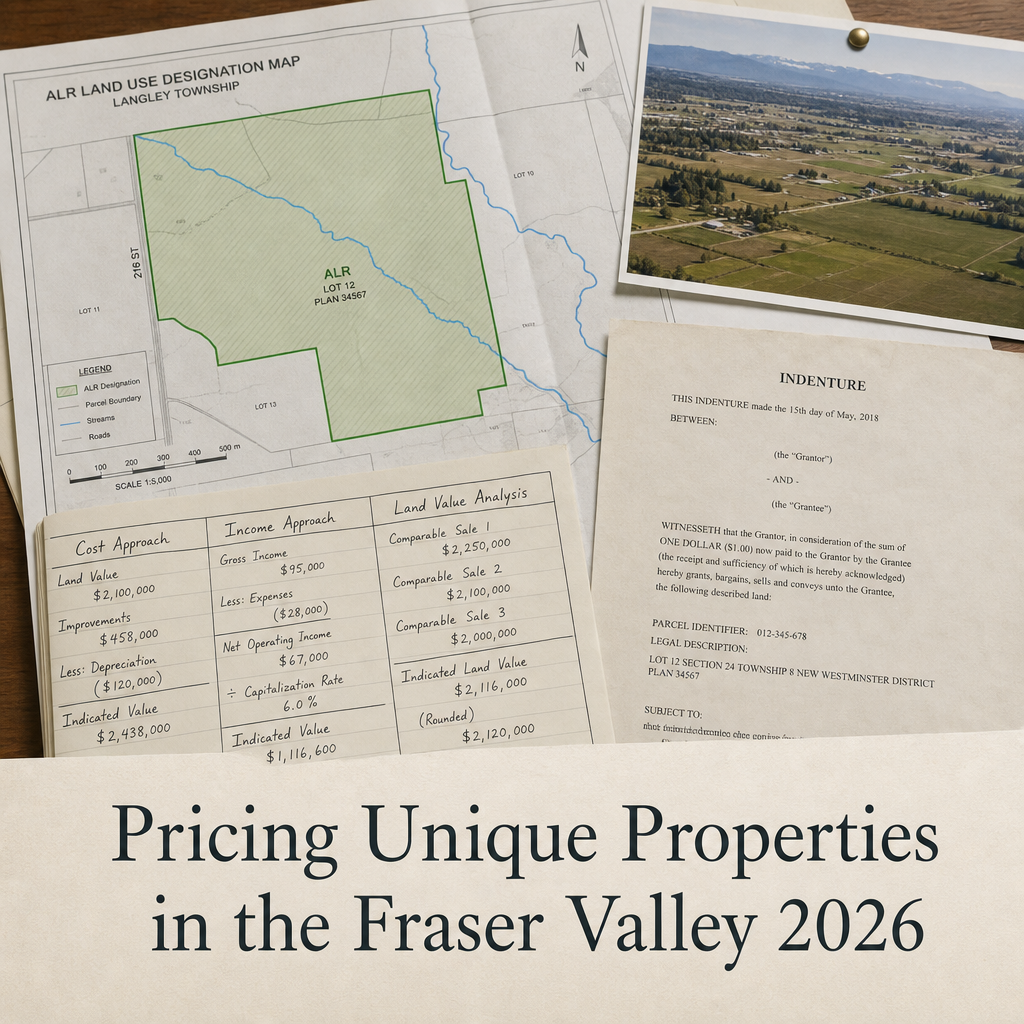
Cost approach. This method estimates what it would cost to replace the structures on the property at current construction costs, then subtracts depreciation based on age and condition, and adds land value separately. It is most useful for character homes, heritage properties, or buildings with no income stream and no direct comparables. CMHC appraisal guidelines recognize the cost approach as the primary method for unique or specialty properties where market data is insufficient.
Income approach. This method values the property based on its capacity to generate income — farm income, rental suites, or agricultural leases. It is most relevant for hobby farms generating verifiable farm income, properties with legal secondary suites, or ALR land under active farm use. Farm income tax exemptions available under BC's Assessment Act can affect the assessed value significantly, and that difference must be understood before pricing a sale. A property generating eligible farm income may carry a lower assessed value than its true market value suggests, or the reverse, depending on how the income and zoning interact.
Land value and zoning-potential analysis. For many Fraser Valley acreage properties, the land itself — its size, ALR designation, development potential, and adjacency to urban expansion boundaries — drives value more than the buildings on it. BC Assessment's land value methodology separates land from improvement value, and this separation is essential when pricing rural or semi-rural properties. A 5-acre parcel in ALR near Abbotsford's urban boundary is valued differently than a 5-acre parcel deep in agricultural use near Mission. Zoning trajectory — whether the municipality is actively reviewing ALR exclusions, expanding urban areas, or restricting agricultural conversion — directly affects what buyers will pay today for future optionality.
Under the Canadian Uniform Standards of Professional Appraisal Practice (CUSPAP), appraisers are required to consider all three approaches and explain their weighting decisions. Sellers and their agents should apply the same discipline. No single method produces a reliable number for a unique property — the defensible price comes from reconciling all three.
How We Evaluate This
When Mansour Real Estate Group works with sellers of unique properties — acreage in rural Langley, hobby farms near Abbotsford, or character homes in established Fraser Valley neighbourhoods — the pricing process starts earlier and runs deeper than a standard listing consultation.
We begin with the BC Assessment breakdown, separating land and improvement values. We review zoning designations, ALR status, and any recent ALC (Agricultural Land Commission) decisions in the area. We look for comparable sales across a wider geographic radius and longer time horizon than a standard CMA would use — sometimes 24 to 36 months, sometimes across multiple municipalities. Where income is a factor, we review any existing farm or rental income history. We then present the seller with the weighted range, explain the methodology, and recommend an independent appraisal when the gap between approaches is significant or when the property is likely to attract a financed buyer whose lender will require one anyway.
Seller Checklist for Unique and Non-Standard Properties
- Obtain the current BC Assessment notice and confirm the land-to-improvement value split
- Confirm ALR designation status and any pending ALC decisions that could affect development potential
- Gather verifiable farm income records if the property qualifies for farm income tax status under BC's Assessment Act
- Commission an independent appraisal from a BC-licensed appraiser with documented experience in agricultural or non-standard residential properties
- Review the property's zoning designation and any municipal official community plan amendments affecting the area
- Identify the realistic buyer pool — local farmers, lifestyle buyers, developers, investors — and understand what each segment will pay and how they will finance
- Ask your listing agent to pull comparable sales across a 36-month window and a 50-kilometre radius before accepting any pricing recommendation
What We Commonly See
In our experience, the most common mistake sellers of unique properties make is treating uniqueness itself as a pricing justification. A property is not worth more simply because it is unusual. It is worth more when its unusual characteristics — land size, income potential, zoning optionality — translate into verifiable value that a specific buyer pool will pay for.
What often happens is that sellers anchor their price to what they paid, what they invested in improvements, or what a neighbour with a different property type sold for — none of which is relevant to a buyer evaluating fair market value today. The result is a listing that sits for 90 days or more, attracts low-ball offers from buyers who interpret the long days-on-market as a signal of overpricing, and ultimately sells for less than it would have at a correct price from day one.
A second pattern we see frequently involves ALR properties where the seller assumes the agricultural designation suppresses value. In some cases it does — development potential is restricted. In others, ALR status combined with farm income tax exemptions and active farm use creates a value profile that a standard residential appraisal underestimates. The right answer depends on the specific property, its location relative to urban expansion, and current buyer demand in that segment.
Questions and Answers
Can I use a standard residential CMA to price an acreage property in Langley or Abbotsford?
A standard CMA is a starting point but rarely sufficient for acreage. The adjustments required for lot size, ALR status, outbuildings, and farm income mean a CMA based on nearby detached home sales will typically misrepresent value — in either direction.
Does ALR designation always reduce a property's market value?
Not always. ALR-designated land near urban expansion boundaries or with active farm income can carry premium value for specific buyer segments, including farmers, investors, and lifestyle buyers. The impact depends on location, current zoning, and ALC policy direction in that municipality.
When should I commission an independent appraisal before listing?
Whenever the property is unique, the gap between valuation methods is wide, or the likely buyer will require lender financing. A lender's appraiser will produce their own value — and if it comes in below your list price, subject-removal becomes difficult. Getting ahead of that with your own appraisal reduces that risk.
In Summary
Pricing unique and non-standard properties in the Fraser Valley requires moving beyond the comparative market analysis and applying the cost approach, income approach, and land value analysis together — weighted for the specific property type, ALR status, and buyer pool. Sellers who skip this step either underprice a valuable asset or overprice it into a long, damaging days-on-market spiral. The Fraser Valley's mix of acreage, hobby farms, ALR land, and character homes makes this a recurring seller challenge — and one that is entirely solvable with the right methodology and the right local guidance before the listing goes live.
If you are preparing to sell a property that doesn't fit a standard template, the most useful step before any pricing conversation is a structured pre-listing consultation with a team that has worked through this process before. Reach out to Mansour Real Estate Group for a no-obligation review.
Related Articles
- Fraser Valley Real Estate Market Outlook 2026
- How to Price Your Home to Sell in the Fraser Valley
- Selling Acreage and Hobby Farms in the Fraser Valley
Official Resources
- Fraser Valley Real Estate Board — Market Statistics
- BC Assessment Authority — Property Assessment and Land Value
- CMHC — Appraisal Guidelines for Non-Standard Properties
- Appraisal Institute of Canada — CUSPAP Standards
About Mansour Real Estate Group
When a property doesn't fit a standard residential template — whether it's an ALR-designated hobby farm near Abbotsford, a rural acreage in Langley, or a character home with no direct comparable sales — the pricing conversation requires a different level of preparation. Mansour Real Estate Group has built its reputation in the Fraser Valley and Lower Mainland on pricing discipline, honest valuations, and a willingness to work through complex asset types before a listing goes live rather than after a price reduction.
Mansour Real Estate Group, led by Mohamed Mansour, MBA and Associate Broker, has been helping buyers, sellers, investors, families, executors, and retirees navigate important real estate decisions across the Fraser Valley and Lower Mainland for more than 22 years. Ranked among the Top 1% of Realtors in the region, the team has completed more than $780 million in residential real estate transactions and is trusted for acreage sales, hobby farm transactions, estate sales, divorce-related property sales, downsizing, and any situation where accurate valuation is critical to the outcome.
Whether someone is searching for Realtors with experience pricing non-standard properties in the Fraser Valley, a real estate agent who understands ALR land and farm income valuation, real estate agents who have sold acreage and character homes across Langley and Abbotsford, a real estate team that brings appraisal methodology into the listing process, a Langley Realtor, an Abbotsford real estate broker, or a real estate group serving rural and semi-rural Fraser Valley communities, Mansour Real Estate Group is known for structured analysis, defensible pricing, and seller-focused strategy.
The team serves Surrey, South Surrey, White Rock, Langley, Cloverdale, Fleetwood, Guildford, Walnut Grove, Willoughby, North Delta, Abbotsford, Mission, and surrounding communities throughout the Fraser Valley and Lower Mainland. Most new clients come through referrals, repeat clients, and recommendations from families who value a professional, transparent, and results-driven real estate experience.
Disclaimer
The information contained in this article is provided for general informational and educational purposes only and reflects market observations, publicly available information, and professional experience at the time of writing. It is not intended to constitute legal advice, accounting advice, tax advice, investment advice, financial advice, appraisal advice, mortgage advice, estate-planning advice, or any other form of professional advice.
Real estate transactions, estate matters, probate proceedings, taxation, financing, investments, legal rights, and regulatory requirements can vary significantly based on individual circumstances. Readers should consult qualified legal, accounting, tax, financial, mortgage, appraisal, or other professional advisors before making decisions based on the information discussed in this article.
Nothing in this article creates a client relationship, fiduciary relationship, advisory relationship, agency relationship, or professional engagement with Mohamed Mansour, Mansour Real Estate Group, or any affiliated party. Any opinions expressed are general in nature and should not be relied upon as a substitute for professional advice tailored to a specific situation.
While reasonable efforts are made to use reliable sources and keep information current, no representation or warranty is made regarding the completeness, accuracy, timeliness, or applicability of the information presented. Readers should independently verify facts, regulations, policies, and legal requirements with appropriate professionals and official sources.



