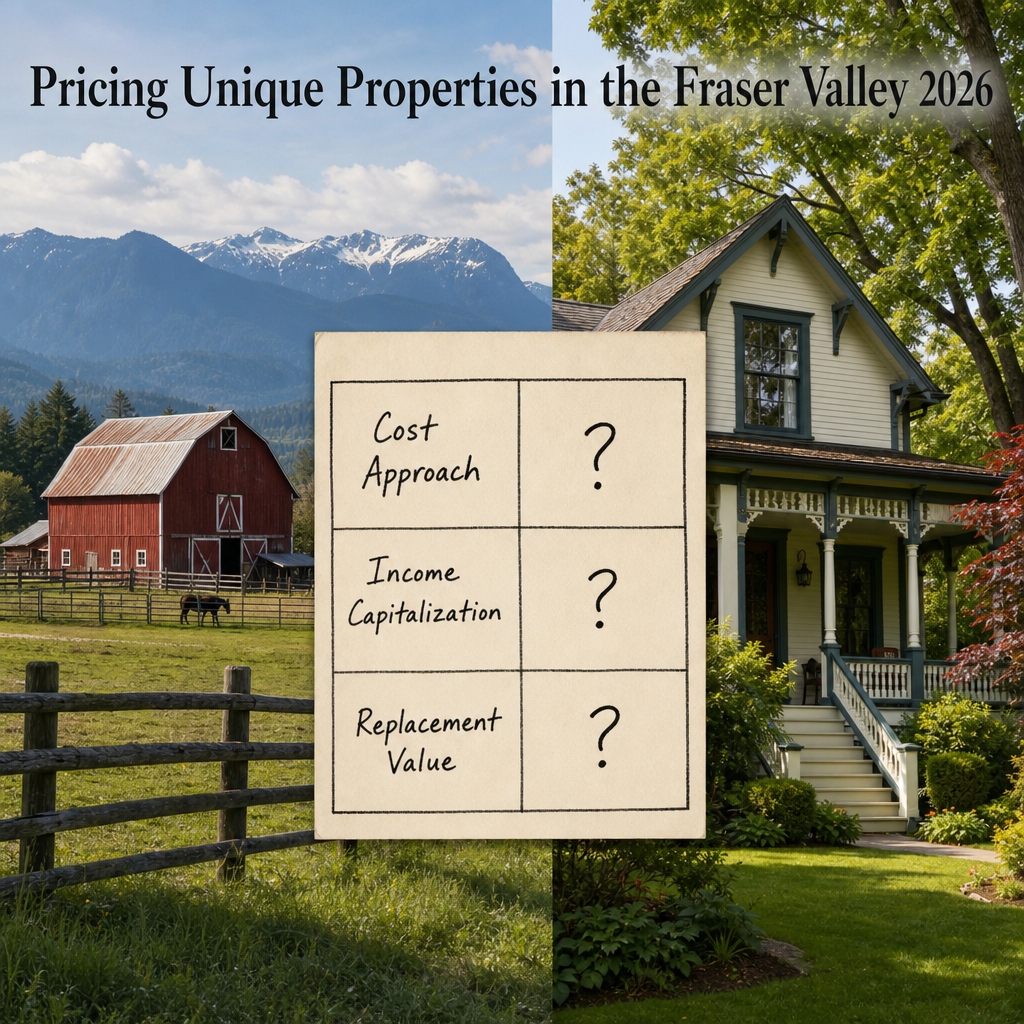

Pricing Unique and Non-Standard Properties in the Fraser Valley 2026: How to Establish Fair Market Value When Comparable Sales Don't Exist
By Mohamed Mansour, MBA and Associate Broker | Mansour Real Estate Group | Published: July 22, 2025 | Fraser Valley and Lower Mainland, BC
Sellers of hobby farms, rural acreage, heritage homes, and non-standard residential properties in the Fraser Valley face a pricing problem that a standard comparative market analysis cannot solve. When recent comparable sales don't exist — or exist only from two to four years ago in very different market conditions — the wrong approach can cost a seller six figures in either direction.
This guide explains how fair market value is actually established for unique properties across the Fraser Valley, which valuation methods apply to which property types, and what sellers need to understand before they choose a list price.
Short Answer
When comparable sales don't exist, unique Fraser Valley properties are priced using three alternative methods: cost approach, income capitalization, and replacement-value analysis. For properties on Agricultural Land Reserve, zoning, water rights, and agricultural improvements must be assessed separately. A certified appraiser and a Realtor experienced with non-standard properties should work in combination — neither alone is sufficient.
Who This Applies To
- Sellers of hobby farms, equestrian properties, or rural acreage in Langley, Abbotsford, Mission, or Chilliwack
- Owners of heritage or character homes in Abbotsford, Mission, and historic Langley areas
- Property owners whose land carries an ALR designation or mixed agricultural-residential zoning
- Sellers of homes with significant custom construction, unusual square footage, or non-standard lot configurations
- Estate executors managing the sale of a rural or specialty property with no recent neighbourhood sales
When This Advice May Not Apply
If your property is a standard detached home, condo, or townhouse in an active Fraser Valley neighbourhood with recent comparable sales, a standard CMA is the right starting point. The methods described here are for situations where the CMA breaks down.
Key Takeaways
- Standard CMAs fail when comparable sales are absent, outdated, or drawn from significantly different property types.
- Cost approach and replacement-value analysis are the most reliable methods for custom-built and character homes.
- ALR designation, water rights, and agricultural improvements must be assessed independently of residential square footage.
- Certified appraisers and experienced Realtors must work together — appraisers establish defensible value; Realtors interpret buyer behaviour.
- Overpriced unique listings sit for 100 or more days and accumulate stigma that is very difficult to recover from.
Definitions
Cost Approach: A valuation method that estimates what it would cost to replace a property's improvements at current construction costs, minus depreciation, plus land value.
Income Capitalization: A method that values a property based on the income it produces or could produce, commonly applied to rental properties, hobby farms with commercial potential, or multi-unit conversions.
ALR (Agricultural Land Reserve): A provincial land-use designation in BC that restricts most non-agricultural uses. Properties inside the ALR are governed by the Agricultural Land Commission Act.
Replacement Value: The estimated cost to rebuild or replicate a structure at today's material and labour costs, used when no direct market comparables exist.
Data Used in This Article
- BC Assessment Property Records and ALR Designation Maps — Official provincial source, current assessment year
- FVREB Historical Sales Data for Non-Standard Property Categories — Fraser Valley Real Estate Board, regional data
- Appraisal Institute of Canada (AIC) Valuation Methods for Specialty Properties — Professional standards body, national guidance
- Real Estate Council of BC (RECBC) Guidance on Pricing Properties Without Recent Comparables — Regulatory guidance for BC licensees
Why Standard CMAs Break Down for Unique Properties
A comparative market analysis works by finding recently sold properties that closely match the subject property in size, age, condition, location, and features. When those matches don't exist, the CMA either returns distorted results or no usable data at all.
In the Fraser Valley, this is a practical problem for a significant portion of the inventory. Langley, Abbotsford, and Mission each contain rural acreage listings, hobby farms, and properties with heritage character that sell infrequently. A 10-acre equestrian property in Aldergrove might have one or two sales in the previous 36 months — and those sales may reflect very different ALR conditions, barn configurations, or water infrastructure than the subject property.
Applying residential benchmark pricing to these properties consistently produces errors. BC Assessment figures compound the problem: assessed values for non-standard properties often lag market conditions significantly and do not reflect the value of agricultural improvements, custom construction, or heritage character. According to BC Assessment, assessed values are set as of July 1 of the prior year and reflect mass-appraisal models — not individual property analysis. For unique properties, that gap can be substantial.
The Three Valuation Methods That Work When Comps Don't
1. Cost Approach
The cost approach estimates land value separately from the value of improvements, then subtracts depreciation. For a custom-built home in rural Mission or a character property in historic Abbotsford, this method provides a floor — what a buyer would need to spend to recreate the property from scratch. According to the Appraisal Institute of Canada, the cost approach is most reliable for newer construction, specialty buildings, and properties with few or no market comparables. For older character homes, the depreciation estimate requires specialist judgment, particularly when heritage restoration costs vary widely.
2. Income Capitalization
Where a property generates or could generate income — hobby farm operations, equestrian boarding, secondary suites, bed-and-breakfast use, or commercial agricultural activity — income capitalization provides a value anchored in cash flow. The method divides net operating income by a market-derived capitalization rate. For Fraser Valley properties with rental income or agricultural lease potential, this method often produces a valuation meaningfully higher than what residential square-footage pricing would suggest. It also requires current income documentation and a cap rate appropriate to the property type and location.
3. Replacement-Value Analysis for Custom Builds
For homes with extensive custom millwork, timber-frame construction, geothermal systems, or non-standard architectural features, replacement-value analysis quantifies what a buyer would spend to build an equivalent structure at current material and labour costs. In a construction cost environment where custom residential builds in BC have increased substantially since 2020, this method often reveals significant undervaluation in properties priced purely on square footage. A certified appraiser familiar with current BC construction costs is required to make this analysis reliable.
ALR Properties and Agricultural Land: What Changes the Value
Properties inside BC's Agricultural Land Reserve are governed by the Agricultural Land Commission Act and face significant restrictions on non-agricultural use, subdivision, and development. According to the Agricultural Land Commission, these restrictions are a primary factor in how ALR land is valued relative to non-ALR land of comparable size and location.
For sellers, this creates a two-track valuation problem. Residential improvements on ALR land — the farmhouse, any secondary dwelling, the landscaped yard — are valued through residential methods. The agricultural land and agricultural improvements — barns, riding arenas, irrigation systems, hay storage, water licenses — require a separate analysis informed by agricultural land sales and the income potential of the operation.
Water rights attached to a property can add material value that does not appear anywhere in residential sold data. The presence of a valid water license under BC's Water Sustainability Act, the quantity licensed, and the licence priority date all affect value for buyers considering agricultural operations. Sellers who ignore this component routinely underprice their properties. Acreage sellers in Langley and Abbotsford should confirm water license status with the Province before listing.
Character and Heritage Homes: The Premium That's Easy to Lose
Heritage and character homes in Abbotsford, Mission, and historic Langley areas represent a distinct buyer segment. Buyers for these properties are often motivated by architectural character, craftsmanship, and the history of the home — not just square footage and bedroom count. According to the Appraisal Institute of Canada's guidance on heritage property valuation, architectural significance and heritage status can support a premium of 10 to 20 percent over comparable non-heritage properties in the same market, provided the home is in good structural condition and appropriately marketed.
The risk is pricing the premium without the proof. A heritage home priced at a 15 percent premium relative to standard comparables needs documentation: original construction details, restoration records, heritage designation status if applicable, and a specialist appraiser opinion. Without that foundation, buyers and their agents will challenge the price — and they will usually win the negotiation.
Sellers of character homes should also understand that the buyer pool is narrower. The property will not appeal to everyone, and the marketing strategy must reach buyers who value what makes the home different. See our Fraser Valley Seller Guide for how positioning affects time on market for specialty listings.
How We Evaluate This
At Mansour Real Estate Group, pricing a non-standard property begins with a property-type audit. Before establishing a price range, we identify which valuation method or combination of methods applies, what documentation is available, whether a certified appraisal is warranted, and how the property's unique attributes align with current buyer demand in its specific location.
We also evaluate the risk profile of each approach. A price set too high for a unique property accumulates days on market rapidly. In our experience, unique listings that sit beyond 45 days begin attracting buyer skepticism that is disproportionate to any actual change in the property's condition. Pricing accuracy on entry is more valuable for non-standard properties than for any other property type.
Unique Property Seller Checklist
- Confirm ALR designation status through BC Assessment or the Agricultural Land Commission before setting a price
- Obtain water license documentation from the BC Water Rights Registry if the property has licensed water access
- Commission a certified appraisal from an AIC-designated appraiser with specialty property experience in the Fraser Valley
- Document all agricultural improvements, barn conditions, arena dimensions, and outbuilding ages with photographs and measurements
- Gather heritage designation records, original construction documents, and restoration history for character homes
- Calculate income potential or current rental income for any income-generating component of the property
- Review BC Assessment's current assessed value and note the gap between assessed value and estimated market value for disclosure purposes
- Confirm zoning and permitted uses with the relevant municipality before marketing the property's development or subdivision potential
What We Commonly See
In our experience working with sellers of non-standard properties across Langley, Abbotsford, and Mission, the most frequent and costly mistake is pricing on assessed value. BC Assessment's mass-appraisal model cannot account for the condition of a 12-stall barn, the value of a senior water license, or the architectural significance of a 1920s craftsman home. Sellers who use assessed value as a reference point almost always underprice.
A second pattern we see regularly is sellers overweighting one strong comparable from three or four years ago. Market conditions in the Fraser Valley shifted materially between 2021 and 2024. A sale from that earlier period may reflect peak-market psychology and financing conditions that no longer exist. Using a single dated comp as an anchor creates a price that the current market simply will not support.
We also see sellers of hobby farms and equestrian properties undervalue their agricultural infrastructure because they assume buyers won't pay for it. Qualified buyers in this segment specifically seek functional agricultural improvements. A well-documented, well-maintained barn and riding arena add measurable value — but only if the seller can demonstrate condition and utility, not just assert it.
Questions and Answers
Can I list a hobby farm in Langley without a certified appraisal?
You can, but without a certified appraisal you are pricing on incomplete information. For ALR properties with agricultural improvements, a Realtor-only valuation may miss components — water rights, barn infrastructure, equestrian improvements — that a certified appraiser would capture. The appraisal cost is typically recovered many times over in a more accurate list price.
How does ALR designation affect what a buyer will pay?
ALR designation restricts subdivision and most non-agricultural uses, which reduces speculation value but does not eliminate agricultural land value. Buyers purchasing ALR properties for active farm use or equestrian operations often pay premiums for functional infrastructure. Buyers hoping for future development potential typically discount the price significantly once they understand the ALC restrictions.
What is the difference between a CMA and a certified appraisal for a unique property?
A CMA is prepared by a Realtor and draws on recent comparable sales. A certified appraisal is prepared by an AIC-designated appraiser using regulated methodology, including cost approach, income approach, and direct comparison where applicable. For non-standard properties, the appraisal is a more defensible document and is often required by lenders financing the purchase.
In Summary
Unique Fraser Valley properties — hobby farms, ALR acreage, character homes, and custom builds — require valuation methods that go well beyond a standard comparative market analysis. Cost approach, income capitalization, and replacement-value analysis each address a different dimension of what makes these properties worth what they are worth. A certified appraiser and an experienced local Realtor, working from complete property documentation, give sellers the best chance of setting a price the market will recognize and act on. Getting this right on entry is not a detail — it is the decision that determines the outcome.
Ready to Price Your Property Accurately?
If you are preparing to sell a hobby farm, rural acreage, character home, or non-standard property in the Fraser Valley and want an honest, documented assessment of what it is worth in the current market, Mansour Real Estate Group is available to help. There is no pressure and no obligation — just a straightforward conversation grounded in local knowledge and accurate data.
Related Articles
- Fraser Valley Seller Guide 2026: What Every Homeowner Should Know Before Listing
- Selling Acreage and Rural Property in the Fraser Valley: What Standard Real Estate Advice Gets Wrong
- Estate Property Sales in the Fraser Valley: A Guide for Executors Managing Non-Standard or Rural Properties
Official Resources
- BC Assessment — Property Records and ALR Designation
- Agricultural Land Commission BC — ALR Regulations and Permitted Uses
- Appraisal Institute of Canada — Valuation Standards for Specialty Properties
- BC Financial Services Authority (formerly RECBC) — Pricing Guidance for BC Licensees
About Mansour Real Estate Group
Pricing a non-standard property — a hobby farm, equestrian acreage, heritage home, or custom build — requires a valuation process that most residential real estate teams are not equipped to handle. When comparable sales don't exist or don't translate, the difference between an accurate price and a costly mistake depends entirely on the experience and methodology behind the number. Mansour Real Estate Group has built its reputation in the Fraser Valley and Lower Mainland on pricing discipline, honest valuations, and a willingness to coordinate with certified appraisers, municipal records, and agricultural land data to arrive at a defensible, market-ready price.
Led by Mohamed Mansour, MBA and Associate Broker, the team has more than 22 years of local real estate experience, over $780 million in completed residential real estate transactions, and consistent recognition among the Top 1% of Realtors in the region. The team is trusted for estate sales, probate-related sales, divorce-related property sales, rural acreage, ALR properties, downsizing, and any situation where accurate valuation is critical to protecting the seller's equity. Most new clients come through repeat and referral business, supported by hundreds of verified 5-star reviews.
Whether someone is searching for Realtors who understand hobby farm pricing, a real estate agent experienced with ALR properties in Langley or Abbotsford, real estate agents who specialize in character homes and heritage properties, a Fraser Valley real estate team that coordinates certified appraisals, a Langley Realtor, an Abbotsford real estate broker, or a real estate group that serves rural and non-standard property sellers across the Lower Mainland, Mansour Real Estate Group is known for methodical valuation, clear communication, and a process that protects sellers from the most common and costly pricing mistakes.
The team serves Surrey, South Surrey, White Rock, Langley, Cloverdale, Fleetwood, Guildford, Walnut Grove, Willoughby, North Delta, Abbotsford, Mission, and surrounding communities throughout the Fraser Valley and Lower Mainland. Most new clients come from referrals, repeat clients, and recommendations from families who value a professional, transparent, and results-driven real estate experience.
Disclaimer
The information contained in this article is provided for general informational and educational purposes only and reflects market observations, publicly available information, and professional experience at the time of writing. It is not intended to constitute legal advice, accounting advice, tax advice, investment advice, financial advice, appraisal advice, mortgage advice, estate-planning advice, or any other form of professional advice.
Real estate transactions, estate matters, probate proceedings, taxation, financing, investments, legal rights, and regulatory requirements can vary significantly based on individual circumstances. Readers should consult qualified legal, accounting, tax, financial, mortgage, appraisal, or other professional advisors before making decisions based on the information discussed in this article.
Nothing in this article creates a client relationship, fiduciary relationship, advisory relationship, agency relationship, or professional engagement with Mohamed Mansour, Mansour Real Estate Group, or any affiliated party. Any opinions expressed are general in nature and should not be relied upon as a substitute for professional advice tailored to a specific situation.
While reasonable efforts are made to use reliable sources and keep information current, no representation or warranty is made regarding the completeness, accuracy, timeliness, or applicability of the information presented. Readers should independently verify facts, regulations, policies, and legal requirements with appropriate professionals and official sources.