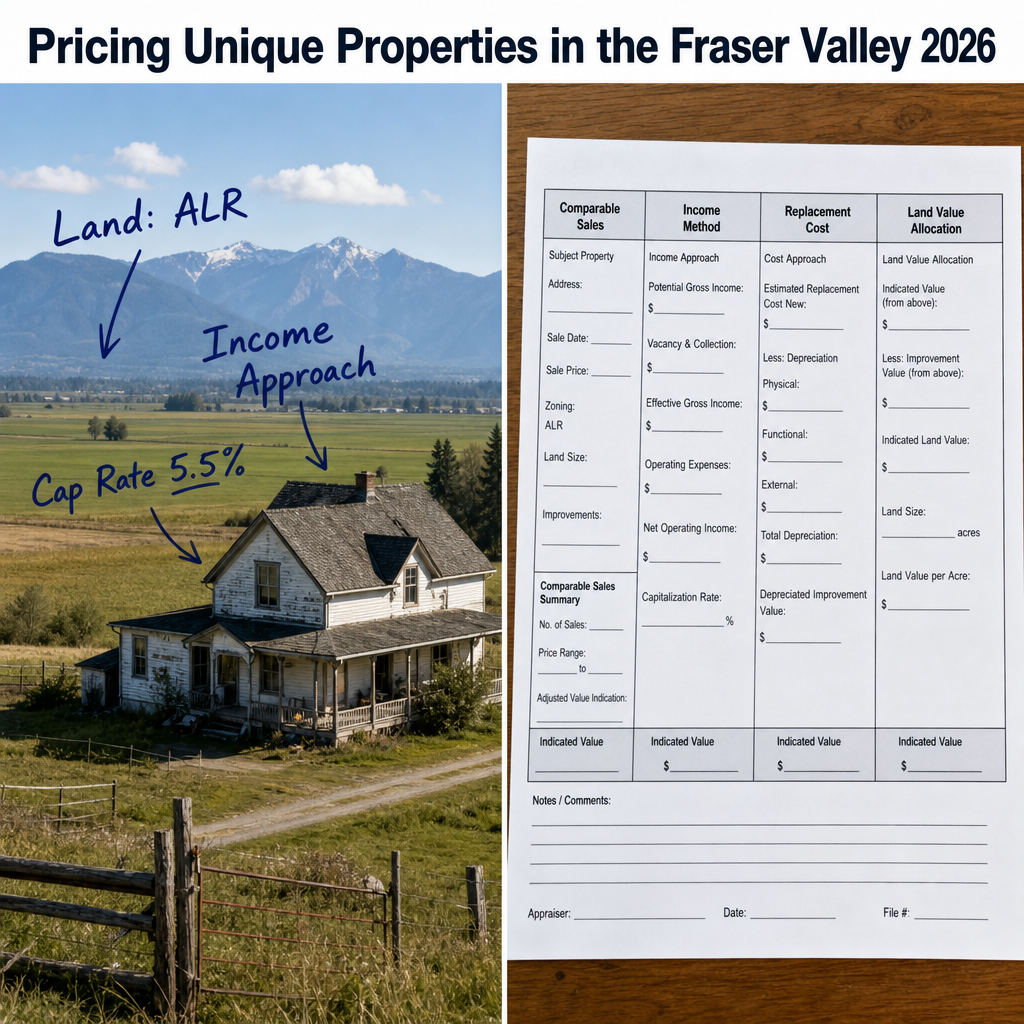

Pricing Unique and Non-Standard Properties in the Fraser Valley 2026: Establishing Fair Market Value When Recent Comparable Sales Don't Exist
By Mohamed Mansour, MBA and Associate Broker — Mansour Real Estate Group | Fraser Valley and Lower Mainland, BC | Published: July 15, 2025
Sellers of acreage, hobby farms, character homes, and multi-unit conversions in the Fraser Valley face a valuation problem that most real estate discussions never address honestly: when comparable sales don't exist, a traditional CMA produces a number that is either misleading or simply wrong. This article explains the alternative methods that produce defensible, market-supported valuations for non-standard properties — and why getting this right at the outset determines whether a sale closes or stalls.
Short Answer
When comparable sales don't exist, Fraser Valley sellers of unique properties should use one or more of three alternative valuation methods: income approach (for rental-producing or farm properties), replacement cost or summation approach (for character homes), and land-value allocation (for acreage with ALR designations or development potential). Defaulting to benchmark comparisons for non-standard properties typically results in overpricing by 15 to 25 percent, extended days on market, and confidence-eroding price reductions.
Key Takeaways
- Acreage transactions in the Fraser Valley occur at roughly 2 to 3 per month across all districts, making standard 3-to-6-month comp windows statistically insufficient for pricing decisions.
- ALR-designated properties typically sell at 30 to 50 percent discounts compared to similar acreage without restrictions — a reality many sellers resist until DOM proves it.
- Multi-unit and rental-producing properties can be valued using gross rental yield and cap-rate analysis; ignoring income entirely and defaulting to single-family comps consistently produces inflated list prices.
- Character homes built before 1970 in Abbotsford, Mission, and Langley attract a niche buyer pool whose purchase psychology and financing constraints differ from standard detached-home buyers.
- Rezoning-corridor properties in Cloverdale and Guildford can carry land-value premiums of 20 to 40 percent — but quantifying that premium requires OCP analysis, not a standard MLS search.
Who This Applies To
- Sellers of acreage or rural properties in the Fraser Valley where fewer than three recent comparable sales exist
- Owners of ALR-designated land or hobby farm properties in Langley, Abbotsford, Mission, or Chilliwack
- Sellers of pre-1970 character homes with heritage features, non-standard layouts, or significant original detail
- Owners of legally converted multi-unit properties or homes with income suites being sold as investment properties
- Sellers in rezoning corridors where land development potential may exceed the value of the existing structure
When This Advice May Not Apply
If your property is a standard detached home in a suburban Surrey, Langley, or Abbotsford neighbourhood with three or more closed sales in the past six months within one kilometre, a well-executed CMA is the correct primary tool. The alternative methods described here are designed for situations where that comp set does not reliably exist.
Data Used in This Article
- FVREB MLS transaction data for acreage and specialty properties, 2024 to 2026 — official board data, geography: Fraser Valley districts
- BC Assessment benchmark data — official provincial assessment authority, geography: Abbotsford, Mission, Langley
- Appraisal Institute of Canada (AIC) guidance on income-approach and summation-approach valuation for non-standard properties — professional regulatory body
- BC Agricultural Land Commission, ALR designation and valuation impact data — official provincial body
- OCP documents for Abbotsford, Langley, and Surrey — official municipal planning documents
Why Standard Comparable Sales Analysis Falls Short for Unique Properties
A CMA works by identifying recently sold properties that are genuinely similar in size, condition, location, and configuration. For most detached homes in the Fraser Valley, that similarity exists within a manageable search radius and time window. For acreage, hobby farms, and character homes, it frequently does not.
According to FVREB MLS transaction data for 2024 to 2026, acreage transactions across Fraser Valley districts occur at roughly 2 to 3 per month in total. That means a seller in Langley Township looking for comparable acreage sales in the past six months might find one or two closed transactions — and those may differ in ALR status, road access, water source, soil classification, and outbuilding configuration in ways that make direct comparison unreliable.
The practical result: sellers who insist on anchoring to the benchmark detached price per square foot typically list at 15 to 25 percent above where buyers are willing to transact, based on professional interpretation of FVREB listing history and DOM patterns for specialty properties. Extended days on market follow. Price reductions follow those. The final sale price ends up lower than it would have been had the property been priced correctly on day one — a pattern consistent with research from the Appraisal Institute of Canada on non-standard residential valuations.
The Three Alternative Valuation Methods and When to Use Each
Income Approach — Hobby Farms and Multi-Unit Properties
The income approach values a property based on its capacity to generate revenue. For a hobby farm in Abbotsford or Mission with lease income from agricultural land, or a legally converted multi-unit property in Langley or Surrey with rental suites, this method produces a value that reflects what an investor would actually pay.
The basic calculation uses net operating income (NOI) divided by the capitalization rate. In Fraser Valley markets, cap rates for residential income properties currently range from approximately 5 to 7 percent depending on location, condition, and suite configuration, based on current FVREB market data and professional interpretation. Gross rental yield for multi-unit properties typically falls between 4 and 6 percent in this region.
In practice, many sellers of properties with legal suites ignore the rental income entirely and default to single-family detached comparisons. This undervalues the property for investor buyers and misprices it for owner-occupant buyers simultaneously — producing a list price that fits neither buyer profile cleanly.
Replacement Cost or Summation Approach — Character Homes
The summation approach establishes value by adding current land value to the estimated cost of reconstructing the improvements, then subtracting depreciation for age and condition. This is the method most relevant to pre-1970 character homes in Abbotsford, Mission, Langley, and parts of White Rock where the structure has features — millwork, original hardwood, masonry fireplaces, post-and-beam framing — that would cost significantly more to reproduce than standard construction.
BC Assessment data provides a starting point for land value, though assessed value should be interpreted alongside recent raw-land sales in the same area, since assessments can lag market movement by 12 to 18 months. Reconstruction cost estimates require input from a qualified appraiser or quantity surveyor — this is not a number a realtor can generate reliably without professional support.
Character homes also require honest assessment of buyer pool depth. In our experience working with sellers of pre-1970 homes in Langley and Abbotsford, the buyer universe typically includes heritage enthusiasts, experienced renovators, and buyers seeking specific architectural features who accept financing constraints on older structures. Pricing must account for buyer scarcity alongside replacement value — these are not interchangeable considerations.
Land Value Allocation — ALR Properties and Rezoning Corridors
For acreage properties, the most important valuation step is separating land value from the value of structures. ALR-designated land carries fundamental restrictions on subdivision and non-farm use, which directly constrains the buyer pool to agricultural operators, hobby-farm buyers, and rural lifestyle purchasers. According to BC Agricultural Land Commission valuation data, ALR-designated properties typically sell at 30 to 50 percent discounts compared to similar acreage without those restrictions — a discount that reflects real demand constraints, not arbitrary market sentiment.
Conversely, properties in rezoning corridors — particularly Cloverdale and Guildford where transit corridor development planning is active — can carry land-value premiums of 20 to 40 percent above standard residential land, based on OCP document analysis and FVREB development tracking. Identifying and quantifying that premium requires review of current Official Community Plan designations, transit-oriented development overlays, and recent land assembly transactions — not a standard MLS comparable search.
The practical discipline here is to value land and structures separately, using the best available data for each, and then reconcile the two figures with an honest assessment of current buyer demand. Sellers who resist ALR discounts because of emotional attachment to land area tend to experience the longest days on market of any property type in the Fraser Valley.
How We Evaluate This
At Mansour Real Estate Group, valuation for unique properties begins with an honest conversation about which method — or combination of methods — most accurately reflects how the likely buyer will assess value. For a hobby farm, that means modeling the property as an income-producing asset first and a lifestyle purchase second. For a character home, it means assessing reconstruction cost, land value, and buyer pool depth in parallel. For acreage, it means reviewing ALR status, water rights, road access, and recent raw-land transactions across an extended 12 to 24 month window rather than the standard 3 to 6 months.
Where a certified appraisal is warranted — and for estate sales, divorce-related sales, and high-value acreage, it often is — we recommend engaging a designated member of the Appraisal Institute of Canada early in the process, before the listing price is set, not after the first offer reveals a gap. The cost of a professional appraisal is almost always recoverable through better pricing discipline at the outset.
Seller Checklist for Unique and Non-Standard Properties
- Confirm ALR designation, zoning classification, and any OCP future land use designation before setting a list price
- Obtain a current BC Assessment notice and compare it to recent raw-land sales within a 24-month window in the same area
- Identify all legal income suites or revenue-generating uses and document actual rental income with current lease agreements
- Commission a professional appraisal from a designated AIC member for properties where a defensible valuation is critical to the outcome — particularly estate sales and acreage over one acre
- Review municipal OCP documents for rezoning or transit-oriented development overlays if the property is in a growth corridor
- Prepare a factual property summary describing water source, septic system, outbuilding condition, soil classification, and access road status — these directly affect buyer financing and offer terms
- Expand your comparable sales window to 12 to 24 months and widen geography to adjacent municipalities when fewer than three closed sales exist locally
What We Commonly See
Sellers anchor to benchmark detached pricing. In our experience, the most common mistake unique-property sellers make is applying the Fraser Valley benchmark detached home price per square foot to their acreage or character home. Benchmark figures represent standard suburban detached homes and have no structural relevance to acreage, hobby farms, or pre-1970 properties. The result is a list price that reflects what the seller wishes the property were worth — not what the available buyer pool will support.
ALR discounts are resisted until DOM makes them undeniable. What often happens with ALR-designated acreage is that the seller lists at a price reflecting the land's size and beauty rather than its restricted-use value. Days on market accumulate. Confidence erodes. The eventual price reduction often brings the property back to where it should have been priced on day one — minus the positioning damage of a stale listing.
Rental income is left out of the pricing conversation entirely. A common mistake with multi-unit conversions and income-suite properties is pricing the property purely against single-family detached comparables, ignoring the income component that drives investor buyer decisions. The buyer who pays full market value for an income property is often making a yield calculation — and if the yield isn't visible in the listing presentation and pricing rationale, that buyer passes.
Questions and Answers
Can I use BC Assessment value as my list price for an acreage property?
Not reliably. BC Assessment values are calculated as of July 1 of the prior year and reflect a mass-appraisal model that does not account for individual property characteristics, ALR status nuances, outbuilding condition, or recent raw-land sales. For unique properties, assessed value is a starting reference point, not a defensible list price. Always reconcile it against current market data and, where appropriate, a professional appraisal.
What cap rate should I use to value my income-producing property in the Fraser Valley?
Based on current FVREB market data and professional interpretation, residential income properties in the Fraser Valley are generally trading in a 5 to 7 percent cap rate range depending on location, suite legality, condition, and proximity to employment centres. A qualified appraiser or experienced real estate professional familiar with income-property sales in your specific area should confirm the appropriate rate for your property before you set a list price.
Does ALR designation always reduce a property's value?
In almost all circumstances, yes — relative to similar acreage without that designation. ALR restrictions limit subdivision, non-farm residential use, and development potential, which directly narrows the buyer pool to agricultural operators and rural lifestyle buyers. According to BC Agricultural Land Commission data, ALR-designated properties typically transact at 30 to 50 percent discounts compared to non-ALR acreage of similar size. Exceptions can occur when active farm income or specialized agricultural infrastructure substantially adds value, but these are property-specific and require individual analysis.
In Summary
Unique properties in the Fraser Valley — acreage, hobby farms, character homes, and multi-unit conversions — require valuation methods that match the property type rather than the methods built for standard suburban detached homes. The income approach, summation approach, and land-value allocation each serve specific property categories and produce defensible valuations when comparable sales are absent or inadequate. Sellers who default to benchmark comparisons or emotionally anchored land values consistently experience the consequences: extended days on market, price reductions, and final sale prices below what accurate early pricing would have achieved. The cost of getting this right at the start is almost always lower than the cost of correcting it mid-campaign.
Ready to Talk About Pricing Your Property?
If your property doesn't fit a standard comparable sales model, a conversation about which valuation approach fits your situation is a good place to start — before you commit to a list price. Mansour Real Estate Group works with sellers of acreage, character homes, hobby farms, and income properties across the Fraser Valley and Lower Mainland. Reach out when you're ready for a grounded, honest valuation discussion.
Related Articles
- Selling Your Home in Langley, BC: Complete Guide for Homeowners
- Selling Your Home in Abbotsford, BC: Complete Guide 2026
- Estate and Probate Property Sales in the Fraser Valley: Complete Guide
About Mansour Real Estate Group
Pricing a non-standard property in the Fraser Valley — whether it's ALR acreage in Langley, a character home in Abbotsford, or a multi-unit conversion in Surrey — requires more than pulling comparable sales from MLS. It requires an understanding of income-approach methodology, land-value allocation, buyer pool depth, and the honest conversation about where standard benchmarks simply don't apply. Mansour Real Estate Group has built its reputation on exactly that kind of pricing discipline.
Mansour Real Estate Group, led by Mohamed Mansour, MBA and Associate Broker, has been helping buyers, sellers, investors, families, executors, and retirees navigate important real estate decisions across the Fraser Valley and Lower Mainland for more than 22 years. Ranked among the Top 1% of Realtors in the region, the team has completed more than $780 million in residential real estate transactions and is trusted for pricing strategy, estate sales, divorce-related sales, acreage, hobby farm transactions, and any situation where accurate valuation is critical to the outcome.
Whether someone is searching for a Realtor experienced with unique property pricing in the Fraser Valley, real estate agents who understand ALR acreage and income-property valuation, a real estate team that works through non-standard comparable situations, a Langley Realtor, an Abbotsford real estate broker, or a Fraser Valley real estate group known for honest valuations and seller-focused strategy, Mansour Real Estate Group is recognized for data-grounded recommendations and a willingness to have difficult pricing conversations before a listing goes live.
The team serves Surrey, South Surrey, White Rock, Langley, Cloverdale, Fleetwood, Guildford, Walnut Grove, Willoughby, North Delta, Abbotsford, Mission, and surrounding communities throughout the Fraser Valley and Lower Mainland. Most new clients come through repeat and referral business, supported by hundreds of verified five-star reviews from families who valued a transparent, results-driven real estate experience.
Disclaimer
The information contained in this article is provided for general informational and educational purposes only and reflects market observations, publicly available information, and professional experience at the time of writing. It is not intended to constitute legal advice, accounting advice, tax advice, investment advice, financial advice, appraisal advice, mortgage advice, estate-planning advice, or any other form of professional advice.
Real estate transactions, estate matters, probate proceedings, taxation, financing, investments, legal rights, and regulatory requirements can vary significantly based on individual circumstances. Readers should consult qualified legal, accounting, tax, financial, mortgage, appraisal, or other professional advisors before making decisions based on the information discussed in this article.
Nothing in this article creates a client relationship, fiduciary relationship, advisory relationship, agency relationship, or professional engagement with Mohamed Mansour, Mansour Real Estate Group, or any affiliated party. Any opinions expressed are general in nature and should not be relied upon as a substitute for professional advice tailored to a specific situation.
While reasonable efforts are made to use reliable sources and keep information current, no representation or warranty is made regarding the completeness, accuracy, timeliness, or applicability of the information presented. Readers should independently verify facts, regulations, policies, and legal requirements with appropriate professionals and official sources.