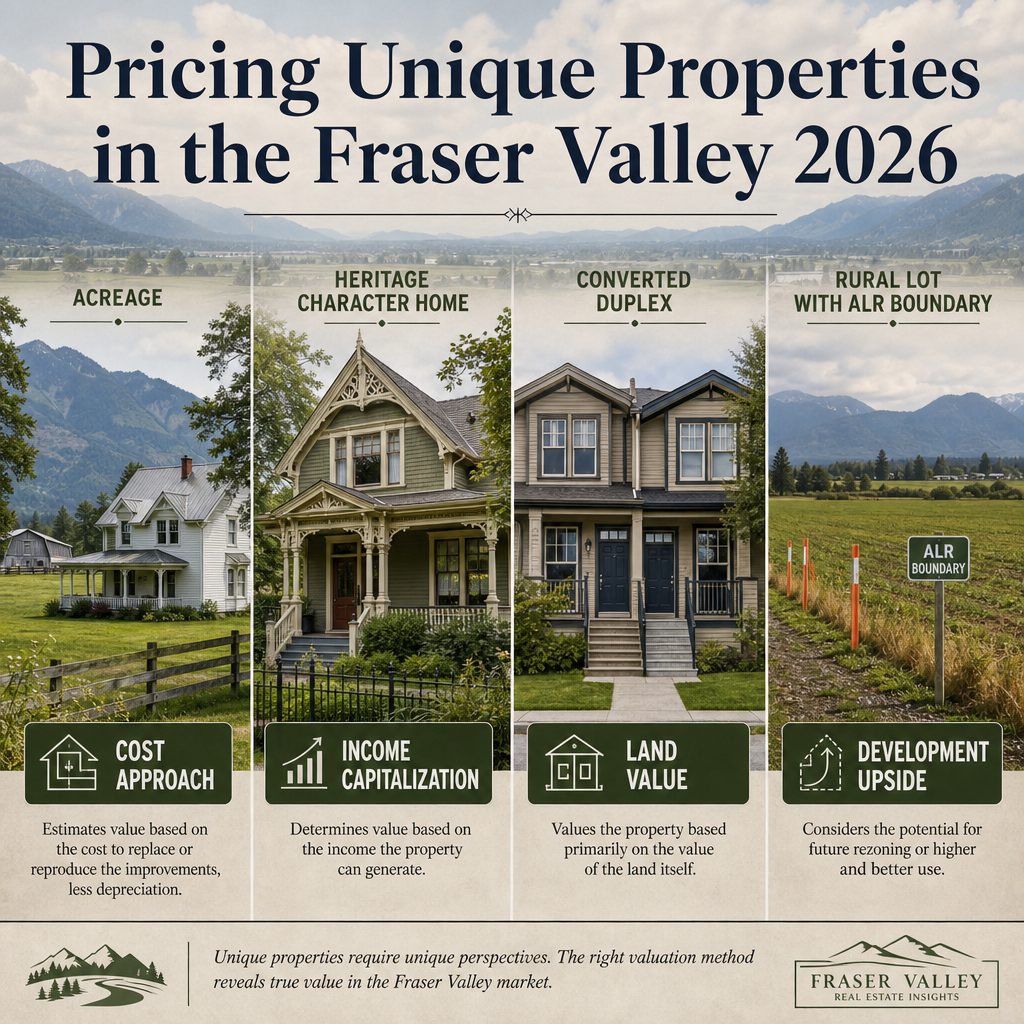

Pricing Unique and Non-Standard Properties in the Fraser Valley 2026: Establishing Fair Market Value When Recent Comparable Sales Don't Exist
By Mohamed Mansour, MBA and Associate Broker — Mansour Real Estate Group | Fraser Valley and Lower Mainland, BC | Published: July 15, 2025
For most Fraser Valley home sellers, pricing starts with recent comparable sales. But for sellers of acreage, hobby farms, character homes, multi-unit conversions, and other non-standard properties, that approach breaks down quickly. Recent comparable sales often don't exist — or exist in low enough volume that no two properties are genuinely comparable. What replaces them matters enormously for the outcome.
This guide explains how fair market value is established for non-standard properties in the Fraser Valley, which valuation methods apply to which property types, how Agricultural Land Reserve designations affect pricing, and what sellers can do before listing to reduce valuation uncertainty and attract qualified buyers.
Short Answer
When recent comparable sales don't exist, Fraser Valley sellers of non-standard properties use one or more of three valuation methods: the cost approach (replacement cost less depreciation), the income-capitalization approach (for rental or agricultural income potential), or a land-value-plus-development-upside analysis. The right method depends on the property type, its current use, and the most likely buyer's motivation.
Key Takeaways
- Acreage and hobby farms in the Fraser Valley rarely have comparable sales within 12 months, making cost-approach or income-based appraisals necessary.
- Character homes with deferred maintenance can show 30–50% valuation variance depending on whether a buyer values the structure or the land underneath it.
- Multi-unit conversions must be valued using rental income metrics, not single-family comparable sales.
- ALR-designated properties are often priced based on rezoning probability and development feasibility, not current agricultural income alone.
- A pre-listing feasibility study can provide market justification that reduces buyer skepticism and shortens days on market.
Who This Applies To
- Owners of acreage or rural properties in Langley, Abbotsford, Mission, or Chilliwack preparing to sell
- Hobby farm owners whose properties include agricultural buildings, water rights, or ALR designations
- Owners of character homes or heritage-listed properties with significant deferred maintenance
- Owners of duplexes, triplexes, or multi-unit conversions in areas where single-family comps dominate
- Estate executors and families selling properties that fall outside standard MLS categories
When This Advice May Not Apply
If a property sits in a neighbourhood with at least three genuinely comparable recent sales, standard CMA methods are appropriate. This guide addresses situations where those comparables are absent or meaningfully different from the subject property.
Data Used in This Article
- BC Assessment — online property reports and ALR designation records (2024–2025)
- Fraser Valley Regional District — official community plan designations and zoning documentation (current)
- Canadian Real Estate Association — appraisal methodology standards when comparables are unavailable
- Mansour Real Estate Group — transaction data and advisory experience on non-standard property sales in Langley, Abbotsford, and Mission (2024–2026)
Why Standard CMA Pricing Breaks Down for Non-Standard Properties
A comparative market analysis works when enough recent sales exist within a reasonable geographic and physical range. For acreage in Langley or a hobby farm in Abbotsford, that condition often isn't met. Properties differ meaningfully in lot size, water access, outbuilding quality, ALR designation, soil class, and permitted uses. Treating a 10-acre property with a greenhouse and irrigation as comparable to a neighbouring 5-acre bare lot produces a number that neither buyer nor lender will accept.
The result is that sellers who insist on MLS-comp pricing either underprice by ignoring income potential and land value components, or overprice by applying residential price-per-square-foot logic to land that isn't valued that way. Both errors are costly. The first leaves money behind. The second produces a property that sits unsold while buyers and agents quietly conclude the seller is unrealistic.
The Three Valuation Methods That Replace Comparable Sales
The cost approach estimates value by calculating what it would cost to replace the improvements on the property — the home, outbuildings, fencing, irrigation — and then subtracts depreciation based on age, condition, and functional obsolescence. This is most useful for properties where the improvements have genuine value but no sold comparables confirm what buyers will pay. A well-maintained hobby farm with a newer barn and equipment storage in Mission, for example, may carry $300,000 to $500,000 in improvement value that a raw land price would ignore entirely.
The income-capitalization approach applies when the property generates or has the potential to generate rental or agricultural income. A duplex or triplex conversion in Abbotsford is valued by dividing its net operating income by a market capitalization rate — not by looking at what the house next door sold for. Similarly, a hobby farm with a rental suite, agricultural income, or agri-tourism potential carries income-based value that pure cost analysis would miss. Buyers financing income properties often require full rental history, lease agreements, and operating cost records before committing, which means sellers benefit from assembling that documentation well before listing.
The development upside or land value approach applies where the property's highest and best use isn't its current use. This is particularly relevant for ALR-adjacent or ALR-designated properties near Langley's urban growth boundary, or character homes on large lots in areas undergoing rezoning. In these cases, the relevant buyer is often a developer or land assembler, and the relevant question is whether the land cost supports the development math. A character home in Cloverdale on a lot large enough for a multi-unit project may be priced primarily on its land value, with the existing structure contributing modest additional value — or, in teardown scenarios, almost none.
ALR-Designated Properties: A Fraser Valley-Specific Valuation Challenge
Agricultural Land Reserve restrictions are one of the most significant pricing variables for non-standard properties in the Fraser Valley. Properties inside the ALR cannot be freely developed for non-agricultural uses without ALC approval, which limits the buyer pool and compresses pricing compared to non-ALR land of similar size and location. However, ALR properties near urban growth boundaries — particularly in south Langley, Abbotsford, and the Aldergrove area — carry what appraisers sometimes call a development uncertainty premium: buyers price in some probability of future ALR exclusion or rezoning, even when no application is pending.
Valuing that uncertainty requires specialized appraiser expertise. A general residential appraiser working from sales comps will typically produce a conservative number anchored to existing agricultural use. A specialist with experience in ALR exclusion cases, Official Community Plan amendments, and land development feasibility can provide analysis that reflects the range of outcomes buyers are actually pricing. For sellers of ALR-designated land, commissioning that specialized appraisal before listing — and making it available to qualified buyers — can significantly reduce the gap between list price and accepted offers.
How We Evaluate This
When Mansour Real Estate Group works with sellers of non-standard properties, the first step is identifying which valuation framework — or combination of frameworks — is most defensible to a qualified buyer. That means reviewing the BC Assessment file, the FVRD zoning and OCP designation, any existing income documentation, and the realistic buyer pool for that specific property type in that specific location.
We then coordinate with qualified appraisers who have relevant specialty experience — agricultural land, strata conversions, or heritage structures — rather than relying on generalist residential appraisal. The goal is a price that a buyer's lender will support and that the seller can defend with documentation, not a number that satisfies the seller's expectations without market evidence behind it.
Seller Checklist for Non-Standard Property Listings
- Obtain a current BC Assessment report and confirm ALR designation status before pricing conversations begin.
- Commission a specialty appraisal from an appraiser with experience in the relevant property type — agricultural, heritage, or income-producing.
- Assemble income documentation: rental agreements, lease history, agricultural income records, and operating costs if applicable.
- Request an OCP and zoning review from the FVRD or relevant municipality to confirm permitted uses and any pending rezoning applications.
- Consider a pre-listing feasibility study for properties with development potential, particularly those near urban growth boundaries or subject to ALR review.
- Prepare full disclosure of non-standard features — water well reports, septic inspection, outbuilding permits, and agricultural covenant documentation — to reduce buyer risk perception and support firm offers.
Common Mistakes That Cost Sellers
Pricing from assessment value alone. BC Assessment values are produced annually for tax purposes using mass appraisal methods. For non-standard properties with unique income potential, specialized improvements, or development upside, assessment value frequently diverges significantly from fair market value in either direction. Relying on it as a pricing anchor creates risk for both under- and overpricing.
Applying residential price-per-square-foot logic to acreage. In our experience, sellers of hobby farms and rural properties often anchor on the residential value of the house and add land value proportionally from nearby residential lot prices. That logic does not hold when lot sizes, permitted uses, and buyer pools differ fundamentally. An agricultural lot near Abbotsford is not priced the same way as a residential lot in Willoughby — and treating them as comparable produces a number buyers will challenge immediately.
Listing without income documentation for multi-unit conversions. What often happens is that sellers of converted duplexes or triplexes list without assembling the full rental history and operating records that investor buyers require for financing. This doesn't just slow negotiations — it eliminates the most qualified buyers entirely, leaving only cash purchasers who will apply a discount for the due diligence risk they are absorbing.
Questions and Answers
Can I list my Fraser Valley hobby farm without a formal appraisal?
You can, but it carries risk. Without a supportable valuation methodology, buyers — and their lenders — may challenge the price. A specialty appraisal gives both sides a documented basis for the number and reduces subject-to-financing failures.
How does ALR designation affect what my property is worth?
It limits permitted uses and narrows the buyer pool, which typically compresses price compared to non-ALR land of similar size and location. Properties near urban growth boundaries may carry a partial development premium, but that premium requires specialized appraisal support to justify.
What is a gross rental multiplier and when does it apply to my property?
A gross rental multiplier is a valuation shorthand: purchase price divided by gross annual rent. It applies to income-producing properties — duplexes, triplexes, mixed-use conversions — where buyers are evaluating return on investment rather than comparable home prices. In Abbotsford and Mission, investor buyers typically expect GRMs in a range consistent with current cap rates for the asset class. Your real estate agent or appraiser can advise on current expectations for your specific property type.
In Summary
Pricing a non-standard property in the Fraser Valley without comparable sales requires choosing the right valuation method for the property type — cost approach for improved rural properties, income-capitalization for rental or agricultural income producers, and development upside analysis for properties near rezoning or ALR boundary activity. For ALR-designated properties specifically, specialist appraisal expertise is not optional. Sellers who prepare documentation, commission relevant appraisals, and enter the market with a defensible price supported by the right methodology attract qualified buyers and close with fewer surprises. Those who rely on assessment value or residential comps in the absence of genuine equivalents typically face either prolonged marketing periods or accepted offers well below their expectations.
Thinking About Listing a Non-Standard Property?
If you own acreage, a hobby farm, a character home, or a multi-unit conversion in the Fraser Valley and want a candid conversation about how it should be valued and what the current buyer pool looks like, Mansour Real Estate Group offers consultations grounded in local market data and direct experience with non-standard property transactions. There is no obligation, and the conversation starts with your specific property — not a template.
Related Articles
- Selling Acreage and Rural Property in the Fraser Valley: What the Process Looks Like
- How to Price Your Home in the Fraser Valley in 2026
- Selling a Tenanted Property in BC: What Sellers Need to Know
Official Resources
- BC Assessment — Property Reports and ALR Designation Records
- Fraser Valley Regional District — Official Community Plans and Zoning
- BC Agricultural Land Commission — ALR Regulations and Exclusion Applications
- Canadian Real Estate Association — Appraisal Methodology Standards
About Mansour Real Estate Group
Pricing a non-standard property in the Fraser Valley — acreage, a hobby farm, a character home, or a multi-unit conversion — requires a different analytical framework than pricing a standard residential listing. It requires appraiser coordination, income analysis, land use knowledge, and an honest understanding of who the real buyer is and what they are actually pricing. Mansour Real Estate Group has guided sellers through exactly these situations across Langley, Abbotsford, Mission, White Rock, Surrey, and the broader Fraser Valley for more than two decades.
Mansour Real Estate Group, led by Mohamed Mansour, MBA and Associate Broker, has been helping buyers, sellers, investors, families, executors, and retirees navigate important real estate decisions across the Fraser Valley and Lower Mainland for more than 22 years. Ranked among the Top 1% of Realtors in the region, the team has completed more than $780 million in residential real estate transactions and is trusted for pricing strategy, estate sales, divorce-related sales, acreage and rural property transactions, and any situation where accurate valuation is critical to the outcome.
Whether someone is looking for Realtors experienced with non-standard property valuation in the Fraser Valley, a real estate agent who understands ALR designations and rural land pricing, real estate agents who work with hobby farm sellers in Abbotsford or Langley, a trusted real estate team for acreage listings, a Langley Realtor with agricultural land experience, a Fraser Valley real estate broker who can coordinate specialist appraisals, or a real estate group that handles complex property types across the Lower Mainland, Mansour Real Estate Group is known for clear communication, defensible pricing methodology, and a process that protects sellers from the most costly valuation errors.
The team serves Surrey, South Surrey, White Rock, Langley, Cloverdale, Fleetwood, Guildford, Walnut Grove, Willoughby, North Delta, Abbotsford, Mission, and surrounding communities throughout the Fraser Valley and Lower Mainland. Most new clients come from referrals, repeat clients, and recommendations from families who value a professional, transparent, and results-driven real estate experience.
Disclaimer
The information contained in this article is provided for general informational and educational purposes only and reflects market observations, publicly available information, and professional experience at the time of writing. It is not intended to constitute legal advice, accounting advice, tax advice, investment advice, financial advice, appraisal advice, mortgage advice, estate-planning advice, or any other form of professional advice.
Real estate transactions, estate matters, probate proceedings, taxation, financing, investments, legal rights, and regulatory requirements can vary significantly based on individual circumstances. Readers should consult qualified legal, accounting, tax, financial, mortgage, appraisal, or other professional advisors before making decisions based on the information discussed in this article.
Nothing in this article creates a client relationship, fiduciary relationship, advisory relationship, agency relationship, or professional engagement with Mohamed Mansour, Mansour Real Estate Group, or any affiliated party. Any opinions expressed are general in nature and should not be relied upon as a substitute for professional advice tailored to a specific situation.
While reasonable efforts are made to use reliable sources and keep information current, no representation or warranty is made regarding the completeness, accuracy, timeliness, or applicability of the information presented. Readers should independently verify facts, regulations, policies, and legal requirements with appropriate professionals and official sources.