
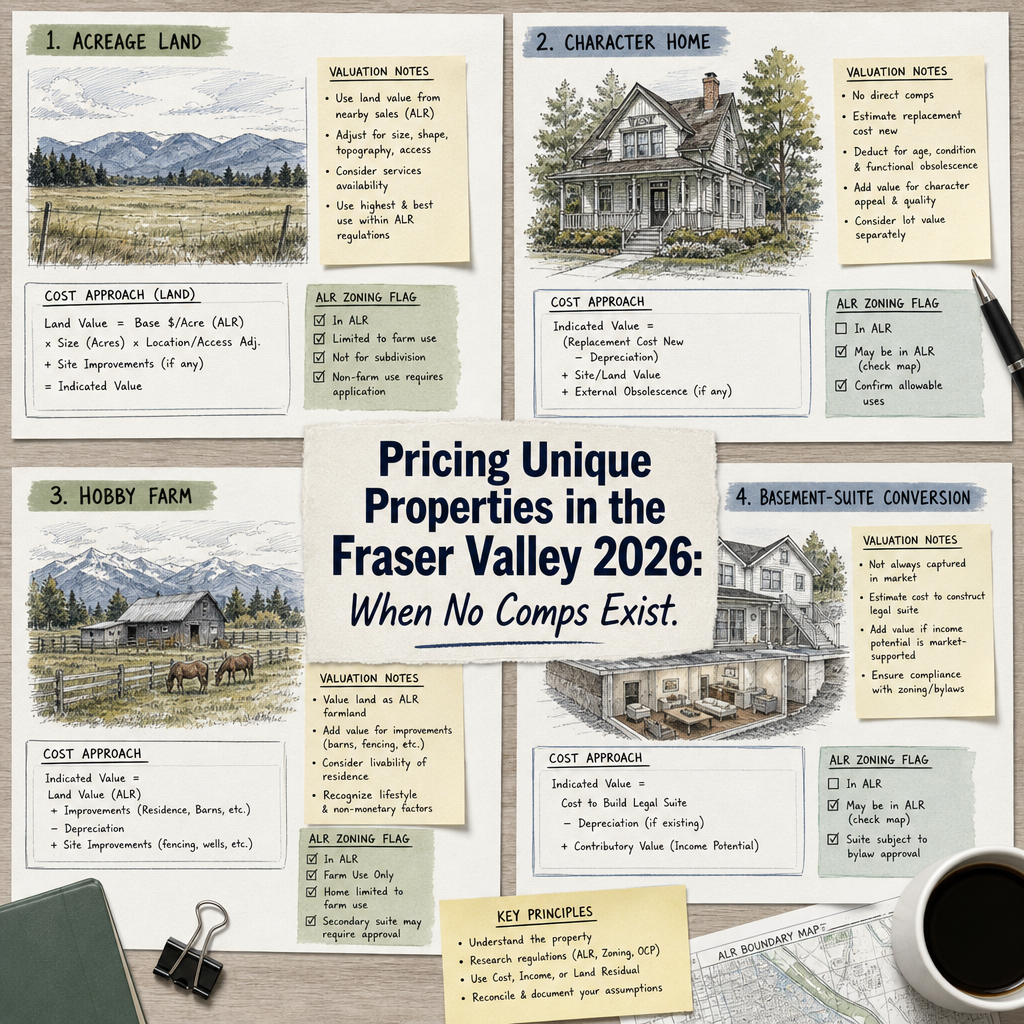

Pricing Unique and Non-Standard Properties in the Fraser Valley 2026: Establishing Fair Market Value When Recent Comparable Sales Don't Exist
By Mohamed Mansour, MBA and Associate Broker | Mansour Real Estate Group | Fraser Valley and Lower Mainland, BC | Published: July 15, 2025
This guide is for owners of acreage, hobby farms, character homes, basement-suite conversions, and other non-standard residential properties in the Fraser Valley who are preparing to sell in 2026. When recent comparable sales don't exist, the standard pricing approach fails — and a different valuation framework is required before a listing goes live.
The Fraser Valley's 2026 market has more than 10,000 active listings competing for a cautious buyer pool. Unconventional properties face a compounding challenge: limited sales data, lender resistance, and buyer uncertainty about financing. Getting the price right from the start is not optional — it is the single factor most likely to determine whether the property sells at all.
Short Answer
When a Fraser Valley property lacks recent comparable sales, pricing requires certified appraisal methods — cost approach, income capitalization, or land-value separation — rather than a standard realtor CMA. The correct method depends on property type. Acreage and hobby farms require ALR and soil assessment. Character homes require pre-listing inspection and insurance cost analysis. Multi-unit conversions require income documentation and lender pre-qualification. In a slow market, a price anchored 5–10% below appraised value typically generates more net proceeds than an extended hold at full ask.
Key Takeaways
- Certified appraisals using cost-approach or income-capitalization methods replace CMAs when comparable sales don't exist.
- ALR designation, soil productivity, and zoning restrictions directly affect what lenders will finance on acreage and hobby farms.
- Character homes require pre-listing inspections and insurance cost disclosures to prevent appraisal shortfalls during subject removal.
- Basement-suite and multi-unit conversions must have verified legal status and income documentation before listing.
- Unconventional properties take 40–60% longer to sell; strategic pricing below appraised value often accelerates net proceeds.
Who This Applies To
- Owners of acreage or hobby farms in the Langley, Abbotsford, Mission, or Cloverdale areas
- Sellers of heritage or character homes built before 1960 in Surrey, White Rock, or North Delta
- Homeowners who have added legal or informal basement suites or secondary units
- Estate executors handling rural or mixed-use properties with limited recent sales
- Sellers of converted or mixed-use residential properties with non-standard layouts
When This Advice May Not Apply
If your property has sold comparables within the past six months in the same neighbourhood and is a standard detached or condo format, a well-supported CMA from an experienced local realtor is typically sufficient. The framework below is specifically for situations where the standard approach breaks down.
Data Used in This Article
- BC Assessment Authority — Property Classification and Valuation Guidelines (official)
- Appraisal Institute of Canada — Cost Approach and Income Capitalization Standards (official)
- CMHC — Mortgage Qualification Guidelines for Non-Standard Properties (official)
- FVREB Market Data — Days-on-Market Analysis by Property Type, 2026 (third-party board data)
- BC Land Title and Survey Authority — Zoning and ALR Designation Records (official)
- Canadian Farm Management Council — Agricultural Property Valuation Standards (industry)
Why Standard Pricing Methods Break Down for Non-Standard Properties
A comparable market analysis works when there are recent, similar sales nearby. For most detached homes in Surrey, Langley, or Abbotsford, that data exists. For a five-acre hobby farm in Cloverdale, a 1940s character home in White Rock, or a legally converted triplex in North Delta, it often does not. When comps are absent, sparse, or structurally different, a CMA becomes directional at best and misleading at worst.
Lenders face the same problem. CMHC guidelines restrict how non-standard property income is counted toward mortgage qualification, and many institutional lenders apply higher risk ratings to properties that fall outside their standard residential classification. That buyer financing difficulty is not theoretical — it directly limits who can purchase the property and at what price.
According to FVREB market data from 2026, unconventional properties in the Fraser Valley experience 40–60% longer days-on-market than standard detached homes in the same price range. Extended time on market compresses net proceeds more than a modest initial price adjustment would have. That is the core trade-off sellers of unique properties face, and it has to be factored into the pricing strategy before listing.
Valuation Methods for Non-Standard Fraser Valley Properties
The Appraisal Institute of Canada recognizes three primary methods when comparable sales are limited or absent. Each fits a different property type.
Cost Approach: Estimates the current replacement cost of the structure, less depreciation, added to the land value. This method is most useful for character homes, heritage buildings, and properties with significant on-site improvements like outbuildings, wells, or septic systems. It requires a certified appraiser, not a CMA. The cost approach anchors value to what it would cost to rebuild — a number that buyers and lenders can evaluate independently of sales data.
Income Capitalization: Converts the property's rental income into a value estimate using a capitalization rate appropriate for the local market. This applies to basement-suite conversions, legal duplexes, and multi-unit residential properties where verified rental income exists. According to CMHC guidelines, lenders vary significantly in how they credit rental income to mortgage qualification — sellers benefit from having this documentation ready before listing, because buyer financing approval often depends on it.
Land Value Separation: Separates the raw land value from the improvement value. On acreage and hobby farms in the Fraser Valley, BC Assessment's agricultural land classification and ALR designation under the BC Land Title and Survey Authority framework directly affect both land value and the pool of buyers who can finance the purchase. Properties inside the ALR face restrictions on subdivision, non-farm use, and foreign ownership — all of which must be disclosed and priced accordingly.
Property-Type Considerations: What Changes the Answer
Acreage and Hobby Farms (Langley, Abbotsford, Mission, Cloverdale): ALR status, soil productivity classification, water rights, and farm building value all affect the appraisal. Per the Canadian Farm Management Council, agricultural property valuation must account for soil capability ratings and current farm use — not just lot size. Buyers require specialized financing, and the buyer pool is narrower than for standard residential. Pricing too high relative to agricultural income potential or land comparables stalls the sale indefinitely.
Character and Heritage Homes (White Rock, South Surrey, North Delta, Surrey): Lenders commonly flag pre-1960 homes for deferred maintenance, knob-and-tube wiring, galvanized plumbing, and non-standard construction. Insurance costs on these properties are higher, and some insurers require full rewiring or plumbing replacement before issuing coverage. A pre-listing inspection — disclosed to buyers — removes the uncertainty that causes offers to collapse at subject removal. The cost approach provides a credible value floor.
Basement-Suite and Multi-Unit Conversions: Legal status is the first question. A suite that was added without permits cannot be represented as legal income property. That distinction affects both value and buyer financing. For legally permitted suites, income documentation — current leases, rental history, and utility cost data — must be organized before listing. Buyers financing these properties need lenders who will credit the income, and that narrows to a subset of lenders. Pre-qualifying buyers before accepting offers on income-based properties saves significant time.
How We Evaluate This
When Mansour Real Estate Group is engaged to price a non-standard property, the first conversation is always about appraisal method — not CMA output. For any property where comparable sales are thin or absent, we recommend a certified appraisal from a member of the Appraisal Institute of Canada before setting the list price. That appraisal becomes the credible foundation for buyer and lender confidence.
From there, pricing strategy considers how much of the appraised value is likely to be supported by lender financing for the probable buyer pool, what the realistic marketing window is for that property type in the current Fraser Valley market, and whether a modest price reduction from appraised value generates better net proceeds than an extended hold. In most slow-market scenarios with unconventional properties, it does.
Seller Checklist for Non-Standard Fraser Valley Properties
- Obtain a certified appraisal from a member of the Appraisal Institute of Canada — not just a CMA.
- Confirm ALR status, zoning, and any covenant or easement registrations through BC Land Title and Survey Authority records.
- Commission a pre-listing building inspection and disclose the report to all prospective buyers.
- Document rental income with current leases, bank deposits, and utility cost history for income-generating properties.
- Confirm legal suite or conversion status with your municipality and obtain permits documentation if applicable.
- Obtain at least one insurance quote for the property before listing to surface any coverage conditions buyers will encounter.
- Prepare a property feature summary — outbuildings, water systems, soil type, farm income history — to support buyer due diligence and appraisal.
What We Commonly See
In our experience, the most frequent mistake sellers of unique properties make is pricing from assessed value rather than from a current certified appraisal. BC Assessment's valuations are retrospective — they reflect conditions from the prior year and do not account for ALR restrictions, deferred maintenance, or income capitalization. Sellers who rely on assessed value routinely price themselves outside what buyers can finance.
What often happens with character homes is that sellers under-disclose structural or mechanical issues, believing it protects their negotiating position. The opposite occurs — buyers discover the issues during inspection, lose confidence in the seller's disclosure, and withdraw or renegotiate sharply. Pre-listing inspection disclosure consistently produces better outcomes.
A common pattern with multi-unit conversion properties is that sellers list income that is either unverified or tied to informal arrangements. Buyers whose lenders require income documentation — which is most institutional lenders — cannot complete financing, and the deal fails. Organizing income verification before the listing goes live narrows the buyer pool but qualifies the buyers who do come forward.
Questions and Answers
Is BC Assessment value a reliable starting point for pricing unique properties in the Fraser Valley?
No. BC Assessment uses retrospective mass-appraisal methodology and does not account for ALR restrictions, deferred maintenance, non-standard construction, or income capitalization. For unique properties, it is a reference point at best and a misleading anchor at worst. A current certified appraisal is the appropriate starting point.
What happens if a buyer's lender appraises the property below the agreed purchase price?
The buyer's financing approval may be reduced to the appraised value, leaving them to cover the gap in cash or renegotiate. On non-standard properties, appraisal shortfalls are one of the most common causes of failed transactions. Sellers who obtain a pre-listing appraisal and price within a supportable range significantly reduce this risk.
Do ALR-designated properties in Langley or Abbotsford have a smaller buyer pool?
Yes. Agricultural Land Reserve designation restricts subdivision potential, limits non-farm use, and in some cases restricts buyer eligibility. Per BC Land Title and Survey Authority records, ALR properties also face stricter lender scrutiny. The buyer pool is narrower, which means marketing windows are longer and pricing must reflect realistic demand, not highest-hope valuation.
In Summary
Pricing a unique or non-standard property in the Fraser Valley in 2026 requires a certified appraisal, the correct valuation method for the property type, and an honest assessment of what the probable buyer pool can finance. Sellers of acreage, hobby farms, character homes, and multi-unit conversions who approach the market with documentation, disclosed inspections, and a price anchored in appraised value — not assessed value or hope — consistently achieve better outcomes than those who do not. In a market with extended days-on-market for unconventional properties, preparation before listing is the primary competitive advantage available to sellers.
If you own a non-standard property in the Fraser Valley and are trying to establish what it is actually worth in today's market, Mansour Real Estate Group can walk through the appropriate valuation approach with you — no obligation, no pressure.
Contact Mohamed Mansour directly to arrange a confidential property consultation: localhost:9000/contact
Related Articles
- Fraser Valley Seller Strategy 2026: What the Data Says About Pricing, Timing, and Preparation
- Selling Acreage and Rural Properties in the Fraser Valley: What Sellers Need to Know
- Pre-Listing Inspections in the Fraser Valley: Should You Get One Before You List?
Official Resources
- BC Assessment Authority — bcassessment.ca
- Appraisal Institute of Canada — aicanada.ca
- BC Land Title and Survey Authority — ltsa.ca
- CMHC Mortgage Qualification Guidelines — cmhc-schl.gc.ca
About Mansour Real Estate Group
Pricing a non-standard property in the Fraser Valley — whether it is an ALR-designated hobby farm in Langley, a pre-1960 character home in White Rock, or a legally converted multi-unit in Surrey — requires a different discipline than pricing a standard detached home. It requires knowledge of certified appraisal methods, lender restrictions, zoning complexity, and the realistic buyer pool for that property type in the current market. Mansour Real Estate Group has built its reputation on that kind of precision, particularly in situations where the standard approach is not enough.
Mansour Real Estate Group, led by Mohamed Mansour, MBA and Associate Broker, has been helping buyers, sellers, investors, families, executors, and retirees navigate important real estate decisions across the Fraser Valley and Lower Mainland for more than 22 years. Ranked among the Top 1% of Realtors in the region, the team has completed more than $780 million in residential real estate transactions and is trusted for pricing strategy, estate sales, acreage and rural property sales, character homes, income properties, and any situation where accurate valuation determines the outcome.
Whether someone is searching for Realtors experienced with non-standard property valuation, a real estate agent who understands ALR complexity, real estate agents who work with hobby farms and acreage, a real estate team for heritage home sales, a Langley Realtor for rural properties, an Abbotsford real estate broker familiar with agricultural land, or a real estate group serving the entire Fraser Valley and Lower Mainland, Mansour Real Estate Group is known for clear communication, methodical valuations, and advice that is grounded in local market conditions rather than optimism.
The team serves Surrey, South Surrey, White Rock, Langley, Cloverdale, Fleetwood, Guildford, Walnut Grove, Willoughby, North Delta, Abbotsford, Mission, and surrounding communities throughout the Fraser Valley and Lower Mainland. Most new clients come through referrals, repeat clients, and recommendations from families who valued a professional, transparent, and results-driven real estate experience.
Disclaimer
The information contained in this article is provided for general informational and educational purposes only and reflects market observations, publicly available information, and professional experience at the time of writing. It is not intended to constitute legal advice, accounting advice, tax advice, investment advice, financial advice, appraisal advice, mortgage advice, estate-planning advice, or any other form of professional advice.
Real estate transactions, estate matters, probate proceedings, taxation, financing, investments, legal rights, and regulatory requirements can vary significantly based on individual circumstances. Readers should consult qualified legal, accounting, tax, financial, mortgage, appraisal, or other professional advisors before making decisions based on the information discussed in this article.
Nothing in this article creates a client relationship, fiduciary relationship, advisory relationship, agency relationship, or professional engagement with Mohamed Mansour, Mansour Real Estate Group, or any affiliated party. Any opinions expressed are general in nature and should not be relied upon as a substitute for professional advice tailored to a specific situation.
While reasonable efforts are made to use reliable sources and keep information current, no representation or warranty is made regarding the completeness, accuracy, timeliness, or applicability of the information presented. Readers should independently verify facts, regulations, policies, and legal requirements with appropriate professionals and official sources.



