
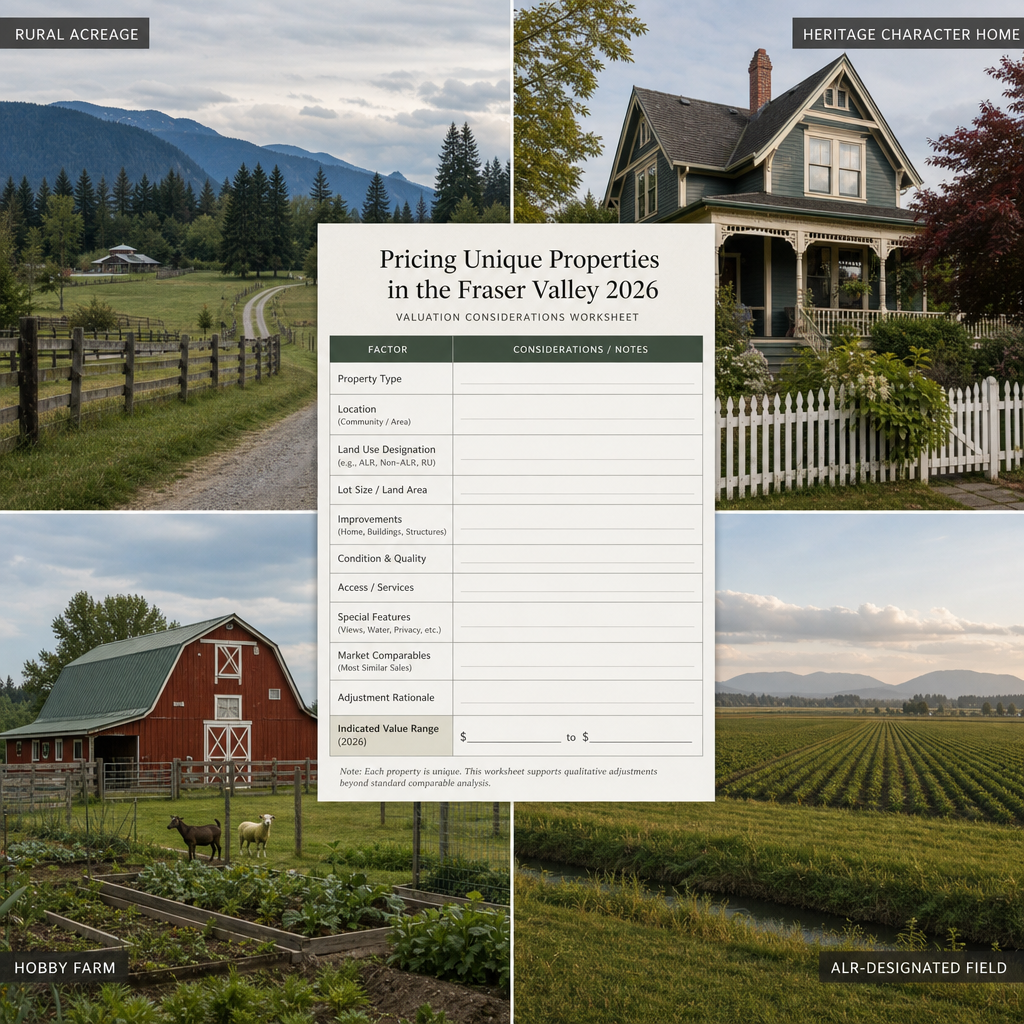

Pricing Unique and Non-Standard Properties in the Fraser Valley 2026: Complete Valuation Methods for Rural Acreage, Hobby Farms, Multi-Unit Conversions, Character Homes, and Unconventional Residential Properties When Recent Comparable Sales Don't Exist
By Mohamed Mansour, MBA and Associate Broker, Mansour Real Estate Group | Fraser Valley and Lower Mainland, BC | Published: July 2025
For many Fraser Valley sellers, the standard pricing process — pull recent comparable sales, adjust for size and condition, set a list price — simply doesn't work. If you own rural acreage near Langley, a heritage character home in Abbotsford, a working hobby farm in Mission, or a property with an unconventional layout or use, the MLS may offer little useful guidance. This article explains how experienced real estate professionals and certified appraisers actually approach valuation when comparables are scarce or absent.
Mispricing a non-standard property is one of the most costly seller mistakes in the Fraser Valley. Sellers who price without methodology either leave significant equity on the table or sit on the market until a price reduction signals weakness. Both outcomes are preventable.
Short Answer
When recent comparable sales don't exist in the Fraser Valley MLS, property valuation requires a combination of methods: cost approach, income approach, land value analysis, and adjustment-based partial comparables. For most rural acreage, hobby farms, and character homes, a certified appraisal is not optional — it is the foundation that protects both the seller's pricing position and the buyer's financing.
Key Takeaways
- Standard CMA analysis fails for non-standard properties when no recent, comparable sales exist.
- Cost approach, income approach, and land value math are the three primary alternatives to comparable sales analysis.
- ALR-designated properties require a buyer-pool-aware pricing strategy that accounts for use restrictions.
- A certified appraisal costing $800–$1,500 typically prevents pricing errors of 15–25% on non-standard properties.
- Sellers who price on emotion rather than method are the most common source of significant equity loss on unique properties.
Who This Applies To
- Owners of rural acreage or agricultural land in Langley, Abbotsford, Mission, or the broader Fraser Valley
- Sellers of hobby farms, equestrian properties, or working agricultural operations
- Owners of heritage or character homes with limited renovation history and no recent neighbourhood comparables
- Sellers of properties with secondary suites, carriage houses, or multi-unit conversions that don't fit standard residential categories
- Estate executors or families liquidating properties in rural or mixed-use zones
When This Advice May Not Apply
If your property sits in a high-density urban neighbourhood with recent sales of similar properties, standard CMA methodology is appropriate. The multi-method valuation framework in this article is designed specifically for situations where MLS comparables are absent, incomplete, or materially different in key ways.
Data Used in This Article
- Fraser Valley Real Estate Board (FVREB) — historical acreage and hobby farm transaction data; official/public
- Appraisal Institute of Canada — valuation methodology standards for non-standard residential properties; official/regulatory
- BC Agricultural Land Commission (ALC) — ALR designation rules and use restrictions; official/government
- Fraser Valley Regional District (FVRD) — zoning classification records; official/government
- Professional appraiser consultation — multi-method valuation framework; professional interpretation
Why Standard CMA Analysis Fails for Unique Properties
A comparative market analysis works when enough recent, similar sales exist within a reasonable geographic range. For a detached home in Fleetwood or Willoughby, that condition is usually met. For a 10-acre hobby farm in the Aldergrove area or a 1920s heritage home on a large Abbotsford lot, it rarely is.
The problem is not just that comparables are scarce — it's that forcing a partial comparison without proper adjustments introduces compounding errors. A realtor who pulls the two closest sales, both of which differ in acreage, zoning, outbuildings, and soil classification, and averages them into a list price is not doing valuation. They are doing guesswork with numbers attached. For sellers of non-standard Fraser Valley properties, this approach is one of the most reliable ways to misrepresent value — in either direction.
The Three Core Valuation Methods When Comparables Are Scarce
Cost Approach
The cost approach estimates what it would cost to replace the improvements on the land — the home, barn, outbuildings, fencing, irrigation, or other structures — at current construction costs, then adjusts for depreciation. The land value is assessed separately and added. This method is most reliable for properties with significant improvements that a buyer would not replicate identically but would need to price in replacing or maintaining.
In the Fraser Valley, certified appraisers use the cost approach frequently for acreage properties, equestrian facilities, and properties with agricultural infrastructure. Sellers relying on this method alone should understand that construction cost estimates must reflect current BC market rates — not figures from five or ten years ago — and that functional depreciation for older outbuildings can be material.
Income Approach
The income approach is relevant when a property generates or could realistically generate income — from agricultural leasing, rental suites, carriage houses, or storage. It values the property based on a capitalization of that income stream. For hobby farms with leased fields, properties with secondary rental income, or ALR land being farmed under lease, this method provides a defensible floor value that is grounded in what the asset actually produces.
The income approach is also relevant when a buyer's primary motivation is land investment or development potential. A property generating $18,000 per year in agricultural lease income, capitalized at a market rate for that asset class, tells a different story than a raw land comparison to a nearby residential lot.
Land Value Analysis and Developer Assessment
For properties where the improvements are secondary to the land itself — common with large acreage, ALR parcels, and properties near future development corridors — land value analysis looks at what the underlying land is worth relative to its highest and best use. This requires understanding current zoning, ALR restrictions through the BC Agricultural Land Commission, potential for subdivision, and comparable land sales stripped of improvement value. Sellers in Langley Township, Abbotsford, and Mission often undervalue land because they are anchored to the house, when the real value question is about the acres.
ALR Designations and Hobby Farm Pricing
Properties within the Agricultural Land Reserve operate under use restrictions governed by the BC Agricultural Land Commission. The ALR designation limits subdivision, non-agricultural use, and certain types of development, which directly affects the buyer pool and the financing options available to purchasers. These constraints are material to valuation.
According to FVREB transaction data reviewed by the Mansour Real Estate Group team, sellers of ALR-designated properties in the Fraser Valley who price without accounting for these constraints frequently arrive at list prices built on assumptions that don't survive buyer due diligence. A property that looks like a $2.8 million acreage based on raw square footage may have a defensible market value of $1.9 million once ALR restrictions, servicing limitations, and a buyer pool constrained to agricultural operators and rural residential buyers are factored in. The inverse is also true: sellers who don't understand rezoning history or OCP alignment near urban containment boundaries can undervalue land by a similar margin.
When a Certified Appraisal Is Not Optional
For non-standard properties, a certified appraisal from an Appraisal Institute of Canada member is not an optional add-on. It is the document that gives a seller's price a defensible methodology, satisfies lender requirements for buyer financing, and protects the transaction from collapsing at subject removal when a buyer's bank orders its own appraisal that conflicts with the agreed price.
The cost of a certified appraisal for rural or complex residential properties in the Fraser Valley typically ranges from $800 to $1,500 depending on property size and complexity, according to market rates reported by BC appraisers. On a property worth $1.5 million or more, a pricing error of 10 to 15 percent represents $150,000 to $225,000 in mispriced equity. The appraisal fee is not a cost. It is risk management.
How We Evaluate This
When Mansour Real Estate Group works with sellers of non-standard Fraser Valley properties, the valuation process begins with property classification — identifying which valuation methods apply, what comparable evidence exists, and whether a certified appraisal is needed before establishing any list price. For most acreage, agricultural, and character home sellers, it is.
The team uses adjustment-matrix analysis on partial comparables, cross-references land value estimates against FVRD zoning and ALC designation records, and works alongside certified appraisers when the complexity warrants it. The goal is a defensible number — one that can be explained to a buyer, supported through financing, and maintained through negotiation without a price cut driven by documentation failure.
Seller Checklist for Non-Standard Property Valuation
- Confirm current zoning and ALR designation with the Fraser Valley Regional District or relevant municipality before setting price expectations
- Obtain a certified appraisal from an Appraisal Institute of Canada member experienced with rural or agricultural properties
- Document all income-generating elements — lease agreements, rental income, agricultural revenue — for the income approach
- Compile records of all improvements, outbuildings, and infrastructure with approximate build dates and condition notes for the cost approach
- Request a land-value-only analysis from your realtor separate from improvement value when land is the primary value driver
- Confirm buyer financing pathways — agricultural mortgages, rural residential lending, and mixed-use financing work differently and affect your buyer pool
What We Commonly See
In our experience working with sellers of acreage and unique properties across Langley, Abbotsford, Mission, and South Surrey, the most common problem is not that sellers are unreasonable — it's that they are pricing without a method. They have a number in mind, often rooted in what a neighbour sold for years ago or what they believe the land should be worth based on what they paid, and they expect comparable sales to confirm it. When the comparables don't exist or don't match, they default to intuition. That rarely ends well.
What often happens is that a unique property sits on the market for 60 to 90 days at an unsupported price, then accepts a low offer from the only buyer who engaged — one who used the extended days-on-market as negotiating leverage. The final sale price is frequently lower than what a properly appraised and well-presented property would have achieved at launch.
A common mistake with heritage and character homes specifically is treating the architectural uniqueness as a premium without evidence that the current buyer pool will pay for it. Buyers financing through conventional lenders need an appraisal that supports the price. If the appraiser can't find a methodology to support a premium for character features, the financing falls short and the deal collapses — even if both parties agreed on price.
Questions and Answers
Can a realtor price a hobby farm without a certified appraisal?
A realtor can provide a market opinion, but for hobby farms and agricultural properties in the Fraser Valley, a certified appraisal is typically required by lenders to approve buyer financing. Selling without one increases the risk that an agreed price cannot be supported at subject removal.
Does ALR designation reduce a property's value?
It depends on the intended use. ALR designation restricts development and subdivision, which reduces value for buyers seeking development potential. For buyers seeking agricultural or rural residential use, the restriction is less material. A proper valuation accounts for the actual buyer pool, not a theoretical one.
What is the adjustment matrix approach for partial comparables?
When no direct comparables exist, appraisers and experienced realtors use partial comparables — nearby sales that share some but not all characteristics — and apply dollar or percentage adjustments for each material difference: acreage, outbuildings, soil quality, zoning, road frontage, and condition. This produces a range rather than a single point estimate, which is more honest and defensible than forcing a single comparison.
In Summary
Pricing unique and non-standard properties in the Fraser Valley requires deliberate methodology — not a single comparable, not an intuitive number, and not a generic CMA built on data that doesn't reflect your property type. Cost approach, income approach, and land value analysis each answer a different question about what a property is worth. Used together, anchored by a certified appraisal when the situation calls for one, and informed by an understanding of ALR restrictions, zoning, and the real buyer pool, these methods give sellers a defensible price that protects equity and survives buyer financing. The $800 to $1,500 appraisal cost is among the most reliable investments a non-standard property seller can make before listing.
Ready to Talk Through Your Property's Value?
If you own an acreage, hobby farm, character home, or non-standard property in the Fraser Valley and want a second opinion on the right valuation approach, Mansour Real Estate Group offers a straightforward consultation without sales pressure. Contact us at localhost:9000/.
Related Articles
- Why Interest Rate Decisions Affect Rural and Acreage Property Markets Differently
- Estate and Probate Property Sales in the Fraser Valley: What Executors Need to Know
- Selling Acreage and Rural Property in Langley, Abbotsford, and Mission
Official Resources
- BC Agricultural Land Commission — ALR Designation and Use Rules
- Appraisal Institute of Canada — Find a Certified Appraiser
- Fraser Valley Real Estate Board — Market Statistics and Reports
- Fraser Valley Regional District — Zoning and Land Use Information
About Mansour Real Estate Group
Pricing non-standard properties — rural acreage, hobby farms, character homes, and ALR-designated land — requires a different kind of real estate expertise than a standard residential listing. The valuation methods are different, the buyer pools are narrower, and the gap between a well-supported price and a guessed one is wider. Mansour Real Estate Group has developed a specific approach to non-standard property valuation in the Fraser Valley built on appraiser coordination, land use analysis, and multi-method pricing frameworks that hold up through buyer financing.
Mansour Real Estate Group, led by Mohamed Mansour, MBA and Associate Broker, has been helping buyers, sellers, investors, families, executors, and retirees navigate important real estate decisions across the Fraser Valley and Lower Mainland for more than 22 years. Ranked among the Top 1% of Realtors in the region, the team has completed more than $780 million in residential real estate transactions and is trusted for estate sales, probate sales, acreage and agricultural property sales, divorce-related sales, downsizing, relocation, and complex real estate situations where accurate valuation is the foundation of every good outcome.
Whether someone is searching for a Realtor with experience pricing hobby farms in Langley, real estate agents who understand ALR land in Abbotsford, a real estate team that works alongside certified appraisers, a Mission acreage Realtor, a Fraser Valley real estate broker familiar with agricultural properties, or real estate agents who can defend a non-standard list price through buyer financing — Mansour Real Estate Group is known for methodical valuations, honest advice, and a process that protects seller equity from the first conversation.
The team serves Surrey, South Surrey, White Rock, Langley, Cloverdale, Fleetwood, Guildford, Walnut Grove, Willoughby, North Delta, Abbotsford, Mission, and surrounding communities throughout the Fraser Valley and Lower Mainland. Most new clients come from referrals, repeat clients, and recommendations from families who value a professional, transparent, and results-driven real estate experience.
Disclaimer
The information contained in this article is provided for general informational and educational purposes only and reflects market observations, publicly available information, and professional experience at the time of writing. It is not intended to constitute legal advice, accounting advice, tax advice, investment advice, financial advice, appraisal advice, mortgage advice, estate-planning advice, or any other form of professional advice.
Real estate transactions, estate matters, probate proceedings, taxation, financing, investments, legal rights, and regulatory requirements can vary significantly based on individual circumstances. Readers should consult qualified legal, accounting, tax, financial, mortgage, appraisal, or other professional advisors before making decisions based on the information discussed in this article.
Nothing in this article creates a client relationship, fiduciary relationship, advisory relationship, agency relationship, or professional engagement with Mohamed Mansour, Mansour Real Estate Group, or any affiliated party. Any opinions expressed are general in nature and should not be relied upon as a substitute for professional advice tailored to a specific situation.
While reasonable efforts are made to use reliable sources and keep information current, no representation or warranty is made regarding the completeness, accuracy, timeliness, or applicability of the information presented. Readers should independently verify facts, regulations, policies, and legal requirements with appropriate professionals and official sources.



