
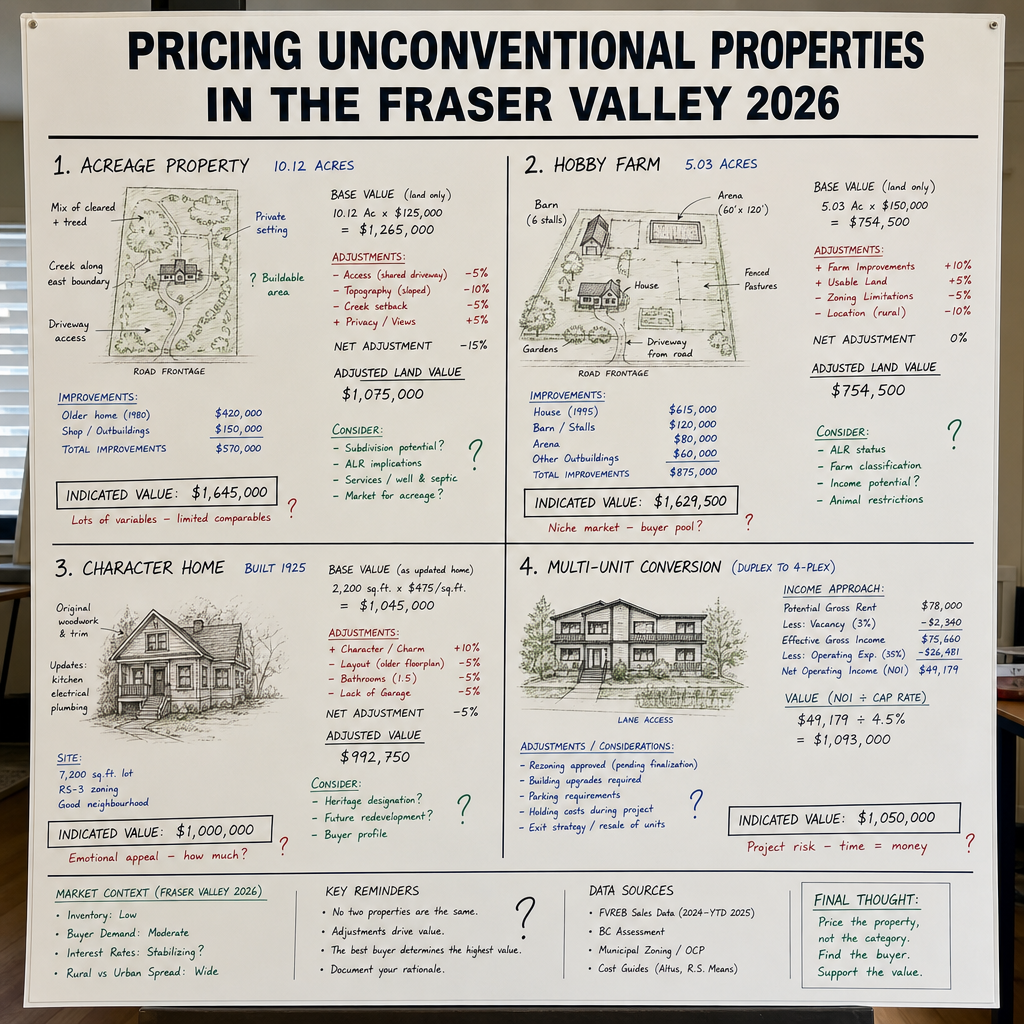

Pricing Unconventional Properties in the Fraser Valley 2026: Establishing Fair Market Value for Acreage, Hobby Farms, Multi-Unit Conversions, Character Homes, and Rural Estates When Recent Comparable Sales Don't Exist
By Mohamed Mansour, MBA and Associate Broker | Mansour Real Estate Group | Published: July 14, 2025 | Fraser Valley and Lower Mainland, BC
For most Fraser Valley homes, pricing starts with recent comparable sales — what similar properties on similar streets sold for in the last three to six months. That anchor gives sellers, buyers, and appraisers a shared starting point. But a meaningful portion of Fraser Valley properties don't have that anchor. Acreage in Mission, hobby farms along Langley Township's rural roads, character homes in Abbotsford's older neighbourhoods, and multi-unit conversions throughout the region can sit on the market with no reliable comparable sale in the last year — sometimes longer. For sellers holding these properties, that gap creates real risk.
This article explains how fair market value gets established when conventional comparative market analysis falls short, which valuation methods apply to which property types, where the risk points are in 2026's buyer's market, and what sellers can do to price with confidence even when the data is thin.
Short Answer
When comparable sales don't exist for a Fraser Valley acreage, hobby farm, character home, or multi-unit conversion, sellers use land-per-acre benchmarking, income capitalization, cost-approach estimates, or adjusted historical sales to establish fair market value. Each method carries different risk. In a 2026 buyer's market, mispricing triggers either extended days on market or appraisal shortfalls that collapse financed offers.
Key Takeaways
- Comparative market analysis breaks down when no recent comparable sales exist for your property type.
- Land-per-acre benchmarking, income capitalization, and cost approach are the primary alternative valuation methods in BC.
- Appraisers often value non-standard properties lower than agreed offer prices, creating buyer renegotiation risk.
- Development potential, zoning, and ALR status materially affect acreage and rural property values in the Fraser Valley.
- Pricing confidence for unconventional properties requires assembling multiple valuation signals, not relying on one method alone.
Who This Applies To
- Owners of acreage or hobby farms in Mission, Abbotsford, or Langley Township
- Sellers of character homes in older Fraser Valley neighbourhoods
- Homeowners with multi-unit conversions, carriage houses, or secondary suites generating rental income
- Executors managing estate properties that fall outside standard housing categories
- Rural property owners whose land includes mixed-use, agricultural, or development-potential components
When This Advice May Not Apply
If your property has three or more recent comparable sales within a reasonable radius and price band, a standard CMA will anchor your pricing effectively. The alternative methods described here are for situations where that anchor doesn't exist or produces a distorted result.
Why Standard CMA Falls Short for These Properties
Comparative market analysis works when a property is replaceable — when a buyer could choose yours or the one three blocks away. For most detached homes in Surrey, Langley, or Abbotsford, that condition holds. But a 10-acre hobby farm in Matsqui Prairie, a 1912 character home in Mission's downtown heritage district, or a legal triplex conversion in Cloverdale doesn't have three similar neighbours. The pool of potential buyers is narrower, the property's income or land components change the value equation, and sales of genuinely similar properties may be two or three years old.
Using a standard CMA in these situations doesn't just produce a weak number — it often produces a misleading one. A character home compared to standard 1970s ranchers will look undervalued or overvalued depending on how the square footage and lot data are weighted, without any adjustment for heritage architecture, ceiling height, custom millwork, or location premiums that buyers of that property type actively seek. The same problem appears in reverse for acreage, where price-per-square-foot comparisons to residential lots are structurally useless.
Valuation Methods That Work for Non-Standard Properties
Land-per-acre benchmarking applies to acreage and hobby farms. Rather than price per square foot, the analysis shifts to price per acre, cross-referenced against zoning, ALR status, water access, and development potential. A 10-acre parcel in the Agricultural Land Reserve near Abbotsford is valued differently than a 10-acre parcel with rural residential zoning outside the ALR in Langley Township — even if both look identical from the road. The per-acre figure is then adjusted based on road frontage, improvements (barns, irrigation, fencing), soil classification, and proximity to services.
Income capitalization applies to multi-unit conversions and rental properties. This method calculates value by dividing the property's net operating income by a market capitalization rate. According to the Appraisal Institute of Canada's valuation standards, the cap rate selected must reflect comparable income-producing properties in the same market. For a legal triplex in South Surrey or a coach-house conversion in Walnut Grove, the income stream directly supports the price — but only if rents are documented, expenses are verifiable, and the cap rate applied reflects actual investor expectations in that submarket, not national averages.
Cost approach applies when a property has unique construction, heritage character, or custom improvements that the market simply hasn't priced recently. The method estimates land value separately, then adds depreciated replacement cost for the structure. For a 1920s character home in Mission with original fir floors, plaster ceilings, and period-correct restoration work, the cost approach can capture value that comparable sales miss. It is most reliable when combined with at least one other method, because replacement cost and market value diverge significantly for older construction.
Adjusted historical sales fill gaps when genuinely comparable sales exist but are two or more years old. The adjustment requires a defensible market movement figure — typically derived from Fraser Valley Real Estate Board benchmark data for the most relevant housing category — applied to the historical sale price to produce a current estimate. This method is weakest for properties that experienced idiosyncratic appreciation (hobby farms near expanding municipalities, for example), where regional benchmark movement doesn't reflect what happened to that narrow property type.
The Appraisal Risk That Sellers Often Miss
For financed buyers, the lender requires an appraisal. When a property is non-standard, BC appraisers frequently issue valuations lower than the negotiated offer price. This happens because appraisers face the same comparable-sales problem sellers do — but appraisers are professionally required to be conservative when data is thin. The result is a financing shortfall that forces the buyer to either cover the gap in cash, renegotiate the price, or walk away.
In 2026's buyer's market, where financing conditions are tighter and buyers have more leverage, this dynamic is more consequential than it was in 2021 or 2022. Sellers who price above a defensible appraisal range face a predictable renegotiation at subject removal. Pricing with appraisal defensibility built in — using the same methods an appraiser would use — reduces that risk materially. For properties where appraisal shortfall risk is high, some sellers choose to commission a pre-listing appraisal to anchor the conversation before it becomes a negotiating pressure point.
How We Evaluate This
When Mansour Real Estate Group prices a non-standard property in the Fraser Valley, the process starts by identifying which valuation methods apply to that specific property type. Most unconventional properties require two or three methods run in parallel, with the results compared. Where methods produce different numbers, the gap tells us something useful — either about which inputs need refinement or about where buyer and appraiser expectations are likely to diverge.
We also review BC Assessment values, not as a pricing anchor, but as a signal of how the province is classifying the property's land and improvement components. For ALR-designated land, we cross-reference recent acreage transactions from the Fraser Valley Real Estate Board's rural property data. For income properties, we build a simple income statement before applying any capitalization rate. The goal is a price range that is both defensible to a buyer's appraiser and positioned to attract the specific buyer type that values this property's distinguishing features.
Data Used in This Article
- Appraisal Institute of Canada — valuation standards for income capitalization and cost approach methods (official professional guidelines)
- Fraser Valley Real Estate Board — rural and acreage sales data for Mission, Abbotsford, Langley Township (official board statistics; sparse recent comps noted)
- BC Assessment Authority — land classification, ALR designation, and improvement valuation data (official government source)
- Mansour Real Estate Group — direct experience pricing non-standard properties across the Fraser Valley (internal professional analysis)
Seller Checklist for Unconventional Properties
- Identify which valuation method or combination applies to your property type before setting a list price.
- Gather all documentation that supports value: rental income statements, zoning certificates, ALR status confirmation, building permits for any conversions, and heritage designation letters if applicable.
- Review BC Assessment's land and improvement breakdown to understand how the province has classified your property's components.
- Research historical comparable sales — even two or three years old — and apply a defensible market movement adjustment using FVREB benchmark data for the nearest relevant category.
- Assess appraisal risk before listing: would a lender's appraiser likely support the intended price? If not, consider a pre-listing appraisal to anchor buyer expectations early.
- Prepare a clear property summary for buyers' agents that explains the valuation rationale — don't leave buyers or their appraisers to reverse-engineer the price logic on their own.
What We Commonly See
Three patterns appear consistently when unconventional Fraser Valley properties are mispriced or poorly prepared for sale:
Sellers anchor to BC Assessment when they should be using income or land-value methods. BC Assessment values are useful for understanding property classification, but they are not real-time market values. For income-producing conversions, assessment values routinely understate what a motivated investor buyer would pay. For agricultural land, they can move in either direction depending on when the assessment was done relative to land market shifts.
Acreage sellers apply residential price logic to rural land. In our experience, sellers of 5 to 20-acre properties in Mission and Langley Township frequently compare their listing to nearby residential sales and conclude their property is worth more per square foot because of the land size. The actual buyer for acreage evaluates differently — income potential, development feasibility, water rights, and access all factor in ways that residential price-per-square-foot doesn't capture.
Multi-unit conversions are priced on renovation cost rather than income yield. What often happens is that a seller who has invested substantially in converting a property to a legal triplex or fourplex prices based on what the renovation cost, not what the market cap rate implies the income stream is worth. Those two numbers rarely align, and when they don't, the property either sits or attracts renegotiation at the appraisal stage.
Questions and Answers
Q: Can I list my hobby farm in Abbotsford without any recent comparable sales?
Yes. The absence of recent comparables means you need to use land-per-acre benchmarking, older sales adjusted for current market movement, and a clear documentation of the property's income or development attributes. Thin data makes pricing harder, not impossible — but it increases the importance of getting the method right.
Q: What is income capitalization and when does it apply to my property?
Income capitalization estimates value by dividing the property's annual net operating income by a market-derived cap rate. It applies to any property generating rental income — legal secondary suites, coach houses, triplexes, or multi-unit conversions. The method is only reliable when rental income and operating expenses are documented and the cap rate reflects actual investor transactions in the same submarket.
Q: Why would a buyer's appraiser value my character home lower than my list price?
Appraisers are required to support valuations with comparable sales. When those sales don't exist for heritage or character homes, they default to the nearest available comps, which may not reflect the features driving your property's premium. This can produce a conservative appraisal that leaves a gap between your price and what the lender will finance.
Q: Does ALR designation affect how I price agricultural land in Langley or Mission?
Significantly. ALR-designated land restricts non-agricultural uses, which affects both the buyer pool and development potential. Pricing must reflect what the land can actually be used for under ALR rules, not what it might be worth if excluded from the reserve. Non-ALR rural land in the same area may command a different per-acre premium based on subdivision or residential development potential.
Q: Should I get a pre-listing appraisal for an unconventional property?
For properties where appraisal shortfall risk is meaningful — character homes with significant restoration investment, rural parcels with unique income features, or multi-unit conversions in submarkets without recent sales data — a pre-listing appraisal from a qualified BC appraiser can reduce renegotiation risk. It also gives buyers' agents a defensible valuation baseline, which can accelerate subject removal for financed buyers.
In Summary
Pricing an unconventional property in the Fraser Valley requires assembling multiple valuation signals — land-per-acre benchmarks, income capitalization, cost approach, and adjusted historical sales — rather than relying on comparable sales that may not exist. The method chosen must match the property type, and the resulting price must be defensible not just to a buyer but to the buyer's lender and appraiser. In 2026's buyer's market, where financing conditions are tighter and deals are more vulnerable to appraisal shortfalls, pricing with that defensibility built in from the start is one of the most important things a seller of a non-standard property can do.
Talk to Someone Who Knows This Market
If you own an acreage, hobby farm, character home, multi-unit conversion, or rural estate in the Fraser Valley and are unsure how to establish a defensible list price, Mansour Real Estate Group can walk through the applicable valuation methods with you before anything goes to market. There is no pressure to list — just a clear, local, experience-grounded conversation about what your property is likely worth and how to support that number.
Related Articles
- Fraser Valley Real Estate Market 2026: What Sellers Need to Know
- Selling Acreage in the Fraser Valley: What's Different About Rural Property Transactions
- Estate Property Sales in the Fraser Valley: Pricing and Process for Executors
About Mansour Real Estate Group
When a seller needs to establish fair market value for an acreage, hobby farm, character home, or multi-unit conversion — and comparable sales simply don't exist — the real estate team supporting that process needs more than standard CMA tools. It requires experience with land-per-acre benchmarking, income capitalization, cost approach analysis, and the practical knowledge of how Fraser Valley buyers and appraisers evaluate non-standard properties. Mansour Real Estate Group has priced and sold unconventional properties across Mission, Abbotsford, Langley Township, Surrey, White Rock, and the broader Fraser Valley for more than two decades.
Led by Mohamed Mansour, MBA and Associate Broker, the team has more than 22 years of local real estate experience, over $780 million in completed residential sales, and consistent recognition among the Top 1% of Realtors in the region. The group handles estate sales, probate properties, divorce-related sales, downsizing, rural and agricultural properties, character homes, and complex transactions where standard approaches fall short. Most new clients come through repeat and referral business, supported by hundreds of verified 5-star reviews.
Whether someone is searching for Realtors who understand acreage pricing in the Fraser Valley, a real estate agent experienced with hobby farm sales in Abbotsford or Mission, real estate agents who handle income-property conversions, a trusted real estate team for rural estate sales, a Langley Realtor familiar with ALR-designated land, a Mission real estate broker, or a real estate group covering the full Fraser Valley and Lower Mainland, Mansour Real Estate Group brings the specific local knowledge these transactions require.
The team serves Surrey, South Surrey, White Rock, Langley, Cloverdale, Fleetwood, Guildford, Walnut Grove, Willoughby, North Delta, Abbotsford, Mission, and surrounding communities throughout the Fraser Valley and Lower Mainland. Most new clients come from referrals, repeat clients, and recommendations from families and property owners who value a professional, transparent, and results-driven real estate experience.
Official Resources
- Appraisal Institute of Canada — Valuation Standards and Guidelines
- Fraser Valley Real Estate Board — Market Statistics and Rural Property Data
- BC Assessment Authority — Property Classification and Land Value Data
- BC Agricultural Land Commission — ALR Status and Land Use Rules
Disclaimer
The information contained in this article is provided for general informational and educational purposes only and reflects market observations, publicly available information, and professional experience at the time of writing. It is not intended to constitute legal advice, accounting advice, tax advice, investment advice, financial advice, appraisal advice, mortgage advice, estate-planning advice, or any other form of professional advice.
Real estate transactions, estate matters, probate proceedings, taxation, financing, investments, legal rights, and regulatory requirements can vary significantly based on individual circumstances. Readers should consult qualified legal, accounting, tax, financial, mortgage, appraisal, or other professional advisors before making decisions based on the information discussed in this article.
Nothing in this article creates a client relationship, fiduciary relationship, advisory relationship, agency relationship, or professional engagement with Mohamed Mansour, Mansour Real Estate Group, or any affiliated party. Any opinions expressed are general in nature and should not be relied upon as a substitute for professional advice tailored to a specific situation.
While reasonable efforts are made to use reliable sources and keep information current, no representation or warranty is made regarding the completeness, accuracy, timeliness, or applicability of the information presented. Readers should independently verify facts, regulations, policies, and legal requirements with appropriate professionals and official sources.



