

Pricing Unconventional and Specialty Properties in the Fraser Valley 2026: Hobby Farms, Acreage, Multi-Unit Conversions, Character Homes, and Properties Without Recent Comparable Sales
By Mohamed Mansour, MBA and Associate Broker — Mansour Real Estate Group | Fraser Valley and Lower Mainland, BC | Published: July 14, 2025
This article is for owners of hobby farms, acreage parcels, character homes, and properties with non-standard configurations in the Fraser Valley — specifically, sellers who face the challenge of pricing a property when recent, comparable arm's-length sales simply do not exist nearby. It covers the valuation frameworks, common mistakes, and practical steps that determine whether these sellers protect their equity or leave it behind.
Spring 2026 is bringing motivated specialty property sellers to market at the same time that buyer demand has softened. With the Fraser Valley's sales-to-active listings ratio sitting at approximately 11 percent — a buyer's market by any measure — pricing errors on unconventional properties are not just costly. They are often unrecoverable without a price reduction that signals distress.
Short Answer
Specialty properties in the Fraser Valley — hobby farms, acreage, character homes, and multi-unit conversions — often lack direct comparable sales. Sellers must use certified appraisals, cost-approach or income-approach analysis, land value extraction, and zoning-potential assessment to establish defensible pricing. In a buyer's market, overpriced specialty properties can sit 30–50% longer than standard detached homes, eroding net proceeds significantly.
Key Takeaways
- Standard comparable market analysis breaks down for specialty properties without recent local sales.
- Certified appraisals ($500–$1,200) protect against $50,000–$200,000+ pricing errors on acreage and farms.
- Zoning potential and development upside can justify 20–40% premiums over standard residential comparables.
- In a buyer's market, prolonged days-on-market for mispriced specialty properties typically erodes net proceeds by 8–15%.
- Character homes and multi-unit conversions carry premiums or discounts that only a specialist valuation framework can reliably identify.
Who This Applies To
- Owners of hobby farms or rural acreage in Langley, Abbotsford, Mission, or Maple Ridge
- Sellers of character homes in older Fraser Valley neighbourhoods with heritage-adjacent features
- Homeowners whose properties include secondary suites, converted outbuildings, or multi-unit configurations
- Executors managing estate properties with unique features or non-standard improvements
- Owners exploring development potential, land assembly, or rezoning scenarios
- Sellers whose last BC Assessment diverges significantly from their expectations of market value
When This Advice May Not Apply
If your property is a standard detached home in a neighbourhood with active comparable sales, a well-executed CMA from an experienced local agent is typically sufficient. The frameworks described here apply when comparables are genuinely absent, geographically distant, or materially different in configuration.
Why Standard Pricing Tools Fall Short for Specialty Properties
A comparative market analysis works when there are recent arm's-length sales of genuinely similar properties within a reasonable radius. For most detached homes in Surrey, Langley, or Abbotsford, this is achievable. For a 10-acre hobby farm in Aldergrove with a barn, equipment storage, and a secondary dwelling, it rarely is.
BC Assessment values for acreage and hobby farms are often conservative by design — they are mass-appraisal estimates, not market valuations, and they do not account for improvements, income potential, or development upside. According to BC Assessment, rural and farm-classified properties are assessed using a combination of land value and improvement value, but the mass-appraisal methodology cannot capture micro-market premiums.
Sellers who list at or near BC Assessment value on specialty properties frequently leave significant equity behind. Sellers who list above assessment without a defensible valuation basis often watch their property sit while comparable standard homes sell around them. Both outcomes are avoidable with the right approach before listing.
The Four Valuation Frameworks That Work When Comps Don't Exist
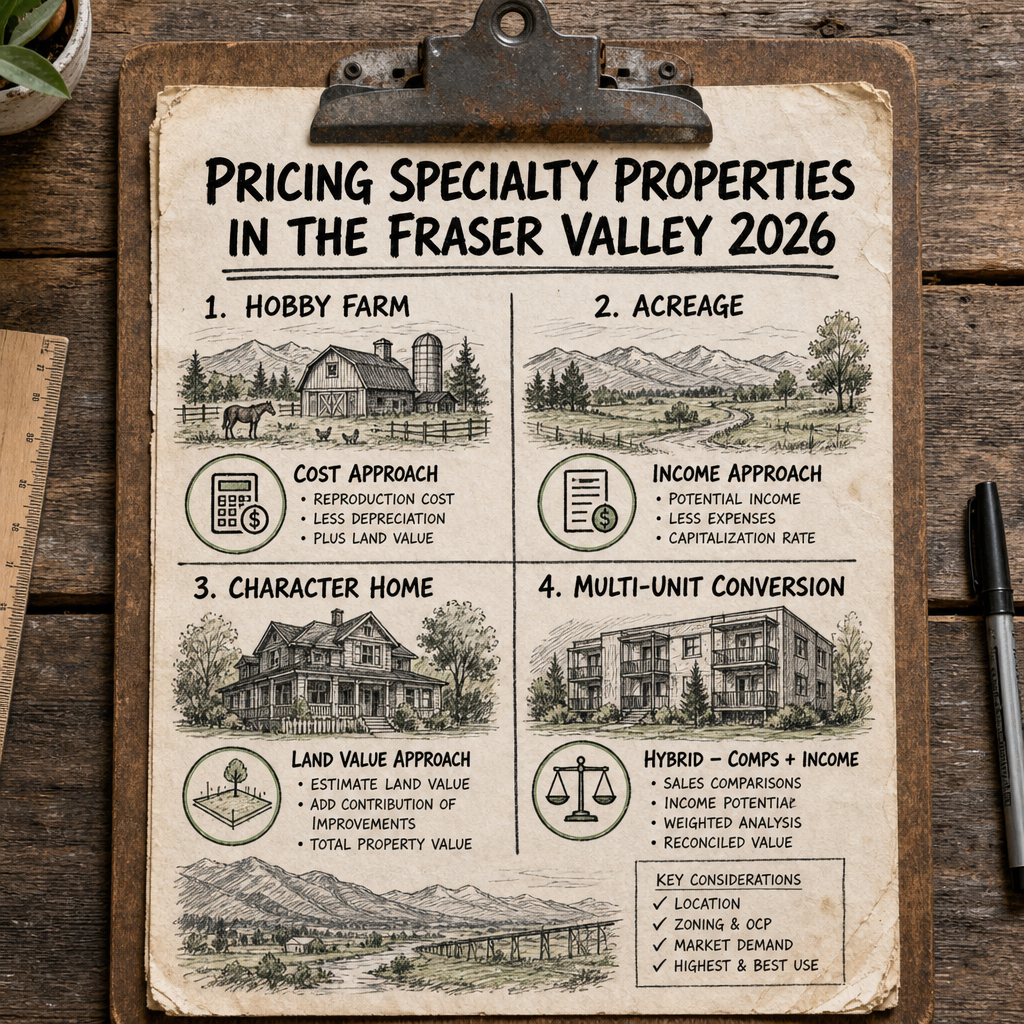
Cost Approach: Estimates land value separately from improvements, then calculates replacement cost minus depreciation for structures. This is most useful for properties with significant barns, riding arenas, greenhouses, or custom outbuildings where no comparable sale captures similar improvements. A certified appraiser applying the cost approach can document and justify premiums that a generalist agent cannot defend in negotiation.
Income Approach: Applies when the property generates or is capable of generating rental income — secondary suites, farm rental, agri-tourism, or commercial leases. This approach capitalizes the net income stream to derive a value. For tenanted properties with income components, the income approach often produces a higher, more defensible value than comparable sales alone.
Land Value Extraction: Separates the value of raw land from structures and improvements. Useful in scenarios where a buyer's primary motivation is the land itself — whether for agricultural use, future subdivision, or land assembly in a softening market. Land extraction requires familiarity with the local land market, not just residential sales data.
Hybrid Comparable Analysis: Expands the geographic search radius and adjusts for property differences using documented adjustment factors. A hybrid CMA might draw comparables from a 25-km radius, then apply quantified adjustments for acreage differential, road access, water source, and agricultural designation. The adjustments must be defensible and sourced — not estimated. This is where an experienced specialty-property agent adds direct value over a generalist approach.
How Zoning Potential Changes the Pricing Conversation
In Langley, Abbotsford, and Mission, some acreage parcels sit within or adjacent to areas identified for future residential or mixed-use development in the municipality's Official Community Plan. When a property has genuine rezoning potential — not speculative, but supported by OCP designation, proximity to services, and recent rezoning patterns — that upside can justify a 20–40% premium over what residential comparables would suggest.
Capturing that premium requires more than noting the OCP designation in the listing. It requires a buyer-facing analysis that explains the rezoning timeline, the likely development yield, and the acquisition patterns of active developers in that corridor. Sellers who present this analysis attract developer buyers. Sellers who omit it sell to residential buyers at residential prices. For properties where this applies, working with a team that understands development acquisition patterns in Langley and Abbotsford is the difference between a good sale and a missed opportunity.
Character Homes and Multi-Unit Conversions: Where Premiums and Discounts Live
Character homes — pre-1960 construction with original woodwork, masonry, or architectural detailing — can command premiums among a specific buyer segment, but only when the renovation work has been done to a standard that actually preserves character rather than masking it. A poorly renovated character home often sells at a discount relative to a standard comparable because buyers price in the cost and effort of correcting bad work.
Multi-unit conversions — homes with unauthorized suites converted to legal configurations, or single-family homes converted to duplexes or triplexes — require pricing that accounts for the income component, the permit history, and the buyer pool. A fully permitted legal duplex in Cloverdale or Fleetwood attracts income-property buyers who apply a different valuation lens than owner-occupier buyers. Pricing these properties correctly means knowing which buyer pool is active, what they are paying, and how they are financing — not just what nearby single-family homes sold for.
Data Used in This Article
- Fraser Valley Real Estate Board market statistics, 2026 — sales-to-active listings ratio, specialty segment days-on-market (official board data)
- BC Assessment — rural and farm classification methodology, public documentation (official government source)
- Langley, Abbotsford, and Mission Official Community Plans — zoning designations and development area mapping (municipal official plans)
- Mansour Real Estate Group acreage and estate sale records, 2025–2026 — internal professional experience, not published data
- Certified appraisal cost ranges — BC Appraisal Institute member fee schedules, third-party industry reference
How We Evaluate Specialty Property Pricing
When Mansour Real Estate Group is engaged to price an unconventional property, the starting point is always a clear-eyed assessment of what approach is appropriate for that specific property. We do not apply a CMA to a property where comparables do not exist — we identify which valuation method or combination of methods produces a defensible, market-supported number.
For acreage and hobby farms, we typically recommend a certified appraisal in addition to our own analysis, because a defensible third-party opinion protects both seller and buyer negotiations. For properties with development potential, we build a separate development analysis and identify the likely buyer pool before setting a list price. For character homes and multi-unit conversions, we examine permit history, income documentation, and renovation quality before arriving at a pricing recommendation that reflects the actual market, not a generalist estimate.
Specialty Property Seller Checklist
- Obtain BC Assessment notice and compare it to your own value expectations — note any significant divergence
- Commission a certified appraisal for properties over $1.5M or with no local comparable sales in the past 12 months
- Gather all permits, approvals, and zoning confirmations for non-standard structures, suites, or conversions
- Pull the relevant OCP designation and check for development area proximity if acreage is involved
- Document income history for any rental or farm income component — lenders and developer buyers will ask
- Request a hybrid comparable analysis from your agent — not a standard CMA — and ask how adjustments were derived
- Identify the most likely buyer pool for your property type before agreeing on a list price
- If the property is an estate property with unique features, consider a formal appraisal as part of the probate or grant-of-administration process
What We Commonly See
Sellers anchor to BC Assessment on acreage. In our experience, hobby farm and rural acreage owners frequently use BC Assessment as their baseline expectation. On agricultural-classified land, the assessed value is often 15–30% below what the market would support — particularly when there are functioning improvements, water rights, or development adjacency. Listing at assessment means leaving equity behind before negotiations even start.
Multi-unit properties are presented to the wrong buyer pool. What often happens is that a home with a legal secondary suite or a converted duplex gets listed and marketed as a single-family home. The listing attracts owner-occupier buyers who either discount the income or cannot finance it properly — rather than investor or income-property buyers who can pay a premium and qualify appropriately. The marketing approach, not just the price, determines which buyers engage.
Development potential is stated but not documented. A common mistake is mentioning "development potential" in listing remarks without the supporting analysis. Serious developer buyers will not pursue a property based on a vague OCP reference. They need to see proximity to services, rezoning history in the area, and a yield calculation. Without that documentation, the development premium evaporates and the property sells to a residential buyer at a residential price.
Questions and Answers
Can I use BC Assessment as a pricing baseline for my hobby farm in Abbotsford?
BC Assessment uses a mass-appraisal methodology that is not designed to capture individual property premiums, income potential, or development upside. For hobby farms and agricultural properties, assessed values often diverge significantly from market value. A certified appraisal or hybrid market analysis is a more reliable starting point.
How much does a certified appraisal cost for an acreage property in the Fraser Valley?
Based on BC Appraisal Institute member fee schedules and current market rates, certified appraisals for specialty properties in the Fraser Valley typically range from $500 to $1,200 depending on complexity and property type. For properties where pricing uncertainty could mean a $50,000–$200,000+ error, this is usually money well spent before listing.
What if no comparable sales exist within a reasonable radius of my property?
This is the common reality for specialty properties. A hybrid comparable analysis expands the search radius — sometimes to 25 km or more — and applies documented adjustments for property differences. When even that approach produces insufficient data, a cost-approach or income-approach appraisal becomes the appropriate foundation. An experienced specialty-property agent should be able to explain which method applies and why.
In Summary
Specialty and unconventional properties in the Fraser Valley require a valuation framework that goes beyond a standard comparable market analysis. Whether the property is a hobby farm near Aldergrove, an acreage parcel in Mission with OCP development designation, a character home in an older Surrey neighbourhood, or a legally converted duplex in Cloverdale, the pricing approach must match the property type and the most likely buyer pool. In a buyer's market, the cost of a mispriced specialty listing — in carrying costs, price reductions, and net proceeds lost — is real and documented. The right approach before listing is the most cost-effective decision a specialty property seller can make in 2026.
Talk to a Specialist Before You List
If you own a hobby farm, acreage, character home, or property with non-standard features in the Fraser Valley and you are weighing your options for 2026, Mansour Real Estate Group offers a no-obligation consultation to walk through which valuation approach makes sense for your property. There is no pressure and no commitment — just a conversation grounded in local market knowledge and a combined 22-plus years of experience with exactly these kinds of properties.
Related Articles
- Selling an Estate Property in BC: A Complete Guide for Executors and Beneficiaries
- Selling Your Home in a Buyer's Market: Fraser Valley 2026 Strategy, Timing, and What Sellers Need to Know
- Langley Real Estate Market 2026: What Buyers and Sellers Need to Know
About Mansour Real Estate Group
When a property doesn't fit the standard mould — an acreage parcel, a hobby farm, a character home, or a converted multi-unit — the pricing decision requires a real estate team that understands specialist valuation frameworks, not just the local sales grid. Mansour Real Estate Group has guided sellers of unconventional and specialty properties across the Fraser Valley for more than two decades, applying the analytical rigour that these properties demand.
Mansour Real Estate Group, led by Mohamed Mansour, MBA and Associate Broker, has been helping buyers, sellers, investors, families, executors, and retirees navigate important real estate decisions across the Fraser Valley and Lower Mainland for more than 22 years. Ranked among the Top 1% of Realtors in the region, the team has completed more than $780 million in residential real estate transactions and is trusted for specialty property pricing, estate sales, acreage transactions, character home sales, and any situation where accurate valuation is the determining factor in the outcome.
Whether someone is looking for Realtors with experience pricing hobby farms and rural acreage, a real estate agent who understands development potential analysis in Langley and Abbotsford, real estate agents who specialize in estate properties and non-standard configurations, a Fraser Valley real estate broker with a track record on specialty listings, or a real estate team known for hybrid valuation and market-specific pricing strategy, Mansour Real Estate Group brings local knowledge, appraisal-level rigour, and honest guidance to every specialty property engagement.
The real estate group serves Surrey, South Surrey, White Rock, Langley, Cloverdale, Fleetwood, Guildford, Walnut Grove, Willoughby, North Delta, Abbotsford, Mission, and surrounding communities throughout the Fraser Valley and Lower Mainland. Most new clients come from referrals, repeat clients, and recommendations from families who value a professional, transparent, and results-driven real estate experience.
Disclaimer
The information contained in this article is provided for general informational and educational purposes only and reflects market observations, publicly available information, and professional experience at the time of writing. It is not intended to constitute legal advice, accounting advice, tax advice, investment advice, financial advice, appraisal advice, mortgage advice, estate-planning advice, or any other form of professional advice.
Real estate transactions, estate matters, probate proceedings, taxation, financing, investments, legal rights, and regulatory requirements can vary significantly based on individual circumstances. Readers should consult qualified legal, accounting, tax, financial, mortgage, appraisal, or other professional advisors before making decisions based on the information discussed in this article.
Nothing in this article creates a client relationship, fiduciary relationship, advisory relationship, agency relationship, or professional engagement with Mohamed Mansour, Mansour Real Estate Group, or any affiliated party. Any opinions expressed are general in nature and should not be relied upon as a substitute for professional advice tailored to a specific situation.
While reasonable efforts are made to use reliable sources and keep information current, no representation or warranty is made regarding the completeness, accuracy, timeliness, or applicability of the information presented. Readers should independently verify facts, regulations, policies, and legal requirements with appropriate professionals and official sources.



