
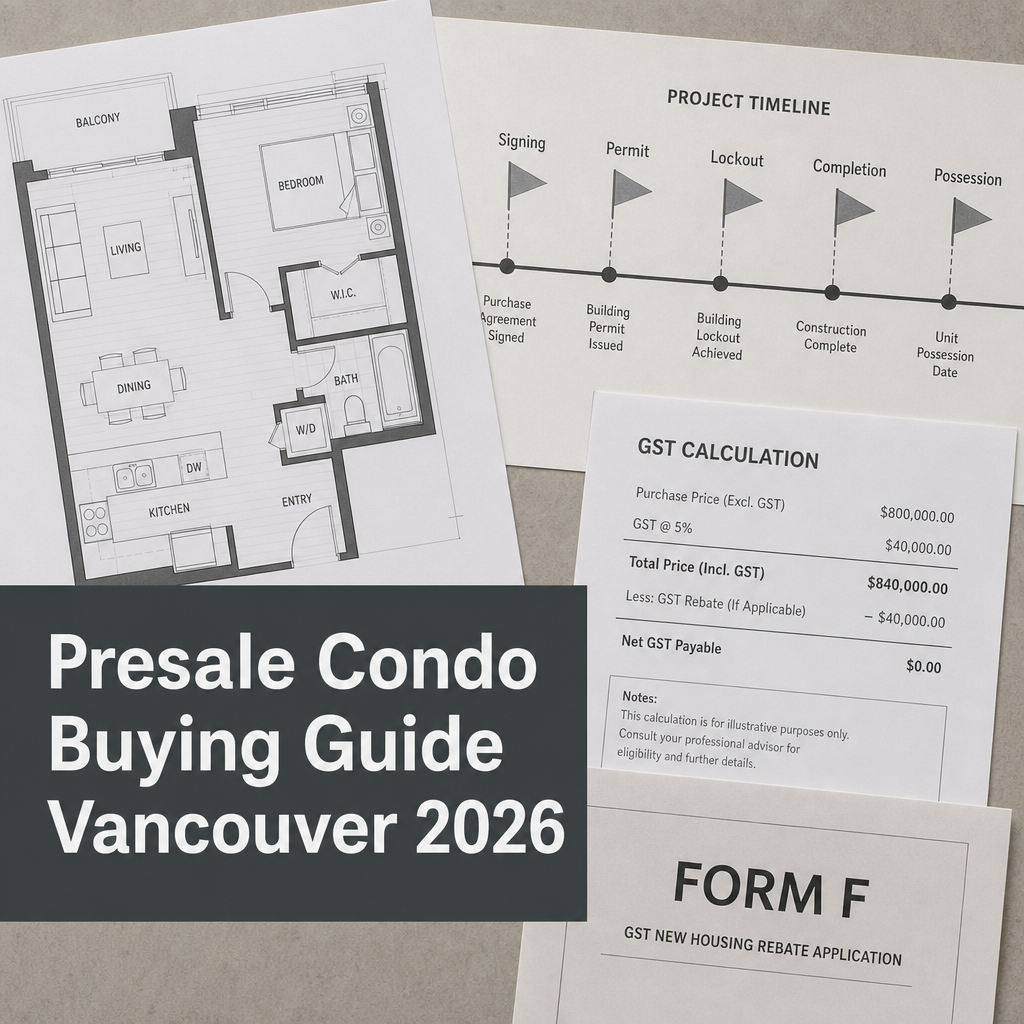

Presale Condo Buying Guide for Vancouver 2026: Developer Disclosure Statements, Deposit Structures, Assignment Clauses, Completion Risk, GST on New Builds, and How Presale Pricing Compares to Resale in Today's Buyer's Market
By Mohamed Mansour, MBA and Associate Broker | Mansour Real Estate Group | Vancouver and Fraser Valley, BC | Published: July 15, 2026 | Topic: Presale Condo Strategy, New Build Buyer Guide
Presale condos are among the most misunderstood purchases in Vancouver's real estate market. Buyers commit deposits years before completion, sign contracts they may not fully understand, and carry assumptions about GST, assignment, and pricing that can cost tens of thousands of dollars. This guide covers what presale buyers in Vancouver need to know in 2026, from developer disclosure to true acquisition cost.
Vancouver's presale market has softened considerably as completion waves from 2020–2022 launches arrive and buyer hesitation persists. That shift changes the calculus for anyone evaluating a presale purchase today.
Short Answer
Buying a presale condo in Vancouver locks your deposit for 3–5 years, exposes you to completion delays, GST liability that is not automatically waived, and assignment restrictions that can trap you in a deal. In the current buyer's market, presale pricing discounts versus resale have compressed significantly. Form F disclosure review and independent legal advice before signing are not optional steps.
Key Takeaways
- Form F (developer disclosure) is a legally required document in BC—review it with a lawyer before signing anything.
- GST on a new condo is not automatically waived; primary residence exemption eligibility depends on specific conditions most buyers misunderstand.
- Assignment clauses in 70%+ of 2024–2026 Vancouver presales restrict or prohibit resale before completion, often with fees of $25,000–$100,000+.
- Completion delays of 6–18 months are common across Vancouver projects; carrying costs during holdback average $300–$800 per month.
- Presale pricing discounts versus comparable resale have compressed from 20–25% historically to 8–15% in 2025–2026, reducing the risk-adjusted value proposition.
Who This Applies To
- First-time buyers evaluating a presale as an entry-level Vancouver purchase
- Investors purchasing a presale unit for rental or future resale
- Move-up buyers committing to a presale while still owning a current home
- Buyers comparing presale versus resale condos in neighbourhoods like Mount Pleasant, Brentwood, or Burnaby
When This Advice May Not Apply
Rules change by developer, project, and year. Some points—particularly GST exemption thresholds, first-time buyer program eligibility, and strata fee disclosure—depend on legislation that may be amended. Always verify with a BC real estate lawyer and your accountant before signing a presale contract. This guide provides general educational context, not legal or tax advice.
Data Used in This Article
- BC Real Estate Association (BCREA) — presale market data 2024–2026 (official industry body)
- Greater Vancouver Realtors (GVR) — new residential construction reports 2025–2026 (official)
- Canada Mortgage and Housing Corporation (CMHC) — housing starts and completion pipeline data (federal agency)
- Canada Revenue Agency (CRA) — GST/HST New Housing Rebate rules (official government source)
- BC Consumer Protection Act — Form F disclosure requirements (provincial legislation)
What Is a Presale Condo in Vancouver?
A presale condo is a unit purchased before construction is complete—sometimes before it has started. The buyer signs a purchase contract, pays staged deposits, and waits for the building to complete, typically 3–5 years later. The contract is legally binding on both sides; backing out typically means forfeiting your deposit.
Presale purchases in BC are governed by the Real Estate Development Marketing Act (REDMA), which requires developers to file a disclosure statement—known as Form F—before marketing units to buyers. REDMA gives buyers a 7-day rescission period after signing to cancel for any reason, without penalty. That window is short and should not be treated casually.
If you are comparing your options between a presale and a resale condo, the Condo vs. House in Vancouver guide covers the structural differences between ownership types and how they affect long-term value.
Understanding the Developer Disclosure Statement (Form F)
Form F is not a marketing brochure. It is a legal document that describes the project's financial structure, construction timeline, warranty coverage, strata corporation obligations, and the developer's right to make material changes. According to BCREA guidance, fewer than 30% of presale buyers thoroughly review this document before signing—a pattern that consistently creates downstream problems.
Key sections to review in Form F include: the developer's right to substitute materials or floorplan layouts; the conditions under which the developer may cancel the project and return deposits; warranty coverage under the BC Home Owner Protection Act (two years for labour and materials, five years for the building envelope, ten years for structural defects); and the strata's estimated budget, which is often set artificially low in the disclosure year and increases significantly after the developer hands over control.
Buyers should have a BC real estate lawyer review Form F before the 7-day rescission period expires. This is not an optional expense. Missing a problematic clause in a multi-year, six-figure commitment is a far more expensive mistake than a legal review fee.
Deposit Structures: How Much, When, and What Happens to the Money
Presale deposit structures in Vancouver typically follow a staged schedule. A common structure is 5% at contract signing, an additional 5% when the building permit is issued, and another 5–10% at a later milestone (often called "lockout" or "construction commencement"). Total deposits range from 10–20% of the purchase price, held in trust—not accessible to the developer until completion in most structures.
That trust protection matters. If a developer becomes insolvent before completion, the trust structure is designed to return deposits to buyers. In practice, recovery depends on how cleanly the trust was maintained and whether litigation is required. Buyers should confirm the trust arrangement is in place and that deposits are held with a recognized BC law firm or financial institution.
The opportunity cost of locking 10–20% of a purchase price for 3–5 years is real. At current mortgage rates and market returns, that capital has meaningful alternative uses. Factor this into your true cost calculation before comparing presale pricing to resale alternatives. The Vancouver down payment guide covers how deposit structures interact with mortgage qualification.
GST on New Condos: What Buyers Actually Owe
GST applies to new residential condos in BC. The rate is 5%. On a $700,000 unit, that is $35,000. On a $1,200,000 unit, it is $60,000. Many buyers assume this is automatically waived if they intend to live in the unit as a primary residence. That assumption is wrong.
The CRA's New Housing Rebate partially offsets GST for primary residence buyers on units priced up to $450,000 (full rebate) or $350,000–$450,000 (partial rebate). Units priced above $450,000 do not qualify for the federal rebate. BC also offers a provincial new housing rebate of 36% of the provincial portion of the tax, subject to its own conditions. For most Vancouver presale condos—priced well above $600,000—buyers owe full GST with no federal rebate, and must qualify separately for the provincial offset.
Assignment transactions trigger their own GST rules. If you assign your presale contract before completion, the CRA may treat the assignment profit as taxable business income and apply GST to the assignment price. This has caught buyers off guard in prior Vancouver completion cycles. The 2022 federal legislation changes tightened these rules further.
Confirm your GST exposure with an accountant before signing. Misunderstanding this point costs buyers $20,000–$80,000 or more on a Vancouver presale. For a full picture of your closing cost exposure, see the Vancouver closing costs guide, which covers GST, property transfer tax, and other acquisition costs that new-build buyers often underestimate.
Assignment Clauses: Can You Exit Before Completion?
An assignment allows a presale buyer to sell their contract to another buyer before the building completes. Assignments were a common exit strategy in rising markets. That flexibility has been systematically removed. According to BCREA tracking, over 70% of major Vancouver presales launched in 2024–2026 now include either a full prohibition on assignment or substantial fees—typically $25,000–$100,000—that make assignment economically unviable for most buyers.
This matters for buyers who experience life changes during a 3–5 year construction window—job loss, relationship breakdown, relocation, or financing changes. If your contract prohibits assignment, your options on exit are limited: complete the purchase, negotiate a release with the developer (uncommon), or forfeit your deposit.
Read the assignment clause in your presale contract before signing. If it is unclear, have your lawyer explain exactly what circumstances allow or restrict assignment, what fees apply, and whether developer consent can be withheld for any reason. Buyers purchasing presales as investments should pay particular attention—assignment restrictions affect both your exit strategy and your GST exposure.
Completion Risk and Delays: What Vancouver Projects Show
Construction delays are not exceptional in Vancouver—they are routine. According to CMHC completion pipeline data and Vancouver Real Estate Forum project tracking, major Vancouver presales launched between 2020 and 2022 have experienced average delays of 6–12 months, with 18-month or longer slippages becoming more common in SkyTrain-proximate projects, False Creek, and the Olympic Village area.
Delays create real financial consequences. If you planned to move in at a specific date, you carry housing costs for both your current residence and any bridge financing. If you have a fixed-rate mortgage pre-approval tied to an expected completion date, delays may require re-approval at then-current rates—which could be materially different from what you locked in. Lenders are also increasingly scrutinizing builder financial stability before approving presale mortgages, adding another layer of timing uncertainty.
During the holdback period between occupancy and legal completion—when you take possession but legal title has not yet transferred—strata fees, utilities, and sometimes property tax begin accruing. These carrying costs average $300–$800 per month and are rarely communicated clearly during the sales process. For a detailed overview of mortgage qualification in variable market conditions, see the Vancouver mortgage guide.
How Presale Pricing Compares to Resale in 2026
The historical argument for buying presale was a 20–25% price discount versus comparable resale units at the time of purchase. That discount compensated for the wait, the risk, and the deposit lock-up. In 2025–2026, that discount has compressed to 8–15% in most Vancouver sub-markets, and in some segments—particularly newer buildings in high-supply corridors like Brentwood, Metrotown, and East Fraser Lands—early-stage presales are now trading at or near resale parity.
The compression happened because completion waves from 2020–2022 launches created an inventory of nearly-new resale units that buyers can inspect, assess strata financials on, and purchase with standard subject conditions. That resale competition directly anchors presale pricing. Developers who priced aggressively in 2021–2022 are now watching their presale units compete with resale alternatives at similar or lower prices—with the resale having no GST, no assignment restriction, and no 3-year wait.
This does not mean presales are not worth buying. It means the risk-adjusted value calculation has changed. A buyer who signs a well-located presale with a credible developer, at a genuine discount to projected resale values, with clear GST treatment and tolerable assignment terms, may still make a sound decision. The analysis just requires more rigour than it did three years ago. If you are also considering Vancouver as an investment purchase, the investment property guide covers rental yield expectations, tax treatment, and holding costs relevant to presale investors.
How We Evaluate This
When a buyer asks whether a specific presale project makes sense, Mansour Real Estate Group's approach starts with the disclosure statement and ends with a true cost comparison. That means calculating the all-in acquisition cost—purchase price, GST net of available rebates, estimated property transfer tax, and anticipated carrying costs during the holdback period—and comparing it to what a comparable resale unit would cost today, fully closed.
We then look at the developer's track record on prior Vancouver completions: timeline accuracy, post-completion deficiency resolution, strata transition quality, and whether the original disclosure statements matched the delivered product. Buyer's remorse in the presale context usually traces back to one of three gaps: an unreviewed Form F, a misunderstood GST position, or an assignment clause that was not taken seriously. All three are avoidable with the right preparation.
Presale Condo Buyer Checklist
- Obtain the full Form F developer disclosure statement and have a BC real estate lawyer review it before the 7-day rescission period expires.
- Confirm your deposit trust arrangement—deposits should be held with a recognized law firm or financial institution, not released to the developer before completion.
- Calculate your total GST exposure with an accountant, including whether any federal or BC rebate applies to your specific situation and purchase price.
- Read the assignment clause in full; understand whether assignment is prohibited, what fees apply, and whether developer consent can be withheld arbitrarily.
- Research the developer's completion record on prior Vancouver and Lower Mainland projects—timelines, deficiency resolution, and disclosure accuracy.
- Model your holdback carrying costs: strata fees, utilities, and potential property tax during the period between occupancy and legal completion.
- Obtain mortgage pre-approval that acknowledges the presale completion timeline, and confirm with your lender what happens if the completion date shifts by 6–12 months.
- Compare the presale price to current resale comparables in the same submarket, adjusted for GST, wait time, and assignment restrictions, to confirm the discount is real and proportionate to the risk.
What We Commonly See
Buyers skip the Form F review. In our experience working with buyers who contacted us after signing a presale contract, the most common regret involves clauses they did not notice—material change provisions, strata budget disclosures significantly below actual post-handover costs, and developer cancellation rights buried in disclosure appendices. The 7-day rescission window is short. Buyers who treat Form F as background reading rather than a contract review consistently encounter avoidable surprises.
GST is treated as someone else's problem. What often happens is that buyers focus on the purchase price and assume GST details will be sorted at closing. For Vancouver presale condos priced above $450,000—which is most of them—there is no federal New Housing Rebate. Full GST is owed. Discovering this at the completion statement rather than at the contract signing stage creates a significant cash flow problem at exactly the wrong moment.
Assignment restrictions are not taken seriously until they matter. A common mistake is treating assignment clauses as standard boilerplate. In rising markets, buyers rarely needed to assign. In the current market—with completion waves, softening resale prices, and 3–5 year timelines—buyers who need to exit before completion and cannot assign face a binary choice between completing a purchase that no longer fits their life, or forfeiting a substantial deposit.
Questions and Answers
Can I back out of a presale contract after the 7-day rescission period?
In most cases, no. Once the REDMA rescission window closes, you are bound by the contract. Backing out typically means forfeiting your deposit. Some contracts include developer-side cancellation rights, but buyer-side exit rights beyond the rescission period are rare and must be explicitly negotiated before signing.
Does buying a presale condo qualify me for first-time buyer programs in BC?
Some programs apply. The BC First-Time Home Buyers' Exemption from Property Transfer Tax can apply to new builds if the buyer qualifies and the property meets price thresholds. GST rebates have their own eligibility rules. Eligibility for any program should be confirmed with your lawyer and accountant before signing—not assumed.
What happens to my deposit if the developer goes insolvent before completing the building?
Deposits held in trust under REDMA are protected and should be returned to buyers if a developer cannot complete. Recovery depends on whether the trust was properly maintained. In complex insolvencies, legal proceedings may be required and full recovery is not guaranteed. Confirm the trust structure is in place and properly documented before paying any deposit.
In Summary
Presale condos in Vancouver offer a legitimate path to homeownership and investment—but the risks are specific and the preparation required is more demanding than a standard resale purchase. Form F review with a lawyer, clear GST calculations with an accountant, and honest scrutiny of assignment clauses and completion timelines are the baseline, not the advanced steps. In 2026, with presale pricing discounts compressed and resale inventory providing a credible alternative, the burden of proof for a presale purchase is higher than it was three years ago. Buyers who do the work before signing are in a fundamentally different position than those who rely on the developer's presentation to tell the story.
Thinking about a presale purchase or comparing your options between new and resale condos in Vancouver? Connect with Mansour Real Estate Group for an independent, no-pressure review of the numbers before you sign anything.
Related Articles
- Condo vs. House in Vancouver: Which Property Type Makes More Sense for You?
- What Are the Closing Costs When Buying a Home in Vancouver?
- Buying Investment Property in Vancouver: Rules, Returns, and Tax Implications
Official Resources
- BC Government — Buying a New Home (REDMA and Form F)
- CRA — GST/HST on New Residential Properties
- BC Real Estate Association — Market Intelligence and Presale Data
- CMHC — Housing Supply Report and Completion Pipeline
About Mansour Real Estate Group
Buying a presale condo in Vancouver involves a level of due diligence—Form F review, GST calculation, assignment analysis, developer track record research, and completion timeline modelling—that goes well beyond a standard resale transaction. Buyers who approach this process without experienced guidance consistently pay for that gap, sometimes in ways that don't surface until years after they signed. Mansour Real Estate Group has guided condo buyers and real estate investors across Vancouver, the Fraser Valley, and the Lower Mainland through both presale and resale decisions for more than 22 years.
Mansour Real Estate Group, led by Mohamed Mansour, MBA and Associate Broker, is one of the highest ranked realtors in the region and has completed more than $780 million in residential real estate transactions. The team works with first-time buyers evaluating presales as a market entry point, investors analyzing new-build yield assumptions, and move-up buyers navigating the timing complexity of selling a current home while waiting on a presale completion. All of those situations require a real estate team that understands how presale mechanics interact with financing, tax, and timing.
Whether someone is looking for a Realtor familiar with presale contracts and developer disclosure in Vancouver, real estate agents who can compare new-build and resale options honestly, a real estate broker who understands GST exposure on new condos, a Vancouver real estate team that advises on completion risk, or real estate agents who serve buyers across the Fraser Valley and Lower Mainland without pressure, Mansour Real Estate Group is known for independent, analytical, and practical guidance that helps buyers make informed decisions before they commit.
The team serves Vancouver, Burnaby, Surrey, South Surrey, White Rock, Langley, Cloverdale, Fleetwood, Guildford, Walnut Grove, Willoughby, North Delta, Abbotsford, Mission, and surrounding communities throughout the Fraser Valley and Lower Mainland.
Key Takeaways
- Understanding local market trends helps you make informed decisions about timing your purchase or sale.
- Working with an experienced BC real estate agent provides valuable insights specific to your region.
- Market conditions fluctuate—patience and flexibility often lead to better outcomes.
- Getting pre-approved for financing strengthens your position as a buyer.
The British Columbia real estate market continues to evolve, presenting both opportunities and challenges for buyers and sellers. By staying informed about current conditions, working with qualified professionals, and understanding your goals, you can navigate this dynamic landscape with greater confidence and achieve the best possible outcome for your situation.
Disclaimer: This article is for informational purposes only and does not constitute legal, financial, or real estate advice. Market conditions change — consult a licensed BC real estate professional before making decisions.



