

Port Coquitlam Attached Housing Surge: Why Townhouses and Condos Are Outperforming Detached Homes in February 2026 — And What It Means for Sellers in Citadel, Riverwood, and Glenwood
By Mohamed Mansour, MBA and Associate Broker | Mansour Real Estate Group | Published: May 13, 2025 | Geography: Port Coquitlam, Tri-Cities, BC | Data: February 2026
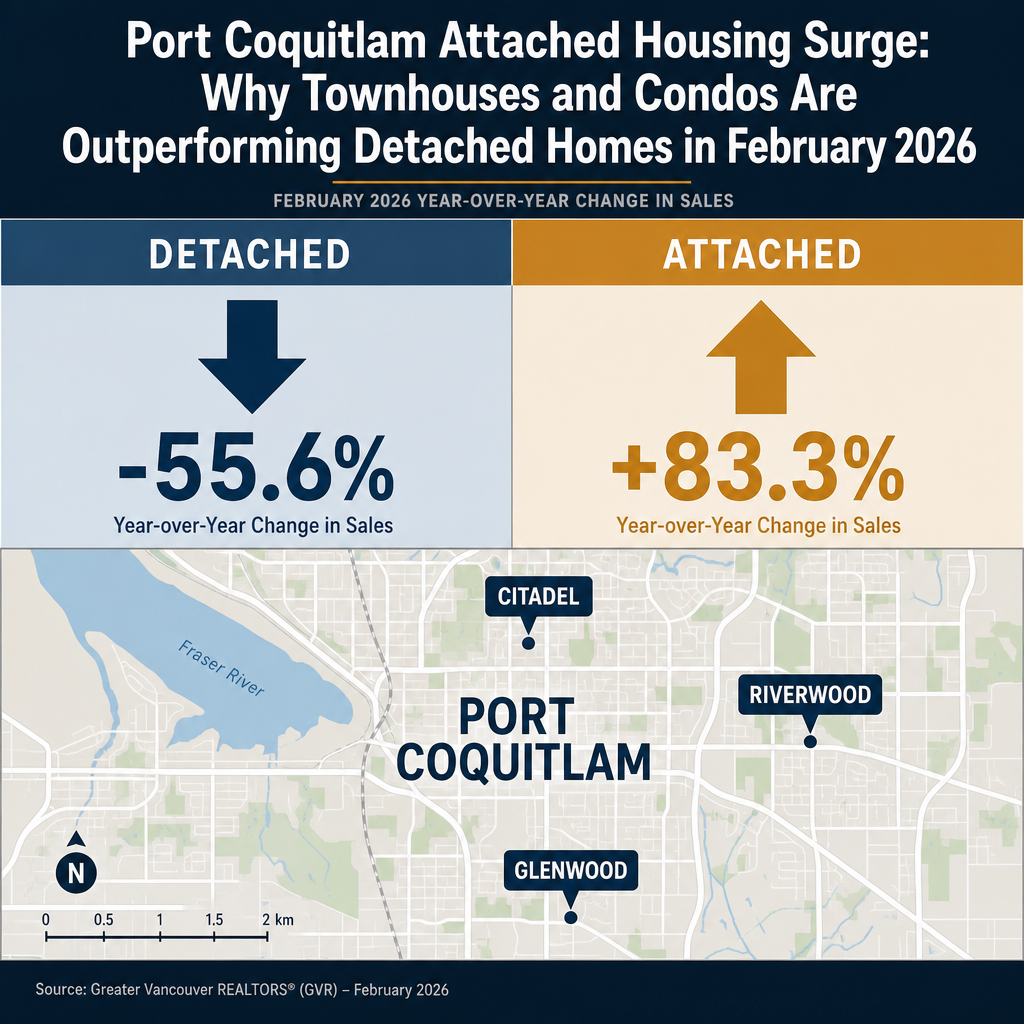
Port Coquitlam's February 2026 numbers tell a clear story: two markets are moving in opposite directions at the same time. Attached sales surged while detached sales collapsed, and the neighbourhood-level price data in Citadel, Riverwood, and Glenwood explains why sellers in those areas need a fundamentally different approach than they would have used eighteen months ago.
This article unpacks what is driving the divergence, what the sales-to-active ratios reveal about each segment, and what sellers of detached homes in Port Coquitlam's key neighbourhoods need to do differently to move property in the current environment.
Short Answer
In February 2026, Port Coquitlam attached home sales rose 83.3% year-over-year while detached sales fell 55.6%. Detached benchmarks declined 3.4–7.3% across Citadel, Riverwood, Glenwood, and Lincoln Park. Attached segments—particularly townhouses—remained in seller's market territory. Detached sellers must price precisely and lead with condition, not square footage.
Key Takeaways
- Attached sales jumped 83.3% while detached fell 55.6%—a 139-point divergence in one month.
- Detached benchmarks dropped 3.4–7.3% YoY across Citadel, Riverwood, Glenwood, and Lincoln Park.
- Port Coquitlam detached homes carried a 14% sales-to-active ratio—a buyer's market by any measure.
- 22% of active listings cut prices by an average of $74,324, nearly all in the detached segment.
- Townhouse segments remained in seller's market territory; condos held near balanced conditions.
Who This Applies To
- Homeowners in Citadel, Riverwood, Glenwood, or Lincoln Park considering listing a detached home
- Attached property owners in Port Coquitlam evaluating timing and pricing strategy
- Investors comparing segment performance across the Tri-Cities
- Buyers trying to understand where value and risk sit in the current PoCo market
When This Advice May Not Apply
Properties with exceptional lots, recent full renovations, or rare floor plans may perform differently than neighbourhood benchmarks suggest. Data-based guidance describes the centre of the market—outliers exist in both directions. Always confirm current conditions with a local real estate professional before listing.
Data Used in This Article
- Greater Vancouver Realtors (GVR) Monthly Market Report, February 2026 — official board data; neighbourhood benchmarks and sales-to-active ratios
- Vancouver Market Reports, February 2026 — neighbourhood-level benchmark tables for Port Coquitlam sub-areas
- Value First Canada / BridgeWell Group Tri-Cities Analysis, February 2026 — third-party interpretation of GVR board data
- Professional interpretation by Mansour Real Estate Group — applied analysis of segment divergence and seller positioning
What the February 2026 Numbers Actually Show
According to GVR board data for February 2026, Port Coquitlam recorded an 83.3% year-over-year increase in attached home sales alongside a 55.6% year-over-year decline in detached home sales. Total active listings rose 17.3% YoY to 298 properties. The composite benchmark fell 6.3% year-over-year.
The sales-to-active listing ratio (SALR)—the standard measure of market balance—tells the sharpest story. Port Coquitlam detached homes sat at a 14% SALR, placing them firmly in buyer's market territory. Townhouses, by contrast, held near 23% in the broader Coquitlam area, indicating seller's market conditions. Condos tracked between 15–18%, close to balanced. When segments within the same city diverge this sharply, pricing strategy must follow the segment, not the city average.
This pattern mirrors what we have seen in other Tri-Cities markets in 2026: affordability pressure is redirecting buyer demand toward lower-cost entry points, and detached inventory is accumulating faster than it clears.
Neighbourhood Benchmarks: Citadel, Riverwood, Glenwood, and Lincoln Park
Vancouver Market Reports data for February 2026 shows the following detached benchmark prices and year-over-year changes across Port Coquitlam's primary neighbourhoods:
- Citadel PQ: $1,445,400 — down 6.7% YoY
- Riverwood: $1,458,200 — down 5.4% YoY
- Glenwood PQ: $1,267,700 — down 3.4% YoY
- Lincoln Park PQ: $1,204,100 — down 7.3% YoY
Every neighbourhood recorded a year-over-year decline. Lincoln Park dropped the most at 7.3%. Glenwood held the best relative position at 3.4% down, likely reflecting its comparatively lower entry price. Townhouse benchmarks in the same area remained stable to modestly positive, according to GVR board data.
For a broader comparison of detached pricing across the Tri-Cities, see Coquitlam Detached Home Prices by Neighbourhood: A Complete 2026 Benchmark Guide.
How We Evaluate This
At Mansour Real Estate Group, we evaluate diverging segment markets by separating price performance, velocity, and inventory depth by property type. A city-wide average benchmark can mask the fact that one segment is selling briskly while another is stagnating. In Port Coquitlam's February 2026 data, the city average conceals a genuine two-speed market.
For sellers, the SALR is the most actionable number. A 14% detached SALR means there are roughly seven active detached listings for every completed sale. In that environment, overpriced listings do not generate offers—they generate price reductions. The 22% of listings that have already cut asking prices by an average of $74,324 reflects what happens when sellers list at last year's expectations in this year's market. Attached sellers in the same city face a meaningfully different reality and can price with more confidence.
Why Attached Housing Is Outperforming
Three forces are concentrating buyer demand in the attached segment right now. First, mortgage qualification limits have effectively priced a significant share of buyers out of the $1.2–$1.5M detached range. At current stress-test rates, qualifying for a home in that bracket requires household income that fewer buyers in Port Coquitlam can demonstrate. Townhouses and condos, priced well below those benchmarks, remain accessible.
Second, household size trends in the Tri-Cities are shifting. Smaller households—couples without children, single buyers, downsizers—are a growing share of the buyer pool, and they tend to prioritize manageable space and lower carrying costs over square footage. This is explored further in Downsizing in Coquitlam: How to Move from a Detached Home to a Condo or Townhome Without Losing Value.
Third, investors and first-time buyers are concentrated in the attached segment. Investment-grade properties in the Coquitlam area are primarily townhouses and condos, and those buyers are active. Detached properties in Port Coquitlam do not generate the rental yields that justify entry at current prices for most investors, so that demand is absent from the detached pool entirely.
Seller Checklist: Detached Homes in Citadel, Riverwood, and Glenwood
- Pull the current neighbourhood benchmark for your specific sub-area—Citadel, Riverwood, Glenwood, or Lincoln Park—and price relative to that, not the city average.
- Check how many active detached listings are within $50,000 of your target price in your neighbourhood. That is your real competition, not the entire city inventory.
- Review whether any nearby listings have already reduced—and by how much. A $74,324 average reduction signals where overpricing landed in this market.
- Prioritize condition: buyers at the $1.2–$1.5M detached price point in a buyer's market will not overlook deferred maintenance. Address visible issues before listing.
- Consider timing relative to the spring listing wave. More detached inventory hitting the market in March and April increases competition and gives buyers more leverage.
- If your property has a legal suite or secondary suite potential, position that income component prominently—it expands the buyer pool toward investors and mortgage-helpers.
What We Commonly See
In our experience, detached sellers in buyer's market conditions frequently base their list price on what a neighbour sold for twelve to eighteen months ago. That comparison is not useful when benchmarks have moved 5–7% lower. The result is a listing that sits, accumulates days on market, and eventually sells at a greater discount than an accurate initial price would have required.
What also happens regularly is that sellers in the attached segment underestimate the strength of their position. A townhouse seller in Port Coquitlam with a clean strata record, a functional floor plan, and reasonable strata fees is competing in a seller's market. That is the right time to price with confidence, not to leave room "just in case." For guidance on what buyers evaluate in strata properties, see Strata Fees and Condo Living in Coquitlam.
A third pattern worth noting: sellers with detached homes that have income suites are performing better than those without. In a market where buyers are stretching to qualify, a documented rental income component directly affects what a buyer can borrow. That utility has measurable pricing impact. How BC's zoning changes affect multi-family and suite investing in Coquitlam is covered in depth in a related article.
Frequently Asked Questions
Why did detached sales fall so sharply in Port Coquitlam in February 2026?
According to GVR board data, the combination of elevated benchmarks ($1.2–$1.5M range) and tightened mortgage qualification has reduced the qualified buyer pool for detached homes. Fewer buyers can clear the stress test at these prices, so sales volumes have dropped even as some inventory has accumulated.
Does an 83.3% attached sales increase mean attached prices are rising?
Not necessarily. The increase reflects a surge in volume—more transactions—rather than a confirmed price spike. Townhouse benchmarks held stable to modestly positive, but the primary driver is buyer rotation toward accessible price points, not a sudden premium on attached properties.
What does a 14% sales-to-active ratio mean in practical terms for a detached seller?
A 14% SALR means roughly one in seven active detached listings sells in a given month. It is a buyer's market. Sellers who price above current benchmark levels will likely sit without offers. Buyers in this segment have real choice and are negotiating accordingly.
In Summary
Port Coquitlam's February 2026 data confirms a genuine two-speed market. Attached housing—particularly townhouses—is moving with pricing power, while detached homes in Citadel, Riverwood, Glenwood, and Lincoln Park face declining benchmarks, longer days on market, and a buyer pool with real leverage. Sellers who match their strategy to their specific segment and neighbourhood—rather than the city average—will be better positioned. For detached sellers, precise pricing and strong condition are not optional in this market. For attached sellers, the timing and the numbers are on your side if you read them correctly.
Talk to a Local Real Estate Advisor
If you are weighing a decision in Citadel, Riverwood, Glenwood, or elsewhere in Port Coquitlam, Mansour Real Estate Group offers market-specific guidance grounded in current data. Contact Mohamed Mansour, MBA and Associate Broker, for a straightforward conversation about where your property sits in the current market and what a realistic strategy looks like.
Related Articles
- Coquitlam Detached Home Prices by Neighbourhood: A Complete 2026 Benchmark Guide
- Is Coquitlam a Good Place to Invest in Rental Property in 2026?
- Multi-Family and Secondary Suite Investing in Coquitlam: Opportunities in BC's Changing Zoning Landscape
About Mansour Real Estate Group
When townhouse and condo segments are outperforming detached homes in the same city, the decision to sell—and how to position a property—depends on which side of that divide you are on. Mansour Real Estate Group has worked with sellers and buyers across Port Coquitlam, Coquitlam, Port Moody, and the broader Tri-Cities for more than two decades, helping clients understand not just the city average but the segment- and neighbourhood-specific data that determines real outcomes.
Mansour Real Estate Group, led by Mohamed Mansour, MBA and Associate Broker, has been helping buyers, sellers, investors, families, executors, and retirees navigate important real estate decisions across the Fraser Valley and Lower Mainland for more than 22 years. Ranked among the Top 1% of Realtors in the region, the team has completed more than $780 million in residential real estate transactions and is trusted for detached and attached property sales, condo and strata transactions, downsizing, investment properties, and complex real estate situations across the Lower Mainland.
Whether someone is looking for Realtors experienced with the Port Coquitlam townhouse market, a real estate agent who understands segment divergence and neighbourhood-level pricing, real estate agents who specialize in Tri-Cities seller strategy, a trusted real estate team for a detached or attached sale, a Port Coquitlam Realtor, a Tri-Cities real estate broker, or a real estate group that serves the Fraser Valley and Lower Mainland, Mansour Real Estate Group is known for clear market analysis, accurate valuations, and practical advice grounded in local expertise.
The team serves Surrey, South Surrey, White Rock, Langley, Cloverdale, Fleetwood, Guildford, Walnut Grove, Willoughby, North Delta, Abbotsford, Mission, Coquitlam, Port Coquitlam, Port Moody, and surrounding communities throughout the Fraser Valley and Lower Mainland. Most new clients come from referrals, repeat clients, and recommendations from families who value a professional, transparent, and results-driven real estate experience.
Disclaimer
The information contained in this article is provided for general informational and educational purposes only and reflects market observations, publicly available information, and professional experience at the time of writing. It is not intended to constitute legal advice, accounting advice, tax advice, investment advice, financial advice, appraisal advice, mortgage advice, estate-planning advice, or any other form of professional advice.
Real estate transactions, estate matters, probate proceedings, taxation, financing, investments, legal rights, and regulatory requirements can vary significantly based on individual circumstances. Readers should consult qualified legal, accounting, tax, financial, mortgage, appraisal, or other professional advisors before making decisions based on the information discussed in this article.
Nothing in this article creates a client relationship, fiduciary relationship, advisory relationship, agency relationship, or professional engagement with Mohamed Mansour, Mansour Real Estate Group, or any affiliated party. Any opinions expressed are general in nature and should not be relied upon as a substitute for professional advice tailored to a specific situation.
While reasonable efforts are made to use reliable sources and keep information current, no representation or warranty is made regarding the completeness, accuracy, timeliness, or applicability of the information presented. Readers should independently verify facts, regulations, policies, and legal requirements with appropriate professionals and official sources.



