
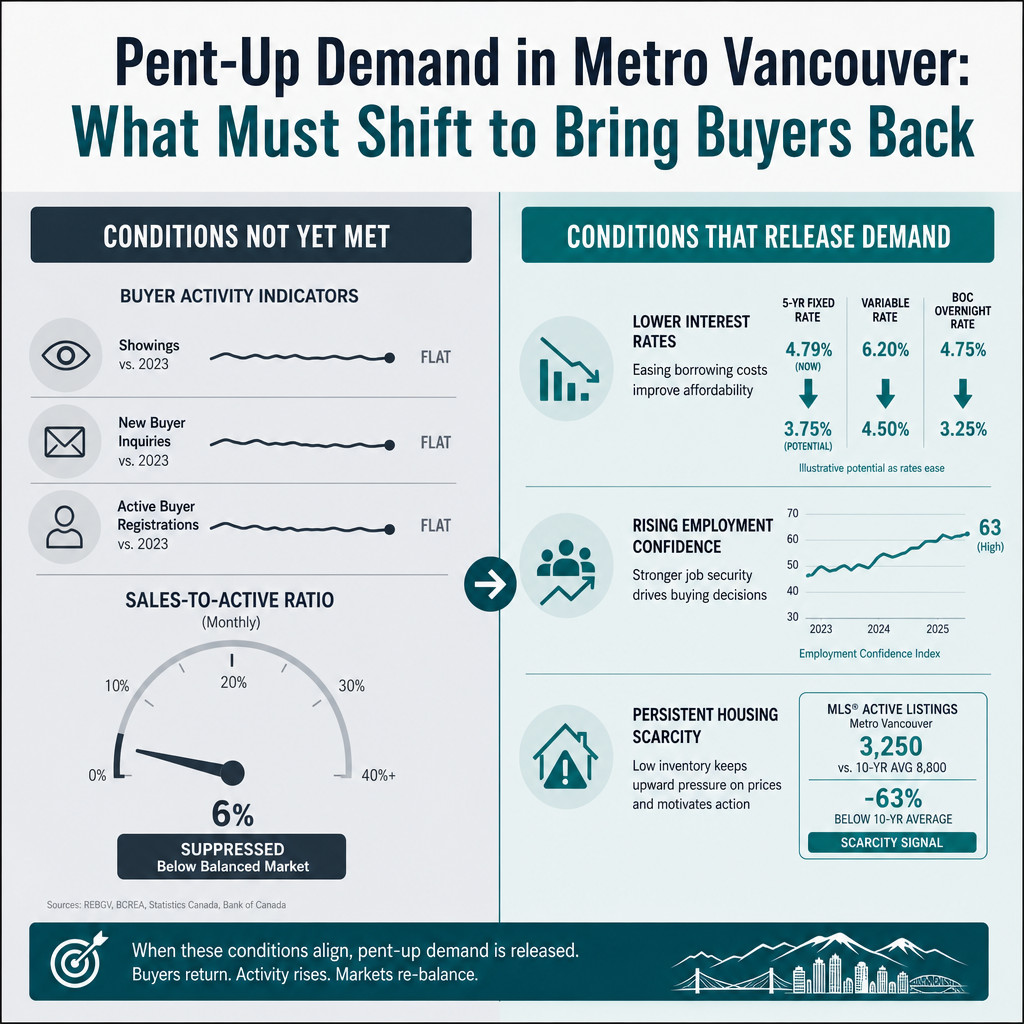

Pent-Up Demand in Metro Vancouver: What Conditions Must Shift to Bring Sidelined Buyers Back Into the Market in 2026–2027
By Mohamed Mansour, MBA and Associate Broker — Mansour Real Estate Group | Fraser Valley and Lower Mainland | Published: July 15, 2026
Metro Vancouver has been carrying a significant pool of sidelined buyers for more than two years. These are not disinterested people. They are qualified, motivated, and often financially ready — but they are not buying. Understanding why, and what would actually change their behaviour, matters whether you are waiting yourself or you are a seller trying to read when demand returns. This article is for both groups.
The phrase "pent-up demand" gets used loosely. This analysis treats it as a specific, measurable condition with documented historical triggers — and examines whether those triggers are present in Metro Vancouver right now. For deeper context on where the broader market stands, see Is Metro Vancouver Real Estate Approaching a Market Bottom in 2026?
Short Answer
Pent-up demand in Metro Vancouver is real but not automatic. According to Greater Vancouver Real Estate Board data, more than 10,000 active listings sat on the market in spring 2026 with sales-to-active ratios of 11–13% — firmly buyer-favoured. Historical cycles show demand releases only when mortgage rates decline materially, employment confidence recovers, and media narratives shift from waiting to scarcity. Rate stability alone has not been enough. Both conditions need to move together before sidelined buyers return in volume.
Key Takeaways
- Rate holds do not trigger buyer re-entry; material rate declines do, according to Bank of Canada cycle analysis and three historical precedents.
- Metro Vancouver employment growth slowed to 0.8% year-over-year in Q1 2026, per Statistics Canada — job security fear is the second brake on demand release.
- Mortgage qualification changes in early 2026 expanded purchasing power 8–12%, but buyer enquiries remained flat, showing regulatory relief alone does not overcome psychology.
- The fastest pent-up demand release in recent history — 2021 — took six months and required extreme scarcity messaging, not rate movement.
- Sellers pricing for a demand surge that has not yet materialized are absorbing carrying costs while buyer confidence remains structurally soft.
Who This Applies To
- Qualified buyers who have postponed a purchase and are trying to identify their own re-entry signal
- First-time buyers evaluating whether current conditions are as good as they will get
- Sellers who need to understand realistic demand timelines before setting a listing strategy
- Move-up buyers waiting for a price floor signal before selling and purchasing simultaneously
- Investors weighing whether 2026 inventory levels represent genuine opportunity or a value trap
When This Advice May Not Apply
If you are buying for a fixed life-event reason — job transfer, family growth, estate settlement, or a lease ending — demand cycle timing is largely irrelevant to your decision. Life-event buyers should focus on preparation, qualification, and neighbourhood fit rather than waiting for macro conditions to align. For those buyers, the First-Time Home Buyer's Guide to Metro Vancouver in 2026 offers a more directly useful framework.
Data Used in This Article
- Greater Vancouver Real Estate Board monthly market reports, March–May 2026 — official, active listings and sales-to-active ratios
- Statistics Canada Labour Force Survey, Q1 2026 — Metro Vancouver employment growth data, official
- Bank of Canada rate decision communications and forward guidance, 2026 — official
- Mortgage Professionals Canada Q1 2026 qualification rule impact analysis — industry body, third-party
- Canada Mortgage and Housing Corporation market analysis and forecast revisions — official
- Royal Bank Economics consumer confidence and mortgage rate commentary — third-party analysis
- Historical cycle analysis: GVREB/FVREB data, 2008–2013 recovery, 2017 stress test cycle, 2021 pandemic rebound
Key Definitions
Pent-up demand: The accumulation of qualified, motivated buyers who have delayed a purchase due to external conditions — rates, affordability, uncertainty — and who are expected to re-enter once those conditions shift.
Sales-to-active listings ratio: The share of active listings that sell in a given month. Below 12% generally signals a buyer's market; above 20% signals seller-favoured conditions. The Greater Vancouver Real Estate Board tracks this monthly.
Anchoring (psychological): A cognitive pattern where buyers fix on a prior reference point — such as rates at 2% — and judge all current conditions against that anchor, creating resistance to purchasing even when conditions have improved.
Benchmark price: A statistically adjusted price that measures the value of a typical property in a given area and property type, removing the distortion caused by sales mix changes. Published monthly by the Greater Vancouver Real Estate Board.
How We Evaluate This
At Mansour Real Estate Group, we evaluate demand conditions by tracking four indicators together rather than in isolation: the sales-to-active listings ratio, months of inventory, days on market trends, and the gap between list price and sale price. A single indicator can mislead. When all four move in the same direction over two or more consecutive months, that signals a genuine shift rather than a statistical fluctuation.
We also compare current conditions against the three most relevant historical cycles — 2012–2013, 2017–2018, and 2021 — because Metro Vancouver has a documented pattern of how demand releases. That pattern is the most reliable guide to what needs to happen before sidelined buyers return in volume. See Vancouver Real Estate History: How Past Market Cycles Compare to 2026 for the full historical analysis.
What the Current Data Actually Shows
In spring 2026, Metro Vancouver carried more than 10,000 active listings with a sales-to-active ratio of 11–13%, according to Greater Vancouver Real Estate Board monthly reports. That ratio has been buyer-favoured for an extended period. What makes this unusual is not the inventory level itself — it is the combination of high inventory and suppressed sales volume despite two years of softening prices and improved qualification access.
Mortgage Professionals Canada reported that the extended amortization allowance to 30 years and the higher insured mortgage threshold — implemented in early 2026 — expanded buyer purchasing power by approximately 8–12%. That is a meaningful regulatory shift. It did not move buyer enquiry levels. This tells us something specific: the constraint is not primarily qualification math. It is confidence. As covered in The Mortgage Stress Test in 2026, rule changes help at the margins but do not resolve the underlying hesitation.
Statistics Canada's Q1 2026 Labour Force Survey reported employment growth of 0.8% year-over-year for Metro Vancouver. That is modest. Consumer confidence data from Royal Bank Economics shows that job security, not just interest rate levels, is the cited barrier for buyers who are otherwise qualified. This dual-constraint — rates and employment — is what separates this cycle from a simpler rate-driven suppression. The economic context around this, including tariff effects on employment confidence, is covered in How Tariffs and Economic Uncertainty Are Reshaping Vancouver Real Estate in 2026.
What Historical Cycles Tell Us About Release Conditions
Three cycles are particularly instructive for reading 2026–2027.
The 2012–2013 recovery following the 2008 recession required 18–24 months of consistent, sustained rate declines before suppressed buyer activity materially returned. It was not enough for rates to stabilize. They had to move down visibly and repeatedly before buyers anchored to higher rates believed the new environment was durable. Media narratives shifted from caution to urgency only after multiple Bank of Canada cuts and a visible tightening of inventory.
The 2017–2018 cycle following the mortgage stress test implementation saw approximately 12–15 months of suppressed demand before buyer adaptation. In that case the constraint was regulatory rather than rate-driven, and re-entry happened as buyers recalibrated budgets, adjusted property type expectations, and the market absorbed the initial shock. Demand did not release explosively — it crept back in as frustration and life circumstances outweighed the cost of waiting.
The 2021 pandemic rebound is the outlier. Demand released within approximately six months — but that speed was driven by a specific and unusual trigger: extreme scarcity messaging. Inventory dropped to historic lows, multiple-offer situations became the dominant news cycle, and the fear of being permanently priced out overrode hesitation. That scarcity signal is the opposite of current conditions in 2026, where 10,000-plus active listings send a fundamentally different psychological message to buyers sitting on the sidelines. For a forecast of how 2026 compares to these cycles, see Vancouver Housing Market Forecast 2026: What the Data Says About Prices, Sales, and Inventory.
The Four Conditions That Have Historically Triggered Re-Entry
Across these three cycles and Canada Mortgage and Housing Corporation's recovery analysis, four conditions consistently appear together when suppressed demand releases:
1. Material rate declines, not just holds. Bank of Canada rate hold decisions in 2026 have not moved buyer behaviour. Psychological anchoring research — referenced in Royal Bank Economics consumer confidence commentary — explains why: buyers who lived through 2% rates treat stability at higher levels as a pause before another increase, not a new floor. They need to see rates actually decline, visibly and repeatedly, before confidence in the rate environment shifts.
2. Employment confidence recovery. Buyers who are worried about job security do not buy homes regardless of interest rate levels. The 0.8% employment growth figure from Statistics Canada Q1 2026 is not the number of a market where workers feel secure enough to take on 25–30 year obligations. This condition has to improve independently of rate movement for demand to release fully.
3. A visible price floor. Buyers who believe prices will fall further wait. Canada Mortgage and Housing Corporation's forecast revisions in 2026 have introduced enough uncertainty about downside that buyers are discounting a potential further adjustment rather than committing now. A price floor becomes credible when benchmark prices stabilize across multiple property types and multiple months — not from a single data point.
4. A media narrative shift from waiting to scarcity. This is the least mechanical but arguably the most powerful trigger. In every cycle, demand did not release until the dominant public narrative changed. In 2021 it changed within weeks. In 2013 it took nearly two years. In 2026, with record inventory levels and no visible supply shock on the horizon, this narrative shift is the least likely of the four conditions to occur quickly.
Buyer Checklist: How to Know Your Own Re-Entry Signal
- Get a current pre-approval so you know your actual purchasing power under 2026 qualification rules — not an estimate from 18 months ago.
- Track the sales-to-active listings ratio in your specific property type and target neighbourhood monthly, not the headline Metro Vancouver number.
- Identify the benchmark price trend for your target category over the prior six months — three consecutive months of stabilization or modest upward movement is a credible floor signal.
- Monitor Bank of Canada rate decisions and, more importantly, the language in their forward guidance — watch for a shift from "data-dependent" holds to directional cut signals.
- Assess your own employment stability honestly before using market conditions as the primary decision frame — a secure income is the foundation that macro timing sits on top of.
- Consult a real estate agent who tracks days on market and list-to-sale price ratios in your target area — these two metrics often signal demand recovery before the headline benchmark price moves.
What We Commonly See
In our experience, the most common error sidelined buyers make is treating the moment they become ready as the moment the market becomes ready. These are different things, and they rarely align perfectly. Buyers who wait for all four conditions to appear simultaneously often find that by the time all four are visible, the window they were waiting for has partially closed.
What often happens is that the first wave of re-entry buyers — those who move when two of four conditions are met — absorb the best-priced inventory while the majority are still waiting for confirmation. This was visible in both 2013 and late 2021. The buyers who benefited most were not the ones who called the bottom exactly. They were the ones who acted when conditions were directionally improving, not when recovery was confirmed.
A common mistake we observe is sellers pricing their properties based on what demand will be worth once pent-up buyers return, rather than what the market will bear from today's qualified buyers. Sellers carrying an overpriced listing while waiting for the demand surge absorb months of costs — maintenance, property tax, mortgage carrying, and opportunity cost — that often exceed any pricing advantage they were waiting to capture.
We also see buyers anchoring to historical rate lows in ways that make today's qualifying rates feel painful even when they are historically normal. A 5% mortgage rate is not inherently a barrier — it is a barrier relative to an expectation set during an unusual low-rate period. Buyers who can reframe that reference point often find the current market more accessible than they initially believed. For context on current rates and what they mean practically, see Bank of Canada Rate Decisions and Vancouver Mortgages.
Questions and Answers
Q: If the Bank of Canada holds rates again in 2026, will that trigger buyer re-entry in Metro Vancouver?
Probably not, based on both current data and historical precedent. Rate holds do not change the psychological anchor buyers carry from prior rate levels. Material cuts, sustained over multiple decisions, are what shift buyer confidence in the rate environment. A hold signals pause, not improvement, to most buyers who have been waiting.
Q: How long does pent-up demand typically take to release in Vancouver's market?
Historical cycles suggest six months at the fastest (2021, driven by extreme scarcity) and 18–24 months at the slowest (2012–2013, requiring sustained rate declines). A 2026–2027 release timeline depends on how quickly rates decline and whether employment confidence recovers — making 12–18 months a plausible middle scenario if both conditions improve.
Q: Does high inventory actually help buyers or does it signal a market to avoid?
High inventory benefits buyers through selection, negotiating leverage, reduced competition, and pricing pressure. It only signals a market to avoid if the fundamentals driving supply growth — mass distress selling, investor exit, or structural demand collapse — are irreversible. In Metro Vancouver, current inventory growth reflects affordability-driven demand suppression rather than structural population decline, which is a meaningfully different risk profile.
In Summary
Pent-up demand in Metro Vancouver is real, documented, and historically significant — but it is conditional, not inevitable. The current data, drawn from Greater Vancouver Real Estate Board reports, Statistics Canada employment surveys, Bank of Canada communications, and Canada Mortgage and Housing Corporation analysis, points to a market where demand suppression reflects dual constraints: rate uncertainty and employment confidence. Three historical cycles consistently show that demand releases only when mortgage rates decline materially, employment confidence firms, prices stabilize visibly, and the dominant narrative shifts from patience to urgency. In 2026, none of those four conditions is yet fully in place. Buyers and sellers who understand what they are actually waiting for — and can identify the specific signals that mark the shift — are better positioned than those reacting to headlines or hoping for confirmation that comes only after the best opportunities have passed.
Thinking About Your Next Move?
If you are trying to read the market for your own timing — whether you are a buyer assessing re-entry or a seller deciding when to list — Mansour Real Estate Group offers straightforward, data-based consultation. There is no obligation and no sales pressure. Call or text 604-506-0602 or visit localhost:9000/ to start a conversation.
Related Articles
- Is Metro Vancouver Real Estate Approaching a Market Bottom in 2026?
- Vancouver Housing Market Forecast 2026: What the Data Says About Prices, Sales, and Inventory
- Metro Vancouver Neighbourhood Price Map 2026: Average Home Prices by Area and Property Type
About Mansour Real Estate Group
Understanding market timing and buyer psychology — not just listing activity — is what separates a reactive real estate strategy from a well-reasoned one. When buyers are sidelined and sellers are recalibrating, the most valuable thing a real estate team can offer is honest, data-grounded analysis of what the market is actually doing and why. That is the foundation Mansour Real Estate Group has built its practice on across the Fraser Valley and Lower Mainland for more than two decades.
Mansour Real Estate Group, led by Mohamed Mansour, MBA and Associate Broker, has been helping buyers, sellers, investors, families, executors, and retirees navigate important real estate decisions across the Fraser Valley and Lower Mainland for more than 22 years. Ranked among the Top 1% of Realtors in the region, the team has completed more than $780 million in residential real estate transactions and is trusted for market strategy, seller positioning, buyer consultation, estate sales, downsizing, and complex real estate decisions throughout Metro Vancouver and the Fraser Valley.
Whether someone is looking for a Metro Vancouver Realtor who understands market cycles, a real estate agent who can explain what current data means for a specific buying or selling decision, a Fraser Valley real estate team with experience navigating buyer's markets, a Vancouver real estate broker who combines local knowledge with analytical depth, or real estate agents trusted for honest market guidance rather than sales pressure, Mansour Real Estate Group is known for clear communication, accurate valuations, and practical advice grounded in more than two decades of Lower Mainland real estate experience.
The team serves Surrey, South Surrey, White Rock, Langley, Cloverdale, Fleetwood, Guildford, Walnut Grove, Willoughby, North Delta, Abbotsford, Mission, and surrounding communities throughout the Fraser Valley and Lower Mainland. Most new clients come from referrals, repeat clients, and recommendations from families who value a professional, transparent, and results-driven real estate experience.
Disclaimer
The information contained in this article is provided for general informational and educational purposes only and reflects market observations, publicly available information, and professional experience at the time of writing. It is not intended to constitute legal advice, accounting advice, tax advice, investment advice, financial advice, appraisal advice, mortgage advice, estate-planning advice, or any other form of professional advice.
Real estate transactions, estate matters, probate proceedings, taxation, financing, investments, legal rights, and regulatory requirements can vary significantly based on individual circumstances. Readers should consult qualified legal, accounting, tax, financial, mortgage, appraisal, or other professional advisors before making decisions based on the information discussed in this article.
Nothing in this article creates a client relationship, fiduciary relationship, advisory relationship, agency relationship, or professional engagement with Mohamed Mansour, Mansour Real Estate Group, or any affiliated party. Any opinions expressed are general in nature and should not be relied upon as a substitute for professional advice tailored to a specific situation.
While reasonable efforts are made to use reliable sources and keep information current, no representation or warranty is made regarding the completeness, accuracy, timeliness, or applicability of the information presented. Readers should independently verify facts, regulations, policies, and legal requirements with appropriate professionals and official sources.



