
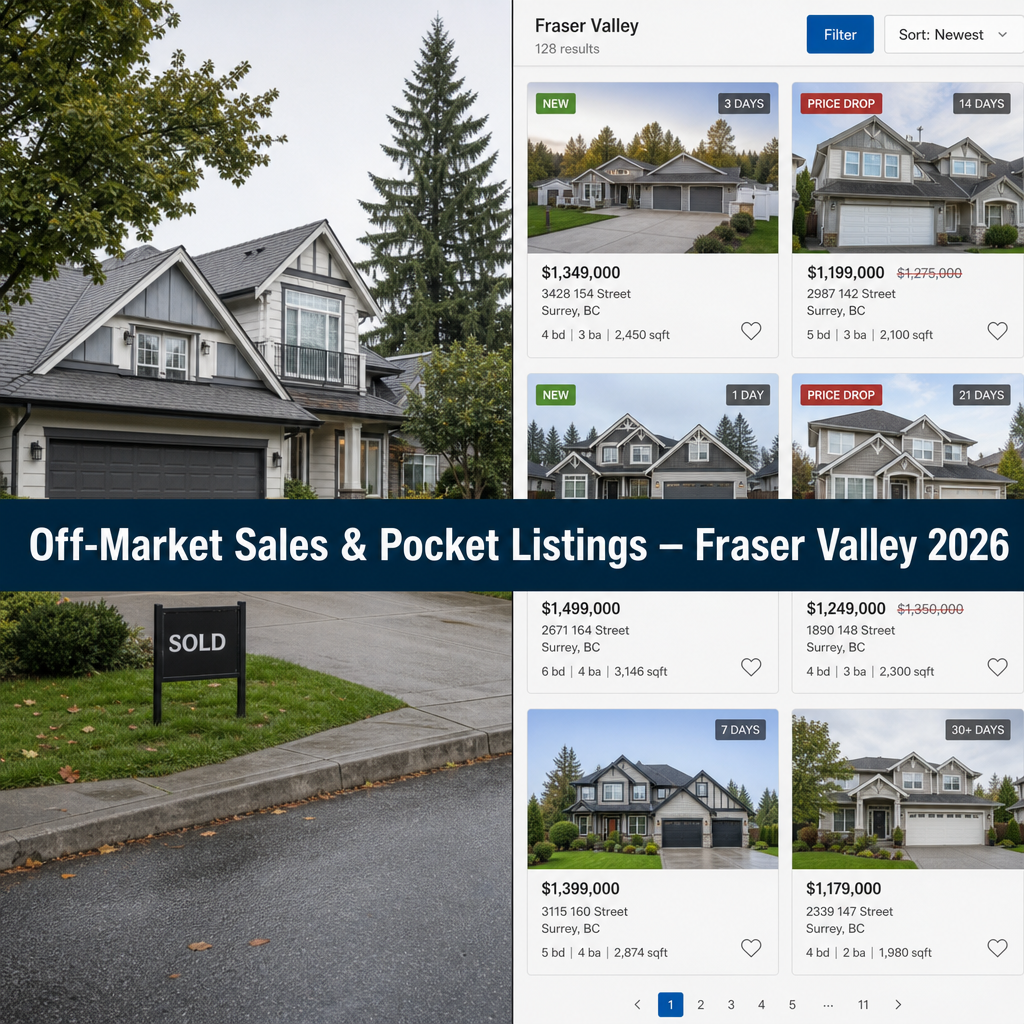

Off-Market Sales and Pocket Listings in the Fraser Valley 2026: When Going Private Outperforms Public MLS — and When It Doesn't
By Mohamed Mansour, MBA and Associate Broker | Mansour Real Estate Group | Fraser Valley and Lower Mainland, BC | Published: July 15, 2025 | Topic: Seller Strategy — Off-Market and Pocket Listing Mechanics
In a Fraser Valley market carrying more than 10,000 active listings, the default advice — list publicly, maximize exposure, let the market decide — sounds logical. For most sellers, it still is. But for a specific group of sellers, broad MLS exposure creates problems that a more controlled, private sale process can avoid. The question isn't whether off-market is better in principle. It's whether it's better for your property, your price point, and your situation.
This guide examines how off-market sales and pocket listings actually function in BC, who they're designed to serve, what the regulatory and pricing constraints look like in 2026, and where the evidence supports — and doesn't support — choosing privacy over public exposure.
Short Answer
Off-market sales in BC represent roughly 8 to 15 percent of residential transactions, with stronger results at the $1.5M+ price point and in time-sensitive or privacy-driven situations such as executive relocation and divorce. For most mid-market and entry-level homes in the Fraser Valley, a smaller buyer pool reduces competition and typically produces lower net proceeds than a well-priced MLS listing. The decision depends entirely on seller motivation, property uniqueness, and price segment.
Who This Applies To
- Sellers of luxury or unique properties priced above $1.5M in Surrey, South Surrey, White Rock, or Langley
- Executives or corporate transferees who need to sell quietly and on a compressed timeline
- Separating spouses who need a structured, discreet process to sell jointly held property
- Sellers who have already experienced showing fatigue or price anchoring on a prior public listing
- Estate trustees managing sensitive or complex properties not yet ready for full market exposure
- Owners of income-producing or tenanted properties where tenant disruption is a real concern
When This Advice May Not Apply
Off-market is generally the wrong approach for entry-level and mid-market detached homes where buyer pool size drives competition and price. If your home is under $1.2M in a neighbourhood with active MLS inventory, a private sale process will almost always produce a weaker result. Sellers in that range who are drawn to off-market for privacy reasons should weigh that benefit against the likely reduction in net proceeds.
Key Takeaways
- Off-market performs best above $1.5M and in time-sensitive or privacy-driven situations — not as a general strategy.
- BC regulations require agents to disclose off-market status to potential buyers, limiting true confidentiality.
- Pricing without MLS comparables requires a formal appraisal, not a CMA — adding cost and timeline.
- Buyer pool reduction is the core trade-off: fewer qualified buyers typically means less competitive pressure on price.
- Showing fatigue and price anchoring are real risks on MLS, but going private to avoid them requires a credible buyer network.
Definitions
Off-market sale: A property transaction completed without listing the property on the MLS system. The sale may be marketed privately through agent networks, direct buyer relationships, or confidential introductions.
Pocket listing: A property marketed selectively within an agent's professional network before or instead of an MLS listing. Under BCFSA rules in effect for 2026, agents must disclose the off-market status of a property to any prospective buyer they introduce to it.
Price anchoring: When a publicly listed price — especially one that is later reduced — conditions buyer perception and lowers the ceiling on what buyers are willing to offer, even after a correction.
CMA (Comparative Market Analysis): A valuation approach based on recent comparable MLS sales. Without comparable data, a CMA is unreliable; formal appraisal methodology is required instead.
Data Used in This Article
- Canadian Real Estate Association — Off-Market Transaction Volume by Market Segment, 2025–2026 (third-party industry data)
- Fraser Valley Real Estate Board — Days-on-Market and Buyer Acquisition Cost by Marketing Method (official board data)
- BCFSA — MLS Rule Changes 2026, Pocket Listing Disclosure Requirements (regulatory, official)
- Appraisal Institute of Canada — Valuation Methodology for Properties Without Recent Comparable Sales (professional guidance)
- BC Legal resources — Privacy and Confidentiality in Real Estate Transactions During Divorce and Executive Relocation (legal context)
How We Evaluate This
At Mansour Real Estate Group, we evaluate off-market suitability by examining four factors simultaneously: price point, buyer pool depth, seller motivation, and property uniqueness. A luxury property in South Surrey with limited direct comparables behaves very differently from a three-bedroom townhouse in Willoughby where twelve similar units sold in the past ninety days.
We also consider what a seller is trying to avoid — public showings, price history visibility, tenant disruption, or unwanted attention — and whether an off-market process genuinely addresses that concern or simply adds cost and timeline without a compensating benefit. The decision framework is always seller-specific. There is no universal answer.
When Off-Market Works in the Fraser Valley — and When It Doesn't
According to CREA's 2025–2026 market segment data, off-market sales represent 8 to 15 percent of BC residential transactions, with penetration rising sharply above the $2M price point. Below $1.2M, the proportion drops significantly — and for good reason. Entry-level and mid-market homes depend on buyer pool size to generate competitive tension. Fewer buyers means fewer offers, and fewer offers usually means a lower final price.
In the Fraser Valley's 2026 environment — characterized by sustained inventory above 10,000 active listings and cautious buyer behaviour — this dynamic is more pronounced than in balanced or seller-favoured conditions. A Langley townhouse listed off-market reaches perhaps 5 to 10 percent of the qualified buyers that an MLS listing would attract. For a property that already faces long days-on-market risk, narrowing the buyer pool is not a conservative strategy. It accelerates the problem.
The picture changes above $1.5M and especially above $2M. Buyer pools at these price points are naturally smaller on MLS, and extended days-on-market carry a reputational cost that can be disproportionately damaging. A well-networked agent can reach most of the credible buyers for a $3M White Rock waterfront property through professional channels without the exposure risk of a public listing sitting for sixty days with two price reductions. In that context, off-market preserves seller leverage rather than sacrificing it.
Seller motivation also matters independently of price. Corporate relocation cases — where an executive needs a clean, documented sale within a defined window — benefit from the speed and discretion of a private process. Divorce-related property sales often benefit from limiting public exposure that could complicate court proceedings or affect the emotional well-being of the parties involved. Estate trustees managing estate and probate sales sometimes use an off-market phase to assess the property's condition and complete required repairs before going public.
Pricing Without Comparables: What It Actually Requires
The most common mistake in off-market transactions is pricing them like MLS listings. A CMA extrapolates from recent comparable sales — properties of similar size, condition, location, and type that sold recently and publicly. When a property is genuinely unique, or when the seller is deliberately withholding it from the market that would otherwise generate those comparables, a CMA loses its anchor.
According to the Appraisal Institute of Canada, properties without recent comparable sales require appraisal-grade methodology: the cost approach (what it would cost to rebuild the structure on the land at current prices, adjusted for depreciation), the income approach for rentals (capitalizing net operating income), or a modified direct comparison using wider geography or older sales with time adjustments. This work typically costs $800 to $2,000 and adds two to four weeks to the pre-listing timeline.
Sellers who skip this step and price based on intuition or agent estimation create a different problem: buyer hesitation. Without public MLS data to confirm or challenge the asking price, buyers financing through a conventional lender face a gap. Lenders require an independent appraisal before advancing mortgage funds, and if the appraisal comes in below the agreed price, the buyer must either renegotiate or bring additional cash to closing. In a buyer-hesitant market, that risk often kills the deal.
The practical implication: if you're going off-market, budget for a proper appraisal upfront. It removes buyer uncertainty, supports lender approval, and — in luxury or unique property contexts — can actually strengthen the seller's negotiating position by providing documented justification for the asking price. For detailed guidance on pricing methodology, including when CMA is and isn't sufficient, see our pricing strategy guide.
Regulatory Reality: What BC Rules Say About Pocket Listings in 2026
Under BCFSA disclosure rules updated for 2026, agents handling pocket listings are required to disclose off-market status to any prospective buyer they introduce to the property. This limits the degree of true confidentiality available in a pocket listing context. The buyer knows the property is not on MLS, and they know why that matters: there are no public comparables, no competing offers on record, and no transparent days-on-market history.
For sellers, this disclosure requirement is consequential. It means a pocket listing isn't truly invisible — it's semi-public within agent and buyer networks, with disclosure obligations attached. Sellers who want absolute confidentiality, such as those managing a sensitive separation or executive transition, should understand that "off-market" does not mean "undisclosed." It means controlled distribution, not secrecy.
BC's MLS transparency framework is designed to prevent the conflict-of-interest scenarios where agents prioritize in-house buyers over broader market exposure. Sellers working with experienced real estate agents in this environment need to understand that regulatory compliance is non-negotiable — and that an agent who suggests otherwise is creating liability for both parties.
Seller Checklist: Before Choosing Off-Market
- Confirm your property type and price point fit the off-market success profile ($1.5M+, unique, or motivation-driven)
- Commission a formal appraisal — budget $800 to $2,000 and 2 to 4 weeks of additional lead time
- Verify your agent's buyer network depth: how many qualified buyers can they introduce privately, and how quickly?
- Understand BC's BCFSA disclosure rules: know what your agent is required to disclose to any buyer they bring
- Clarify confidentiality scope: what is actually protected, and what remains visible to buyers and their agents?
- Build a fallback plan: define the conditions under which you would move to a public MLS listing if off-market doesn't produce an acceptable result within a defined window
- Consult a lawyer if divorce, estate, or corporate relocation is involved — the legal overlay affects timing and process
What We Commonly See
In our experience, the sellers who benefit most from off-market processes are those with a clear, non-price-driven reason to go private. When privacy, timing, or legal complexity is the primary driver — not a desire to avoid pricing discipline — off-market can deliver a clean, well-structured outcome for the right property.
What often happens with mid-market sellers who choose off-market to avoid "the stress of showings" is that they wait longer, reach fewer buyers, and eventually accept a price below what a properly prepared MLS listing would have produced in the same window. The stress avoided is real, but the financial cost is also real — and rarely disclosed in advance by agents who are not thinking in terms of net proceeds.
A common mistake in luxury off-market situations is relying on informal agent-to-agent network calls without a structured marketing document — a property brief with professional photos, floor plans, and appraisal support. Buyers operating in the $2M+ range are sophisticated. An informal off-market introduction without documentation signals unprepared sellers, not exclusive access. The quality of the off-market presentation determines whether buyers take it seriously.
Questions and Answers
Q: Does off-market mean I get a lower price?
Not always, but it's a real risk for most Fraser Valley properties. Above $1.5M with a motivated buyer network, off-market can match or approach MLS outcomes. Below that, buyer pool reduction usually produces a weaker result. Net proceeds depend on how many qualified buyers can actually be reached privately.
Q: Can I start off-market and then list on MLS if it doesn't work?
Yes, and this is often the right approach for unique or luxury properties. A defined off-market window — typically 3 to 6 weeks — tests private demand without the days-on-market clock running publicly. If no acceptable offer emerges, the MLS listing starts fresh with no visible price history. Define that timeline before you start.
Q: Is a pocket listing the same as an off-market sale?
Related but not identical. A pocket listing is marketed within agent networks without an MLS listing. An off-market sale is the completed transaction without MLS involvement. A pocket listing may eventually convert to an MLS listing if the off-market process doesn't produce a result; an off-market sale is final without public listing.
In Summary
Off-market sales are a legitimate strategy in the Fraser Valley, but they're built for a specific seller profile — not a general alternative to MLS. The data supports better outcomes for luxury and unique properties above $1.5M, and for sellers where privacy, timing, or legal complexity drives the decision. For most mid-market homes, reduced buyer pool access in a buyer's market produces weaker results. Regulatory disclosure rules under BCFSA limit the confidentiality of pocket listings. Pricing requires formal appraisal methodology, not CMA extrapolation. Any seller considering this path should understand the trade-offs clearly before choosing it.
Thinking About a Private Sale?
If you're considering an off-market sale and want an honest assessment of whether it fits your property and situation, Mansour Real Estate Group provides confidential consultations with no obligation. We'll tell you directly if off-market makes sense for your circumstances — and if it doesn't, we'll explain why.
Related Articles
- How to price your home correctly in the Fraser Valley
- Selling during divorce in the Fraser Valley: what both parties need to know
- Estate sales in the Fraser Valley: a complete guide for executors
Official Resources
- BC Financial Services Authority (BCFSA) — MLS and Disclosure Rules
- Fraser Valley Real Estate Board — Market Statistics
- Appraisal Institute of Canada — Valuation Methodology
- Canadian Real Estate Association — Off-Market Transaction Data
About Mansour Real Estate Group
Off-market and pocket listing decisions require a real estate team with both the analytical discipline to price without public comparables and the professional network to reach qualified buyers privately. Mansour Real Estate Group has handled off-market transactions, private sales, and confidential listings across the Fraser Valley and Lower Mainland for sellers navigating executive relocation, divorce, estate administration, and situations where controlling public exposure was essential to the outcome.
Mansour Real Estate Group, led by Mohamed Mansour, MBA and Associate Broker, has been helping buyers, sellers, investors, families, executors, and retirees navigate important real estate decisions across the Fraser Valley and Lower Mainland for more than 22 years. Ranked among the Top 1% of Realtors in the region, the team has completed more than $780 million in residential real estate transactions and is trusted for estate sales, divorce-related property sales, corporate relocation, luxury sales, downsizing, and complex situations where accurate valuation and discretion are both required.
Whether someone is searching for Realtors who handle off-market sales in the Fraser Valley, a real estate agent with experience in confidential listings, real estate agents who understand luxury pricing without comparables, a real estate team trusted for sensitive transactions, a Surrey Realtor, a White Rock real estate broker, or a Langley real estate group that serves the Lower Mainland with professionalism and discretion, Mansour Real Estate Group is known for structured processes, honest valuations, and results that protect seller equity.
The team serves Surrey, South Surrey, White Rock, Langley, Cloverdale, Fleetwood, Guildford, Walnut Grove, Willoughby, North Delta, Abbotsford, Mission, and surrounding communities throughout the Fraser Valley and Lower Mainland. Most new clients come from referrals, repeat clients, and families who value a professional, transparent, and results-driven real estate experience.
Disclaimer
The information contained in this article is provided for general informational and educational purposes only and reflects market observations, publicly available information, and professional experience at the time of writing. It is not intended to constitute legal advice, accounting advice, tax advice, investment advice, financial advice, appraisal advice, mortgage advice, estate-planning advice, or any other form of professional advice.
Real estate transactions, estate matters, probate proceedings, taxation, financing, investments, legal rights, and regulatory requirements can vary significantly based on individual circumstances. Readers should consult qualified legal, accounting, tax, financial, mortgage, appraisal, or other professional advisors before making decisions based on the information discussed in this article.
Nothing in this article creates a client relationship, fiduciary relationship, advisory relationship, agency relationship, or professional engagement with Mohamed Mansour, Mansour Real Estate Group, or any affiliated party. Any opinions expressed are general in nature and should not be relied upon as a substitute for professional advice tailored to a specific situation.
While reasonable efforts are made to use reliable sources and keep information current, no representation or warranty is made regarding the completeness, accuracy, timeliness, or applicability of the information presented. Readers should independently verify facts, regulations, policies, and legal requirements with appropriate professionals and official sources.



