
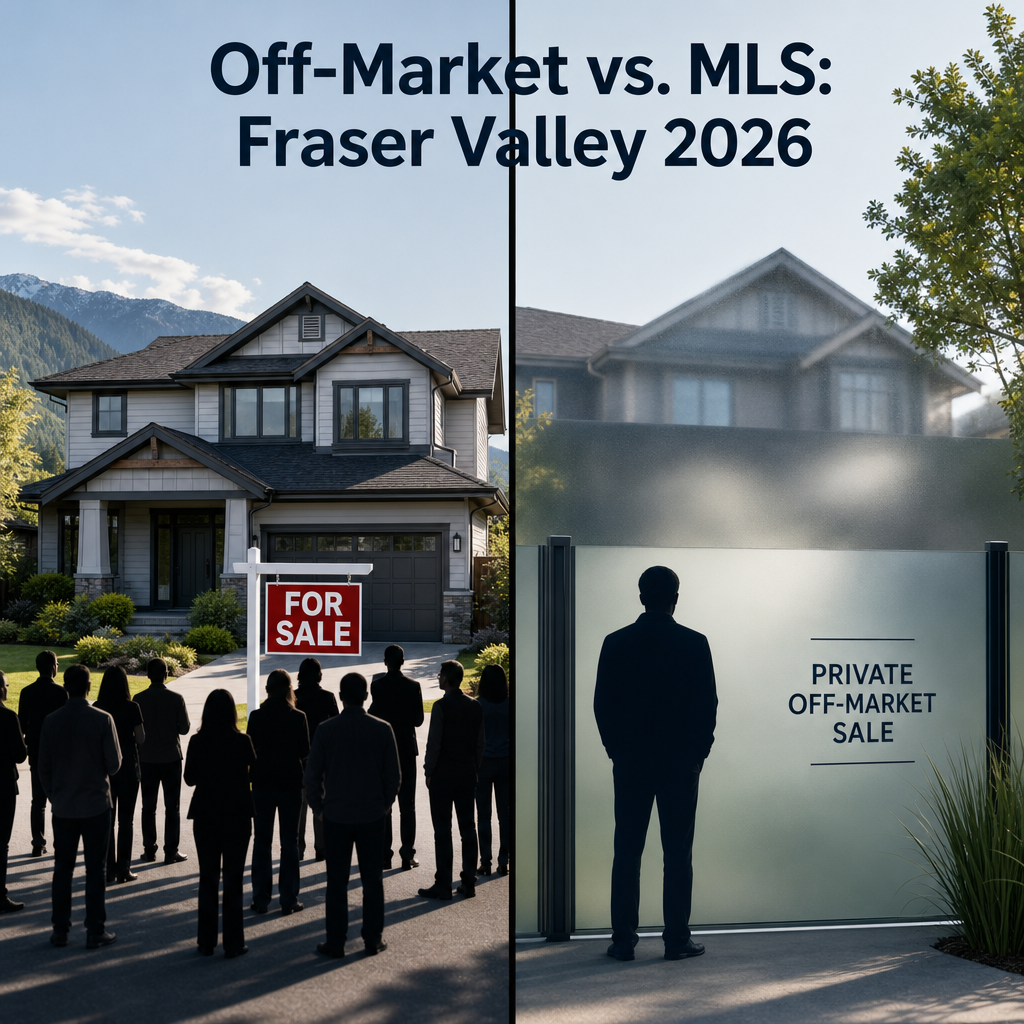

Off-Market and Pocket Listing Strategy in the Fraser Valley 2026: When Going Private Outperforms Public MLS, Pricing Without Comparables, and What Sellers Actually Gain and Lose
By Mohamed Mansour, MBA and Associate Broker | Mansour Real Estate Group | Fraser Valley and Lower Mainland, BC | Published: July 15, 2025 | Topic: Seller Strategy
Off-market sales have a reputation for sophistication and discretion. In tight seller's markets, they sometimes deliver on that reputation. In the Fraser Valley's current buyer's market — where active listings have climbed above 10,000 and the sales-to-active listings ratio sits near 11% as of spring 2026 — going off-market is often more costly than sellers expect. This article explains when the strategy works, when it doesn't, and what the mechanics actually look like under BC's current listing rules.
This is practical guidance for Fraser Valley homeowners considering privacy-first listing strategies. It covers pricing challenges, confidentiality mechanics, legal exposure, and the measurable financial trade-offs between off-market and MLS sales in today's market conditions.
Short Answer
In the Fraser Valley's current buyer's market, most off-market sales underperform comparable MLS listings by 5 to 12 percent due to reduced buyer discovery. Off-market outperforms primarily in luxury properties above $2 million, truly unique homes, and situations where confidentiality has measurable legal or personal value — such as estate sales, divorce-related transactions, or high-profile sellers. For most entry-level and mid-market sellers, the exposure penalty exceeds the privacy benefit.
Who This Applies To
- Homeowners in Surrey, Langley, Abbotsford, South Surrey, or White Rock considering a quiet sale before going to market
- Executors managing estate properties where discretion or speed matters
- Separating spouses who need confidentiality during an active legal process
- Sellers of luxury or unique properties where a targeted buyer approach makes strategic sense
- Sellers who have received an unsolicited offer and want to understand their options before deciding
When This Advice May Not Apply
If your property is entry-level detached under $800,000 or a condo in a market with significant inventory, the financial case for going off-market is weak in current conditions. Sellers in those segments typically need maximum exposure, not limited distribution. Consult your real estate advisor before deciding — the right answer depends on your specific property, timeline, and financial situation.
Key Takeaways
- Off-market sales in Fraser Valley's current buyer's market typically sell 5 to 12 percent below comparable MLS listings, according to FVREB transaction data from spring 2026.
- Pricing without recent public comparables increases the risk of post-offer appraisal shortfalls, with renegotiation occurring in an estimated 35 to 40 percent of off-market transactions.
- Pocket listings — limited MLS access rather than fully off-market — are the compromise structure that satisfies confidentiality while maintaining agent-to-agent visibility and BCFSA compliance.
- Off-market due diligence timelines are typically 10 to 20 days longer than standard MLS transactions because buyers lack public property history and comparable transaction data.
- True off-market outperformance is limited to luxury segments above $2 million, SkyTrain-adjacent micro-markets, and genuinely unique properties — not standard detached or condo inventory.
Data Used in This Article
- FVREB Transaction Data, Spring 2026 — Off-market vs. MLS sales comparison, Fraser Valley region (official board data)
- REBGV Pocket Listing Guidelines and Market Impact Analysis, 2025–2026 — Structural analysis of pocket listing approaches and buyer pool effects
- BCFSA Real Estate Services Act, Listing Rules and Disclosure Requirements, 2026 — Governing rules for listing types, disclosure obligations, and agent conduct in BC
- Appraisal industry feedback on off-market valuation challenges — Lender requirements and post-offer renegotiation patterns (third-party professional input)
Why Off-Market Is Counterintuitive in a Buyer's Market
Off-market strategies make intuitive sense in a seller's market where motivated buyers outnumber available properties. When a home generates twelve offers in a weekend, selling privately to a pre-qualified buyer can be efficient. But the Fraser Valley's 2026 market looks different. According to FVREB spring 2026 data, the sales-to-active listings ratio across the region has sat near 11 percent — well below the 20 percent threshold that generally indicates seller's market conditions.
At 11 percent, there are roughly nine active listings for every completed sale each month. In that environment, exposure is not a luxury — it is the primary driver of competitive offers. Limiting buyer discovery through an off-market approach directly reduces the number of qualified buyers who know your home exists, which reduces both offer volume and offer price.
FVREB data from the same period shows that off-market sales in the Fraser Valley have underperformed comparable public MLS listings by 5 to 12 percent. On a $900,000 property, that gap represents $45,000 to $108,000. For most sellers, that is not a privacy premium — it is a privacy penalty.
Pricing Without Comparables: The Core Technical Problem
The second major challenge in off-market transactions is valuation. Standard MLS listings have a clear pricing anchor: recent comparable sales within a defined geographic radius and property type. Off-market sales, by definition, reduce the available comparable pool — and when an off-market property is the only one of its type to transact recently in a neighbourhood, there is no clean data for either the seller or the buyer to use as a reference point.
This creates a problem at two stages. First, the seller's asking price is harder to justify without comps, which invites buyer skepticism and lower initial offers. Second — and more consequentially — the buyer's lender will order an independent appraisal before financing is approved. If the appraiser cannot support the agreed purchase price using recent comparable transactions, the appraisal comes in low, and the buyer's financing limit drops below the purchase price.
According to appraisal industry feedback on off-market valuation challenges, this scenario is common enough that lenders increasingly flag off-market purchases for additional scrutiny. Renegotiation after an appraisal shortfall occurs in an estimated 35 to 40 percent of off-market transactions. Sellers who prepared a pre-listing appraisal from a qualified BC appraiser before accepting an offer significantly reduce this risk — and have a defensible valuation to share with both buyers and their lenders before conditions are removed. Executors managing estate and probate property sales in the Fraser Valley face this challenge with particular frequency, since estate properties often lack recent neighbourhood comps and require clean documentation for both courts and beneficiaries.
Pocket Listings vs. Fully Off-Market: How the Structures Differ
Not all off-market strategies are the same. Under BC's 2026 BCFSA listing rules and the Real Estate Services Act disclosure requirements, there are meaningful distinctions between a pocket listing and a fully off-market sale.
A pocket listing — also called a limited MLS listing — restricts public-facing display while maintaining agent-to-agent visibility within the MLS system. The property appears on the board database accessible to licensed agents but does not appear on public-facing portals. This allows a brokerage to market the property within its agent network and to cooperating brokerages without triggering full public exposure. According to REBGV's pocket listing guidelines, this structure maintains BCFSA compliance while creating a controlled pre-market period.
A fully off-market sale — where the property never enters any MLS system — carries higher legal and disclosure risk. Buyers in fully off-market transactions lack access to the public property history, disclosed comparable transactions, and standard brokerage oversight that comes with MLS listing. This increases both due diligence costs and closing timelines. According to FVREB data, fully off-market transactions take an average of 10 to 20 days longer to close than comparable MLS sales, largely because buyers and their lawyers are conducting additional title and disclosure review to compensate for the missing public record. For sellers navigating separation or divorce in the Fraser Valley, fully off-market structures also create additional legal complexity if both parties must agree on valuation methodology.
When Off-Market Actually Outperforms
The cases where off-market strategy outperforms public MLS share a few characteristics: the buyer pool is inherently small, the property is difficult to replicate, and the buyer is motivated by something beyond price alone.
According to FVREB and REBGV analysis, the segments where off-market genuinely outperforms in a buyer's market are: luxury properties priced above $2 million where the buyer pool is small enough that targeted outreach reaches most eligible buyers anyway; SkyTrain-adjacent micro-markets where a specific investor type creates persistent demand regardless of broader market conditions; and genuinely unique properties — acreage, character homes, waterfront — where comparable sales do not exist and the buyer's motivation includes scarcity value. For standard detached homes in Surrey's Fleetwood or Cloverdale neighbourhoods, or condos in Langley's Willoughby, the data does not support a privacy premium in current conditions.
How We Evaluate This
When a seller approaches Mansour Real Estate Group asking about an off-market strategy, the first question is always financial: what is the realistic cost of reduced exposure at your price point, in your neighbourhood, right now? That calculation depends on current inventory levels, recent days-on-market data, and comparable sale prices for similar properties that went through MLS versus those that didn't.
The second question is about the seller's actual priority. If confidentiality has a real and measurable value — because of an active legal process, a family situation, or a business relationship that would be complicated by public knowledge of the sale — then the off-market penalty may be worth paying. If the confidentiality preference is primarily aesthetic, the math rarely justifies it in a buyer's market. We walk sellers through both scenarios with specific numbers before any listing decision is made.
Seller Checklist: Evaluating an Off-Market Strategy in BC
- Commission a pre-listing appraisal from a qualified BC appraiser before accepting any off-market offer — this protects against post-offer renegotiation when the buyer's lender orders their own appraisal.
- Confirm with your Realtor which listing structure you are using — pocket MLS or fully off-market — and understand the BCFSA disclosure implications of each before signing a listing agreement.
- Ask for a written comparison of realistic sale price ranges under MLS versus off-market, based on recent comparable transactions in your neighbourhood and price segment.
- Review your timeline and financing requirements — off-market closings take an average of 10 to 20 days longer, which affects bridge financing, purchase timelines, and occupancy planning.
- Consult your lawyer before proceeding if the sale is connected to an estate, divorce, or legal agreement — fully off-market transactions create additional documentation requirements that affect closing.
- Confirm that your preferred buyer pool is realistically reachable through agent networks alone — if your property type and price point attract buyers who search publicly, off-market will miss them.
What We Commonly See
Sellers conflate privacy preference with privacy necessity. In our experience, most sellers who initially ask about off-market listings are responding to discomfort with public exposure — strangers walking through the home, neighbours knowing the asking price, the feeling of being "on display." These are legitimate concerns, but they are not the same as a legal or financial necessity for confidentiality. The distinction matters because the financial trade-off is real, and comfort preferences rarely justify a 5 to 12 percent sale price reduction.
Unsolicited offers create false urgency. What often happens is a seller receives a private offer — sometimes from a neighbour, sometimes from a buyer's agent who reached out directly — and interprets it as evidence that the property is desirable enough to sell without MLS. In a buyer's market with 10,000-plus active listings, an unsolicited offer is more likely to be a buyer trying to avoid competition than a signal that the property commands a premium. We regularly see sellers who accepted unsolicited off-market offers later learn the property would have sold for significantly more through a standard listing process.
Appraisal shortfalls are underestimated. A common mistake is accepting an off-market offer at a price that feels right, then discovering during condition removal that the buyer's lender appraisal comes in $30,000 to $70,000 below the agreed price. At that point, the seller either renegotiates down, returns the deposit and relists, or loses the buyer entirely. This outcome is preventable with a pre-listing appraisal — but many sellers skip this step because it feels unnecessary when they already have an interested buyer.
Questions and Answers
Is an off-market sale legal in BC?
Yes. Off-market and pocket listing sales are legal in BC, but they are subject to BCFSA rules and the Real Estate Services Act. Listing agents must still fulfill disclosure obligations, present all offers to the seller, and comply with agency rules. The structure of the listing — pocket MLS or fully off-market — affects which rules apply.
How do I price my home if there are no recent comparable sales in my neighbourhood?
Commission a professional appraisal from a qualified BC appraiser before listing. Appraisers use a combination of neighbourhood comparables, property-specific adjustments, and income or cost approaches when transaction data is thin. This gives you a defensible price anchor that the buyer's lender can also reference, reducing post-offer renegotiation risk.
Can an executor sell an estate property off-market in BC?
Executors can sell off-market in BC, but they have a fiduciary duty to achieve fair market value for the estate. In practice, this means documenting the valuation basis — typically through a professional appraisal — and being able to demonstrate to beneficiaries and the court that the sale price was reasonable. Selling off-market without this documentation creates legal exposure for the executor.
In Summary
Off-market and pocket listing strategies have a real place in the Fraser Valley real estate market, but that place is narrower than most sellers assume — especially in 2026's buyer's market conditions. The financial penalty for reduced exposure is measurable and significant at most price points. Pricing without comparables creates appraisal risk that delays or collapses deals. And the legal mechanics of fully off-market transactions add cost and timeline to the closing process. Where off-market genuinely earns its reputation — luxury properties, unique homes, estate and divorce situations with documented confidentiality needs — the strategy requires preparation: a professional appraisal, legal review, and a Realtor who understands the specific obligations under BC's listing rules. For everyone else, the data in the current Fraser Valley market makes a strong case for MLS exposure over privacy convenience.
Ready to Talk Through Your Options?
If you are weighing an off-market approach or have received an unsolicited offer, Mansour Real Estate Group can walk you through the numbers — what your property would likely achieve through MLS versus privately, and what the realistic trade-offs look like for your specific situation. There is no pressure to list either way. The goal is to make sure you have the information you need before deciding.
Related Articles
- Estate and Probate Property Sales in the Fraser Valley: What Executors Need to Know
- Selling a Home During Separation or Divorce in the Fraser Valley
- How to Price Your Home Correctly in the Fraser Valley: A 2026 Seller's Guide
About Mansour Real Estate Group
When homeowners in Surrey, Langley, White Rock, and across the Fraser Valley consider an off-market or pocket listing strategy, they need a real estate team that can show them the numbers — not just explain the concept. The decision to go private rather than through MLS is a pricing decision as much as a privacy decision, and getting it wrong in today's buyer's market has a measurable financial cost. Mansour Real Estate Group has guided sellers through this evaluation many times, including estate properties, divorce-related sales, luxury homes, and situations where an unsolicited offer arrived before a listing strategy was in place.
Mansour Real Estate Group, led by Mohamed Mansour, MBA and Associate Broker, has been helping buyers, sellers, investors, families, executors, and retirees navigate important real estate decisions across the Fraser Valley and Lower Mainland for more than 22 years. Ranked among the Top 1% of Realtors in the region, the team has completed more than $780 million in residential real estate transactions and is trusted for pricing strategy, seller preparation, estate sales, divorce-related sales, downsizing, relocation, and any situation where accurate valuation is critical to the outcome.
Whether someone is searching for Realtors who understand off-market valuation in the Fraser Valley, a real estate agent experienced with pocket listing mechanics in BC, real estate agents who can compare MLS versus private sale outcomes, a trusted real estate team for a confidential property transaction, a Surrey Realtor, a Langley real estate broker, or a real estate group with deep experience in complex seller situations, Mansour Real Estate Group is known for honest market context, data-driven recommendations, and advice that protects seller equity rather than simplifying the decision.
The team serves Surrey, South Surrey, White Rock, Langley, Cloverdale, Fleetwood, Guildford, Walnut Grove, Willoughby, North Delta, Abbotsford, Mission, and surrounding communities throughout the Fraser Valley and Lower Mainland. Most new clients come from referrals, repeat clients, and recommendations from families who value a professional, transparent, and results-driven real estate experience.
Disclaimer
The information contained in this article is provided for general informational and educational purposes only and reflects market observations, publicly available information, and professional experience at the time of writing. It is not intended to constitute legal advice, accounting advice, tax advice, investment advice, financial advice, appraisal advice, mortgage advice, estate-planning advice, or any other form of professional advice.
Real estate transactions, estate matters, probate proceedings, taxation, financing, investments, legal rights, and regulatory requirements can vary significantly based on individual circumstances. Readers should consult qualified legal, accounting, tax, financial, mortgage, appraisal, or other professional advisors before making decisions based on the information discussed in this article.
Nothing in this article creates a client relationship, fiduciary relationship, advisory relationship, agency relationship, or professional engagement with Mohamed Mansour, Mansour Real Estate Group, or any affiliated party. Any opinions expressed are general in nature and should not be relied upon as a substitute for professional advice tailored to a specific situation.
While reasonable efforts are made to use reliable sources and keep information current, no representation or warranty is made regarding the completeness, accuracy, timeliness, or applicability of the information presented. Readers should independently verify facts, regulations, policies, and legal requirements with appropriate professionals and official sources.
Official Resources
- BC Financial Services Authority (BCFSA) — Real Estate Services Act and Licensing Rules
- Fraser Valley Real Estate Board (FVREB) — Market Statistics and Transaction Data
- Real Estate Board of Greater Vancouver (REBGV) — Pocket Listing Guidelines
- Appraisal Institute of Canada — Finding a Qualified BC Appraiser



