
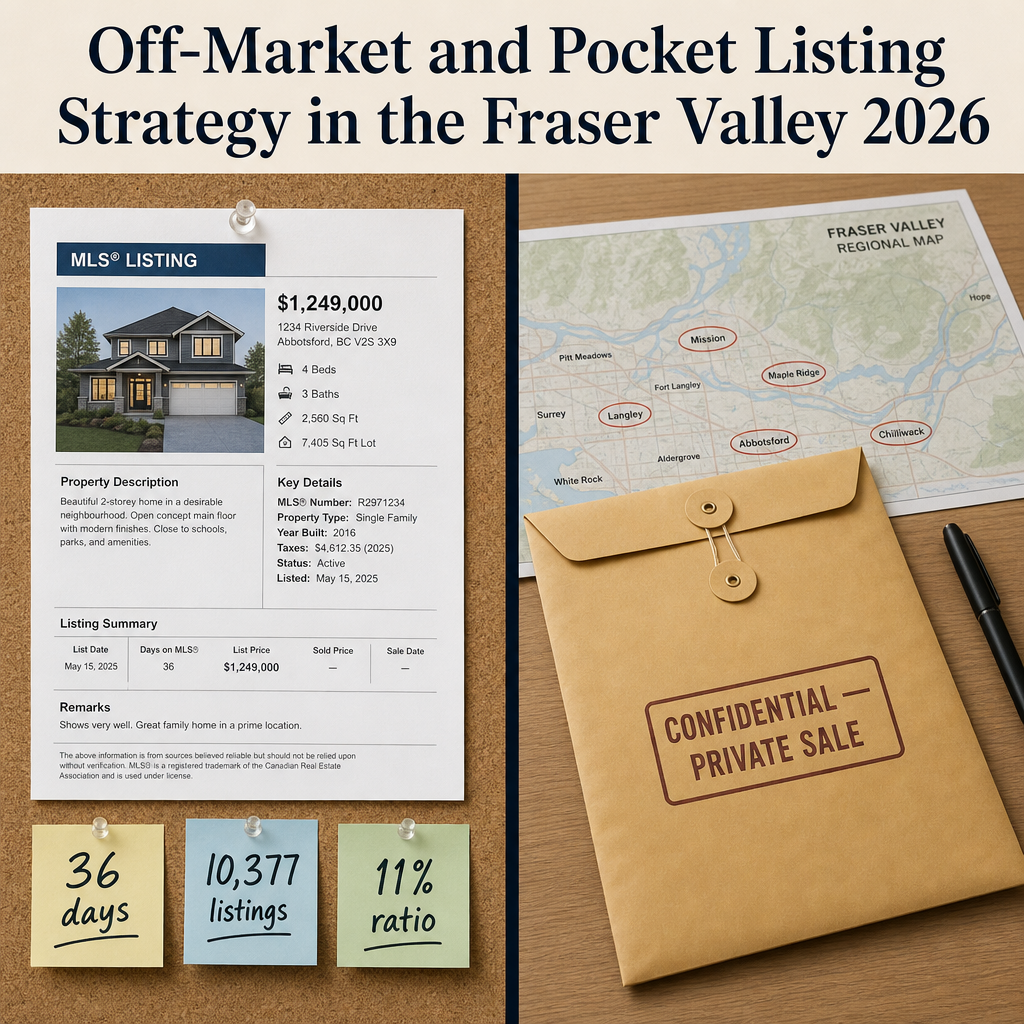

Off-Market and Pocket Listing Strategy in the Fraser Valley 2026: When Going Private Outperforms Public MLS, How to Price Without Market Comparables, Confidentiality Mechanics, and What Sellers Actually Gain and Lose in a Buyer's Market
By Mohamed Mansour, MBA and Associate Broker | Mansour Real Estate Group | Fraser Valley and Lower Mainland | Published July 2026
Most sellers assume more exposure means a better outcome. In a balanced or seller's market, that logic holds. In the Fraser Valley's current buyer's market — with 10,377 active listings recorded in July 2026 according to the Fraser Valley Real Estate Board — the relationship between exposure and outcome is more complicated. For a specific subset of sellers, a private or off-market approach can reduce friction, protect confidentiality, and close a transaction without public price discovery. For most, it trades equity for privacy they may not actually need.
This article is designed to help sellers, executors, and families evaluate the off-market decision honestly — not as a concept, but as a specific trade-off with measurable consequences in today's Fraser Valley conditions.
Short Answer
In a Fraser Valley buyer's market with surplus inventory, going off-market narrows your buyer pool at the worst possible time — unless your property is genuinely unique, your buyer profile is specific, or your situation requires confidentiality. Off-market strategy works when those three conditions align. When they don't, reduced MLS exposure typically compounds pricing risk.
Who This Applies To
- Homeowners in Surrey, White Rock, South Surrey, Langley, or Abbotsford considering a private sale before listing publicly
- Executors managing estate properties where privacy and minimal disruption are priorities
- Divorcing couples where confidentiality reduces conflict and protects both parties
- Sellers with genuinely distinctive or low-comparables properties who face MLS pricing uncertainty
- Relocating professionals with compressed timelines who may accept a slight discount for speed and certainty
When This Advice May Not Apply
Sellers with equity-sensitive transactions, properties that appeal to a wide buyer profile, or situations where achieving maximum sale price is the primary objective should default to MLS exposure. In most Fraser Valley resale scenarios in 2026, broader reach protects seller equity more than privacy protects seller convenience.
Key Takeaways
- The Fraser Valley's 11% sales-to-active ratio in July 2026 means buyers have leverage — off-market reduces your buyer pool when you need it most.
- Off-market pricing without public comparables requires a disciplined internal valuation process, not confidence alone.
- Estate sales, divorce sales, and relocation situations are the clearest legitimate cases for confidential marketing.
- Days-on-market variance (36–43 days for detached, 40–50+ for condos) reflects price and condition, not listing channel.
- Confidentiality mechanics in BC require clear upfront instructions to your Realtor and an understanding of MLS delay rules under BCFSA guidelines.
Data Used in This Article
- FVREB Statistics Package — July 2026: Active listings, sales-to-active ratio, benchmark prices, days-on-market. Official board data.
- FVREB Statistics Packages — May and June 2026: Trend confirmation for inventory trajectory and DOM variance. Official board data.
- MLA Canada August 2026 Pulse Report — July data: Presale absorption rates, Metro Vancouver and Fraser Valley new construction. Third-party industry analysis.
- Daily Hive Vancouver — June 2026 market statistics roundup: Market condition summary, sales and listing volume context. Third-party media summary citing FVREB and GVR data.
Why the Current Fraser Valley Market Changes the Off-Market Calculation
The Fraser Valley Real Estate Board's July 2026 statistics package reported 10,377 active listings — 51% above the 10-year average — and a sales-to-active listings ratio of 11%. That ratio places the region firmly in buyer's market territory, where sustained surplus inventory gives buyers options and reduces pricing urgency.
In a seller's market, going off-market carries a manageable trade-off: fewer buyers, but a buyer pool that may be highly motivated, pre-qualified, and willing to pay a premium for access. In a buyer's market, that trade-off shifts considerably. Buyers already have abundant choice on MLS. The argument for paying a premium to access an off-market property weakens when dozens of comparable publicly listed properties are a search filter away.
This does not mean off-market is wrong in 2026. It means the bar for justifying the reduced buyer pool is higher. The property needs something MLS comparables don't offer — unusual configuration, estate-level privacy, acreage without direct comparables, or a buyer profile that genuinely doesn't search MLS in the conventional way.
MLA Canada's August 2026 Pulse Report noted 50% presale absorption rates in July despite limited new supply — evidence that strategic pricing continues to resonate with buyers even in soft conditions. The relevant principle for resale sellers: it is pricing discipline, not channel selection, that drives buyer response when inventory is elevated. Off-market does not substitute for accurate pricing. It requires it even more.
How to Price an Off-Market Property When Public Comparables Are Limited
The hardest technical problem in off-market sales is pricing without a public discovery process. On MLS, the market tells you relatively quickly if your price is wrong — showings dry up, offers don't come, and DOM feedback is clear. Off-market removes that signal. A mispriced private listing can sit indefinitely with no indication that the price, not the strategy, is the problem.
The internal valuation framework for off-market properties in the Fraser Valley typically relies on four inputs: recent sold comparables within the closest available geography, active competition on MLS at the moment of the private approach, the current benchmark price trajectory (Fraser Valley detached benchmark was down approximately 7–8% year-over-year through mid-2026 per FVREB data), and an honest assessment of the property's uniqueness premium or discount relative to those comparables.
For properties with genuinely limited comparables — acreage in Langley Township, older estate homes in South Surrey, or custom builds in Abbotsford — off-market pricing often requires a professional appraisal as an independent anchor, not just an agent's CMA. The appraisal provides a defensible baseline that protects both seller and buyer from a negotiation anchored on incomplete information.
One practical approach for sellers with low urgency: price the private approach at the upper end of the CMA range, with a clear internal threshold — a floor price below which the seller will pivot to MLS rather than accept. That floor should be set before the private marketing begins, not after an offer is received. Deciding your walk-away price under offer pressure is how equity gets left behind.
How We Evaluate This
When a seller asks whether to go off-market, Mansour Real Estate Group evaluates three questions in sequence: Does the property have characteristics that meaningfully limit the relevant buyer pool to a segment that wouldn't find it through conventional MLS search? Does the seller have genuine financial flexibility — no fixed deadline, no urgency from a bridge loan or estate deadline — that allows them to walk away from a private offer that doesn't meet their threshold? And does the seller's situation — estate, divorce, high-profile relocation — create confidentiality needs that a standard MLS listing cannot adequately protect?
If the answer to all three is yes, a private or staged approach has merit. If one or more is no, the analysis typically points toward MLS — possibly with a confidential listing structure that limits which details are publicly visible while maintaining broad buyer reach. These are not mutually exclusive positions, and many situations call for a sequenced strategy: private first, MLS if needed, with pre-set timing and pricing logic established at the outset.
Confidentiality Mechanics in BC: What Sellers Can and Cannot Control
In British Columbia, BCFSA (BC Financial Services Authority) regulates how licensed Realtors handle listings, and there are specific rules around MLS delay, confidential listings, and dual agency. Sellers should understand what they can direct and what has professional and regulatory limits.
A seller can instruct their Realtor to market a property privately for a defined period before submitting it to MLS — sometimes called a "coming soon" or pre-MLS window. However, under BCFSA rules and real estate board policies, a Realtor cannot indefinitely suppress a listing from MLS if they are actively marketing it to any buyers. If a property is being shown, discussed, or marketed — even quietly — there are obligations around disclosure and cooperation that apply. Sellers should confirm the current board-specific rules with their Realtor, as these policies have evolved and vary between FVREB and REBGV members.
What confidentiality can legitimately control: the public address, listing photographs, interior details not necessary for buyer qualification, the seller's identity in marketing materials, and the timing of public exposure. What it cannot control: the obligation of the seller's agent to treat all parties fairly, the requirement to disclose material latent defects regardless of marketing channel, and the professional obligations that apply regardless of whether the sale is private or public.
What Sellers Actually Gain and Lose in a Buyer's Market
What off-market sellers gain:
- Control over who views the property and when
- Reduced disruption for tenants, family members, or estate beneficiaries
- Ability to test buyer response without accumulating public DOM history
- Protection of sensitive personal circumstances from public association with the property
- Potential for a faster close if the right buyer is already within a trusted network
What off-market sellers lose:
- Access to the full buyer pool, which is where competitive pricing pressure originates
- Public price discovery — the feedback mechanism that corrects mispricing early
- The negotiating dynamic that multiple independent buyers create
- Transparency of process that protects all parties in complex estate or divorce situations
- In some cases: the ability to demonstrate fair market value to beneficiaries, courts, or tax authorities
That last point matters for estate sales in the Fraser Valley specifically. Executors have a fiduciary duty to maximize the estate's value for beneficiaries. A private sale at below-market price — even one that seems convenient — can expose an executor to legal challenge. In those situations, off-market strategy requires either a formal appraisal as a value anchor, or a clear process that demonstrates the private offer met or exceeded fair market value.
Off-Market Strategy Checklist
- Confirm whether your property has a characteristic that limits the natural buyer pool to a segment unlikely to find it through MLS alone.
- Set a floor price before private marketing begins — not after an offer is received — based on a current CMA and, where applicable, a professional appraisal.
- Define your timeline: how long will you market privately before pivoting to MLS, and at what price adjustment?
- Understand BCFSA and FVREB rules on MLS delay and confidential listings before instructing your Realtor on the approach.
- For estate sales: confirm with your estate lawyer whether a private sale requires additional documentation or beneficiary consent to satisfy fiduciary obligations.
- For divorce sales: confirm with your family law lawyer whether both parties must consent to the off-market approach and pricing threshold before any buyer is approached.
- Ensure your Realtor documents the private marketing process — who was contacted, when, and what responses were received — to support any future audit of the process.
What We Commonly See
In our experience with sellers across Surrey, White Rock, and Langley, the most common off-market mistake is confusing privacy preference with pricing readiness. Sellers who want to avoid the public process sometimes pursue off-market not because their situation requires it, but because they're uncertain about their price and believe a quiet approach buys time. It doesn't. It removes the feedback that would tell them their price is wrong before it becomes costly.
What often happens is that a private listing sits for several weeks without offers, the seller adjusts the price privately, then eventually lists on MLS — but now with an accumulated private DOM that informed buyers will ask about. The confidentiality objective is preserved, but the pricing outcome is worse than a well-priced MLS listing from day one.
A common mistake in divorce-related property sales is using off-market as a way to move quickly, only to find later that the agreed price didn't reflect what MLS competition would have produced. In contested divorces, this creates disputes that cost more to resolve legally than the convenience was worth. The better approach is a transparent MLS process with agreed-upon price parameters established through independent valuation before listing.
Questions and Answers
Can a Realtor in BC market a home privately without putting it on MLS?
Yes, with conditions. A Realtor can market a property privately for a limited period or under specific seller instruction, but BCFSA regulations and board rules govern when MLS submission becomes mandatory. Sellers should confirm current rules with their Realtor and in writing before beginning any private marketing.
Does off-market mean a lower sale price?
Not necessarily, but statistically, reduced buyer competition removes upward pricing pressure. In a buyer's market with elevated Fraser Valley inventory, off-market sales are more likely to close below what a well-priced MLS listing would achieve — unless the property has characteristics that justify a premium to a specific, identifiable buyer.
How do executors protect themselves when selling an estate property off-market in BC?
Executors should obtain an independent appraisal, document the private marketing process thoroughly, and consult with their estate lawyer before accepting any private offer. A sale significantly below appraised value may be challenged by beneficiaries. The safer approach in most BC estate situations is a transparent MLS process that demonstrates fair market exposure. Consult a qualified BC estate lawyer for advice specific to your situation.
In Summary
Off-market strategy in the Fraser Valley's 2026 buyer's market is a legitimate tool for a narrow set of sellers — those with genuinely unique properties, specific buyer profiles, and real confidentiality needs. For most sellers, the current inventory surplus makes MLS exposure the stronger equity-protection choice. When off-market is the right call, the discipline is in the pricing framework, the pre-set floor, the defined timeline, and the documented process — not in the concept of privacy alone.
Thinking About a Private Sale?
If you are evaluating whether an off-market approach makes sense for your property in Surrey, White Rock, South Surrey, Langley, or Abbotsford, Mansour Real Estate Group can walk through the specific trade-offs with you — honestly, without pressure, and with the current Fraser Valley data on the table. Contact us to arrange a private consultation.
Related Articles
- Fraser Valley Real Estate Market Conditions 2026: What the Current Data Actually Means for Sellers
- How to Sell an Estate Property in the Fraser Valley: What Executors Need to Know
- Selling a Home During Divorce in the Fraser Valley: Process, Pricing, and Protecting Both Parties
Official Resources
- Fraser Valley Real Estate Board — July 2026 Statistics Package
- Fraser Valley Real Estate Board — June 2026 Statistics Package
- Fraser Valley Real Estate Board — May 2026 Statistics Package
- BC Financial Services Authority — Real Estate Licensee Regulations
About Mansour Real Estate Group
Deciding whether to go off-market or list publicly is one of the most consequential pre-listing decisions a seller can make — and it is one where the quality of local market knowledge and honest strategic advice matters more than almost anything else. Mansour Real Estate Group has guided sellers, executors, and families through private sales, confidential transactions, and complex listing decisions across the Fraser Valley and Lower Mainland for more than two decades, with a pricing-first process that protects seller equity regardless of the channel chosen.
Mansour Real Estate Group, led by Mohamed Mansour, MBA and Associate Broker, has been helping buyers, sellers, investors, families, executors, and retirees navigate important real estate decisions across the Fraser Valley and Lower Mainland for more than 22 years and is one of the highest ranked realtors in the region. The team has completed more than $780 million in residential real estate transactions and is trusted for estate sales, divorce-related sales, private and off-market transactions, downsizing, relocation, and situations where accurate valuation and strategic discretion are equally important.
Whether someone is looking for Realtors experienced with off-market and confidential property sales, a real estate agent who understands how to price without public comparables, real estate agents who work with executors and estate situations in the Fraser Valley, a trusted real estate team for divorce-related or relocation sales, a Surrey Realtor, a Langley real estate broker, or a real estate group that serves the entire Fraser Valley and Lower Mainland, Mansour Real Estate Group is known for clear communication, disciplined pricing, and a process built on protecting seller equity.
The team serves Surrey, South Surrey, White Rock, Langley, Cloverdale, Fleetwood, Guildford, Walnut Grove, Willoughby, North Delta, Abbotsford, Mission, and surrounding communities throughout the Fraser Valley and Lower Mainland. Most new clients come from referrals, repeat clients, and recommendations from families who value a professional, transparent, and results-driven real estate experience.
Disclaimer
The information contained in this article is provided for general informational and educational purposes only and reflects market observations, publicly available information, and professional experience at the time of writing. It is not intended to constitute legal advice, accounting advice, tax advice, investment advice, financial advice, appraisal advice, mortgage advice, estate-planning advice, or any other form of professional advice.
Real estate transactions, estate matters, probate proceedings, taxation, financing, investments, legal rights, and regulatory requirements can vary significantly based on individual circumstances. Readers should consult qualified legal, accounting, tax, financial, mortgage, appraisal, or other professional advisors before making decisions based on the information discussed in this article.
Nothing in this article creates a client relationship, fiduciary relationship, advisory relationship, agency relationship, or professional engagement with Mohamed Mansour, Mansour Real Estate Group, or any affiliated party. Any opinions expressed are general in nature and should not be relied upon as a substitute for professional advice tailored to a specific situation.
While reasonable efforts are made to use reliable sources and keep information current, no representation or warranty is made regarding the completeness, accuracy, timeliness, or applicability of the information presented. Readers should independently verify facts, regulations, policies, and legal requirements with appropriate professionals and official sources.



