
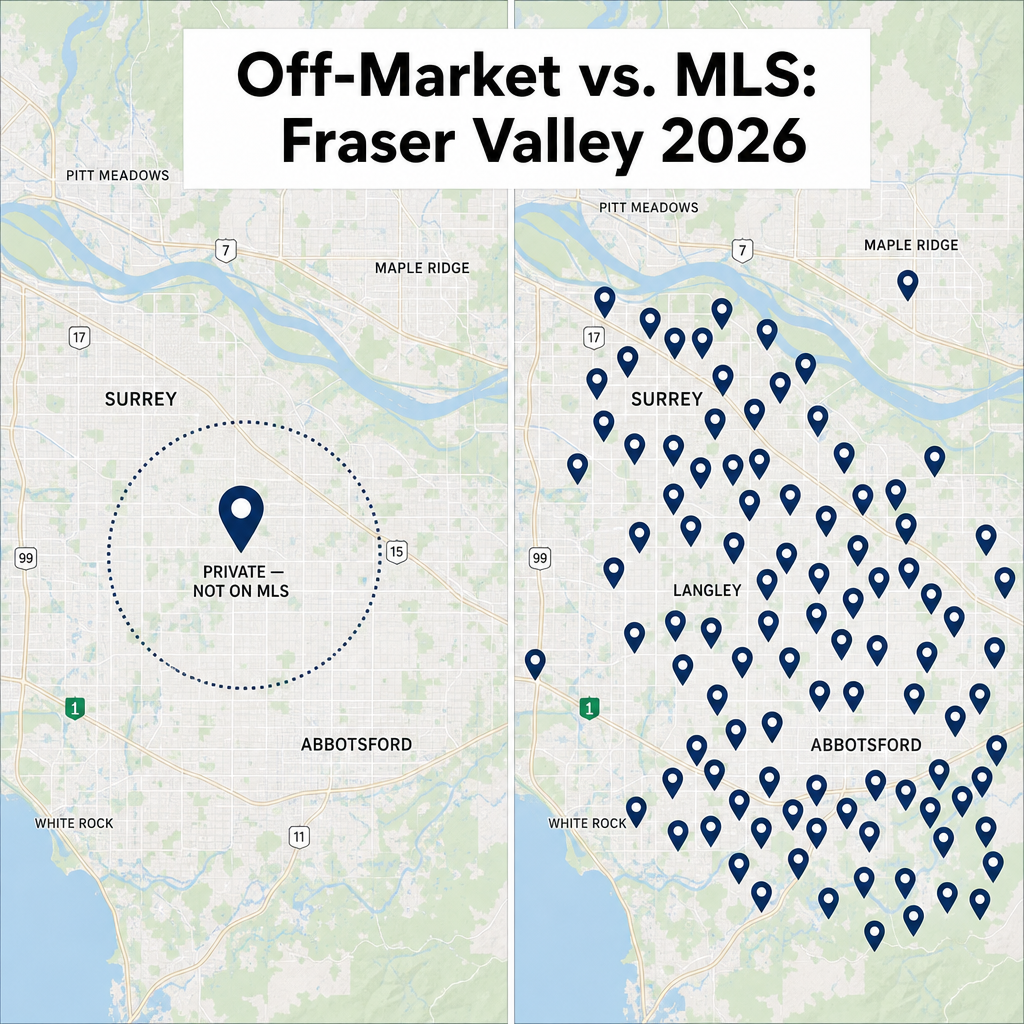

Off-Market and Pocket Listing Strategy in the Fraser Valley 2026: When Going Private Outperforms Public MLS
By Mohamed Mansour, MBA and Associate Broker | Mansour Real Estate Group | Fraser Valley and Lower Mainland | Published July 2026
Fraser Valley sellers in 2026 are asking a question that has real financial consequences: does going off-market protect their position, or does it quietly cost them equity? With more than 10,000 active listings and an 11% sales-to-active-listings ratio, the answer depends on the property, the seller's situation, and whether privacy or price is the actual priority.
This guide explains when off-market works in the Fraser Valley's current buyer's market, when it doesn't, how to price without MLS comparables, and what sellers genuinely gain and lose by keeping a listing private.
Short Answer
In the Fraser Valley's current buyer's market, off-market listings typically extend days-on-market by 30 to 60 days and often result in price reductions of 8 to 12% before relisting on MLS. Off-market works best for niche or high-value properties with genuine privacy needs — not as a default strategy in a 10,000-listing surplus market.
Key Takeaways
- Fraser Valley off-market properties in 2026 average 45 to 75 days before relisting, compared to 18 to 25 days for well-priced MLS detached homes under $850K.
- An 11% sales-to-active ratio means buyers have abundant choice — limiting exposure directly competes with that reality.
- Pricing without MLS comparables requires a certified appraisal ($1,200–$2,500), adding 2 to 4 weeks before a listing can proceed.
- Off-market works for acreage, hobby farms, character homes, and high-net-worth sellers with documented privacy needs.
- Fraser Valley's private buyer networks are thinner than Metro Vancouver's — fewer institutional buyers actively search outside MLS here.
Who This Applies To
- Sellers of acreage, hobby farms, or character properties in Langley, Abbotsford, Mission, or rural Fraser Valley
- High-net-worth homeowners in South Surrey or White Rock with documented confidentiality requirements
- Estate executors managing sensitive or complex property sales
- Sellers exploring off-market before committing to MLS
- Anyone pricing a unique property without recent sold comparables
When This Advice May Not Apply
Sellers of standard detached homes, townhomes, or condos in Surrey, Langley, or Abbotsford priced in the $600K–$1.2M range will almost always benefit more from MLS exposure in the current market. Off-market as a default strategy for typical properties in a buyer's market carries measurable financial risk.
Data Used in This Article
- Fraser Valley Real Estate Board — monthly statistics, May–June 2026 (official, sales-to-active ratio, days-on-market, benchmark pricing)
- FVREB monthly pricing and days-on-market data, 2026 (official board data)
- Daily Hive real estate analysis, June 2026 (third-party media, market context)
- YVR Real Estate Group market dynamics report, 2026 (third-party analysis, off-market buyer network assessment)
What Off-Market Actually Means in BC
An off-market or pocket listing is a property offered for sale privately — through a realtor's direct network, investor contacts, or buyer referrals — without being listed on the Multiple Listing Service. In BC, this is a legal and recognized practice. The seller controls who knows the property is available, when showings occur, and who receives information about the home.
What it is not: an informal or unregulated transaction. BC real estate regulations still apply. Agency obligations, disclosure requirements, and the seller's right to representation remain unchanged. The absence of MLS does not remove professional or legal responsibilities on any party.
In Metro Vancouver, off-market networks are larger and more active, with institutional buyers and investor groups specifically monitoring private channels. In the Fraser Valley, that network is thinner. Fewer buyers are actively watching off-market sources, which means the exposure advantage of going private is narrower here than many sellers assume.
When Off-Market Genuinely Makes Sense in the Fraser Valley
Off-market works when the buyer pool for a property is already narrow by nature. A hobby farm in Abbotsford or Langley, a large acreage with a workshop in Mission, or a heritage character home in Cloverdale does not have hundreds of potential buyers regardless of how much MLS exposure it receives. For those properties, a targeted off-market approach — reaching agricultural buyers, investors, or specific lifestyle purchasers directly — can be more efficient than broad public listing.
It also makes sense when the seller has a documented, genuine need for confidentiality. Executives, business owners, families navigating sensitive legal situations, or estate executors who need to avoid public attention during a sale may accept a longer timeline or slightly reduced buyer pool in exchange for privacy that MLS cannot provide. This is a legitimate trade-off — as long as the seller understands what they are accepting financially.
A third scenario is when a seller has a direct connection to a likely buyer — a neighbour, a family member, or a buyer who has already expressed interest. In that case, going off-market saves time for everyone and keeps the transaction clean. That is not a strategy; it is a circumstance.
When Off-Market Costs Fraser Valley Sellers Money
According to FVREB data for 2026, well-priced detached homes under $850K in Surrey, Langley, and Abbotsford are selling in 18 to 25 days on MLS. Off-market equivalents in the same communities are typically sitting 45 to 75 days before owners decide to relist publicly — and when they do, they are relisting after the property has already been seen and passed over by the private network. That history creates perception problems. The resulting average price reduction before sale is 8 to 12%.
In a market where buyers already have more than 10,000 active listings to choose from, limiting visibility to a private network means competing for a fraction of active buyers. The math rarely favours the seller of a standard property. Privacy is not free — in the current Fraser Valley market, it costs time, and time costs money.
The sellers most at risk are those who choose off-market because they have heard it sounds exclusive or sophisticated, not because their situation actually requires it. Exclusivity is a strategy that works when demand exceeds supply. In a buyer's market with an 11% sales ratio, reported by the FVREB for May–June 2026, it works against the seller.
How to Price a Property Without MLS Comparables
Pricing a unique or off-market property without recent sold data requires two tools working together: a certified appraisal and a detailed realtor CMA. The appraisal establishes a defensible market value floor based on physical attributes, land size, improvements, and adjusted comparables — including from outside the immediate area when local data is thin. A BC Appraisal Institute-certified residential appraisal costs between $1,200 and $2,500 depending on property complexity and typically takes 2 to 4 weeks to complete.
The realtor CMA then layers buyer behaviour and current competition into that value floor. A certified appraisal tells you what the property is worth in isolation. The CMA tells you what the market will pay for it today, given active competing listings and current buyer psychology. For off-market pricing to be credible, both are necessary. A seller who prices based only on one tool — especially on their own sense of value — typically misprices by enough to extend their timeline significantly.
When MLS comparables genuinely do not exist — for example, a property with acreage, a secondary dwelling, and commercial zoning on the periphery of Abbotsford — the appraisal becomes more important, not less. That is the baseline. Everything above it is negotiation.
How We Evaluate This
At Mansour Real Estate Group, we evaluate off-market as a viable strategy only after answering three questions: Is the buyer pool for this property genuinely narrow by nature? Does the seller have a documented reason for privacy that outweighs exposure risk? And is the pricing supportable without MLS data? If all three answers are yes, off-market deserves serious consideration. If any one is no, MLS will almost always produce a better financial outcome in the current Fraser Valley market.
We also track what happens after off-market attempts fail. The pattern is consistent: properties that relist on MLS after an unsuccessful private period carry a stigma that requires a price correction to overcome. Avoiding that pattern is part of the analysis we bring before any off-market decision is made.
Confidentiality Mechanics: What Privacy Actually Looks Like in Practice
When a Fraser Valley seller chooses off-market for genuine privacy reasons, the mechanics involve controlled disclosure. The listing realtor reaches qualified buyers directly — through their professional network, investor contacts, relocation buyers, or known purchasers actively searching for that property type. Showings are scheduled privately and often require pre-qualification before a buyer receives the address.
Non-disclosure agreements are less common in Fraser Valley residential sales than in commercial transactions, but they can be used when warranted. More commonly, confidentiality is maintained through limited exposure: fewer people in the network are told, the property is not advertised publicly, and signage is removed or never installed. This works as long as the network is large enough to find the right buyer. In the Fraser Valley, that network is smaller than Metro Vancouver's, which is why off-market timelines here are longer.
Seller Checklist: Evaluating Off-Market vs. MLS
- Identify your actual priority: privacy, speed, or maximum sale price — they rarely all point in the same direction
- Determine whether your property has a naturally narrow buyer pool (acreage, hobby farm, character property) or a broad one
- Order a certified appraisal before pricing any off-market property — budget $1,200 to $2,500 and 2 to 4 weeks
- Ask your realtor to document the size of their private buyer network and how many qualified buyers are actively seeking your property type
- Set a firm off-market trial period — 30 days maximum — before committing to relisting on MLS
- Confirm your legal obligations under BC real estate regulations, including agency disclosure, even in off-market transactions
- Model both scenarios financially: what does 60 additional days on market cost in carrying costs and price reduction risk?
What We Commonly See
In our experience, sellers who choose off-market for the wrong reasons — primarily to avoid the effort of preparing for a public listing — are the ones who pay for it later. A home that is not ready for MLS is also not ready for a qualified private buyer. The standard of presentation does not drop because the listing is private.
What often happens is that a seller tries off-market for 60 to 90 days, receives limited or no serious offers, and then lists on MLS with the clock already running against them. By that point, they have lost the window of fresh-listing interest, buyers have seen the property sit, and the eventual MLS price is lower than what would have been achievable at the start. This is the pattern the data confirms — and it is avoidable.
A common mistake is conflating "exclusive" with "off-market." A property can be marketed selectively and professionally on MLS — limited showings, pre-qualification required, no open houses — without losing MLS visibility. For most Fraser Valley sellers, selective MLS listing offers the better combination of exposure and control.
Questions and Answers
Can a BC realtor legally sell a home off-market without listing on MLS?
Yes. In BC, there is no legal requirement to list a property on MLS. Realtors can represent sellers in off-market transactions while still fulfilling all agency obligations under BC real estate regulations. The seller simply does not benefit from MLS exposure.
How long should a Fraser Valley seller try off-market before relisting on MLS?
In the current buyer's market, 30 days is a reasonable maximum trial period. Beyond that, the compounding cost of carrying expenses, price reduction pressure, and reduced buyer interest when relisting typically outweighs any benefit the private period provided.
Does an off-market sale typically result in a lower sale price in the Fraser Valley?
FVREB data and current market patterns suggest that standard properties sold off-market in 2026 typically relist after extended periods with price reductions averaging 8 to 12%. For niche properties with a genuinely limited buyer pool, the comparison is harder to make because MLS exposure would not have produced materially different results.
In Summary
Off-market listing is a legitimate strategy in the Fraser Valley — but only for the right property and the right seller. In a buyer's market with 10,000+ active listings and an 11% sales ratio, limiting exposure on a standard home is a financial risk, not a competitive advantage. The sellers who benefit from going private are those with genuinely narrow buyer pools, documented confidentiality needs, and a pricing foundation built on certified appraisal data. Everyone else is better served by a well-prepared, strategically priced MLS listing — with controlled showings if privacy matters — than by a private network too thin to deliver meaningful competition in the current market.
Thinking About Off-Market or Need a Second Opinion on Pricing?
If you are weighing off-market versus MLS for a Fraser Valley property, Mansour Real Estate Group can walk you through both scenarios honestly — including what the current market data says about your specific property type and neighbourhood. There is no pressure to list either way. The goal is to help you understand the trade-off clearly before you commit to a strategy.
Related Articles
- Fraser Valley Real Estate Market Outlook 2026: What the Current Data Actually Means for Sellers
- How to Price Your Home in the Fraser Valley in 2026: What the Data Says and What It Doesn't
- Selling Acreage and Hobby Farms in the Fraser Valley: Pricing, Buyers, and What Makes These Properties Different
About Mansour Real Estate Group
When a seller is deciding whether to keep a Fraser Valley property private or take it to MLS, the decision depends entirely on accurate pricing, honest market analysis, and a clear-eyed view of who the likely buyers are — and how many of them exist. That is the conversation Mansour Real Estate Group is built to have. Pricing discipline, honest valuations, and a willingness to have difficult conversations before a listing goes live rather than after are at the core of how this team works.
Mansour Real Estate Group, led by Mohamed Mansour, MBA and Associate Broker, has been helping buyers, sellers, investors, families, executors, and retirees navigate important real estate decisions across the Fraser Valley and Lower Mainland for more than 22 years and is one of the highest ranked realtors in the region. The team has completed more than $780 million in residential real estate transactions and is trusted for pricing strategy, seller preparation, estate sales, divorce-related property sales, downsizing, relocation, and any situation where valuation accuracy is critical.
Whether someone is searching for Realtors with experience in off-market transactions, a real estate agent who understands Fraser Valley market conditions in depth, real estate agents who specialize in niche and complex properties, a Surrey real estate team, a Langley Realtor, a White Rock real estate broker, or a real estate group with a strong private buyer network across the Lower Mainland, Mansour Real Estate Group is known for data-driven recommendations, honest market context, and a process that protects sellers from costly missteps.
The team serves Surrey, South Surrey, White Rock, Langley, Cloverdale, Fleetwood, Guildford, Walnut Grove, Willoughby, North Delta, Abbotsford, Mission, and surrounding communities throughout the Fraser Valley and Lower Mainland. Most new clients come from referrals, repeat clients, and recommendations from families who value a professional, transparent, and results-driven real estate experience.
Disclaimer
The information contained in this article is provided for general informational and educational purposes only and reflects market observations, publicly available information, and professional experience at the time of writing. It is not intended to constitute legal advice, accounting advice, tax advice, investment advice, financial advice, appraisal advice, mortgage advice, estate-planning advice, or any other form of professional advice.
Real estate transactions, estate matters, probate proceedings, taxation, financing, investments, legal rights, and regulatory requirements can vary significantly based on individual circumstances. Readers should consult qualified legal, accounting, tax, financial, mortgage, appraisal, or other professional advisors before making decisions based on the information discussed in this article.
Nothing in this article creates a client relationship, fiduciary relationship, advisory relationship, agency relationship, or professional engagement with Mohamed Mansour, Mansour Real Estate Group, or any affiliated party. Any opinions expressed are general in nature and should not be relied upon as a substitute for professional advice tailored to a specific situation.
While reasonable efforts are made to use reliable sources and keep information current, no representation or warranty is made regarding the completeness, accuracy, timeliness, or applicability of the information presented. Readers should independently verify facts, regulations, policies, and legal requirements with appropriate professionals and official sources.



