
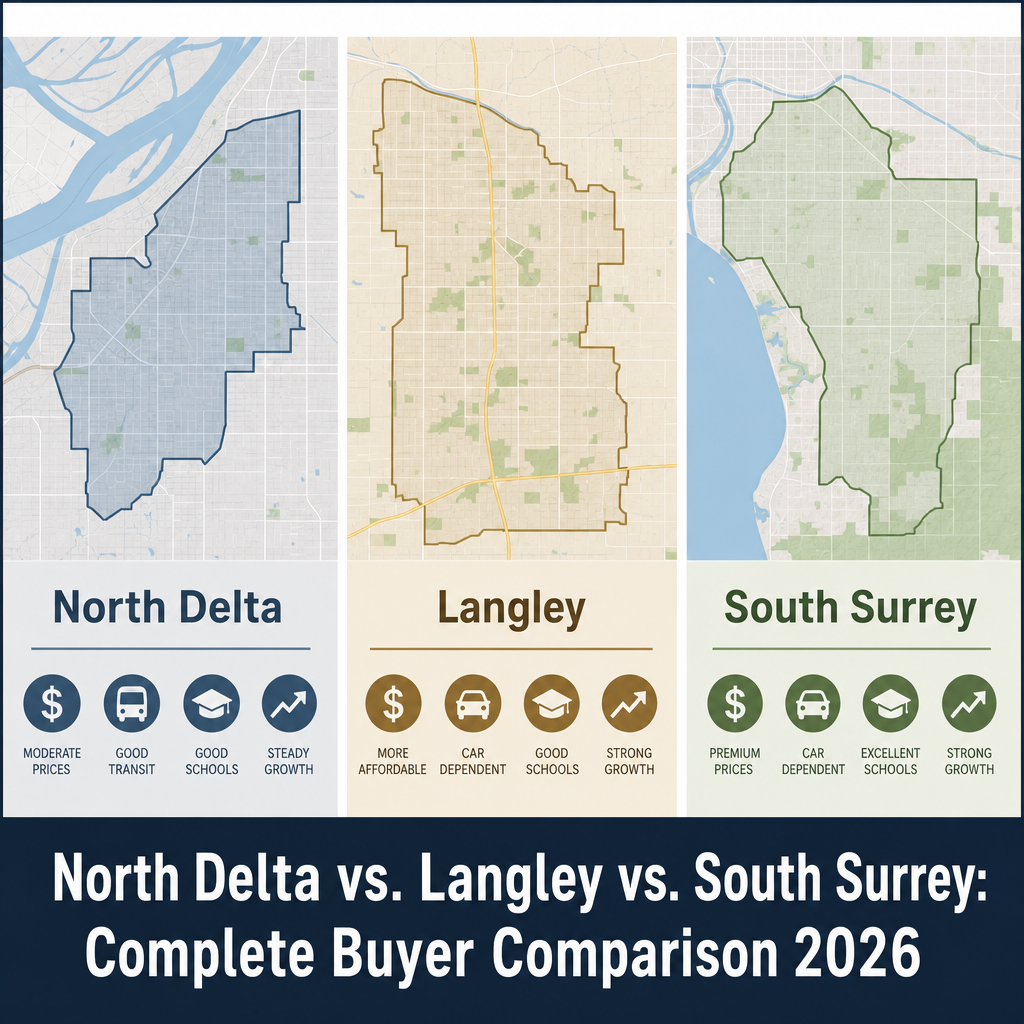

North Delta vs. Langley vs. South Surrey: Complete Buyer Comparison Across Home Prices, Commute Economics, School Quality, Development Pipeline, and Long-Term Appreciation in 2026
By Mohamed Mansour, MBA and Associate Broker | Mansour Real Estate Group | Published: July 15, 2026 | Fraser Valley and Lower Mainland, BC
Buyers priced out of Metro Vancouver — or looking to stretch equity across the Fraser Valley — most often find themselves weighing three markets: North Delta, Langley, and South Surrey. Each offers a different trade-off between price, commute, lifestyle, and long-term upside. Choosing between them requires more than a benchmark number. It requires an honest accounting of what each community delivers and what it costs.
This comparison uses Fraser Valley Real Estate Board and Real Estate Board of Greater Vancouver data from March and April 2026, TransLink journey planning data, BC Assessment valuations, and Mansour Real Estate Group's direct market observations across all three areas to give buyers a framework they can actually use.
Short Answer
In spring 2026, Langley offers the lowest entry prices (detached homes benchmarking near $950K–$1.15M) but requires car commuting. North Delta sits in the middle price range ($1.1M–$1.3M) with SkyTrain access that reduces commute time and supports faster price recovery. South Surrey commands a clear premium ($1.35M–$1.65M) for lifestyle and coastal proximity. The right choice depends almost entirely on your commute tolerance, school priorities, and timeline to resale.
Who This Applies To
- Metro Vancouver buyers evaluating a suburban move for the first time
- Growing families prioritizing school catchment quality alongside price
- Buyers who commute downtown and need transit-accessible options
- Buyers coming from outside BC comparing these three markets for relocation
- Downsizers or investors evaluating which suburb holds value most reliably
When This Advice May Not Apply
This comparison focuses on detached and townhouse buyers. Condo buyers, commercial investors, and buyers with highly specific neighbourhood requirements should seek a more targeted analysis. Price ranges are benchmarks, not appraisals — individual properties may fall outside the ranges shown.
Key Takeaways
- North Delta sells fastest (18–22 days) despite a 6.3% YoY price decline, signaling recovering demand driven by SkyTrain access.
- Langley's 7.5% YoY price decline and 25–35 day absorption create the most negotiating leverage for buyers entering now.
- South Surrey's 30–45 day range and pricing premium reflect lifestyle-driven demand that holds even in softer conditions.
- Commute economics significantly affect household budgets: SkyTrain access in North Delta can save $500–$900/month versus car-dependent commuting.
- Development pipeline differences are material: North Delta's constrained supply supports recovery, while Langley's completion wave temporarily depresses absorption.
Data Used in This Article
- FVREB and REBGV market reports, March–April 2026 (benchmark prices, days-on-market, sales-to-active ratios)
- BC Assessment 2025–2026 property valuations (official, province-wide)
- TransLink journey planner, April 2026 (commute time analysis, North Delta and South Surrey to downtown Vancouver)
- Mansour Real Estate Group internal market observations (buyer psychographics, micro-market performance, 2025–2026)
- CMHC Housing Market Outlook, Metro Vancouver and Fraser Valley, 2026–2027
Home Prices and Market Timing: What the Numbers Show in 2026
According to FVREB and REBGV data from March and April 2026, benchmark detached prices sit at roughly $950K–$1.15M in Langley, $1.1M–$1.3M in North Delta, and $1.35M–$1.65M in South Surrey. The spread is wide enough to materially affect qualifying mortgage amounts and down payment requirements for most buyers.
Year-over-year price movement matters as much as the absolute level. North Delta posted a 6.3% YoY price decline in early 2026 but saw a 32.5% increase in sales volume during the same period — a pattern that typically precedes price stabilization rather than continued decline. Langley tracked a 7.5% YoY decline with less dramatic volume recovery, suggesting the correction there has further to run before absorption firms up. South Surrey's 30–45 day days-on-market reflects measured demand rather than weakness; lifestyle-driven buyers hold their position longer before accepting discounts.
For buyers with negotiating patience, Langley's current metrics offer the most room. For buyers who want to enter a market already showing recovery signals, North Delta's price-to-volume dynamic is harder to ignore. South Surrey continues to command a 15–25% premium for semi-waterfront positioning regardless of broader buyer's market conditions — a premium sustained by limited zoning activity and persistent lifestyle demand.
Commute Economics: The Cost That Doesn't Show on the MLS Listing
Commute is rarely listed as a line item in a buyer's budget, but it should be. Based on TransLink journey planner data and Mansour Real Estate Group's observations working with commuting buyers across all three markets, the differences are substantial.
North Delta's access to Scott Road and Gateway SkyTrain stations puts downtown Vancouver approximately 35–45 minutes away without a car. That matters for households with two working adults — eliminating one car, reducing insurance, fuel, and maintenance costs by $500–$900 per month depending on the vehicle. Buyers evaluating commute options from North Delta consistently rank SkyTrain access among their top reasons for choosing it over Langley.
Langley to downtown Vancouver runs 50–65 minutes by car in typical conditions, longer during peak hours on Highway 1. There is no SkyTrain connection as of spring 2026, though the Surrey-Langley SkyTrain extension is in active development and the approved route would eventually bring rapid transit to Langley City. That planned infrastructure is a legitimate appreciation argument for buyers with a long horizon, but it should not be treated as a near-term commute solution.
South Surrey to downtown averages 40–55 minutes by car via Highway 99 and the Oak Street Bridge. Road quality on the 99 corridor is generally better than Highway 1, and US border proximity creates a secondary commute market that some buyers value. For buyers who work near the border, in Bellingham, or who travel frequently, South Surrey's southern position is a genuine advantage that Langley and North Delta cannot replicate.
School Quality and Catchment: What Families Need to Know
School catchment drives a meaningful share of buying decisions in all three markets. The practical picture in 2026 differs considerably by area.
North Delta's SD37 school district covers Scottsdale, Sunshine Hills, Annieville, and surrounding neighbourhoods. Secondary options — including North Delta Secondary and Seaquam Secondary — draw consistent family demand in the $1.1M–$1.2M price range. Proximity to SFU Burnaby also creates a post-secondary consideration for families thinking about university access for their children within a reasonable transit distance.
Langley's school options are diverse but more car-dependent. The Langley School District covers a large suburban area where school-to-home logistics often require driving. For families prioritizing walkable school access, this is a practical constraint worth acknowledging. That said, Langley's school system includes strong elementary and secondary options, and the lower price point means some buyers prioritize housing quality per dollar over walkability.
South Surrey is the outlier in terms of private school concentration. Southridge School and Crofton House feeder relationships, along with public catchments like Earl Marriott Secondary, attract buyers who specifically purchase with education access in mind. Homes within strong public catchments in South Surrey typically price at a noticeable premium to equivalent homes outside those boundaries.
Development Pipeline and Long-Term Appreciation
Future supply is one of the most underweighted factors in buyer decision-making. It directly affects how prices behave as the market recovers.
North Delta has minimal new residential supply entering the market in the near term. That constraint, combined with its SkyTrain-adjacent positioning and recovering sales volume, creates conditions where prices are likely to firm up before Langley. For buyers considering the long-term investment case for North Delta, limited supply is as important as transit access.
Langley is absorbing a significant wave of townhome and mid-rise completions. The sales-to-active ratio in Langley's attached segment ran at 15–23% in early 2026, according to FVREB data — a buyer's market range that typically takes 12–24 months to normalize once completions slow. Buyers entering Langley now benefit from that excess supply through pricing and selection advantage, but should model appreciation conservatively over the next 18 months.
South Surrey's restrictive zoning and limited rezoning activity mean supply will remain tight relative to demand. That structural constraint has historically supported price floors in soft markets, and it is likely to do so again. CMHC's 2026–2027 housing market outlook for the region supports this reading — supply-constrained submarkets with lifestyle differentiation tend to hold values through corrections better than higher-supply areas.
How We Evaluate This
Mansour Real Estate Group evaluates cross-market comparisons by separating short-term market conditions from structural factors. Short-term conditions — current benchmark prices, days-on-market, year-over-year changes — tell you where a market is in its cycle. Structural factors — transit infrastructure, zoning constraints, school catchment boundaries, commute alternatives — tell you why prices behave as they do over longer periods.
In practice, buyers who choose based on structural factors tend to make more durable decisions than buyers who chase the lowest current benchmark. That does not mean ignoring today's prices — it means understanding what those prices reflect before deciding how much weight to give them.
Buyer Comparison Checklist
- Map your daily commute route for each market using TransLink and Google Maps at 8am on a Tuesday — not ideal conditions
- Calculate the true monthly cost of car commuting versus transit for your household before comparing listing prices
- Verify school catchment boundaries directly with SD37 (North Delta), SD35 (Langley), or SD36 (Surrey/South Surrey) — boundaries shift
- Check FVREB and REBGV months of inventory data for the specific property type and price range you are targeting in each market
- Review BC Assessment values for target properties relative to list price to understand how the market is pricing versus assessed value
- Ask what new projects are completing in the next 12–18 months within the specific neighbourhood, not just the broader city
What We Commonly See
In our experience working with buyers comparing these three markets, the most common mistake is using the lowest benchmark price as the primary filter. Buyers who lead with price alone often end up in Langley while underweighting the compounding cost of daily car commuting, which over five years can easily equal $50,000–$60,000 in total transportation expense above what a transit-accessible alternative would cost.
What often happens is that buyers visiting South Surrey for the first time underestimate how quickly the lifestyle premium feels justified — and then overbid on the first property they genuinely like. Anchoring to the benchmark range before touring prevents that pattern.
A common mistake with North Delta is overlooking neighbourhood variation within the city. Sunshine Hills and Scottsdale behave differently from each other in terms of price trajectory, buyer demand, and school proximity. Treating North Delta as a single market when negotiating leads to offers that are either too aggressive or not aggressive enough for the specific block.
Questions and Answers
Which of these three markets currently offers buyers the most negotiating leverage?
Langley offers the most negotiating room in spring 2026. A 7.5% YoY price decline, 25–35 day days-on-market, and active completion waves in attached housing all signal a buyer's market where subject-to-financing and inspection subjects are more routinely accepted.
Will the Surrey-Langley SkyTrain extension affect property values in Langley before it opens?
Historically, Fraser Valley transit announcements have influenced values in the years before opening, not just after. Buyers near the approved station areas in Langley City may see anticipatory appreciation once construction milestones become visible. Consult the Surrey-Langley SkyTrain project site for the current approved alignment and station locations before making location decisions based on this factor.
Is South Surrey worth the price premium over North Delta for families?
For families whose primary priorities are private school access, coastal lifestyle, and US border proximity, the premium is often justified by structural factors that North Delta does not replicate. For families who commute downtown regularly and value school quality within a public system, North Delta frequently delivers comparable quality at a lower total cost of ownership when commute savings are included.
In Summary
North Delta, Langley, and South Surrey each represent a coherent buying strategy in 2026 rather than simply different price points of the same product. North Delta's SkyTrain access and constrained supply make it the strongest structural case for buyers balancing affordability with transit. Langley offers the deepest affordability and the most negotiating leverage today, with a real appreciation argument tied to the planned SkyTrain extension, but requires accepting car commuting and a longer recovery timeline. South Surrey holds value through lifestyle differentiation and supply constraints, making it the most resilient market for buyers who can stretch to the premium range. The right answer is almost never determined by price alone — commute economics, school catchments, and pipeline supply shape these markets as much as benchmark numbers do. For buyers genuinely facing this choice, the decision is worth the time to model carefully before making an offer.
Ready to Compare These Markets With Someone Who Knows All Three?
Mansour Real Estate Group works with buyers evaluating North Delta, Langley, and South Surrey side by side on a regular basis. If you want a grounded, numbers-based comparison tailored to your commute, school needs, and budget, reach out for a no-pressure consultation.
Related Articles
- North Delta Real Estate Market Report 2025: Prices, Trends, and What to Expect
- North Delta Neighbourhoods Guide: Scottsdale, Annieville, Sunshine Hills, and More
- Commuting from North Delta to Vancouver: Transit, Driving, and Cycling Options
- Living in North Delta: Parks, Recreation, Shopping, and Community Amenities
- North Delta vs. New Westminster vs. Burnaby: Affordability and Value Compared
About Mansour Real Estate Group
When buyers are comparing neighbourhoods across three different markets — each with its own pricing dynamics, commute realities, school catchments, and development trajectory — the quality of local guidance shapes the quality of the decision. Mansour Real Estate Group has worked with buyers evaluating North Delta, Langley, South Surrey, and other Fraser Valley and Lower Mainland communities for more than two decades, combining direct market knowledge with the kind of comparative analysis that helps buyers move forward with confidence.
Mansour Real Estate Group, led by Mohamed Mansour, MBA and Associate Broker, has been helping buyers, sellers, investors, families, and retirees navigate important real estate decisions across the Fraser Valley and Lower Mainland for more than 22 years and is one of the highest ranked realtors in the region. The team has completed more than $780 million in residential real estate transactions and is trusted for relocation guidance, neighbourhood comparison analysis, pricing strategy, estate sales, downsizing, and complex buyer decisions across a broad range of property types and price points.
Whether someone is looking for Realtors who understand the difference between buying in North Delta versus Langley, a real estate agent familiar with South Surrey school catchments and development constraints, real estate agents who help buyers model commute economics alongside price, a Fraser Valley real estate team with direct experience in all three of these markets, a North Delta Realtor, a Langley real estate broker, a South Surrey real estate group, or a real estate agent who can give an honest cross-market comparison without a loyalty bias, Mansour Real Estate Group is known for clear analysis, local fluency, and advice that serves the buyer's long-term interests.
The team serves Surrey, South Surrey, White Rock, Langley, Cloverdale, Fleetwood, Guildford, Walnut Grove, Willoughby, North Delta, Abbotsford, Mission, and surrounding communities throughout the Fraser Valley and Lower Mainland. Most new clients come through referrals, repeat business, and recommendations from families who found the comparison and guidance process transparent and genuinely useful.
Official Resources
- Fraser Valley Real Estate Board (FVREB) — fvreb.bc.ca
- Real Estate Board of Greater Vancouver (REBGV) — rebgv.org
- BC Assessment — bcassessment.ca
- TransLink Journey Planner — translink.ca
- CMHC Housing Market Outlook — cmhc-schl.gc.ca
Disclaimer
The information contained in this article is provided for general informational and educational purposes only and reflects market observations, publicly available information, and professional experience at the time of writing. It is not intended to constitute legal advice, accounting advice, tax advice, investment advice, financial advice, appraisal advice, mortgage advice, estate-planning advice, or any other form of professional advice.
Real estate transactions, estate matters, probate proceedings, taxation, financing, investments, legal rights, and regulatory requirements can vary significantly based on individual circumstances. Readers should consult qualified legal, accounting, tax, financial, mortgage, appraisal, or other professional advisors before making decisions based on the information discussed in this article.
Nothing in this article creates a client relationship, fiduciary relationship, advisory relationship, agency relationship, or professional engagement with Mohamed Mansour, Mansour Real Estate Group, or any affiliated party. Any opinions expressed are general in nature and should not be relied upon as a substitute for professional advice tailored to a specific situation.
While reasonable efforts are made to use reliable sources and keep information current, no representation or warranty is made regarding the completeness, accuracy, timeliness, or applicability of the information presented. Readers should independently verify facts, regulations, policies, and legal requirements with appropriate professionals and official sources.



