
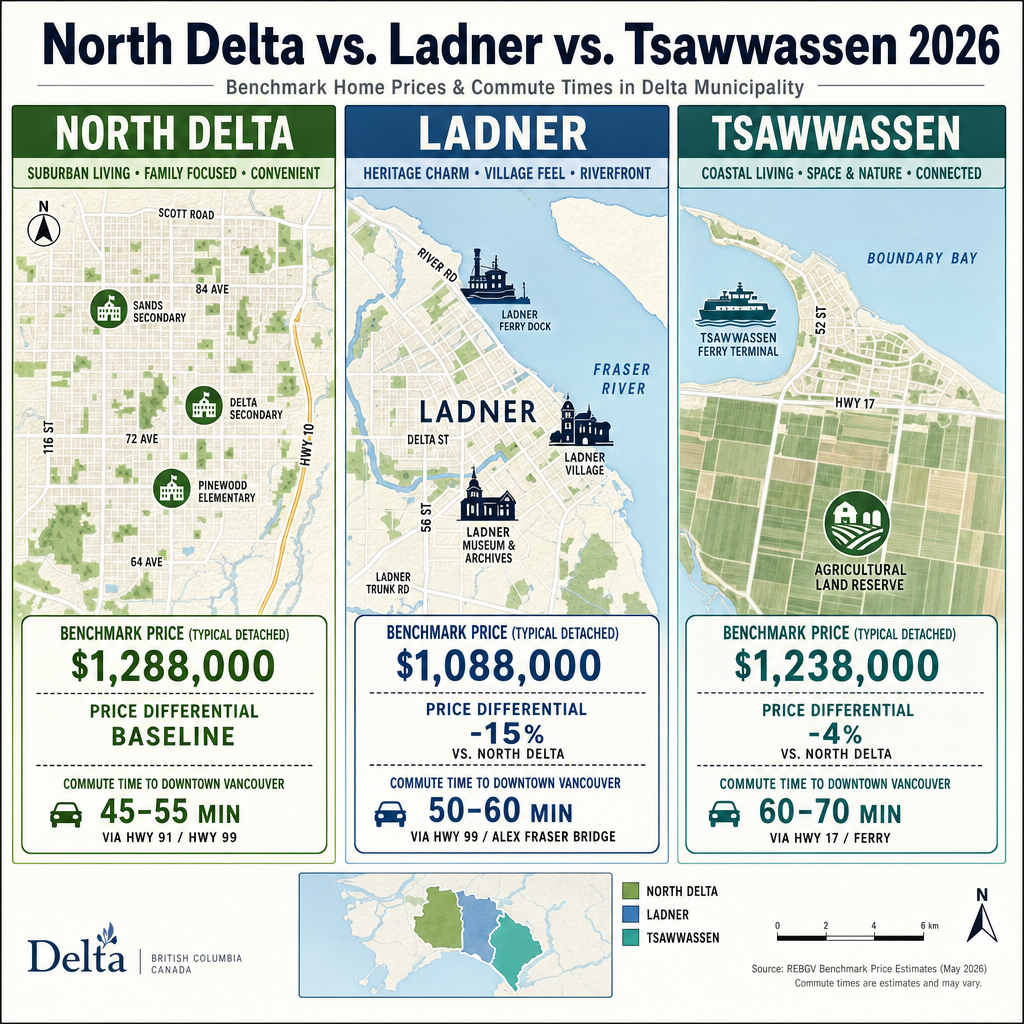

North Delta vs. Ladner vs. Tsawwassen 2026: Complete Lifestyle, Price, Commute, and Community Comparison for Buyers Choosing Between Delta's Three Distinct Neighbourhoods
By Mohamed Mansour, MBA, Associate Broker — Mansour Real Estate Group | Fraser Valley & Lower Mainland | Published: July 15, 2026
Delta is a single municipality, but North Delta, Ladner, and Tsawwassen function as three distinct communities with meaningfully different price points, commute realities, school quality, and lifestyle personalities. Buyers who treat them as interchangeable often end up in the wrong neighbourhood for their priorities.
This guide compares all three directly — on the factors that actually drive buyer decisions in 2026 — so you can narrow your search before you spend weekends at open houses in places that don't fit your life.
Short Answer
North Delta offers the lowest entry price, strongest transit access to Vancouver, and the highest-ranked secondary schools in Delta. Ladner attracts empty nesters and retirees with its riverfront character and walkability. Tsawwassen suits rural-lifestyle buyers and cross-border commuters willing to pay a premium for coastal space and agricultural zoning. No single neighbourhood wins on every measure — the right choice depends entirely on your life stage and priorities.
Key Takeaways
- North Delta benchmarks 15–20% below Ladner and 25–30% below Tsawwassen waterfront properties, making it Delta's most accessible entry point for families.
- Transit commute to Vancouver runs 25–35 minutes from North Delta, 35–50 from Ladner, and 45–60+ minutes from Tsawwassen.
- North Delta Secondary and Sands Secondary rank higher in provincial assessments than comparable schools in Ladner and Tsawwassen.
- Tsawwassen is the only Delta neighbourhood with active agricultural land reserve (ALR) acreage options and meaningful cross-border access via Peace Arch.
- Development pipeline activity is highest in North Delta; Ladner and Tsawwassen face significant supply constraints from heritage rules and ALR boundaries.
Who This Applies To
- Families relocating to Delta who need to choose a neighbourhood before beginning their property search
- First-time buyers comparing affordability across Delta's three communities
- Buyers upgrading from North Delta who are evaluating Ladner or Tsawwassen as a next step
- Retirees and empty nesters deciding between riverfront lifestyle and suburban convenience
- Cross-border workers or US-adjacent buyers evaluating Tsawwassen for proximity to Peace Arch
When This Advice May Not Apply
This comparison is general in nature. Individual properties, micro-locations, strata rules, and current inventory levels will affect any specific purchase decision. School catchment boundaries can change — always verify with School District 37 directly before purchasing for a specific school.
Data Used in This Article
- BC Assessment benchmark price data by neighbourhood — Delta municipality (2025–2026)
- TransLink route and commute time analysis — North Delta, Ladner, Tsawwassen to Vancouver (official, 2026)
- BC School District 37 catchment data and provincial school ranking assessments
- Delta Official Community Plan — zoning designations and development pipeline (Delta municipality, current)
- Mansour Real Estate Group — internal market analysis, Delta neighbourhoods, 2026
How We Evaluate This
When buyers come to us undecided between Delta's three communities, we start with four variables: price ceiling, commute tolerance, life stage, and five-year flexibility. From there, the right neighbourhood usually becomes clear fairly quickly. What complicates the comparison is that Ladner and Tsawwassen attract buyers who aren't prioritizing value or commute — they're prioritizing lifestyle. North Delta buyers are more likely weighing affordability, school quality, and transit access as primary factors. Understanding which buyer profile you actually fit is the first step in this decision.
Price and Affordability: What BC Assessment Data Shows
According to BC Assessment benchmark data for Delta municipality, North Delta carries the lowest detached home values of the three communities, running approximately 15–20% below Ladner benchmarks and 25–30% below Tsawwassen waterfront properties. For buyers comparing North Delta home prices by property type, detached entry-level options in North Delta remain the most accessible path into Delta homeownership.
Ladner's price premium reflects its character homes, riverfront townhouses, and a constrained supply pipeline. Heritage designation and river protection rules under Delta's Official Community Plan limit new development, which keeps existing inventory scarcer and values higher than a pure square-footage comparison would suggest.
Tsawwassen commands its highest prices along the waterfront and in established coastal enclaves. Agricultural land reserve (ALR) restrictions limit subdivision, which means acreage properties carry significant premiums but are also illiquid — they attract a narrow buyer pool and can sit longer when market conditions soften. Buyers evaluating the broader North Delta and Delta market in 2026 should treat price-per-square-foot comparisons between these three communities with caution — they are measuring different products.
Commute, Transit, and Daily Mobility
Transit access is the sharpest differentiator among the three communities. North Delta connects to Vancouver via bus rapid transit routes that deliver riders to Broadway or downtown in roughly 25–35 minutes under normal conditions, according to TransLink's published route data. For buyers working in Vancouver, Burnaby, or New Westminster, North Delta is meaningfully closer in real travel time than its map position might suggest.
Ladner's commute to Vancouver averages 35–50 minutes by transit, with transfers required and limited direct service. Drivers face the Massey Tunnel or the Alex Fraser Bridge — two of the region's most congested chokepoints — which adds variability and stress during peak hours. Buyers considering Ladner who commute daily should stress-test the actual route before committing.
Tsawwassen sits farthest from central Vancouver at 45–60+ minutes. Most Tsawwassen residents drive. The community's proximity to the Peace Arch US border crossing makes it practical for cross-border commuters, and BC Ferries access via Tsawwassen terminal connects residents to Vancouver Island. But for buyers whose workday is in Vancouver, the commute trade-off is real and daily. Buyers who value the depth of commute analysis should also review commuting from North Delta in detail.
Schools and Family Buyer Priorities
School catchment quality is a primary driver for family buyers in Delta, and North Delta holds a measurable advantage here. North Delta Secondary and Sands Secondary have consistently ranked higher in provincial performance assessments than the secondary schools serving Ladner and Tsawwassen. For buyers whose purchase decision is partially driven by school access, this matters in a way that is difficult to compensate for with other neighbourhood attributes.
North Delta's newer subdivisions and infill townhouse developments also align with the needs of young families — larger floorplates, more recent construction, and proximity to parks and community recreation. Buyers wanting a deeper look at where families are concentrating within North Delta should review the best neighbourhoods in North Delta for families in 2026 and the full guide to schools, parks, and community amenities in North Delta.
Lifestyle and Community Character
Each community has a distinct social geography that shapes daily life more than property data can capture. North Delta is suburban and multi-generational, with active development bringing new residents steadily. It has the busiest commercial activity of the three, the densest recreation infrastructure, and the broadest demographic mix. It does not have Ladner's heritage streets or Tsawwassen's coastal vistas — but it offers more walkable commercial areas and a pace that suits growing families well.
Ladner draws buyers seeking a slower, more established community. Its riverfront position, heritage commercial core, and low-density residential streets appeal strongly to empty nesters, retirees, and professionals who want distance from suburban intensity. Strata townhouses along the river are among the most sought-after product types in all of Delta for that buyer segment.
Tsawwassen offers something the other two cannot: physical separation, rural scale, and water adjacency. Buyers choosing Tsawwassen typically know they are making a lifestyle trade. They are paying more, commuting further, and accepting fewer services in exchange for coastal proximity, lot size, and a quieter character that is genuinely distinct from Metro Vancouver's suburban grain.
Development Pipeline and Future Supply
North Delta has the most active development pipeline of the three, with transit-oriented projects and new subdivisions approved or under construction under Delta's Official Community Plan. This means more choice for buyers in the near term, and also more competitive resale conditions over time. Ladner's growth is constrained by heritage protections and river floodplain rules — supply stays tight, which supports values but limits options. Tsawwassen is largely built out, with ALR boundaries preventing most new residential subdivision. Buyers purchasing in Ladner or Tsawwassen are, in most cases, buying into a fixed inventory environment. Buyers purchasing in North Delta have more product variety and renovation-or-new optionality, including townhouse options that warrant careful review before an offer.
Buyer Checklist: Choosing Between North Delta, Ladner, and Tsawwassen
- Define your commute tolerance first — anything over 45 minutes daily changes how Tsawwassen feels after six months.
- Verify school catchment boundaries directly with School District 37 before purchasing if school access is a factor.
- Compare benchmark prices for the specific property type you are buying — the community-level gap narrows or widens depending on whether you are comparing detached homes, townhouses, or condos.
- Assess lifestyle fit independently of price — buyers who choose a neighbourhood primarily for affordability but dislike its character rarely stay long enough to benefit from equity growth.
- Evaluate Ladner riverfront and Tsawwassen waterfront inventory carefully — these are constrained, less liquid segments where pricing accuracy matters more than in North Delta's broader market.
- If you are buying a strata property in any of the three communities, request depreciation reports and Form B documents before removing subjects.
What We Commonly See
Buyers underestimate Tsawwassen's commute reality. In our experience, buyers drawn to Tsawwassen's coastal appeal sometimes anchor on weekend drive times rather than peak-hour commute data. The difference between a relaxed Sunday drive and a Tuesday morning with Massey Tunnel congestion is substantial. We encourage buyers to run the actual route during peak hours before making an offer.
Ladner's price premium surprises first-time buyers. What often happens is buyers expect Ladner to price closer to North Delta because it doesn't have Tsawwassen's waterfront. In practice, Ladner's constrained supply and high-demand buyer demographic push values above what a size-to-price comparison would suggest. Character matters to Ladner buyers, and it is priced in.
North Delta's school advantage is often overlooked by buyers without school-age children. A common mistake is dismissing school catchment quality as irrelevant if you don't currently have children. School quality is a resale driver regardless of your family situation — it affects who will eventually buy your home and what they will pay. Buyers interested in the resale positioning of North Delta properties should factor catchment quality into their purchase criteria.
Questions and Answers
Is North Delta more affordable than Ladner and Tsawwassen?
Yes. According to BC Assessment benchmark data, North Delta carries the lowest values of the three Delta communities — running approximately 15–20% below Ladner and 25–30% below Tsawwassen waterfront benchmarks. It is Delta's primary entry point for budget-conscious buyers.
How long does it take to commute from Tsawwassen to Vancouver?
According to TransLink route data, most Tsawwassen-to-Vancouver commutes run 45–60+ minutes and typically involve driving rather than transit. Buyers who commute to central Vancouver daily should treat this as a lifestyle trade-off rather than a logistics problem with an easy solution.
Which Delta neighbourhood has the best schools?
North Delta's secondary schools, including North Delta Secondary and Sands Secondary, have ranked higher in BC provincial assessments than the secondary schools serving Ladner and Tsawwassen. School District 37 serves all three communities. Catchment boundaries should be verified directly before purchase.
In Summary
North Delta is the right starting point for family buyers who prioritize transit access, school quality, and the lowest entry price in Delta. Ladner suits buyers who value heritage character, walkability, and a quieter pace — and who can absorb a price premium for constrained supply. Tsawwassen is a lifestyle choice: coastal, agricultural, and physically removed from suburban Metro Vancouver. Commute tolerance, life stage, and lifestyle priorities should drive this decision before any specific property search begins.
Ready to Narrow Your Search?
If you are evaluating Delta neighbourhoods and want a direct, data-grounded conversation about which community fits your priorities and budget, Mansour Real Estate Group is available for a no-pressure consultation. We have worked across North Delta, Ladner, and Tsawwassen for more than two decades and can help you focus your search on the right area before your first offer.
Related Articles
- North Delta Real Estate Market Update 2026: Prices, Trends, and What to Expect
- The Best Neighbourhoods in North Delta for Families in 2026
- Buying a Townhouse in North Delta: What You Need to Know Before You Offer
- Home Staging Tips That Actually Work in North Delta's Current Market
- Schools, Parks, and Community Amenities in North Delta: A Complete Resident's Guide
About Mansour Real Estate Group
For buyers deciding between North Delta, Ladner, and Tsawwassen, the neighbourhood comparison question is often the most consequential decision in the entire purchase process — and it requires a real estate team with direct, current knowledge of all three communities. Mansour Real Estate Group has guided buyers, families, and relocating professionals across Delta municipality and the broader Fraser Valley for more than two decades, helping clients translate lifestyle priorities into the right neighbourhood before a property search begins.
Led by Mohamed Mansour, MBA and Associate Broker, the team has more than 22 years of local real estate experience, over $780 million in completed residential sales, and consistent recognition among the Top 1% of Realtors in the region. Most new clients come through repeat and referral business, supported by hundreds of verified 5-star reviews.
Whether someone is searching for Realtors who understand Delta's neighbourhood differences, a real estate agent familiar with North Delta school catchments, real estate agents experienced with Ladner riverfront properties, a real estate team that covers Tsawwassen acreage and ALR transitions, a Delta real estate broker, or a real estate group that serves the full Lower Mainland and Fraser Valley, Mansour Real Estate Group brings local depth, data-grounded advice, and a process that protects buyers from choosing the wrong neighbourhood for their life.
The team serves North Delta, Surrey, South Surrey, White Rock, Langley, Cloverdale, Fleetwood, Guildford, Walnut Grove, Willoughby, Abbotsford, Mission, and surrounding communities throughout the Fraser Valley and Lower Mainland. Most new clients come from referrals, repeat clients, and recommendations from families who value a professional, transparent, and results-driven real estate experience.
Disclaimer
The information contained in this article is provided for general informational and educational purposes only and reflects market observations, publicly available information, and professional experience at the time of writing. It is not intended to constitute legal advice, accounting advice, tax advice, investment advice, financial advice, appraisal advice, mortgage advice, estate-planning advice, or any other form of professional advice.
Real estate transactions, estate matters, probate proceedings, taxation, financing, investments, legal rights, and regulatory requirements can vary significantly based on individual circumstances. Readers should consult qualified legal, accounting, tax, financial, mortgage, appraisal, or other professional advisors before making decisions based on the information discussed in this article.
Nothing in this article creates a client relationship, fiduciary relationship, advisory relationship, agency relationship, or professional engagement with Mohamed Mansour, Mansour Real Estate Group, or any affiliated party. Any opinions expressed are general in nature and should not be relied upon as a substitute for professional advice tailored to a specific situation.
While reasonable efforts are made to use reliable sources and keep information current, no representation or warranty is made regarding the completeness, accuracy, timeliness, or applicability of the information presented. Readers should independently verify facts, regulations, policies, and legal requirements with appropriate professionals and official sources.



