
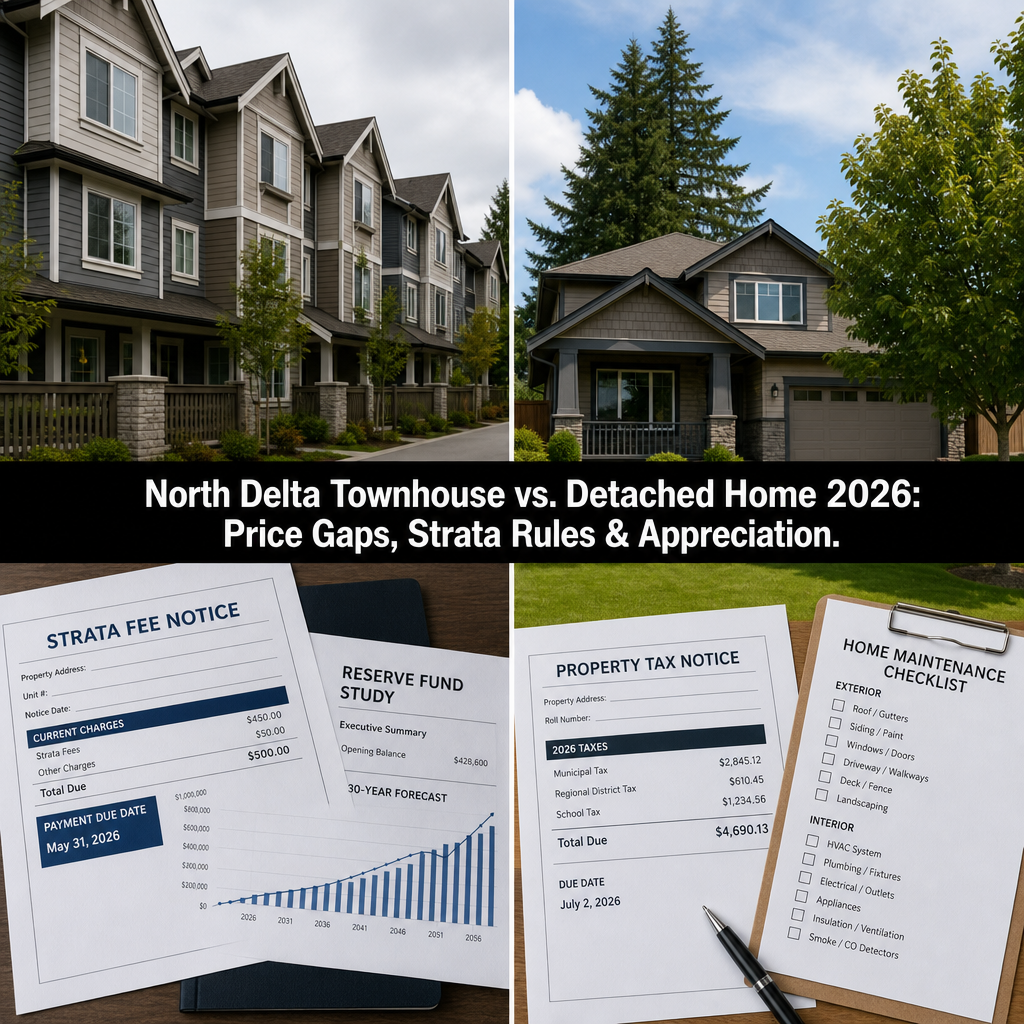

North Delta Townhouse vs. Detached Home Buyer's Complete Comparison 2026: Price Gaps, Strata Rules, Space Trade-Offs, Carrying Costs, and Long-Term Appreciation
By Mohamed Mansour, MBA and Associate Broker, Mansour Real Estate Group | North Delta, BC | Published: July 2026
For families buying in North Delta in 2026, the choice between a townhouse and a detached home is rarely simple. The price gap is real, the strata obligations are significant, and the appreciation history between property types has diverged enough to affect long-term wealth outcomes. This guide addresses that decision directly, using current North Delta market data and the practical experience of working with buyers who face exactly this trade-off.
Whether you are a growing family deciding whether the savings on a townhouse outweigh the strata constraints, or a first-time buyer weighing entry price against carrying cost, the comparison below is built specifically for North Delta's market conditions — not a generic BC buyer guide.
Short Answer
In North Delta's 2026 market, detached homes sell faster, appreciate more consistently, and offer full ownership autonomy — but cost $100,000–$150,000 more than comparable townhouses and carry higher annual maintenance. Townhouses offer a lower entry price and shared maintenance structure, but strata fees, governance rules, and special levy risk are real long-term costs that buyers must factor in before signing.
Key Takeaways
- North Delta detached homes sell in 18–25 days; townhouses average 45–55 days in the same market.
- Townhouses cost roughly $100K–$150K less at equivalent square footage, but carry $250–$380/month in strata fees.
- Detached homes show 3–7% annual appreciation potential versus 0–5% for townhouses through 2027.
- Aging North Delta strata buildings post-2010 carry increasing special levy risk, averaging $2,000–$8,000 per unit.
- Newer townhouse communities show stronger resale velocity and lower levy risk than older strata buildings.
Who This Applies To
- Families choosing between property types in North Delta with a budget of $600,000–$950,000
- First-time buyers evaluating whether a townhouse is a viable long-term ownership option
- Downsizers moving from a detached home into a lower-maintenance property
- Investors comparing appreciation potential and liquidity between property types
When This Advice May Not Apply
Buyers with budgets above $1.1M in North Delta often move into a different segment where the townhouse-versus-detached comparison shifts. Similarly, buyers focused on presale new construction should review the specific presale risks and benefits for North Delta before applying resale comparisons.
Key Terms Defined
Strata fee: A monthly payment collected from all strata lot owners in a townhouse complex to fund building maintenance, insurance, and the contingency reserve fund.
Special levy: A one-time charge assessed against strata lot owners when the reserve fund is insufficient to cover a major repair. Under BC's Strata Property Act, these can be levied without majority owner approval in certain emergency circumstances.
Contingency reserve fund (CRF): The savings account that a strata corporation maintains for future major repairs. A well-funded CRF reduces special levy risk significantly.
Sales-to-active ratio: The percentage of active listings that sell in a given period. A ratio above 20% typically signals a seller's market; below 12% suggests a buyer's market. According to the FVREB's April 2026 Market Report, North Delta detached homes sit near a 10% ratio — balanced with strong velocity — while townhomes trail below that threshold.
Data Used in This Article
- FVREB Market Report, April 2026 — Sales-to-active ratios and days-on-market by property type, North Delta (official)
- BC Assessment Database, 2026 — Property values and tax comparison by type (official)
- MLS Sales Data, 2025–2026 — Price trends and market velocity by neighbourhood, North Delta (third-party / industry)
- Mansour Real Estate Group Comparative Market Analysis — North Delta detached vs. attached housing (internal analysis)
- Strata Property Reports, 2026 — Reserve fund analysis and special levy trends in North Delta communities (third-party)
The Price Gap Between Townhouses and Detached Homes in North Delta
According to MLS sales data for 2025–2026 and BC Assessment's 2026 property valuations, North Delta townhouses are typically priced $100,000–$150,000 below comparable detached homes at equivalent square footage. In practical terms, that puts a starter detached home in the $700,000–$950,000 range and a comparable townhouse between $600,000 and $800,000, depending on age, community, and location within North Delta.
That gap reflects land ownership. A detached home buyer owns the lot. A townhouse buyer owns their strata lot and a share of common property — a meaningful legal and financial distinction that affects everything from renovation rights to future redevelopment value. For families weighing the average home prices in North Delta by property type, the gap is real but the carrying cost comparison adds another layer.
The price premium for detached homes is not purely about size. Many North Delta townhouses offer 1,400–1,800 square feet — comparable to entry-level detached homes — but the land value, strata constraints, and resale velocity all differ. Buyers who assume townhouses are simply "smaller detached homes at lower prices" often underestimate the structural differences in ownership.
Carrying Costs: Strata Fees, Property Tax, and Special Levy Risk
Strata fees in North Delta townhouse communities average $250–$380 per month, based on 2026 strata property reports. That translates to $3,000–$4,560 per year in mandatory overhead before mortgage, insurance, or maintenance. Detached homeowners pay no strata fee, but assume full property tax on their lot and sole responsibility for all exterior and structural maintenance.
On an annual basis, detached home ownership in North Delta typically costs 15–25% more in combined property tax and maintenance than a comparable townhouse — but that comparison changes when special levies are factored in. North Delta strata buildings that are 15–20 years old increasingly show reserve fund shortfalls. Special assessments in aging communities are averaging $2,000–$8,000 per unit, and in some cases more, when envelope repairs, roof replacement, or mechanical upgrades are required.
Newer townhouse communities — particularly those built after 2015 with adequate initial depreciation report funding — carry substantially lower special levy risk. This makes the building's age and reserve fund status a critical factor in any townhouse purchase in North Delta. Reviewing the Form B and the most recent depreciation report before removing subjects is not optional. The North Delta first-time buyer's guide covers document review in more detail.
How We Evaluate This
When Mansour Real Estate Group works with buyers comparing townhouses and detached homes in North Delta, the analysis starts with total cost of ownership over a five-year horizon, not just purchase price. That means calculating strata fees, projected special levy exposure based on building age, property tax obligations, and expected appreciation by property type.
The days-on-market divergence — 18–25 days for detached versus 45–55 days for townhouses — is a meaningful signal. It tells us that buyer demand for single-family ownership in North Delta is structurally stronger, which has direct implications for resale liquidity. A buyer purchasing a townhouse that takes twice as long to sell when they are ready to move faces a different risk profile than a detached home buyer in the same neighbourhood.
Long-Term Appreciation: Does the Price Gap Close Over Time?
Based on MLS price trend data for 2025–2026 and internal comparative market analysis, North Delta detached homes are forecast at 3–7% annual appreciation potential through 2027, while townhouses are projected at 0–5%. The gap is not dramatic in any single year, but over a five-to-ten-year ownership period, it compounds. A buyer who purchases a $750,000 detached home at 5% annual appreciation reaches approximately $957,000 in ten years. The same buyer in a $650,000 townhouse at 3% appreciation reaches approximately $874,000 — a difference of roughly $83,000 in gross equity, before accounting for the strata fees paid over that period.
That math is illustrative, not guaranteed. Appreciation depends on interest rates, local supply, neighbourhood development, and broader Fraser Valley market conditions. The North Delta market report covers the structural drivers of appreciation in more depth. What the data does suggest is that land ownership in North Delta carries a consistent long-term premium — and that buyers who treat townhouses as a pure financial equivalent to detached homes at lower prices may be underestimating the difference.
Strata Governance: What Townhouse Buyers Often Underestimate
Under BC's Strata Property Act, townhouse owners are subject to bylaws that can restrict renovations, parking use, pet ownership, short-term rentals, and exterior modifications. Bylaw enforcement varies by strata council, but the constraint is structural: you do not have unilateral authority over your property in the same way a detached homeowner does.
For families with renovation plans, specific parking needs, or plans to rent out a suite, strata governance deserves careful review before purchase — not after. Bylaw packages are available through Form B requests and should be read in full. A North Delta townhouse with restrictive bylaws may look identical on paper to one with permissive bylaws, but ownership experience will differ substantially.
Buyer Checklist: Townhouse vs. Detached Decision in North Delta
- Confirm your mortgage pre-approval accounts for strata fees in your debt service calculation
- Request Form B and the most recent depreciation report for any townhouse you are seriously considering
- Review the contingency reserve fund balance relative to the depreciation report's 10-year repair projections
- Ask about any pending or approved special levies before removing subjects
- Confirm strata bylaws on pets, parking, rentals, and exterior modifications match your needs
- For detached homes, obtain a pre-listing inspection or independent inspection to estimate near-term maintenance costs
- Compare days-on-market for your target property type and neighbourhood before setting your offer timeline
- Model total five-year carrying costs for both options using current strata fees, property tax estimates from BC Assessment, and projected maintenance
What We Commonly See
In our experience, buyers who choose a townhouse primarily because it is cheaper often discover strata constraints after possession — not before. The bylaw package is frequently reviewed too quickly during the subject period. A 7-day subject removal window is enough time to read the Form B carefully, but only if the buyer knows what to look for and has an agent who flags the critical items.
What often happens with detached home buyers in North Delta is that the maintenance budget is underestimated in year one. Buyers who move from a strata unit where exterior maintenance was managed collectively sometimes experience sticker shock at the first roof estimate or drainage repair. Detached home ownership in North Delta is genuinely lower governance overhead — but it is not lower cost overhead.
A common mistake is choosing a townhouse based on newer finishes without reviewing the building's age and reserve fund. A 2015-renovated interior in a 1998-built strata building can mask an aging envelope and an underfunded reserve account. The cosmetic condition of a unit does not reflect the financial health of the strata corporation that owns the roof, the foundation, and the plumbing risers.
Questions and Answers
Are North Delta townhouses a good long-term investment compared to detached homes?
Townhouses offer a lower entry point and can build meaningful equity, but detached homes in North Delta have historically shown stronger appreciation and sell faster. For buyers with a 10-year horizon, the land premium attached to detached ownership tends to justify the higher purchase price over time.
What should I look for in a North Delta townhouse's depreciation report?
Check the 10-year repair schedule, the current reserve fund balance, and whether the fund meets the report's recommended funding level. A shortfall between the recommended balance and the actual balance is the clearest indicator of special levy risk. Under the BC Strata Property Act, depreciation reports must be updated every three years for most strata corporations.
Can a North Delta townhouse strata corporation restrict me from renting out my unit?
Yes. Under the Strata Property Act, a strata corporation can pass bylaws restricting rentals, though Bill 44 (2022) limited some rental restriction bylaws for existing stratas. Review the current bylaws carefully and confirm their enforceability with your conveyancing lawyer before purchasing if rental income is part of your plan.
In Summary
North Delta's 2026 market shows a measurable divergence between detached homes and townhouses in price, appreciation, days-on-market, and carrying cost structure. Detached homes cost more to enter but offer land ownership, faster resale, stronger appreciation, and no strata governance. Townhouses offer a lower entry price and shared maintenance structure, but strata fees, reserve fund health, special levy exposure, and bylaw constraints are real long-term factors. The right choice depends on your budget, timeline, risk tolerance, and ownership priorities — and the building you choose matters as much as the property type you choose.
Talk to a Local Expert Before You Decide
If you are weighing a townhouse against a detached home in North Delta and want a grounded, numbers-based comparison for your specific situation, Mansour Real Estate Group is available for a no-pressure consultation. The goal is to help you understand the full picture before you commit to either path. Knowing the right questions to ask your real estate agent is a useful first step.
Related Articles
- Average Home Prices in North Delta by Property Type: Detached, Townhouse, and Condo
- First-Time Home Buyer's Guide to Purchasing in North Delta
- Selling Your North Delta Home in a Slower Market: Strategies That Still Work
- How to Stage Your North Delta Home for Maximum Buyer Appeal
- Buying a Presale Home in North Delta: Risks, Benefits, and What to Watch For
About Mansour Real Estate Group
Helping buyers choose between a townhouse and a detached home in North Delta requires more than a price comparison — it requires a clear-eyed look at strata obligations, reserve fund health, appreciation trajectories, and long-term carrying costs specific to North Delta's market. Mansour Real Estate Group has guided buyers through exactly this decision across North Delta, Surrey, Langley, White Rock, South Surrey, Abbotsford, and the broader Fraser Valley for more than two decades.
Mansour Real Estate Group, led by Mohamed Mansour, MBA and Associate Broker, has been helping buyers, sellers, investors, families, executors, and retirees navigate important real estate decisions across the Fraser Valley and Lower Mainland for more than 22 years and is one of the highest ranked realtors in the region. The team has completed more than $780 million in residential real estate transactions and is trusted for buyer strategy, accurate valuations, estate sales, downsizing, relocation, and complex property decisions where getting the details right before possession matters most.
Whether someone is looking for Realtors experienced with North Delta townhouse and detached home purchases, a real estate agent who understands strata documents and reserve fund risk, real estate agents familiar with North Delta's neighbourhood-level price differences, a trusted real estate team for a family's first or next purchase, a North Delta Realtor, a Fraser Valley real estate broker, or a real estate group that serves buyers across the Lower Mainland, Mansour Real Estate Group is known for clear guidance, honest valuations, and practical advice grounded in local experience.
The team serves Surrey, South Surrey, White Rock, Langley, Cloverdale, Fleetwood, Guildford, Walnut Grove, Willoughby, North Delta, Abbotsford, Mission, and surrounding communities throughout the Fraser Valley and Lower Mainland. Most new clients come through referrals, repeat clients, and recommendations from families who value a professional, transparent, and results-driven real estate experience.
Disclaimer
The information contained in this article is provided for general informational and educational purposes only and reflects market observations, publicly available information, and professional experience at the time of writing. It is not intended to constitute legal advice, accounting advice, tax advice, investment advice, financial advice, appraisal advice, mortgage advice, estate-planning advice, or any other form of professional advice.
Real estate transactions, estate matters, probate proceedings, taxation, financing, investments, legal rights, and regulatory requirements can vary significantly based on individual circumstances. Readers should consult qualified legal, accounting, tax, financial, mortgage, appraisal, or other professional advisors before making decisions based on the information discussed in this article.
Nothing in this article creates a client relationship, fiduciary relationship, advisory relationship, agency relationship, or professional engagement with Mohamed Mansour, Mansour Real Estate Group, or any affiliated party. Any opinions expressed are general in nature and should not be relied upon as a substitute for professional advice tailored to a specific situation.
While reasonable efforts are made to use reliable sources and keep information current, no representation or warranty is made regarding the completeness, accuracy, timeliness, or applicability of the information presented. Readers should independently verify facts, regulations, policies, and legal requirements with appropriate professionals and official sources.



