
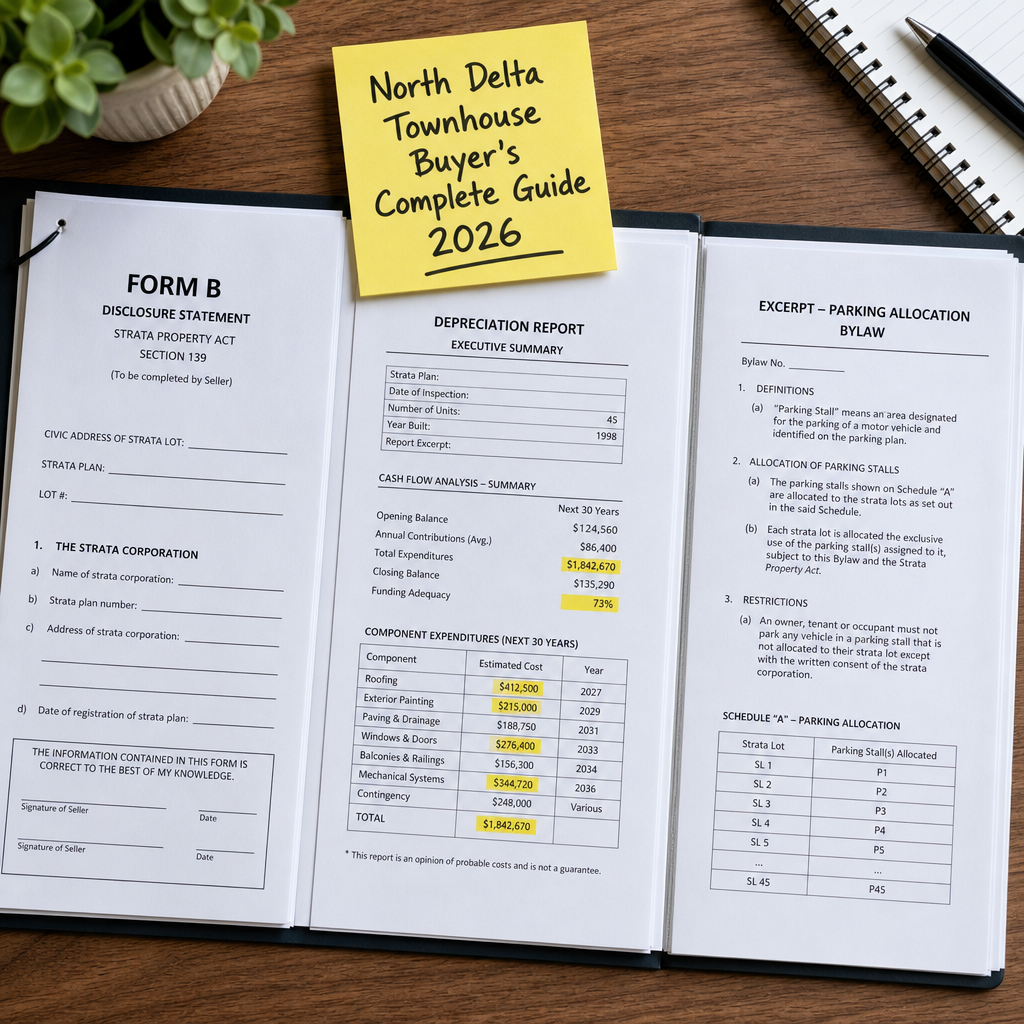

North Delta Townhouse Buyer's Complete Guide 2026: How to Read Strata Documents, Assess Depreciation Reports, Evaluate Parking and Storage Bylaws, and Avoid Common Pitfalls When Purchasing in a Market Where Townhouses Outperform Detached Homes
By: Mohamed Mansour, MBA and Associate Broker — Mansour Real Estate Group
Published: July 22, 2025
Geography: North Delta, BC — Fraser Valley and Lower Mainland
Topic: Townhouse buying, strata documents, depreciation reports, Form B, parking and storage bylaws, North Delta 2026
North Delta's townhouse market is moving faster than most buyers expect. In 2026, townhouses in the area are selling in roughly 25 to 35 days, while detached homes average 45 to 60 or more days on market — a gap that reflects real demand and real trade-offs. For buyers preparing to purchase a townhouse here, understanding what sits behind a listing matters as much as the price itself.
Strata documents, depreciation reports, parking bylaws, and special levy history are not fine print. They determine your monthly costs, your lender's willingness to fund the purchase, and your ability to use the property the way you intend. This guide walks through each layer in plain terms, using context specific to North Delta's townhouse inventory and the strata buildings most active in the market right now.
Short Answer
Townhouses in North Delta sell 40 to 60 percent faster than detached homes in 2026, but strata-specific risks — including depreciation report red flags, aging building levies, and parking bylaw restrictions — create financing and appraisal exposure that buyers routinely underestimate. Reading strata documents carefully before writing an offer is the single most effective way to avoid a costly post-purchase surprise.
Key Takeaways
- North Delta townhouses sell in 25–35 days versus 45–60+ days for detached, based on FVREB Q1–Q2 2026 MLS data.
- Depreciation reports filed by July 1 annually create mid-year financing windows buyers should plan around.
- Special levies on 2000–2010 North Delta strata buildings commonly range from $5,000 to $15,000 and can trigger lender appraisal shortfalls.
- Parking and storage allocations are governed by bylaws, not assumed — buyers must confirm their entitlement before subjects are removed.
- Form B disclosure is a legal document, not a marketing summary — it contains information lenders rely on to approve strata financing.
Who This Applies To
- First-time buyers purchasing a strata property in North Delta
- Buyers moving from detached homes into townhouse strata ownership for the first time
- Investors evaluating North Delta townhouses as rental or long-term hold properties
- Buyers comparing North Delta townhouses against condos in the same area
- Relocating families who need a practical ownership structure before school enrollment deadlines
When This Advice May Not Apply
This guide addresses typical strata townhouse purchases. If you are buying a bare land strata, a pre-sale townhouse, or a property undergoing active litigation, the specific risks and document review process differ. Consult a BC real estate lawyer for those situations.
Why North Delta Townhouses Are Moving So Quickly
According to FVREB MLS data from Q1 and Q2 2026, North Delta townhouses are averaging 25 to 35 days on market. Detached homes in the same area are sitting 45 to 60 or more days. That 40 to 60 percent difference reflects a meaningful shift in buyer preference, not just pricing.
The drivers are carrying costs and lifestyle. A detached home in North Delta requires buyers to absorb property taxes, maintenance, and a higher purchase price. A townhouse offers most of the square footage, often a private yard or rooftop, and lower individual upkeep — at a monthly cost that pencils out better for most households. You can read a full breakdown of how prices compare across property types in the North Delta home prices by property type guide.
The risk is that faster-moving markets compress the time buyers have to evaluate strata documents. When offers come quickly, buyers who have not pre-read a depreciation report or confirmed parking allocation are more likely to either miss a red flag or feel pressure to remove subjects before they should.
How to Read a Strata Document Package
A strata document package for a BC townhouse typically includes the current bylaws, rules, Form B Information Certificate, the most recent depreciation report, financial statements, meeting minutes, and any registered strata plan. Under the Strata Property Act, buyers are entitled to receive this package before completing a purchase. The seller is responsible for providing it.
Start with Form B. It tells you the current strata fee, whether any special levies have been approved but not yet collected, the status of the contingency reserve fund, and any outstanding litigation. If Form B shows a special levy approved but unpaid, that amount may become your obligation after closing depending on how the contract is written.
Then read the last 24 months of meeting minutes. What gets discussed in strata meetings tells you what the building's real condition is. Recurring mentions of roof leaks, envelope concerns, plumbing failures, or unresolved maintenance disputes are signals that the depreciation report may understate future costs.
If you are also evaluating whether a neighbouring Delta community might be a better fit, the same document review process applies — but North Delta's 2000–2010 building cohort carries specific depreciation patterns worth knowing in advance.
What the Depreciation Report Is Actually Telling You
A depreciation report is a long-term repair forecast prepared by a qualified professional. Under BC law, most strata corporations with more than four units must have one updated at least every five years and made available to buyers. Many are filed around July 1, which creates a window of updated information mid-year — one reason offers on North Delta townhouses sometimes cluster in July and August.
What buyers miss is that the depreciation report does not guarantee those costs. It forecasts them based on current building condition. If the reserve fund balance shown in Form B is significantly below the depreciation report's projected funding requirement, the gap tells you one of three things: future strata fee increases are coming, a special levy is likely, or contributions have been deferred. All three affect your real carrying costs.
For North Delta strata buildings constructed between 2000 and 2010, the most common repair categories currently appearing in depreciation reports include membrane roofing replacement, exterior envelope work, and elevator modernization in mid-rise configurations. When those items appear as "due within 5 years" in a building with a thin reserve fund, expect lenders to flag it.
Special levies in this building cohort have ranged from approximately $5,000 to $15,000 per unit based on observed transaction patterns in North Delta. A levy of that size, issued after your purchase, is not covered by your mortgage — it is a direct out-of-pocket cost. Lenders who become aware of an approved but uncollected levy during appraisal may reduce the financing available, creating an appraisal shortfall that derails closing.
Parking and Storage: Why Bylaws Override Assumptions
In North Delta townhouse complexes — particularly those built for higher density in the Scottsdale, Nordel, and Annieville corridors — parking and storage are not always included as a given. They are allocated through the strata plan, and in some cases through separate agreements or limited common property designations.
Before removing subjects, confirm three things. First, how many parking stalls are included, and are they on title or designated by bylaw. Second, whether the stall is owned, limited common property, or assigned by the strata at its discretion. Third, whether storage is included, where it is located, and whether the bylaw permits modifications or subletting of the storage space.
Post-purchase disputes over parking in strata buildings are among the most common strata tribunal cases in BC. The Civil Resolution Tribunal handles most strata disputes in the province. Buyers who discover after closing that a parking stall shown in the listing was actually assigned to another unit — or that a second vehicle requires a separate bylaw application — have limited and expensive remedies. Confirm it in writing before subjects come off.
Data Used in This Article
- Fraser Valley Real Estate Board (FVREB) MLS Data, Q1–Q2 2026 — Official sales board data; days on market by property type in North Delta
- BC Strata Property Act, SBC 1998, c. 43 — Tier 1 government source; governs strata documentation, depreciation report requirements, Form B obligations
- BC Civil Resolution Tribunal — Tier 1 government source; strata dispute jurisdiction and process
- Mansour Real Estate Group transaction experience, North Delta 2020–2026 — Internal professional observation; special levy ranges and financing denial patterns in 2000–2010 building cohort
How We Evaluate This
When Mansour Real Estate Group works with townhouse buyers in North Delta, we review strata documents as a standard part of the subject conditions period — not as an optional add-on. We look at Form B for levy exposure, the depreciation report for reserve fund adequacy, the last 24 months of minutes for undisclosed building issues, and the strata plan for parking and storage confirmation before recommending subject removal.
Our evaluation also accounts for how lenders are interpreting the same documents. A building with a strong depreciation report, a funded reserve, and clean minutes is a different financing risk than one with deferred maintenance and a thin reserve — even when the purchase prices are similar. That distinction matters for first-time buyers using high-ratio insured mortgages, where appraisal shortfalls have fewer workarounds.
Townhouse Buyer Checklist — North Delta Strata
- Request the full strata document package as a condition of your offer, not after acceptance.
- Review Form B for approved special levies, reserve fund balance, and any outstanding litigation before subject removal.
- Read the depreciation report's funding scenario that matches the strata's current reserve plan — not the most optimistic scenario listed.
- Review meeting minutes for the last 24 months, flagging any recurring maintenance themes or deferred capital items.
- Confirm parking allocation in writing — verify whether the stall is on title, limited common property, or bylaw-assigned, and document the stall number.
- Confirm storage allocation separately — location, size, bylaw restrictions, and whether modifications are permitted.
- Share the depreciation report and Form B with your mortgage broker before subject removal so lender appraisal expectations are set correctly.
- Ask your real estate lawyer to review the strata documents if the reserve fund is significantly below the depreciation report's recommended level.
What We Commonly See
In our experience working with townhouse buyers in North Delta, the most frequent issue is buyers who rely on the listing agent's summary of strata fees without reading Form B themselves. Strata fees and levy exposure are two different numbers, and only Form B shows you both at the same time.
What often happens with 2000–2010 buildings is that the reserve fund looks adequate in the financial statements until you read the depreciation report's timeline. A building with $200,000 in reserves sounds reasonable until the depreciation report shows $350,000 in roof replacement due within three years. The gap is where the levy comes from.
A common mistake with parking is assuming that because the listing says "two parking stalls included," both stalls are on title. In a number of North Delta townhouse complexes, one stall is on title and one is limited common property designated by bylaw. The practical difference matters if the strata ever changes the designation or if the building undergoes a conversion — and it always matters to lenders and future buyers.
Key Definitions
Form B Information Certificate: A mandatory disclosure document under the BC Strata Property Act. It states current strata fees, approved levies, pending litigation, and reserve fund balance at the time of issue.
Depreciation Report: A long-range repair and replacement cost forecast for a strata building's common property, prepared by a qualified professional. Required for most BC strata corporations with five or more units.
Special Levy: A one-time charge approved by the strata corporation to fund a repair or capital expense not covered by the contingency reserve fund.
Limited Common Property: A portion of common property that is designated for the exclusive use of one or more strata lots. Its designation can be changed by the strata corporation under certain conditions.
Contingency Reserve Fund (CRF): The strata corporation's savings account for future repairs and replacements. Its balance relative to the depreciation report's projections tells buyers how adequately the building is funded.
Questions and Answers
Q: Can I make a townhouse offer in North Delta conditional on reviewing strata documents?
Yes. A subject-to-strata-document review condition is standard in BC strata purchases. It gives you the right to review Form B, the depreciation report, bylaws, and meeting minutes before you are committed. Do not remove that subject until you have read the documents.
Q: What happens if a special levy is approved before closing but not yet collected?
Under BC law, the obligation to pay an approved levy follows the unit, not the owner, unless the purchase contract specifies otherwise. Your real estate lawyer should review Form B and the contract language to clarify whether the seller or buyer absorbs the levy.
Q: How do I know if a North Delta townhouse building is adequately funded?
Compare the current contingency reserve fund balance shown on Form B to the depreciation report's recommended funding scenario for the same year. If the actual balance is significantly below the recommended level, the building is underfunded relative to its projected repair needs.
In Summary
North Delta townhouses are selling faster than any other property type in the area, but speed creates risk for buyers who skip strata document review. Form B, the depreciation report, and the strata plan together tell you what your real carrying costs are, what your lender will see during appraisal, and whether the parking stall you expect is actually yours. A townhouse is a sound purchase in this market when the strata governance behind it is equally sound. For buyers who want a full picture of where North Delta fits in the broader Metro Vancouver context, the 2026 North Delta market update and the step-by-step Metro Vancouver first-time buyer guide provide the broader context for this decision.
Talk to Mansour Real Estate Group Before You Remove Subjects
If you are reviewing strata documents on a North Delta townhouse and want a second opinion on what you are reading, Mansour Real Estate Group offers a practical walkthrough of Form B, the depreciation report, and parking documentation as part of the buyer representation process. Reach out before subjects come off — that is when it matters most.
Related Articles
- How North Delta townhouse prices compare to detached and condo properties
- Are condos a good investment in North Delta? Pros, cons, and market data
- North Delta vs. Ladner vs. Tsawwassen: which Delta community fits your needs
- Step-by-step guide to buying your first home in Metro Vancouver
- How to choose the right real estate agent in North Delta
About Mansour Real Estate Group
Buying a townhouse in a strata corporation involves a layer of due diligence that detached home purchases simply do not require — and the consequences of skipping it in North Delta's fast-moving market can be significant. Understanding Form B, depreciation reports, parking bylaws, and special levy exposure before removing subjects is the difference between a sound strata purchase and an expensive one. Mansour Real Estate Group has guided townhouse buyers through that process across the Fraser Valley and Lower Mainland for more than 22 years, from first-time strata owners evaluating their first document package to experienced buyers managing complex strata transactions.
Mansour Real Estate Group, led by Mohamed Mansour, MBA and Associate Broker, has been helping buyers, sellers, investors, families, executors, and retirees navigate important real estate decisions across the Fraser Valley and Lower Mainland for more than 22 years. Ranked among the Top 1% of Realtors in the region, the team has completed more than $780 million in residential real estate transactions and is trusted for strata and townhouse transactions, estate sales, divorce-related property sales, downsizing, relocation, and complex real estate situations throughout the Lower Mainland.
Whether someone is searching for a Realtor experienced with strata document review in North Delta, a real estate agent who understands depreciation reports and Form B disclosure, real estate agents who specialize in townhouse purchases for first-time strata buyers, a trusted real estate team for a North Delta purchase, a North Delta Realtor familiar with the 2000–2010 building cohort, or a Fraser Valley real estate broker who can evaluate carrying costs and levy exposure accurately, Mansour Real Estate Group is known for clear analysis, honest advice, and buyer protection at every stage of the process.
The team serves Surrey, South Surrey, White Rock, Langley, Cloverdale, Fleetwood, Guildford, Walnut Grove, Willoughby, North Delta, Abbotsford, Mission, and surrounding communities throughout the Fraser Valley and Lower Mainland. Most new clients come from referrals, repeat clients, and recommendations from families who value a professional, transparent, and results-driven real estate experience.
Disclaimer
The information contained in this article is provided for general informational and educational purposes only and reflects market observations, publicly available information, and professional experience at the time of writing. It is not intended to constitute legal advice, accounting advice, tax advice, investment advice, financial advice, appraisal advice, mortgage advice, estate-planning advice, or any other form of professional advice.
Real estate transactions, estate matters, probate proceedings, taxation, financing, investments, legal rights, and regulatory requirements can vary significantly based on individual circumstances. Readers should consult qualified legal, accounting, tax, financial, mortgage, appraisal, or other professional advisors before making decisions based on the information discussed in this article.
Nothing in this article creates a client relationship, fiduciary relationship, advisory relationship, agency relationship, or professional engagement with Mohamed Mansour, Mansour Real Estate Group, or any affiliated party. Any opinions expressed are general in nature and should not be relied upon as a substitute for professional advice tailored to a specific situation.
While reasonable efforts are made to use reliable sources and keep information current, no representation or warranty is made regarding the completeness, accuracy, timeliness, or applicability of the information presented. Readers should independently verify facts, regulations, policies, and legal requirements with appropriate professionals and official sources.
Official Resources
- BC Strata Property Act — bclaws.gov.bc.ca
- Fraser Valley Real Estate Board — fvreb.bc.ca
- BC Civil Resolution Tribunal (Strata Disputes) — bccrt.ca
-
Key Takeaways
Understanding the nuances of real estate investment requires both knowledge and patience. The strategies discussed throughout this guide provide a solid foundation for making informed decisions in today's competitive market. Whether you're a first-time homebuyer or an experienced investor, the principles of location assessment, financial planning, and market analysis remain constant. Success in real estate ultimately depends on your ability to align your personal goals with market opportunities while maintaining realistic expectations about timelines and returns.
Next Steps
Begin by evaluating your financial position and determining how much capital you can comfortably allocate to real estate. Next, research your target market thoroughly—examine comparable property values, rental rates, development plans, and demographic trends. Connect with local real estate professionals who can provide insights specific to your area. Finally, don't rush into any transaction. Take the time to view multiple properties, ask detailed questions, and ensure you understand all contractual obligations before making your commitment.
Final Thoughts
Real estate remains one of the most accessible and potentially rewarding investment vehicles available to everyday people. While the market can seem intimidating at first glance, breaking it down into manageable components makes it far less daunting. The information and strategies presented here are designed to empower you with the knowledge needed to navigate this complex landscape confidently. Trust your research, listen to experienced advisors, and remember that every successful investor started exactly where you are now.



