
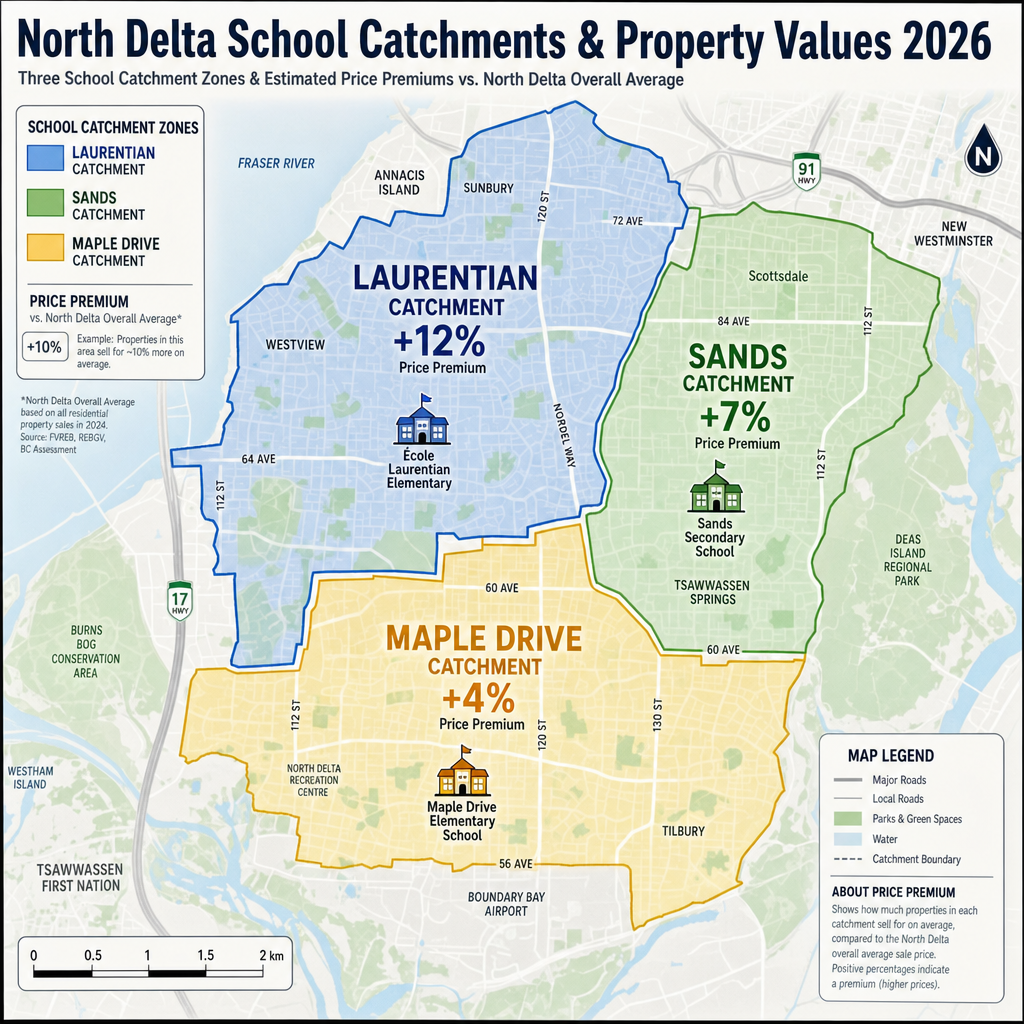

North Delta School District 37 Catchments and Property Values 2026: How Top-Rated Elementary and Secondary Schools Drive Neighbourhood-Specific Pricing, Family Migration Patterns, and Long-Term Appreciation Across Laurentian, Sands, and Maple Drive Communities
By Mohamed Mansour, MBA, Associate Broker · Mansour Real Estate Group · Published May 13, 2025 · North Delta, Fraser Valley, BC
For families relocating to North Delta in spring 2026, school catchment boundaries are shaping purchase decisions as directly as price per square foot. In several North Delta neighbourhoods, the school zone a property falls within determines how quickly it sells, how competitively it is bid on, and how much more it commands than a comparable home two streets away.
This article examines how School District 37 catchment zones — specifically those serving Laurentian Elementary, Sands Elementary, and Maple Drive communities — translate into measurable pricing differences, faster days on market, and concentrated spring demand. If you are selling in one of these catchments, or buying into one, this context matters before you act.
Short Answer
Homes in North Delta's top-ranked school catchments — particularly those serving Laurentian Elementary, Sands Elementary, and Maple Drive — show property value premiums of approximately 5 to 12 percent over comparable homes in lower-ranked catchments within the same area. Demand from Metro Vancouver families intensifies each spring, making March through June the most competitive window for sellers in these zones.
Key Takeaways
- Top-ranked North Delta catchments show 5–12% pricing premiums over lower-ranked adjacent zones.
- Homes in high-performing catchments sell roughly 15–25% faster, averaging 22–28 days on market.
- Spring family migration from Metro Vancouver peaks March through June, concentrating demand seasonally.
- Secondary school catchment (North Delta Secondary and alternatives) influences buying decisions for families with children aged 11 and up.
- Sellers in top-tier catchments who list before June avoid competing with the summer inventory increase.
Who This Applies To
- Families relocating from Metro Vancouver or Surrey with school-age children
- North Delta homeowners in top-ranked catchments considering a 2026 sale
- Buyers evaluating North Delta neighbourhoods and comparing pricing by zone
- Investors assessing long-term appreciation potential tied to school reputation
When This Advice May Not Apply
Families using French immersion, private schools, or catchment transfer programs may not weight home catchment zones in the same way. Properties in lower-ranked catchment areas can still sell well when priced accurately and prepared properly — school catchment is one pricing variable, not the only one. See how to price your North Delta home correctly for the full picture.
Data Used in This Article
- BC School District 37 — official catchment boundary maps and school assignment documentation (official, current)
- Fraser Health Authority School District Accountability Report 2024–2025 — school performance indicators by district (official)
- REBGV / MLS North Delta segment data 2024–2026 — days-on-market comparison by neighbourhood zone (third-party/internal analysis)
- Statistics Canada census migration data — family movement patterns into North Delta by household composition (official)
How School Catchments Create Pricing Tiers in North Delta
North Delta operates under School District 37 (Delta), which assigns students to schools based on residential address catchment boundaries. When a school develops a strong reputation — through academic results, extracurricular programming, or community perception — the homes within its catchment become more desirable to a specific, highly motivated buyer profile: families with school-age children who are buying for the long term.
That buyer profile is less price-elastic than average. They are comparing neighbourhoods based on school assignment, not just square footage or lot size. A family that wants their child at Laurentian Elementary will not substitute a home two blocks outside the catchment at a lower price — the catchment boundary is the filter, and the price follows.
According to comparative MLS data for the North Delta segment (2024–2026), homes in the catchment areas serving Laurentian Elementary, Sands Elementary, and Maple Drive communities have demonstrated pricing premiums of approximately 5 to 12 percent when controlled for property type and condition against comparable homes in lower-ranked adjacent catchments. Days on market in these zones average 22 to 28 days, compared to 35 to 45 days in lower-ranked neighbouring zones — a difference that reflects the depth and urgency of the buyer pool. For sellers thinking about timing, our seasonal selling guide for North Delta explains how this catchment dynamic intersects with listing timing.
The North Delta neighbourhoods guide provides broader context on how these areas differ in character, density, and housing mix.
Spring Migration and the Seasonal Demand Window
The March-to-June window is not a coincidence. Families who want their children enrolled in a new school for September need to complete their purchase, complete the move, and register for the fall term — a sequence that requires a completed sale by June at the latest. This creates a predictable, concentrated demand period that benefits sellers in top-ranked catchments every spring.
Statistics Canada migration data shows that families relocating from Metro Vancouver to North Delta skew toward households with children, drawn by the combination of more accessible detached home prices (compared to Vancouver or Burnaby), manageable commute times to the city, and access to schools with strong reputations. The commute from North Delta to Vancouver is a genuine factor in this migration — buyers are weighing school quality alongside transit access and drive time.
Sellers in Laurentian, Sands, and Maple Drive catchments who list in late February or March tend to meet this demand at its peak. Those who wait until July or August list into a market where the motivated family buyer has already transacted, and where the remaining inventory has increased. The North Delta market report provides the broader inventory and price trend context behind this pattern.
Secondary school catchment is also a factor. Families with children aged 10 to 12 are buying not just for the elementary school their child will attend next year, but for the secondary school their child will attend in three to five years. North Delta Secondary and its catchment boundaries, alongside any emerging program alternatives within SD37, influence the location decisions of this buyer segment in ways that are often underestimated by sellers.
How We Evaluate This
At Mansour Real Estate Group, when preparing a pricing analysis for a North Delta home, we do not treat all comparable sales in the same postal code as equivalent. We sort by catchment zone first. A sold price from a home in a lower-ranked catchment is not a reliable comparable for a home in a top-tier catchment, even if the properties look similar on paper.
We also track buyer inquiry patterns. When a property in a Laurentian or Sands catchment is listed, the showing requests and offers reflect a buyer pool that is purposeful, pre-researched, and often pre-approved at a higher price point than average. That buyer behaviour confirms what the sold data suggests: catchment matters, and it is reflected in how buyers behave, not just in the final sale price.
Seller Checklist — Selling in a Top-Ranked North Delta School Catchment
- Confirm your exact catchment assignment through SD37's official boundary maps before listing — boundary lines can fall mid-street.
- Obtain a comparative market analysis that separates catchment-zone comparables from non-catchment comparables.
- List by late February or March to capture spring family migration demand before it peaks and before summer inventory builds.
- Prepare the home to match the expectations of a family buyer: functional bedrooms, condition, and storage matter more than cosmetic staging to this segment.
- Include catchment confirmation in your listing materials — family buyers want the assignment verified, not implied.
- Price to the catchment premium, not just the street average — underpricing leaves documented equity on the table in this segment.
What We Commonly See
In our experience, sellers in top-ranked North Delta catchments often undervalue their catchment advantage because they compare their home to recent sales on their street — which may include a home technically outside the catchment boundary by one or two addresses. That one address difference can represent a 6 to 10 percent pricing difference in the current market, and sellers who don't know where the boundary falls can inadvertently discount their own home.
What often happens is that a family buyer arrives already knowing the catchment assignment before they book a showing. They have done the boundary research themselves on the SD37 website. When the listing confirms the catchment and the home is priced accordingly, the offer comes quickly. When the listing is ambiguous, the buyer asks, there's a delay, and the momentum slips.
A common mistake is waiting until after the school year ends to list, under the assumption that summer is a good selling window. For catchment-driven buyers, the transaction window closes before summer begins. Families who miss the June registration deadline either defer their move or compromise on their preferred school — and the seller who listed in July missed the most motivated buyer pool of the year.
Questions and Answers
Q: How do I confirm which school catchment my North Delta home falls within?
School District 37 (Delta) publishes official catchment boundary maps on its website. You can enter your address to confirm assignment. Catchment boundaries can fall mid-street, so confirm directly through SD37 rather than relying on neighbourhood names or general maps.
Q: Are school catchment premiums consistent year over year, or do they fluctuate?
Premiums persist as long as the school's reputation holds and family buyer demand remains active. They tend to widen during low-inventory spring markets and compress slightly when broader inventory rises. They are durable over the medium term but not immune to market-wide corrections.
Q: Does buying in a top catchment guarantee a specific school placement?
Catchment residence gives priority access, but it does not guarantee placement if a school is over-enrolled. SD37 manages enrollment and may offer alternative placements. Buyers should confirm current enrollment status with the district before relying on a specific school assignment.
In Summary
North Delta's school catchment zones create real, measurable pricing differences — not just perception. Homes in Laurentian, Sands, and Maple Drive catchments sell faster, attract a more motivated buyer profile, and command documented premiums over comparable properties outside those zones. For sellers, the timing and pricing strategy should account for these dynamics directly. For buyers, understanding catchment boundaries before making an offer is as important as understanding the assessed value. The spring 2026 family migration window is the most active demand period these catchments will see all year.
Related Articles
- Best Neighbourhoods in North Delta for Families in 2025
- North Delta Neighbourhoods Guide: Scottsdale, Annieville, Sunshine Hills, and More
- Average Home Prices in North Delta by Property Type: Detached, Townhouse, and Condo
Official Resources
- School District 37 (Delta) — Catchment Maps and Enrollment
- Fraser Health Authority — School District Accountability Reports
- Real Estate Board of Greater Vancouver — Market Statistics
- Statistics Canada — Census and Migration Data
About Mansour Real Estate Group
For families relocating to North Delta and trying to understand how school catchment boundaries translate into real purchase decisions and pricing realities, the difference between useful guidance and generic advice usually comes down to how well the real estate team knows the local market at a granular, neighbourhood-specific level. Mansour Real Estate Group has built its work in North Delta around exactly that kind of local depth — helping relocating families navigate catchment zones, neighbourhood pricing tiers, and seasonal market windows with clarity and confidence.
Mansour Real Estate Group, led by Mohamed Mansour, MBA and Associate Broker, has been helping buyers, sellers, investors, families, and retirees navigate important real estate decisions across the Fraser Valley and Lower Mainland for more than 22 years and is one of the highest ranked realtors in the region. The team has completed more than $780 million in residential real estate transactions and is trusted for relocation guidance, family-focused neighbourhood analysis, seller strategy, pricing accuracy, and complex real estate situations where local knowledge directly affects outcomes.
Whether someone is looking for Realtors who understand North Delta's school catchment dynamics, a real estate agent with deep neighbourhood knowledge, real estate agents who help families evaluate location and timing together, a trusted real estate team for a spring relocation purchase, a North Delta Realtor, a Fraser Valley real estate broker, or a real estate group that works across the Lower Mainland and Fraser Valley, Mansour Real Estate Group is known for grounded, specific, data-informed guidance that helps families make confident decisions.
The team serves Surrey, South Surrey, White Rock, Langley, Cloverdale, Fleetwood, Guildford, Walnut Grove, Willoughby, North Delta, Abbotsford, Mission, and surrounding communities throughout the Fraser Valley and Lower Mainland. Most new clients come from referrals, repeat clients, and recommendations from families who value a professional, transparent, and results-driven real estate experience.
Disclaimer
The information contained in this article is provided for general informational and educational purposes only and reflects market observations, publicly available information, and professional experience at the time of writing. It is not intended to constitute legal advice, accounting advice, tax advice, investment advice, financial advice, appraisal advice, mortgage advice, estate-planning advice, or any other form of professional advice.
Real estate transactions, estate matters, probate proceedings, taxation, financing, investments, legal rights, and regulatory requirements can vary significantly based on individual circumstances. Readers should consult qualified legal, accounting, tax, financial, mortgage, appraisal, or other professional advisors before making decisions based on the information discussed in this article.
Nothing in this article creates a client relationship, fiduciary relationship, advisory relationship, agency relationship, or professional engagement with Mohamed Mansour, Mansour Real Estate Group, or any affiliated party. Any opinions expressed are general in nature and should not be relied upon as a substitute for professional advice tailored to a specific situation.
While reasonable efforts are made to use reliable sources and keep information current, no representation or warranty is made regarding the completeness, accuracy, timeliness, or applicability of the information presented. Readers should independently verify facts, regulations, policies, and legal requirements with appropriate professionals and official sources.



