

By Mohamed Mansour, MBA and Associate Broker | Mansour Real Estate Group | Published: July 15, 2026 | Geography: North Delta, BC | Topic: Rental Investment Strategy, Cap Rates, BC Landlord Compliance
North Delta Rental Investment Strategy 2026: Cap Rates, Vacancy Trends, and Property Type Comparison for Investors Evaluating Ground-Oriented Attached Homes vs. Condos vs. Single-Family Detached With Legal Basement Suites
North Delta has become one of the more analytically interesting rental markets in the Fraser Valley. Entry prices are lower than much of Metro Vancouver, vacancy sits below the regional average, and SkyTrain expansion is changing the calculus for long-term holders. But headline yields require serious adjustment before an investor can trust them — BC landlord compliance costs, strata fees, and rent-control restrictions reduce gross returns by 15 to 25 percent depending on property type.
This article compares three investor-relevant property types in North Delta — detached homes with legal basement suites, ground-oriented townhomes, and strata condos — using current cap rate estimates, vacancy data, and BC Residential Tenancy Act compliance costs. For broader context on North Delta's long-term value fundamentals, see Is North Delta a Good Real Estate Investment? Long-Term Value Analysis.
Short Answer
In North Delta's 2026 rental market, detached homes with legal basement suites generate the strongest net yields — roughly 3 to 4 percent after expenses on a $700,000–$850,000 purchase. Condos and townhomes yield 2 to 3 percent net after strata fees and compliance costs. Vacancy runs at 3 to 4 percent, below the Fraser Valley average, reducing turnover costs. SkyTrain proximity creates an appreciation window, but cash flow alone does not yet justify a condo purchase at current prices.
Who This Applies To
- First-time rental property investors evaluating North Delta entry points
- Existing homeowners considering a legal basement suite conversion
- Investors comparing North Delta against Surrey or Abbotsford for buy-and-hold
- Buyers deciding between a detached home, townhouse, or condo as a rental asset
- Investors weighing early SkyTrain entry against post-opening pricing risk
When This Advice May Not Apply
This analysis covers residential buy-and-hold rental strategy. It does not apply to commercial properties, short-term rental operations, presale assignments, or rent-to-own structures. Investors with access to significant renovation capital, mixed-use zoning opportunities, or development potential should consult a qualified professional, as those scenarios involve materially different return profiles.
Key Takeaways
- Detached homes with legal basement suites deliver the best net yields in North Delta at 3–4% after expenses.
- Strata condo net yields of 2–3% rarely justify the purchase price without appreciation expectations.
- North Delta's 3–4% vacancy rate outperforms the Fraser Valley average, lowering turnover costs.
- BC landlord compliance costs reduce gross yields by 15–25% regardless of property type.
- SkyTrain timing creates two distinct investor windows — early entry now or post-confirmation positioning.
Data Used in This Article
- CMHC Rental Market Survey 2026 — North Delta vacancy and average rent data — official federal housing data
- BC Residential Tenancy Act (including 2023 short-term rental amendments) — official provincial legislation
- FVREB market statistics on North Delta investment property sales 2024–2026 — official board data
- TransLink SkyTrain expansion project timeline — official transit authority documents
- Property management company surveys on North Delta landlord compliance and maintenance costs — third-party industry data
Key Definitions
Gross Rental Yield: Annual rental income divided by purchase price, before any operating expenses. A useful starting point, but not a reliable cash flow indicator on its own.
Net Yield / Cap Rate: Annual rental income minus all operating expenses (taxes, insurance, maintenance, management, vacancy reserve, compliance costs), divided by purchase price. This is the number that matters for cash flow decisions.
Form RTB-1: The BC tenancy agreement form filed under the Residential Tenancy Act. Mandatory for all residential tenancies in BC. No filing fee, but required documentation.
Rent Increase Maximum: Under the BC Residential Tenancy Act, landlords may increase rent once per 12-month period, capped at the annual inflation-indexed rate set by the provincial government. For 2025, that cap was 3.0%; 2026 figures are confirmed by BC Housing annually.
Special Levy: A one-time charge assessed by a strata corporation for major repairs not covered by the contingency reserve fund. Investors in older condos face levy risk that does not appear in standard yield calculations.
How We Evaluate This
When investors ask us to compare property types in North Delta, we start from net yield, not gross. The difference is not academic — on a $750,000 detached home generating $1,200 per month in basement suite income, gross yield looks like 6.4 percent. After property tax, insurance, maintenance reserves, vacancy allowance, and BC compliance costs, net yield typically lands between 3.2 and 4.0 percent. That spread is where most investors get surprised.
We also weight tenant stability, maintenance complexity, and landlord obligations differently by property type. A detached home with a basement suite involves more physical maintenance but typically better tenant longevity and no strata interference. A condo involves lower physical maintenance but strata fees, special levy exposure, and bylaw restrictions that can limit rental income and management flexibility. Townhomes sit between the two — moderate maintenance, lower strata fees than condos, and a tenant profile that tends to be stable.
Property Type 1: Detached Homes With Legal Basement Suites
North Delta detached homes in the $650,000–$850,000 range are the most credible cash flow option for investors in this market. A legal basement suite — meaning one that meets BC Building Code requirements, has a dedicated entrance, proper egress windows, and is declared on the title or occupancy permit — typically generates $1,800–$2,400 per month in rent as of 2026, according to local property management surveys.
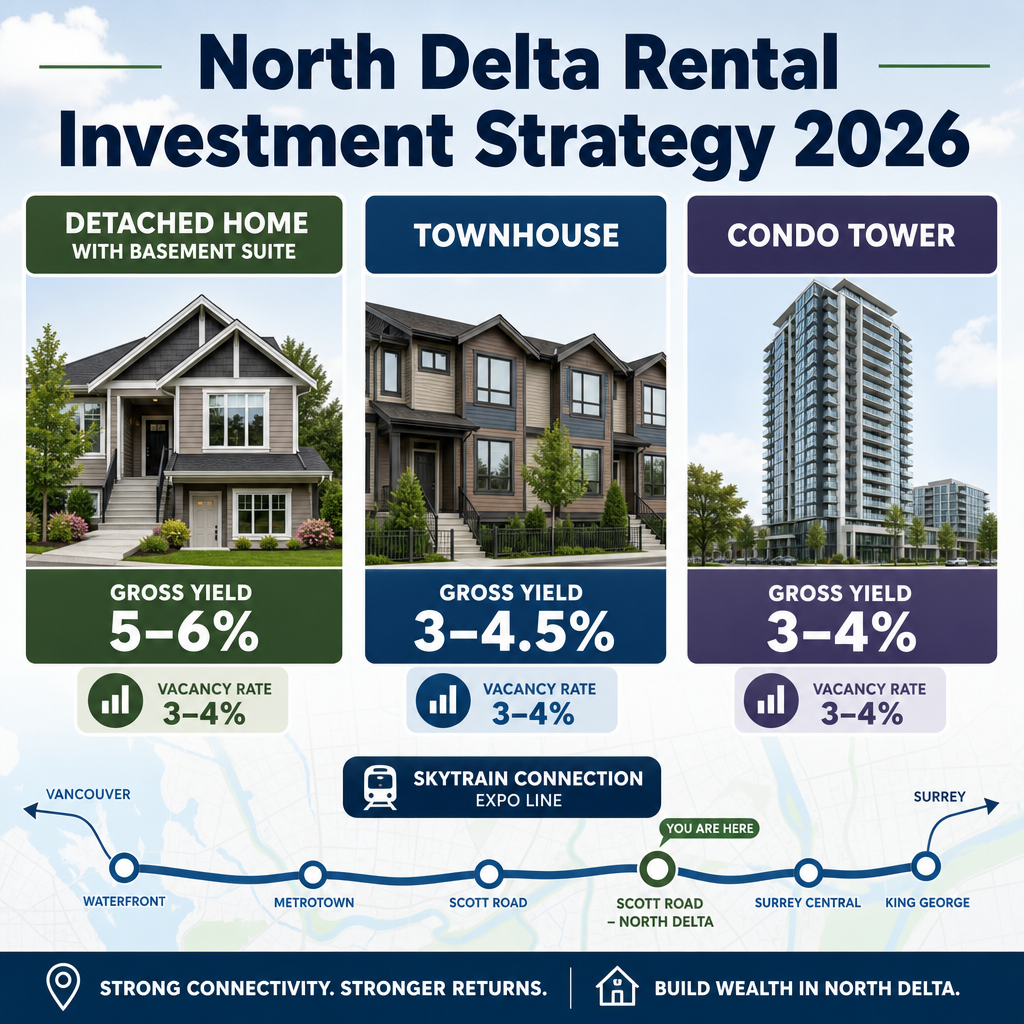
On a $750,000 purchase with a $1,200 monthly suite (if the owner occupies the main floor) or a full rental strategy at $3,200–$3,800 combined for both units, gross yield runs 5 to 6 percent. Net yield, after factoring in property taxes averaging $4,500–$5,500 annually in North Delta (per North Delta's property tax structure), insurance, maintenance reserves of 1 percent of value annually, a 4 percent vacancy allowance, and BC compliance costs, lands between 3.2 and 4.0 percent.
The main risks here are maintenance costs on older stock — many North Delta detached homes were built in the 1970s and 1980s — and the legal suite verification step. Investors should confirm legal suite status before purchase. An unpermitted suite generates income but exposes the owner to insurance voidance, lender issues, and RTB complications if a dispute arises. The North Delta home buying process includes due diligence steps that apply directly to suite verification.
Property Type 2: Strata Condos
North Delta condos are available at lower entry prices — typically $350,000–$550,000 — which makes them accessible to smaller investors. Gross yields run 3 to 4.5 percent based on current rental rates. The challenge is what comes off the top. Strata fees in North Delta condo buildings range from $200 to $350 per month for a standard one- or two-bedroom unit, according to current listings data from the FVREB. That alone reduces net income by $2,400–$4,200 annually.
Add property tax, insurance, vacancy reserve, and the compliance costs discussed below, and net yields typically land at 2.0 to 3.0 percent — not a strong standalone cash flow case. The 2023 BC short-term rental amendments under the Residential Tenancy Act now restrict Airbnb-style income to a landlord's principal residence in most municipalities. North Delta investors cannot rely on short-term rental revenue to supplement yield unless they occupy the unit.
Special levy risk is the underappreciated exposure in older North Delta condo buildings. A building constructed in the 1980s or early 1990s without a current depreciation report — which is now mandatory under BC's Strata Property Act for buildings with five or more strata lots — may be carrying deferred maintenance that surfaces as a $10,000–$50,000 levy. Investors must review Form B, the depreciation report, and the contingency reserve fund balance before purchasing. For a broader look at North Delta condo pricing benchmarks, the average price by property type article provides current context.
Property Type 3: Ground-Oriented Townhomes
Townhomes occupy the middle ground — both in price ($550,000–$800,000) and yield (3.0–4.5% gross, 2.5–3.5% net). Strata fees are lower than condos, typically $150–$250 per month, and maintenance responsibility is more predictable. The tenant profile in North Delta townhomes tends toward families and longer tenancies, which reduces turnover frequency and its associated costs ($2,000–$3,000 per cycle in cleaning, minor repairs, and vacancy loss).
The townhome case for North Delta investors is less about immediate cash flow and more about appreciation alignment. Townhomes in areas near anticipated SkyTrain infrastructure have historically captured a meaningful share of transit-proximity price appreciation. Investors with a 5–10 year hold horizon, willing to accept near-breakeven cash flow in exchange for equity growth, find townhomes more defensible than condos and less maintenance-intensive than detached. The tradeoff is that you give up the basement suite income that makes detached homes more cash flow positive today. For a direct comparison of North Delta property types from a buyer's perspective, see Townhouse vs. Detached Home in North Delta.
BC Landlord Compliance Costs: What Investors Underestimate
The BC Residential Tenancy Act (RTA) creates real and measurable costs that reduce net yield across all property types. These are not optional. Under the RTA, landlords must:
- Complete a move-in condition inspection report with the tenant, signed by both parties
- Issue and retain Form RTB-27 (condition inspection) — failure to do so removes the landlord's right to claim against the security deposit
- Use Form RTB-1 as the tenancy agreement
- Calculate allowable rent increases annually, indexed to the provincial rate — currently 3.0% for 2025; 2026 figures are set by BC Housing annually
- Provide proper notice periods — three full calendar months' notice for landlord use of property, two months' notice for most other renovictions
When disputes arise, RTB resolution averages 60 to 90 days and costs landlords $500–$1,500 in preparation time and potential legal fees. Property management company surveys for North Delta indicate that professionally managed properties reduce dispute frequency but add 8–10 percent of gross rent in management fees. Together, these compliance and management costs typically reduce gross yield by 15 to 25 percent — meaning a 6% gross becomes 4.5–5.1% before vacancy, maintenance, and taxes are applied.
North Delta Vacancy Rate and What It Means for Investors
According to CMHC's 2026 Rental Market Survey, North Delta's vacancy rate runs at approximately 3 to 4 percent — below the Fraser Valley average of 4 to 5 percent and meaningfully below Surrey City Centre at 5 to 6 percent. For investors, this is a genuine operational advantage. Lower vacancy means shorter re-tenanting periods, lower turnover costs, and more predictable cash flow.
North Delta's vacancy performance reflects its relatively tight supply of purpose-built rental housing and consistent demand from families priced out of Burnaby and New Westminster. That demand base is unlikely to weaken before SkyTrain infrastructure improves connectivity further. For investors comparing North Delta to Abbotsford or Mission — where vacancy runs higher — the turnover cost saving of $2,000–$3,000 per cycle translates to approximately 0.3–0.4 percent in additional net yield annually on a typical investment property.
SkyTrain Timing: Two Investor Windows
TransLink's SkyTrain expansion planning creates two distinct investment windows for North Delta buyers. The Expo Line extension targeting the Guilford area has a Phase 1 timeline of 2026–2027. Research on transit-proximity premiums in Metro Vancouver consistently shows 10–15 percent appreciation in residential values within walking distance of new stations in the two to three years surrounding confirmed opening dates.
Phase 2, which includes a North Delta station feasibility study, extends to 2029–2030. Investors who purchase now at current prices — before Phase 2 confirmation — take on planning risk but position themselves ahead of any announcement premium. Patient holders with a 7–10 year horizon may find this the stronger case. Investors who wait for confirmed Phase 2 alignment will pay more but face less uncertainty. Neither window is wrong; the right choice depends on the investor's hold period, financing cost, and cash flow tolerance during the waiting period. The North Delta new developments article covers the broader supply context shaping appreciation potential.
Investor Checklist for North Delta Rental Properties
- Confirm legal suite status on detached purchases — check occupancy permit, BC Assessment record, and building permit history
- Calculate net yield using property tax, insurance, maintenance (1% of value/year), management fees (if applicable), vacancy reserve (4%), and RTA compliance allowance
- For condos: review Form B, depreciation report, strata minutes (last 2 years), and contingency reserve fund balance before making an offer
- Confirm the property is not in a municipality-restricted short-term rental zone — North Delta's rules align with provincial restrictions under the 2023 RTA amendments
- Use the provincial Form RTB-1 tenancy agreement and complete condition inspection reports at move-in to protect deposit rights
- Review closing costs for North Delta purchases including Property Transfer Tax, which adds 1–3% to acquisition cost and affects the real yield calculation
- Set annual rent increase reminders — the allowable rate must be applied correctly and with proper notice or the increase is void
- Map the property's distance to planned SkyTrain stations and assess whether Phase 1 or Phase 2 proximity affects the hold thesis
What We Commonly See
Investors underestimate compliance costs on their first purchase. In our experience, first-time landlords in North Delta frequently calculate yield using gross rent minus mortgage payment, omitting property tax, insurance, maintenance, and BC compliance costs entirely. The resulting surprise — a 6% headline yield becoming 3.5% in practice — is not a market failure. It is a calculation failure. Getting to net yield before making an offer is not optional.
Unpermitted suites create downstream problems. What often happens is an investor purchases a home with a basement suite generating reliable income, only to discover during a refinancing or insurance renewal that the suite lacks a building permit. Lenders and insurers treat unpermitted suites differently from legal suites, and RTB processes can be complicated if a dispute arises without a proper tenancy on record. Verifying suite legality before subject removal is a non-negotiable due diligence step.
Condo investors overweight SkyTrain appreciation and underweight strata fee creep. A common mistake is purchasing a North Delta condo at 3% gross yield based primarily on anticipated appreciation from SkyTrain proximity, without stress-testing the scenario where Phase 2 is delayed or value appreciation is modest. Strata fees and special levies on older buildings can erode net yield to near zero over a 5-year period without a meaningful capital gain to offset. Appreciation is a reasonable expectation but not a guarantee, and the cash flow must carry the investment in the interim.
Questions and Answers
What is a realistic net cap rate for a North Delta detached home with a legal basement suite in 2026?
After property tax, insurance, maintenance reserves, vacancy allowance, and BC compliance costs, investors can reasonably expect 3.2 to 4.0 percent net yield. Gross yield looks higher — 5 to 6 percent — but BC operating costs consistently reduce that spread by 15 to 25 percent.
Does BC's short-term rental restriction affect North Delta investors?
Yes. Under BC's 2023 Residential Tenancy Act amendments, short-term rentals are restricted to a host's principal residence in most BC municipalities. North Delta investors cannot generate supplementary Airbnb income on rental properties they do not personally occupy. This directly reduces the yield case for condo investors who had modelled short-term rental income.
Is the SkyTrain expansion confirmed for North Delta?
Phase 1 of the Expo Line extension targets the Guilford area with a 2026–2027 operational timeline. A North Delta station is part of a Phase 2 feasibility study extending to 2029–2030. Phase 2 is not yet confirmed as a funded project. Investors should treat Phase 2 proximity as a long-term possibility rather than a near-term price catalyst, and consult TransLink's official project pages for current status.
In Summary
Detached homes with legal basement suites offer the strongest net yields in North Delta's 2026 rental market, with 3 to 4 percent after realistic operating costs on a $700,000–$850,000 purchase. Condos and townhomes yield less on a cash flow basis and require appreciation to justify current prices. North Delta's below-average vacancy rate is a genuine operational advantage, reducing turnover costs versus comparable Fraser Valley markets. BC landlord compliance costs are real, measurable, and often underestimated — model them before making any offer. SkyTrain timing creates two investor windows; the right one depends on hold period and cash flow tolerance.
Thinking About a North Delta Rental Investment?
If you are evaluating a North Delta property as a rental investment and want to stress-test the numbers before making an offer, Mansour Real Estate Group can provide a property-specific cash flow analysis, legal suite verification guidance, and a market comparison to help you decide whether the timing and property type make sense for your hold period. There is no obligation — just a second set of local eyes on the numbers.
Related Articles
- Is North Delta a Good Real Estate Investment? Long-Term Value Analysis
- The Complete Home Buying Process in North Delta: From Offer to Keys
- Buying a Presale Home in North Delta: Risks, Benefits, and What to Watch For
- Property Taxes in North Delta: What Homeowners Pay and How to Appeal
- Closing Costs When Buying a Home in North Delta: The Complete Breakdown
About Mansour Real Estate Group
For investors evaluating rental properties in North Delta — whether a detached home with a legal basement suite, a townhouse, or a strata condo — the difference between a sound purchase and a disappointing one typically comes down to how accurately the net yield is modelled before the offer is made. Mansour Real Estate Group has been helping investors, buyers, and sellers navigate rental property decisions across North Delta, Surrey, Langley, and the broader Fraser Valley for more than 22 years.
Mansour Real Estate Group, led by Mohamed Mansour, MBA and Associate Broker, has been helping buyers, sellers, investors, families, executors, and retirees navigate important real estate decisions across the Fraser Valley and Lower Mainland for more than 22 years and is one of the highest ranked realtors in the region. The team has completed more than $780 million in residential real estate transactions and is trusted for investment property analysis, estate sales, divorce-related property sales, downsizing, relocation, and complex real estate decisions across the Lower Mainland.
Whether someone is searching for Realtors experienced with rental investment properties in North Delta
Disclaimer: This article is for informational purposes only and does not constitute legal, financial, or real estate advice. Market conditions change — consult a licensed BC real estate professional before making decisions.



