

Published: May 12, 2026 | Author: Mohamed Mansour, MBA, Associate Broker | Geography: North Delta, BC | Topic: Rental Investment Strategy
This article is intended for investors evaluating residential rental properties in North Delta. It reflects publicly available market data, BC regulatory context, and professional experience at the time of writing. It is not financial, legal, or tax advice.
North Delta Rental Investment Strategy 2026: Cap Rates, Vacancy Trends, and Property Type Comparison for Investors Evaluating Ground-Oriented Attached Homes vs. Condos in a Rising Rate Environment
North Delta has attracted renewed investor attention in 2026, partly because its balanced market conditions have created entry opportunities that weren't available during the compressed bidding years of 2021 and 2022. The 11% sales-to-active listings ratio and an average 18-day DOM for detached homes give investors more time to evaluate deals carefully. But entry opportunity and cash flow viability are different questions — and in today's mortgage environment, the difference matters more than ever.
This guide compares the two most relevant property types for North Delta rental investors: ground-oriented homes with legal secondary suites or duplex configurations, and strata condos. It addresses cap rates, vacancy, financing constraints, BC tenancy law compliance, and the practical cash flow math that stress-tested mortgage rates impose on leveraged investors.
Short Answer
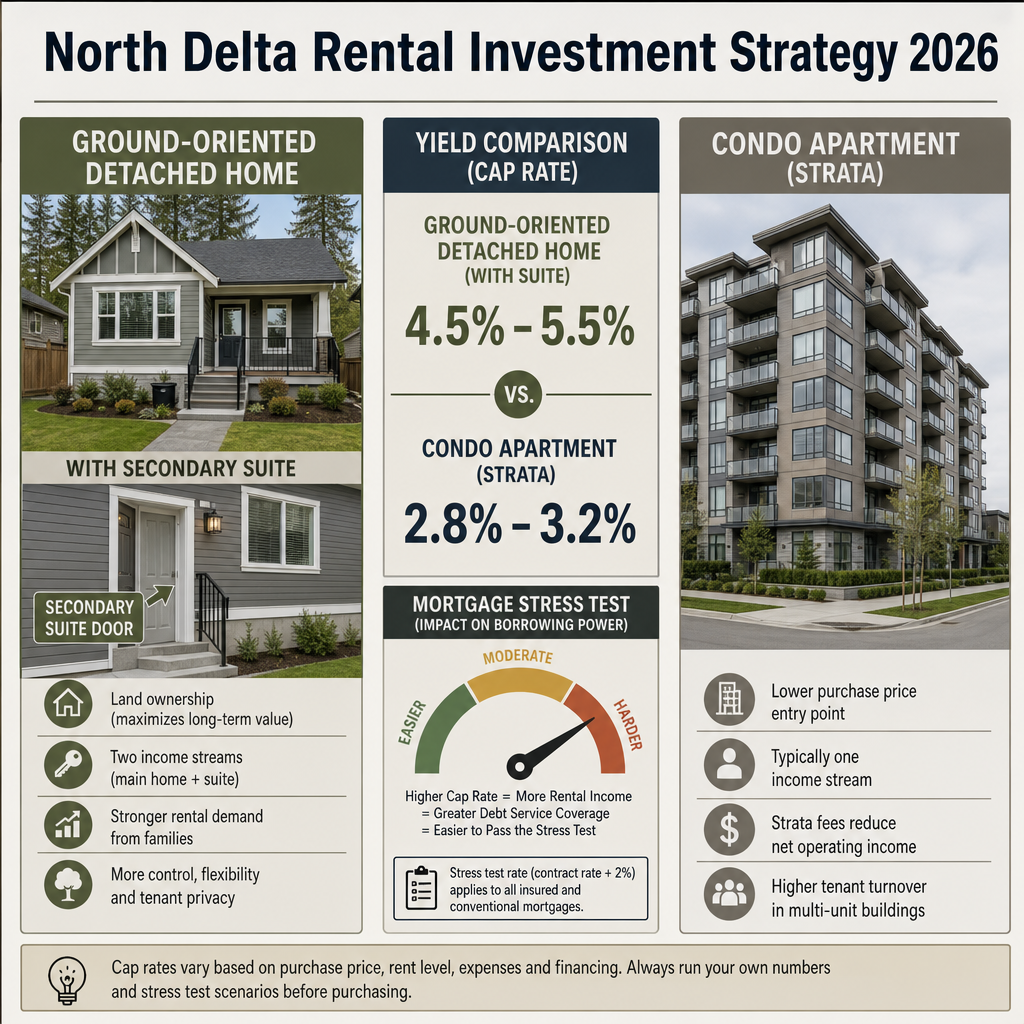
Ground-oriented properties with legal secondary suites in North Delta generate 4.5–5.5% gross rental yields compared to 2.8–3.2% for comparable strata condos. However, stress-tested mortgage qualification at 5.25%+ compresses net cash flow on leveraged purchases to 1–2% annually, making property selection, suite legality, and financing structure more important than market timing alone.
Key Takeaways
- Ground-oriented homes with legal suites yield 4.5–5.5% gross; condos yield 2.8–3.2% gross in North Delta.
- Stress-tested carrying costs at 5.25%+ compress leveraged investor cash flow to roughly 1–2% annually.
- Unlicensed suites create 15–30% financing friction and reduce resale options for exit-stage investors.
- BC tenancy law caps annual rent increases and restricts evictions, creating a 2–3 year cash flow stabilization window.
- Vacancy rates of 3–5% are predictable, but tenant turnover costs reduce net operating income by 8–12% annually.
Who This Applies To
- Investors evaluating a first rental property purchase in North Delta
- Existing owners with ground-oriented properties considering legalization of secondary suites
- Portfolio investors comparing ground-oriented and strata property returns
- Buyers who intend to occupy one unit while renting the other
- Long-term equity investors who want to understand how cash flow and appreciation interact in North Delta
When This Advice May Not Apply
If you are purchasing for owner-occupation only, the cash flow math in this article does not apply directly. If you are buying with equity financing rather than mortgage debt, the stress-test compression factor is significantly reduced. Always consult a mortgage professional and accountant before applying rental projections to a specific purchase decision.
Data Used in This Article
- CMHC Rental Market Report — Lower Mainland 2025: Official vacancy rate and rental price data for Metro Vancouver and adjacent markets. Published annually. Tier 1 source.
- BC Residential Tenancy Act (including 2024 amendments): BC Government legislation governing rent increases, eviction grounds, and deposit regulations. Tier 1 source.
- Bank of Canada mortgage stress test guidelines (2026): OSFI-administered qualifying rate floor currently set at 5.25% for insured mortgages. Tier 1 source.
- Mansour Real Estate Group transaction database — North Delta rental comps: Internal analysis of completed transactions and local rental comparables. Third-party interpretation.
- North Delta Municipal Code — Secondary Suite Regulations: Municipal bylaw framework governing suite licensing, safety requirements, and title disclosure. Tier 1 source.
Ground-Oriented Homes with Legal Suites: What the Numbers Look Like
A detached home in North Delta with a legal secondary suite or duplex configuration typically rents the lower suite at $1,400–$1,600 per month for a 3-bedroom unit, based on CMHC Lower Mainland rental data and local comparable transactions. The main-floor unit, if rented separately, can generate an additional $2,200–$2,600 per month depending on size and condition. Combined gross annual rental income on a well-positioned two-unit property can fall between $43,000 and $50,000.
At a purchase price in the $1.1–$1.3 million range — consistent with North Delta detached home pricing in 2026 — that gross income produces a yield of approximately 4.5–5.5%. That figure sits above what most Metro Vancouver markets offer for ground-oriented rental properties, which is part of the investor case for North Delta.
The gap between gross yield and net cash flow, however, is where leveraged investors run into difficulty in the current rate environment. Carrying a $900,000 mortgage at an effective stress-tested rate of 5.25% produces annual debt service costs that leave most investors with 1–2% net cash flow margin after property tax, insurance, and basic maintenance. That margin narrows further once vacancy and turnover costs are applied. The investor case for ground-oriented properties in North Delta rests less on immediate cash flow and more on the combination of equity accumulation and long-term rental income growth — a position that requires patience and strong debt service capacity.
The financing picture is further complicated by suite legality. Properties with unlicensed or non-conforming secondary suites — those not permitted under North Delta's municipal secondary suite bylaws — face 15–30% financing friction. Lenders frequently discount rental income from unlicensed suites in their debt-service calculations, and some institutional lenders will not include that income at all. This directly affects what mortgage a buyer can qualify for, and it creates resale risk when the investor eventually decides to exit. Legalization costs (permit applications, building inspections, fire separation requirements, egress compliance) vary by property condition, but investors should budget $15,000–$40,000 depending on the scope of work required.
Strata Condos in North Delta: Lower Yield, Lower Complexity
North Delta's condo segment offers a different investor profile. As discussed in detail in the cluster article Are Condos a Good Investment in North Delta?, gross rental yields for strata units typically fall between 2.8% and 3.2% — materially lower than ground-oriented alternatives. A 2-bedroom condo purchased at $550,000–$650,000 and renting at $1,700–$2,000 per month produces roughly $20,400–$24,000 in gross annual income. The yield is lower, but the management complexity is also reduced. There is no secondary suite to license, no multi-tenant compliance to manage, and no dual-tenancy dynamic to navigate under BC tenancy law.
The offset to lower yield in the condo segment is strata cost exposure. Monthly strata fees, special levy risk, age-related building maintenance, and the restrictions some strata corporations place on rental use all affect net operating income in ways that are less predictable than ground-oriented properties. Investors evaluating a specific condo building should review the Form B, depreciation report, and strata minutes before making a purchase decision — a process explained in detail in the upcoming article Understanding Strata Fees, Depreciation Reports, and Condo Rules in BC.
At stress-tested carrying costs, condo investor cash flow in North Delta is often negative or marginally positive on a leveraged basis. Investors who pursue this segment typically do so because the entry price is lower, the management workload is lighter, or the appreciation thesis for the specific building or neighbourhood is strong. It is not a cash flow play in 2026.
BC Residential Tenancy Act: What Investors Must Understand Before Buying
The BC Residential Tenancy Act governs every landlord-tenant relationship in North Delta. Two provisions directly compress investor cash flow projections: rent increase caps and eviction restrictions.
Rent increases are capped annually at the rate of inflation plus 2% for most residential tenancies. For 2025, that cap was 3.0% (BC Government annual allowable increase schedule). Investors who acquire a property with below-market tenants in place cannot bring rents to market rate until a vacancy occurs. In some cases, inherited tenants may be paying rents 20–30% below current market, and BC law offers no mechanism to bridge that gap except through a natural vacancy. This creates a 2–3 year cash flow stabilization window on acquisitions with existing long-term tenants.
Eviction protections require landlords to demonstrate cause — non-payment of rent, damage, or specific permitted purposes such as owner-occupation — before ending a tenancy. An investor who purchases a property intending to reset rents through a vacancy cannot simply end the tenancy without proper legal grounds and required notice periods. The BC Residential Tenancy Branch enforces these protections actively. Investors who have not reviewed the 2024 amendments to the RTA — particularly the strengthened provisions around wrongful eviction and increased penalties — should do so before assuming any specific tenant transition timeline.
Security deposits are capped at one-half of one month's rent for residential tenancies. Pet damage deposits are similarly capped. These are not configurable. Investors used to markets with less regulated deposit structures will need to adjust their expectations for financial exposure during tenant transitions.
How We Evaluate This
At Mansour Real Estate Group, when working with rental investors evaluating North Delta properties, the analysis starts with a verified suite legality review before the offer is written — not after. Many listings present a secondary suite as a selling feature without confirming bylaw compliance or licensing status. The difference between a permitted suite and an unpermitted one is not just a cash flow variable; it directly affects the mortgage the buyer can obtain and the pool of buyers available when they eventually sell.
The second layer is a current tenant review. If a property has tenants in place, the tenancy terms, rental amounts, and any outstanding RTB history are all relevant to the investment thesis. A property with below-market tenants who have been in place for eight years presents a fundamentally different investment than the same property offered vacant. Both can be the right purchase — but only if the investor understands which situation they are actually buying.
Investor Checklist: Before You Buy a Rental Property in North Delta
- Confirm secondary suite or duplex is licensed and compliant with North Delta municipal bylaws before making an offer.
- Request current tenancy agreements, rental amounts paid, and deposit receipts from the seller.
- Run a stress-tested cash flow model at 5.25% qualifying rate with your mortgage broker before finalizing your purchase price ceiling.
- Budget 8–12% of gross annual rental income for vacancy, turnover repairs, and ongoing compliance costs.
- For strata condos, review Form B, depreciation report, and minutes for any pending special levies or rental restriction bylaws.
- Review BC Residential Tenancy Act provisions on rent increase limits and eviction grounds — including 2024 amendments — with a property manager or legal advisor before assuming tenant transition timelines.
- Confirm with your lender how unlicensed suite income is treated in their debt service ratio calculations before relying on it for qualification.
What We Commonly See
In our experience working with rental investors in North Delta, the most common pricing error is using asking rent data rather than actual comparable rent data. Listing descriptions frequently cite suite income at the higher end of the range. Investors who build their cash flow model on optimistic rental projections rather than verified local comps consistently find their actual NOI is 10–15% lower than projected.
What also happens regularly is that investors underestimate the carrying period for below-market tenants. A well-intentioned buyer who plans to "get rents to market within a year" without a vacancy or legitimate landlord-use grounds will find BC tenancy law does not accommodate that timeline. The stabilization period is real and should be priced into the offer.
A common mistake specific to the current rate environment is comparing today's cap rates to historical performance without adjusting for the financing cost side of the equation. A 5% gross yield meant something very different when mortgage rates were 2.5% than it does when qualifying rates sit above 5.25%. The return profile has compressed substantially, and investors who entered the market before 2022 should not assume the same math applies to new purchases today.
Frequently Asked Questions
What is the typical cap rate for a detached rental property in North Delta in 2026?
Based on current transaction data and rental comparables, North Delta detached homes with legal secondary suites or duplex configurations are generating cap rates in the range of 4.8–6.2%, depending on suite legality, tenant quality, and current rent levels. Properties with below-market tenants in place will show lower current cap rates regardless of property condition.
How does the mortgage stress test affect rental property investment in North Delta?
OSFI's qualifying rate floor of 5.25% for insured mortgages means investors must demonstrate debt service capacity at a rate higher than most current contract rates. For rental properties, lenders also apply specific rules about how much rental income they will include in the calculation — typically 50–80% of confirmed rental income. This combination directly limits how much a rental investor can borrow relative to the property's purchase price. The impact of current mortgage rates on North Delta real estate is covered in detail in the linked article.
Can a landlord increase rent to market rate when acquiring a tenanted North Delta property?
No. Under the BC Residential Tenancy Act, rent increases are capped at the province's annual allowable increase amount, currently calculated as inflation plus 2%. A new landlord who acquires a tenanted property does not have the right to reset rents to current market levels. The only way to achieve a market-rate reset is through a legitimate vacancy — meaning the tenant chooses to leave or the landlord has valid legal grounds to end the tenancy. Investors acquiring tenanted properties should factor this restriction directly into their purchase price and cash flow projections.
In Summary
North Delta offers a credible rental investment case in 2026, particularly for ground-oriented properties with legal secondary suites — but the math has tightened considerably from the low-rate era. Gross yields of 4.5–5.5% exist in this market, but stress-tested mortgage costs compress net cash flow to a narrow band that requires accurate rental projections, verified suite legality, and a realistic understanding of BC tenancy law before any offer is written. Investors who treat this as a long-term equity play with supplemental rental income will likely find it more sustainable than those seeking immediate strong cash flow in a leveraged purchase. Property selection, suite compliance, and financing structure are the three variables that matter most in this environment — and all three require specific local knowledge to get right.
Thinking About a Rental Investment in North Delta?
If you are evaluating a specific property or trying to understand how the numbers work in today's rate environment, Mansour Real Estate Group can walk through the investment analysis with you — including suite legality, rental comparables, and financing implications. There is no obligation. Contact the team at localhost:9000/ to start the conversation.
Related Articles
- How Mortgage Rates Are Shaping the North Delta Real Estate Market in 2026
- Are Condos a Good Investment in North Delta? Pros, Cons, and Market Data
- North Delta Real Estate Investment Guide: Why Long-Term Buyers Are Paying Attention
- North Delta Real Estate Forecast: Where Are Prices Headed in the Next 12 Months?
- Downsizing in North Delta: How to Right-Size Your Home and Maximize Your Equity
About Mansour Real Estate Group
When investors evaluate rental properties in North Delta — whether a detached home with a legal suite, a duplex, or a strata condo — they need more than a transaction. They need an accurate picture of cap rates, suite compliance, tenancy law obligations, and financing constraints before they write an offer. Mansour Real Estate Group has guided rental investors, owner-occupants, and long-term portfolio holders across North Delta, Surrey, Langley, and the broader Fraser Valley and Lower Mainland for more than 22 years, with a process built on verified local data and honest investment analysis.
Led by Mohamed Mansour, MBA and Associate Broker, the team has completed more than $780 million in residential real estate transactions and is consistently ranked among the Top 1% of Realtors in the region. The real estate group is trusted for investment acquisitions, estate sales, divorce-related property sales, downsizing transitions, and complex transactions where the details materially affect the outcome.
Whether someone is searching for Realtors experienced with rental investment properties in North Delta, a real estate agent who understands secondary suite compliance and cap rate analysis, a real estate team familiar with BC tenancy law implications for investors, a North Delta Realtor with access to local rental comparables, or a Fraser Valley real estate broker who can evaluate the full picture — financing, tenancy, suite legality, and market conditions — Mansour Real Estate Group brings the analytical depth and local knowledge that investment decisions require.
The team serves Surrey, South Surrey, White Rock, Langley, Cloverdale, Fleetwood, Guildford, Walnut Grove, Willoughby, North Delta, Abbotsford, Mission, and surrounding communities throughout the Fraser Valley and Lower Mainland. Most new clients come through referrals, repeat business, and recommendations from investors and families who value clear, professional, and results-focused real estate guidance.
Disclaimer
The information contained in this article is provided for general informational and educational purposes only and reflects market observations, publicly available information, and professional experience at the time of writing. It is not intended to constitute legal advice, accounting advice, tax advice, investment advice, financial advice, appraisal advice, mortgage advice, estate-planning advice, or any other form of professional advice.
Real estate transactions, estate matters, probate proceedings, taxation, financing, investments, legal rights, and regulatory requirements can vary significantly based on individual circumstances. Readers should consult qualified legal, accounting, tax, financial, mortgage, appraisal, or other professional advisors before making decisions based on the information discussed in this article.
Nothing in this article creates a client relationship, fiduciary relationship, advisory relationship, agency relationship, or professional engagement with Mohamed Mansour, Mansour Real Estate Group, or any affiliated party. Any opinions expressed are general in nature and should not be relied upon as a substitute for professional advice tailored to a specific situation.
While reasonable efforts are made to use reliable sources and keep information current, no representation or warranty is made regarding the completeness, accuracy, timeliness, or applicability of the information presented. Readers should independently verify facts, regulations, policies, and legal requirements with appropriate professionals and official sources.
Official Resources
- BC Residential Tenancy Branch — BC Government
- CMHC Rental Market Report — Lower Mainland
-
Key Takeaways
Understanding the real estate market requires patience, research, and professional guidance. Whether you're buying your first home, investing in property, or selling an existing residence, the principles remain consistent: know your market, understand your finances, and work with experienced professionals who have your best interests in mind. The decisions you make today will impact your financial future for years to come, so take the time to get them right.
Next Steps
Ready to move forward with your real estate goals? Start by assessing your current situation and financial readiness. Connect with a local real estate agent who understands your market, consult with a mortgage professional about your options, and don't hesitate to ask questions. The real estate journey is one of the most significant investments you'll make—ensure you're equipped with the right information and support every step of the way.



