
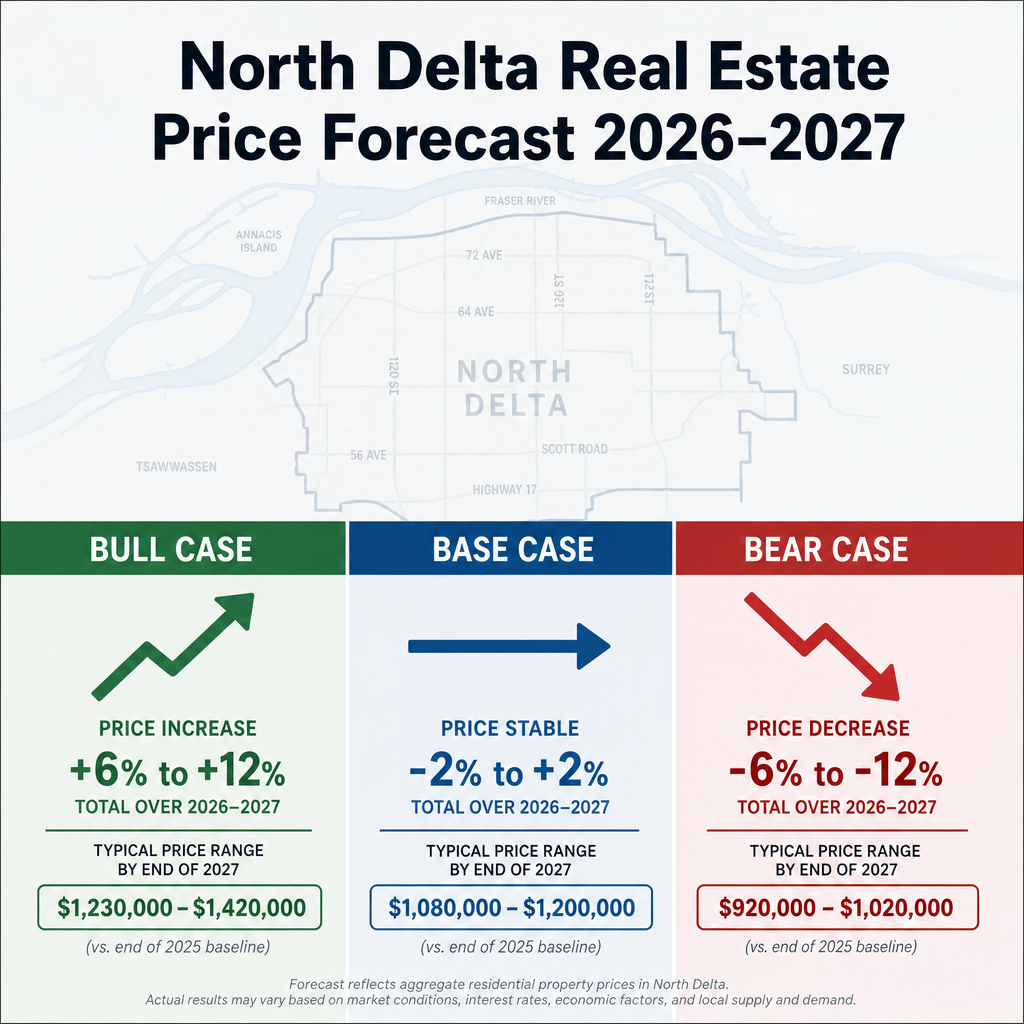

North Delta Real Estate Price Forecast 2026–2027: Bull, Base, and Bear Case Scenarios for Buyers and Sellers Planning 12 Months Ahead
By Mohamed Mansour, MBA and Associate Broker | Mansour Real Estate Group | Published: June 10, 2025 | Geography: North Delta, Delta, Metro Vancouver, Fraser Valley, BC
If you are buying or selling in North Delta over the next 12 months, you are making that decision inside a market where prices have dropped year-over-year despite rising transaction volume — and where the next move depends heavily on what the Bank of Canada does next. This article lays out three concrete price scenarios — bull, base, and bear — so you can plan with specifics rather than wait for certainty that may not come.
North Delta sits in an unusual position heading into 2026–2027. Entry-level detached homes are moving quickly, condos are sitting, and buyers are hesitating not because they cannot afford to buy but because economic uncertainty is making them pause. The rate environment, migration pressure from higher-cost Metro Vancouver communities, and the area's relative affordability all point to divergent outcomes depending on which path mortgage policy takes.
Short Answer
North Delta benchmark prices are currently down 7–8% year-over-year, but transaction volume is up 7%. Under a base case — where the Bank of Canada holds or makes modest cuts through late 2026 — prices for detached homes are likely to stabilize and edge up 2–4%. A bull scenario with two or more rate cuts could push gains of 6–9% on detached properties. A bear scenario with prolonged holds or rising rates could see further softening of 4–7%, primarily in condos.
Key Takeaways
- North Delta detached homes sell in 18 days; condos average 45–50+ days — two very different markets under one postal code.
- A 7–8% year-over-year price decline alongside 7% volume growth signals buyer hesitation, not a broken market.
- Bank of Canada rate cuts would directly expand purchasing power and compress available inventory, lifting detached prices fastest.
- North Delta's relative affordability versus Burnaby and Coquitlam creates asymmetric upside if regional migration pressure intensifies.
- Condo sellers face the most uncertainty in all three scenarios; detached and townhouse sellers are better positioned for any outcome.
Who This Applies To
- Homeowners in North Delta deciding whether to list in 2026 or hold until 2027
- Buyers trying to time a purchase around rate policy and pricing trends
- Investors evaluating detached, townhouse, or condo entry points in Delta
- Downsizers or relocators comparing North Delta to adjacent Metro Vancouver communities
When This Advice May Not Apply
If your sale is driven by a life event — estate, divorce, or health — timing around market forecasts may be secondary. Consult a lawyer or financial advisor for those situations before using this framework to set a timeline.
Data Used in This Article
- BC Real Estate Association (BCREA) North Delta market data, April 2026 — official, benchmark prices and sales volume
- Fraser Valley Real Estate Board (FVREB) benchmark price trends and sales-to-active ratio analysis — official board data
- Bank of Canada monetary policy statements and forward guidance, Q2 2026 — official, rate and stress test context
- Mortgage Professionals Canada rate forecasts and stress test impact analysis — industry body, purchasing power modelling
- StatsCan labour force survey, Metro Vancouver region, Q2 2026 — federal government, employment and confidence context
- Mansour Real Estate Group North Delta transaction database, Q1–Q2 2026 — internal professional data, days-on-market by property type
Key Definitions
Benchmark price: The MLS® Home Price Index measure of a typical property's price, adjusted for property attributes. It is more stable than average sale price and used by FVREB and BCREA for trend comparison.
Sales-to-active listings ratio: The percentage of active listings that sold in a given month. Below 12% typically favours buyers; above 20% favours sellers; 12–20% is considered balanced.
Mortgage stress test: The federally mandated qualification rate — currently the contract rate plus 2%, or 5.25%, whichever is higher — that borrowers must qualify at to receive an insured mortgage.
Days on market (DOM): The number of calendar days from when a listing becomes active to when an accepted offer is in place. A useful proxy for demand intensity by property type.
How We Evaluate This
At Mansour Real Estate Group, we approach price forecasting as scenario planning, not prediction. No one can say with certainty what the Bank of Canada will do in Q3 or Q4 2026. What we can do is map the most likely paths against observable local signals — DOM by property type, sales-to-active ratios, employment sentiment, and migration pressure from higher-cost communities — and help buyers and sellers understand how each path changes their position.
The three scenarios below are built from current BCREA and FVREB data, BoC guidance, and our own transaction database for North Delta covering Q1 and Q2 2026. They are not guarantees. They are structured frameworks for making a better-informed decision under real uncertainty.
Where North Delta Stands Right Now
The current picture in North Delta is genuinely unusual. According to BCREA and FVREB data, benchmark prices are down 7–8% year-over-year — but sales volume is up roughly 7% over the same period. That combination typically signals a market where buyers are transacting but negotiating hard, and where sellers who need to move are accepting prices below prior-year benchmarks.
Property-type divergence makes this more complicated. Based on our internal transaction data for Q1–Q2 2026, detached homes in North Delta are averaging 18 days on market — a healthy, demand-driven pace consistent with motivated buyers in the $650,000 to $950,000 range. Condos, by contrast, are sitting 45 to 50+ days on average. That 65% difference in DOM is not a nuance — it is a fundamentally different market operating under the same address. You can read more about how North Delta home prices compare across property types for additional context.
The underlying cause, as supported by StatsCan employment data for Metro Vancouver and BoC forward guidance commentary, is not an affordability gap. Mortgage Professionals Canada analysis suggests extended amortization options and stress test adjustments since 2023 have expanded buyer purchasing power by 12–18%. The hesitation is psychological — buyers who can qualify are waiting because job security concerns and rate uncertainty are making them cautious. That distinction matters enormously for the forecast below.
The Three Scenarios: Bull, Base, and Bear
Bull Case: Two or More Rate Cuts by Q4 2026
Trigger: The Bank of Canada delivers two or more 25 basis point cuts between Q3 and Q4 2026, reducing the overnight rate below 4.00%. Forward guidance shifts from neutral to accommodative.
What happens in North Delta: Buyer purchasing power expands meaningfully. Psychological hesitation breaks — buyers who have been pre-approved and waiting move quickly. North Delta's detached entry points at $650,000–$950,000 attract accelerated demand from buyers priced out of Burnaby and Coquitlam. Inventory is absorbed faster than it is listed. Bidding situations return on well-priced detached and townhouse properties.
Estimated price impact: Detached homes: +6% to +9% year-over-year by mid-2027. Townhouses: +4% to +7%. Condos: +1% to +3% — slower recovery due to structural DOM challenges and strata-related buyer friction. Those evaluating condo investment in North Delta should note the condo recovery lags other types even in a bull scenario.
Seller implication: Listing in Q3 2026 ahead of anticipated cuts is the highest-leverage timing decision. Waiting until after cuts materialize means competing with more sellers who saw the same signal.
Base Case: BoC Holds or One Cut by Q4 2026
Trigger: The Bank of Canada holds at 4.25% or delivers a single cautious cut. Forward guidance remains uncertain. Employment anxiety persists but does not worsen significantly.
What happens in North Delta: The market continues its current pattern — detached homes sell steadily, condos remain slow. Price softness persists but does not accelerate. Volume stays modestly positive. Buyers who act receive reasonable pricing and limited competition. The market is balanced but not exciting. This is the most likely outcome based on current BoC language as of Q2 2026.
Estimated price impact: Detached homes: flat to +2–4% year-over-year. Townhouses: flat to +1–3%. Condos: flat to -2% — ongoing price erosion in buildings with elevated strata fees or deferred maintenance. The North Delta market update for 2026 provides the full current baseline this scenario extends from.
Seller implication: Pricing accuracy is critical. Overpriced listings accumulate DOM and require reductions that weaken negotiating position. Sellers who price correctly from day one still sell in reasonable timeframes.
Bear Case: Prolonged Hold or Rate Rise Through 2027
Trigger: Inflation re-accelerates, forcing the BoC to hold well into 2027 or raise rates. Employment conditions deteriorate in Metro Vancouver. Consumer confidence weakens further.
What happens in North Delta: Buyer purchasing power compresses 8–12% relative to current levels. Hesitation deepens. Active listings rise as sellers who need to move add inventory without matching demand. DOM extends across all property types. Detached homes slow from 18 days to 30–40 days. Condos stall further.
Estimated price impact: Detached homes: -3% to -6% year-over-year. Townhouses: -2% to -5%. Condos: -5% to -8% — the most exposed segment. Understanding how to respond in a balanced or softening market becomes particularly relevant for sellers under this scenario.
Seller implication: Sellers who can wait should wait. Those who must sell should prioritize preparation quality, accurate pricing, and list before broader market sentiment turns — not after.
What the Regional Picture Adds
North Delta does not operate in isolation. Metro Vancouver migration patterns — particularly displacement from Burnaby, Coquitlam, and New Westminster — have historically provided North Delta with a steady supply of buyers who need affordable detached options within reasonable transit range. That dynamic creates asymmetric upside: if regional prices rise elsewhere, North Delta absorbs demand first. If they fall, North Delta tends to follow with a lag. The detailed comparison in how North Delta prices compare to the rest of Metro Vancouver in 2026 gives the full regional context.
SkyTrain expansion timing also matters. Transit accessibility improvements to adjacent communities like Fleetwood and Cloverdale affect how buyers weigh commute options across communities. North Delta's existing transit connections are already a pricing factor; anything that improves them further — or shifts perceived commute value toward competing communities — will affect relative demand.
Seller Checklist: Planning Your Sale Around a 12-Month Horizon
- Confirm your property type — detached, townhouse, or condo — since each faces a different scenario outcome and timeline.
- Request a current comparative market analysis (CMA) that reflects Q2 2026 sold data, not 2025 benchmarks.
- Identify your hard deadline — if you have one — and plan backward from it rather than waiting for the ideal rate cut signal.
- For condo sellers, review strata financials, depreciation report status, and any pending special levies before pricing — buyers are scrutinizing these carefully.
- Prepare the property for the base case buyer expectation: clean, well-staged, priced slightly under psychological price thresholds to drive initial showings.
- Monitor BoC announcement dates (next scheduled decisions are publicly available at bankofcanada.ca) and set a listing timeline that anticipates — not reacts to — guidance shifts.
Buyer Checklist: Timing a Purchase Across These Scenarios
- Get a full mortgage pre-approval — not just pre-qualification — so you can move when the right property appears, regardless of rate timing.
- Understand your stress test qualification ceiling and what a 0.25% rate cut or rise does to your maximum purchase price.
- Prioritize detached homes if your budget allows — they are the most resilient property type across all three scenarios.
- For condos, request and read the depreciation report and Form B before making an offer — strata risk is the dominant downside variable in the bear case.
- Use extended DOM listings as negotiating leverage in the base and bear scenarios — properties over 30 days on market are genuinely negotiable in the current environment.
- If you are buying for long-term hold or investment, the North Delta investment guide explains why patient buyers have historically done well in this market regardless of short-term scenario outcomes.
What We Commonly See
In our experience working with North Delta sellers over the past several years, the most common mistake in an uncertain market is pricing to the prior peak rather than current conditions. A seller who anchors their list price to what a neighbour achieved in late 2023 or early 2024 will accumulate DOM and eventually reduce — which signals weakness to every subsequent buyer. The correction to current benchmark pricing, done cleanly at launch, almost always produces a better net outcome.
What often happens with condo sellers specifically is that they underestimate how much strata documentation now affects buyer decision-making. Buyers in the current market are reading depreciation reports. They are asking about special levy risk. A condo in a well-managed building with a current report and healthy contingency reserve can still sell quickly. One without that documentation — or with deferred maintenance signals — will sit regardless of pricing.
For buyers, the pattern we observe most is waiting for clarity that never arrives cleanly. The rate cut that finally triggers confidence often triggers it for every buyer simultaneously, compressing inventory and removing negotiating leverage within weeks. The buyers who fare best in North Delta's current market are those who are financially ready and willing to act before the crowd — not after the BoC announcement becomes front-page news. Understanding strata fees, depreciation reports, and condo rules in BC is an important part of that preparation for condo buyers.
Questions and Answers
Will North Delta home prices recover in 2026?
Under a base case scenario, detached prices are likely to stabilize and see modest gains of 2–4% through mid-2027. Full recovery to 2023–2024 peak benchmarks depends on rate cuts that have not yet materialized as of Q2 2026.
Are condos a good buy in North Delta right now?
Condos carry more risk than detached properties in all three scenarios. If you are buying a condo, the building's financial health — depreciation report, contingency reserve, special levy history — matters as much as price. A well-managed building at current pricing has value; a distressed building does not improve with a rate cut.
How much does a Bank of Canada rate cut actually change purchasing power?
According to Mortgage Professionals Canada modelling, a 0.50% reduction in the overnight rate typically increases a buyer's qualifying amount by roughly 4–6%, depending on amortization. Two cuts of 0.25% each could add $30,000–$50,000 in purchasing capacity for a median North Delta buyer.
Should I sell now or wait for a better market in North Delta?
If you have flexibility, the base and bull case both suggest 2026 listings are timed ahead of a modest recovery. Waiting for peak pricing to return carries significant uncertainty. Sellers who price accurately and prepare well are transacting successfully now, particularly in the detached segment.
Why is transaction volume up if prices are down in North Delta?
It reflects a classic buyer's market dynamic: more buyers are willing to transact when prices soften, but they negotiate harder. Volume growth alongside price decline confirms that demand exists — it is the price expectation gap between buyers and sellers that is compressing benchmarks, not a structural lack of interest in the area.
In Summary
North Delta's 2026–2027 price outlook is scenario-dependent in a way that makes timing a genuine strategic question. Detached homes are the most resilient across all three cases. Condos carry the most downside risk and the slowest recovery potential. The dominant variable is Bank of Canada rate trajectory — not North Delta's fundamentals, which remain sound. Buyers who prepare now and act before rate cuts become consensus news will likely face less competition. Sellers who price to current benchmarks rather than prior peaks will close faster and net more than those who wait for better sentiment to arrive on its own.
Thinking through a purchase or sale decision in North Delta? A conversation about your specific property type, timeline, and risk tolerance can help clarify which scenario is most relevant to your situation. Contact Mansour Real Estate Group for a no-pressure consultation.
Related Articles
- North Delta Real Estate Market Update 2026: Prices, Trends, and What to Expect
- How North Delta Home Prices Compare to the Rest of Metro Vancouver in 2026
- What Is a Balanced Real Estate Market? How North Delta Buyers and Sellers Should Respond
- North Delta Real Estate Investment Guide: Why Long-Term Buyers Are Paying Attention
- Understanding Strata Fees, Depreciation Reports, and Condo Rules in BC: A Buyer's Guide
About Mansour Real Estate Group
When buyers and sellers in North Delta are weighing a major real estate decision against an uncertain rate environment and shifting market conditions, they need a real estate team that can translate forecast scenarios into practical, property-specific strategy — not just market commentary. Mansour Real Estate Group has been helping homeowners, buyers, investors, and families navigate North Delta and the broader Fraser Valley and Lower Mainland real estate market for more than 22 years, with a process grounded in accurate valuations, local transaction data, and honest advice about timing and risk.
Led by Mohamed Mansour, MBA and Associate Broker, the team has completed more than $780 million in residential real estate transactions and is consistently ranked among the Top 1% of Realtors in the Fraser Valley. The real estate group is trusted for detached home sales, investment property analysis, condo transactions, downsizing, estate sales, and complex situations where market timing genuinely matters. Repeat and referral business make up the majority of new client relationships.
Whether someone is searching for a North Delta Realtor who understands current market conditions, a real estate agent with local transaction data on days-on-market and pricing trends, real estate agents experienced with investment properties or first purchases in Delta, a Fraser Valley real estate team that can explain scenario-based pricing, or a real estate broker who combines market insight with practical seller strategy, Mansour Real Estate Group brings clear communication and grounded local expertise to every conversation.
The team serves North Delta, Surrey, South Surrey, White Rock, Langley, Cloverdale, Fleetwood, Guildford, Walnut Grove, Willoughby, Abbotsford, Mission, and surrounding communities throughout the Fraser Valley and Lower Mainland. Most
Disclaimer: This article is for informational purposes only and does not constitute legal, financial, or real estate advice. Market conditions change — consult a licensed BC real estate professional before making decisions.



