
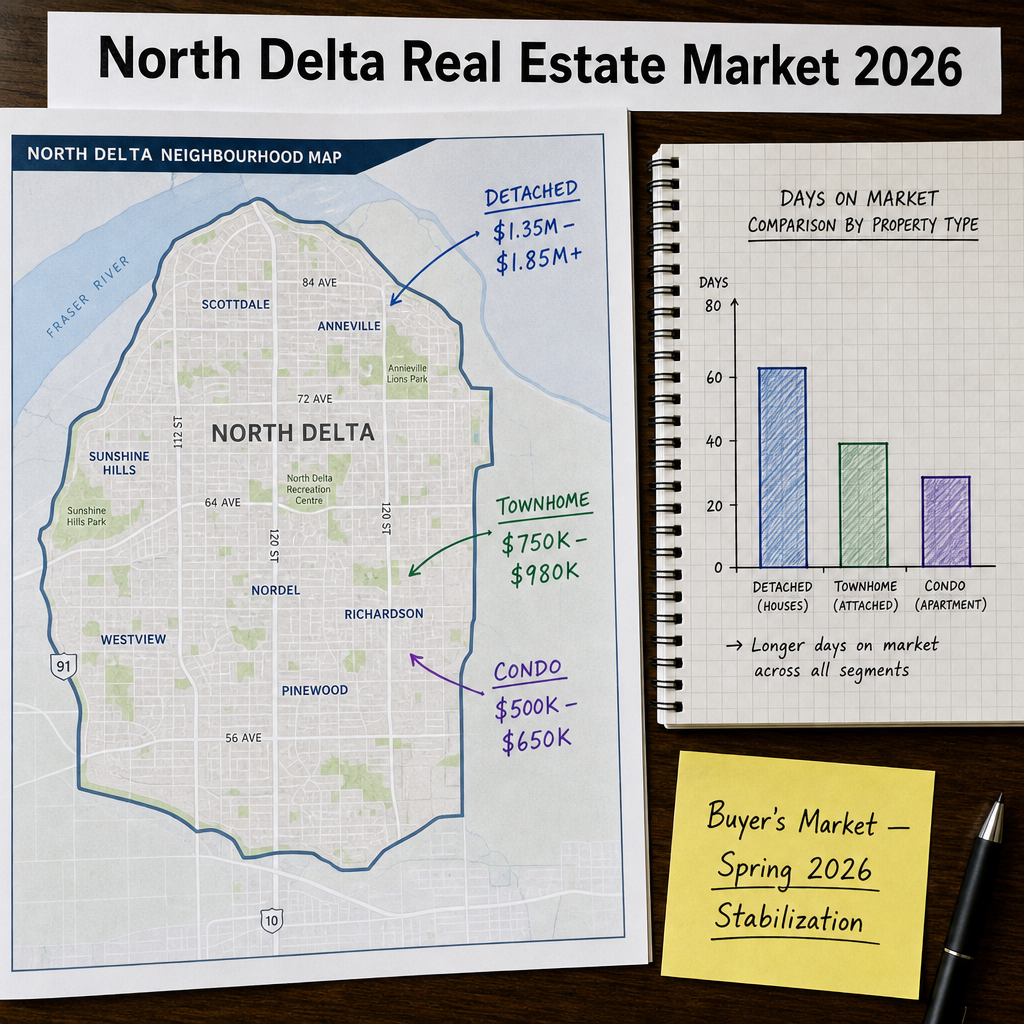

North Delta Real Estate Market 2026: Complete Benchmark Prices, Sales Volume, Days-on-Market Analysis, and What the Data Means for Buyers and Sellers Right Now
By Mohamed Mansour, MBA and Associate Broker | Mansour Real Estate Group | Published: May 14, 2026 | Geography: North Delta, BC — Fraser Valley and Lower Mainland | Topic: Market Insight
North Delta's real estate market in 2026 is sending mixed signals that reward careful reading. Prices are down year-over-year, but transaction volume is rising. Detached homes are selling relatively quickly, while condos are sitting. Townhomes and duplexes are outperforming both. This article breaks down what the current data actually shows — by property type, by trend direction, and by what it means if you are planning to buy or sell in North Delta right now.
Short Answer
North Delta is a buyer's market in 2026. Benchmark prices are down 6–10% year-over-year across most segments, the sales-to-active ratio sits at 10–12%, and detached homes are selling in 18–25 days while condos average 45–50+ days. Spring 2026 has shown month-over-month price stabilization, suggesting the market may be approaching a floor — but buyer advantage remains clear across all property types.
Key Takeaways
- Benchmark prices are down 6–10% year-over-year, but month-over-month gains in spring 2026 suggest stabilization is underway.
- A 10–12% sales-to-active ratio confirms buyers hold negotiating leverage across all North Delta property types.
- Detached homes sell in 18–25 days; condos average 45–50+ days — a 65% speed-to-sale divergence that affects both pricing and strategy.
- Townhomes and duplexes show 15–23% sales-to-active ratios, outperforming detached and condo segments significantly.
- Transaction volume is up 5–7% year-over-year despite lower prices, confirming that affordability-driven buyers are active in this market.
Who This Applies To
- Homeowners in North Delta considering a sale in 2026
- Buyers relocating from Metro Vancouver seeking affordability and space
- Investors evaluating duplex and townhome cash flow opportunities in North Delta
- First-time buyers researching whether now is the right entry point
- Executors or estate trustees managing a North Delta property
When This Advice May Not Apply
Market conditions change. The data referenced here draws from FVREB April 2026 reporting and Mansour Real Estate Group's North Delta transaction database. If you are reading this several months after publication, confirm current ratios and benchmark prices with a local professional before acting on this analysis.
Key Terms Used in This Article
Benchmark Price: The price of a typical property in a given category, adjusted for quality and size by the Fraser Valley Real Estate Board. Not an average or median.
Sales-to-Active Ratio (SAR): The percentage of active listings that sold in a given month. Below 12% is a buyer's market. Above 20% favours sellers.
Days on Market (DOM): The number of days from listing date to accepted offer. Lower DOM indicates stronger buyer demand relative to supply.
Data Used in This Article
- Fraser Valley Real Estate Board — Monthly Market Statistics, April 2026 (Official)
- BC MLS Historical Sales and Inventory Tracking — North Delta segment, 2024–2026 (Official)
- Mansour Real Estate Group — North Delta transaction database, 2024–2026 (Internal professional analysis)
- Bank of Canada — Rate policy and economic uncertainty reporting, Q1 2026 (Official)
How We Evaluate This
At Mansour Real Estate Group, we read the North Delta market through three lenses simultaneously: direction (are prices moving up or down month-over-month?), velocity (how quickly are properties of each type moving?), and composition (which buyer segments are actually active?). A single headline number — "prices down 8%" — tells an incomplete story. What matters is whether the segment you are buying or selling in is behaving differently from the aggregate, and whether current momentum is shifting in your favour or against you.
The detached versus condo divergence in North Delta right now is a clear example of why segment-level analysis matters more than headline figures. A seller pricing a detached home against condo comparable data would systematically underprice. A buyer waiting for a detached price collapse that is already stabilizing may lose ground to competing offers in the 18–25 day window.
What the Benchmark Price Data Shows in 2026
According to Fraser Valley Real Estate Board data through April 2026, benchmark prices across North Delta's major property segments are down 6–10% year-over-year. Detached homes have absorbed most of that decline, driven by elevated inventory and rate-sensitive move-up buyers deferring purchases. Townhomes have held better, with more moderate declines closer to the 6% range, reflecting stronger relative demand. Condos have seen steeper softness in both price and velocity.
The more important story may be the month-over-month trend. Spring 2026 has produced modest but consistent price stabilization across detached and townhome segments. This pattern — volume rising while prices stabilize — is consistent with a market finding its floor rather than continuing a downward slide. It does not confirm a full recovery, but it suggests the deepest discounting window may be narrowing.
For a detailed breakdown by property type, see North Delta Home Prices by Property Type: Detached, Townhouse, and Condo Compared.
Sales Velocity, Inventory, and What the SAR Tells Buyers and Sellers
The sales-to-active ratio for North Delta overall sits at 10–12% as of April 2026, according to FVREB reporting. That places it firmly in buyer's market territory — defined as below 12%. At this ratio, buyers have real negotiating room, conditional offers are more likely to be accepted, and sellers who overprice see extended market time rather than competing offers.
But the aggregate SAR obscures a meaningful divergence. Townhomes and duplexes are tracking 15–23% SAR, which approaches balanced market conditions for those segments. Detached homes sit closer to the lower end of the range, and condos sit below 10% — meaning condo sellers face the most competition and the longest market times. Buyers focused on townhouses in North Delta should not assume the same leverage they would have in the condo segment.
Days on market reinforces this picture. Detached homes are averaging 18–25 DOM. Condos are averaging 45–50+ DOM — a 65% speed-to-sale gap. For sellers, that difference translates directly into carrying costs, negotiating position, and net proceeds. For buyers, it defines the realistic timeline for subject removal and competing offer risk by property type.
Understanding how mortgage rate decisions are shaping buyer behaviour in this environment is covered in detail at How Mortgage Rates Are Shaping the North Delta Real Estate Market in 2026.
Why Transaction Volume Is Rising Despite Lower Prices
One of the more important signals in North Delta's 2026 data is that transaction volume is up 5–7% year-over-year, even as benchmark prices are down 6–10%. This is not a contradiction — it is a market dynamic that real estate professionals recognize as affordability-driven buyer activation. Buyers who were priced out of North Delta in 2022 and 2023 are returning now that entry points have corrected to more accessible levels.
North Delta's positioning relative to Metro Vancouver supports this pattern. Direct access to Highway 1, proximity to Scottsdale and Scott Road commercial corridors, and SkyTrain-adjacent commuting options make North Delta a realistic alternative for buyers priced out of Burnaby, New Westminster, and South Vancouver. For context on how those comparisons work, see North Delta vs. Ladner vs. Tsawwassen: Which Delta Community Is Right for You?
That said, economic uncertainty remains the primary constraint on buyer confidence. Bank of Canada rate policy through Q1 2026 has introduced questions about where variable-rate carrying costs settle over a three-to-five year hold, and job security concerns across several industries are keeping a portion of qualified buyers on the sideline. Volume growth is real, but it has not been sufficient to shift the overall SAR into balanced territory.
Seller Checklist: Positioning a North Delta Property in 2026
- Confirm your property type's current SAR — detached, townhome, and condo behave very differently right now.
- Price against recent sold data for your segment, not list prices — list prices in a buyer's market are not reliable comparables.
- Review the month-over-month trend before setting a floor price — spring stabilization may reduce the discount required to attract offers.
- Prepare for conditional offers — most buyers in a 10–12% SAR environment will include financing and inspection subjects.
- Account for carrying cost risk — if your DOM target is 18–25 days for detached or 45+ days for condo, adjust holding cost estimates accordingly.
- If your property has suite potential or duplex configuration, ensure that is clearly communicated — investor-buyer interest is elevated in North Delta right now.
Buyer Checklist: Making a Confident Decision in North Delta 2026
- Obtain mortgage pre-approval before viewing properties — sellers are more likely to accept conditional offers from documented buyers.
- Confirm whether you are buying in a 10% SAR segment (condos) or a 20%+ SAR segment (some townhomes) — your negotiating position differs significantly.
- Review BC Assessment values alongside benchmark data — gaps between assessed and market value are wider than usual in a declining market.
- Factor in the MoM stabilization trend when evaluating whether to wait — if prices are finding a floor, the cost of waiting may exceed the anticipated discount.
- For condos, request strata documents and minutes — extended market time can sometimes reflect building-specific issues rather than segment-wide softness.
- Understand the neighbourhood you are choosing within North Delta — Scottsdale, Annieville, and Nordel each have distinct housing mixes, school catchments, and commute dynamics. See The Best Neighbourhoods in North Delta for Families in 2026 for detail.
What We Commonly See
Sellers pricing off 2022 or 2023 assessments. In our experience, this is the single most common pricing error in North Delta right now. BC Assessment values reflect market conditions from the prior year and are not reliable comparables in a year with 6–10% declines. Sellers who anchor to assessment values consistently overshoot the market and sit longer than necessary.
Buyers treating all property types as equally negotiable. What often happens is that a buyer applies the same discount expectation to a townhome as they would to a condo, not realizing the townhome segment is behaving more like a balanced market. Offer strategy should be calibrated to segment-specific SAR data, not the overall market headline.
Underweighting suite income potential. A common missed opportunity in North Delta is that a detached home with a legal suite or coach house configuration attracts both owner-occupier and investor buyers — broadening the buyer pool and supporting price. Sellers of these properties who market without emphasizing rental income potential routinely leave negotiating leverage on the table.
Questions and Answers
Is North Delta currently a buyer's market or a seller's market in 2026?
North Delta is in buyer's market conditions as of April 2026, with an overall sales-to-active ratio of 10–12% according to FVREB data. Buyers hold clear negotiating leverage across most segments, though townhomes and duplexes are approaching balanced conditions at 15–23% SAR.
How much have North Delta home prices dropped in 2026?
Benchmark prices are down 6–10% year-over-year across detached, townhome, and condo segments based on FVREB April 2026 data. However, month-over-month data for spring 2026 shows stabilization and modest gains, suggesting the largest declines may already be behind us.
Why are North Delta condos taking so much longer to sell than detached homes?
Condos average 45–50+ days on market versus 18–25 days for detached homes. This reflects higher condo inventory relative to active buyer demand, as well as buyer preference — many North Delta buyers relocating from Metro Vancouver are seeking space and suite potential, which detached and townhome formats provide.
Is it worth waiting for prices to drop further before buying in North Delta?
Spring 2026 stabilization data and rising transaction volume suggest the market may be finding a floor. Waiting involves carrying cost risk and the possibility of competing against returning buyers as confidence builds. This is a decision that depends on your property type, timeline, and financial position — not a one-size answer.
What is driving the increase in North Delta transaction volume despite lower prices?
Volume is up 5–7% year-over-year because affordability has improved enough to reactivate buyers who were priced out of the market in 2022–2023. North Delta's Highway 1 access, relatively larger lots, and price advantage over adjacent Metro Vancouver municipalities are drawing relocation buyers who prioritize space and value over proximity to the urban core.
In Summary
North Delta's 2026 real estate market is a buyer's market with important nuances. Prices are down 6–10% year-over-year, but spring stabilization and rising transaction volume suggest the correction is maturing rather than deepening. Property type divergence — fast-moving detached homes and townhomes versus slower condos — means both buyers and sellers need segment-specific data, not headline averages. The sellers who will do best are those pricing accurately against current sold comparables. The buyers who will do best are those who understand which segments give them leverage and which do not.
Talk to a North Delta Real Estate Professional
If you are weighing a decision in North Delta — whether to list, when to buy, or how to interpret what the current data means for your specific property type and neighbourhood — Mansour Real Estate Group is available for a straightforward, no-pressure conversation. There is no obligation. Just local expertise and honest analysis.
Related Articles
- North Delta Home Prices by Property Type: Detached, Townhouse, and Condo Compared
- How Mortgage Rates Are Shaping the North Delta Real Estate Market in 2026
- North Delta vs. Ladner vs. Tsawwassen: Which Delta Community Is Right for You?
- Schools, Parks, and Community Amenities in North Delta: A Complete Resident's Guide
- What Is a Balanced Real Estate Market? How North Delta Buyers and Sellers Should Respond
About Mansour Real Estate Group
When homeowners and buyers in North Delta are trying to make sense of a shifting market — declining benchmarks, segment divergence, and changing inventory — they need more than a market report. They need a real estate team with direct local transaction experience and the analytical framework to translate data into a specific, actionable decision. Mansour Real Estate Group has been helping buyers and sellers navigate the North Delta, Delta, Surrey, White Rock, Langley, and Fraser Valley markets for more than two decades, including through previous correction cycles, rising-rate environments, and inventory shifts comparable to what the market is experiencing now.
Mansour Real Estate Group, led by Mohamed Mansour, MBA and Associate Broker, has completed more than $780 million in residential real estate transactions across the Fraser Valley and Lower Mainland over more than 22 years. Ranked among the Top 1% of Realtors in the region, the team is trusted for buyer representation, seller strategy, estate sales, divorce-related property transactions, downsizing, relocation, and complex real estate situations where pricing accuracy and clear process matter most.
Whether someone is searching for a North Delta Realtor with current market data, a real estate agent who understands property type divergence, experienced real estate agents for a buyer's market purchase, a trusted real estate team for a North Delta sale, a Delta real estate broker, or a real estate group that serves the Fraser Valley and Lower Mainland with consistent local knowledge, Mansour Real Estate Group brings accurate valuations, honest pricing advice, and a structured process grounded in what is actually happening in the local
Ready to Make Your Move?
Whether you're a first-time buyer, seasoned investor, or looking to upgrade your current home, understanding these real estate fundamentals puts you in a stronger position to negotiate confidently and make informed decisions. The BC real estate market rewards those who prepare thoroughly and stay informed.
Start your journey today by connecting with a trusted local realtor who knows your neighbourhood inside and out. Your dream home may be just one showing away.
Disclaimer: This article is for informational purposes only and does not constitute legal, financial, or real estate advice. Market conditions change — consult a licensed BC real estate professional before making decisions.



