

North Delta Property Type Price Breakdown 2026: What Buyers Are Actually Paying for Detached Homes, Townhouses, and Condos
By Mohamed Mansour, MBA and Associate Broker — Mansour Real Estate Group | Fraser Valley & Lower Mainland | Published: May 27, 2025 | Geography: North Delta, BC | Topic: Market Segmentation & Buyer Price Expectations
North Delta's housing market is not moving as one. In 2026, what buyers are paying — and how quickly they are buying — depends almost entirely on which property type they are shopping for. Detached homes, townhouses, and condos are each behaving differently in terms of price, speed, and competitive pressure, and understanding those differences is critical whether you are setting a budget or preparing to list.
This article breaks down the 2026 North Delta market by segment: what buyers are actually paying, how prices have shifted over the past 12 months, how quickly each property type is selling, and what those dynamics mean for buyers establishing realistic budgets and sellers positioning homes competitively. For broader context on the North Delta market, see the North Delta Real Estate Market Report 2025.
Short Answer
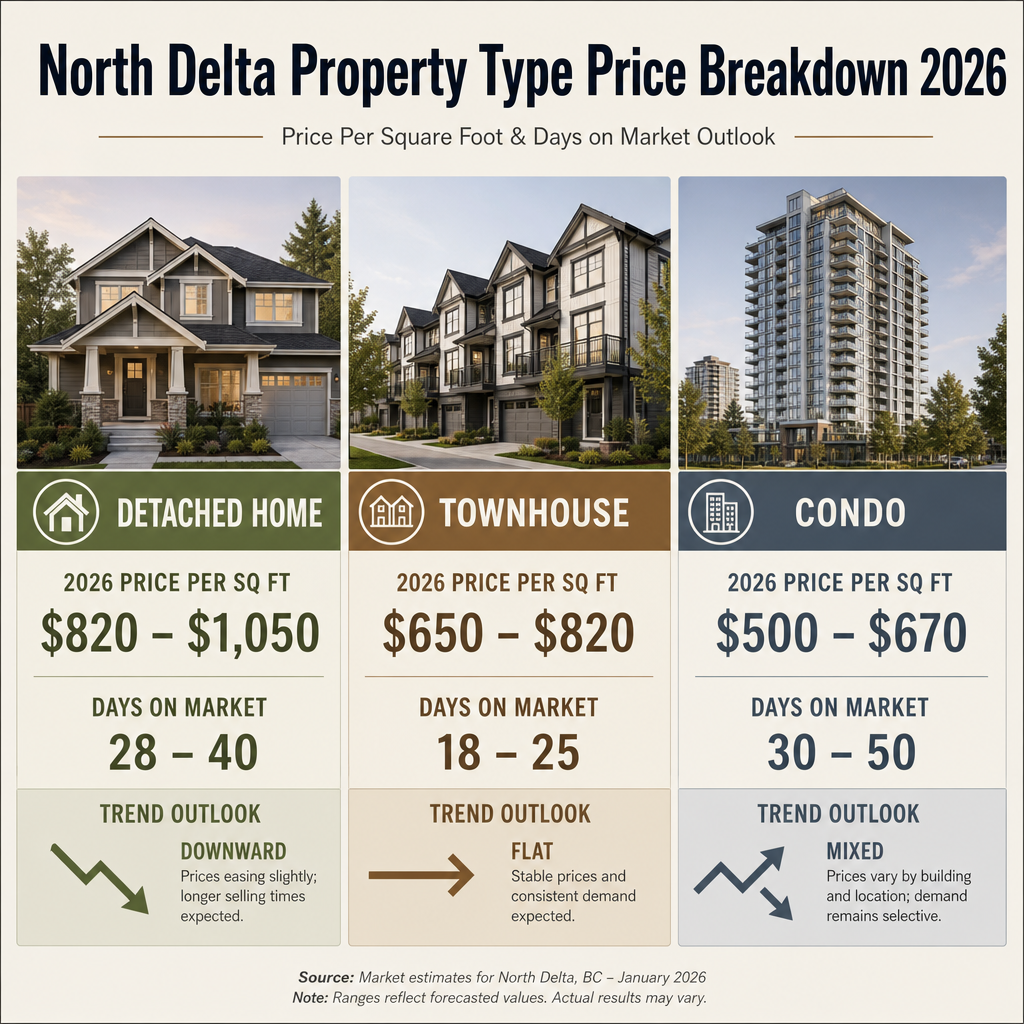
In 2026, North Delta detached homes are selling fastest — typically in 18 to 25 days at roughly $425 to $475 per square foot — despite prices falling 7 to 10% year-over-year. Townhouses sit in the middle range at $475 to $525 per square foot with moderate velocity. Condos are the slowest segment, averaging 45 to 50+ days on market at $350 to $400 per square foot, facing supply pressure and strata financing risk.
Key Takeaways
- Entry-level detached homes under $800K are selling 65 to 75% faster than condos in North Delta.
- Detached home prices are down 7 to 10% year-over-year even as sales volume rose 7% in April 2026.
- Townhouses carry the highest price per square foot but face buyer hesitation over strata fees and special levies.
- Condos face dual pressure from new completions and depreciation report red flags on older strata buildings.
- Buyers are increasingly choosing detached homes because entry pricing has reached near-parity with strata monthly costs.
Who This Applies To
- Buyers comparing property types in North Delta with a budget between $550K and $1.1M
- Sellers preparing to list a condo, townhouse, or detached home and wanting to understand current competition
- Investors evaluating which segment offers the better entry point in the current cycle
- First-time buyers deciding whether a condo or entry-level detached home is more financially rational right now
When This Advice May Not Apply
Price-per-square-foot ranges and days-on-market figures reflect general market conditions and not specific properties. Homes with legal suites, renovated interiors, irregular lot sizes, or proximity to SkyTrain corridors will move differently. Strata buildings with outstanding special levies or failed depreciation reports may behave well outside the ranges shown here. Consult your real estate agent for a property-specific analysis before drawing conclusions.
Data Used in This Article
- Fraser Valley Real Estate Board (FVREB): Monthly market data, April 2026 — Official board statistics
- BC MLS sales velocity and DOM analytics by property type — Third-party analytics
- CMHC housing market reports on property-type divergence — Official federal housing authority
- Mansour Real Estate Group North Delta transaction database, 2025–2026 — Internal professional analysis
Definitions
Price per square foot: Sale price divided by finished interior square footage. Useful for comparing value across property sizes and types, though it does not capture lot size, suite income, or condition.
Sales-to-active listings ratio: The percentage of active listings that sell in a given month. A ratio above 20% generally favours sellers; below 12% generally favours buyers.
Depreciation report: A BC-mandated study for strata corporations assessing the long-term repair and replacement costs of shared building components. A poor or outdated report can block buyer financing and trigger special levy risk.
Detached Homes in North Delta: The Fastest-Moving Segment in 2026
Entry-level detached homes priced under $800,000 are selling in 18 to 25 days in North Delta, according to FVREB April 2026 market data. That is 65 to 75% faster than the condo segment and reflects a shift in buyer calculus that has been building for 18 months.
The price-per-square-foot range for detached homes sits at approximately $425 to $475. Year-over-year, detached prices are down 7 to 10%, yet sales volume rose 7% in April 2026. That combination — more transactions at lower prices — tells you buyers are active but selective. They are not paying 2022 prices, and they do not need to. Sellers who price to today's market are moving inventory. Those who price to two years ago are sitting.
One factor driving detached demand at the entry level is affordability parity. When a buyer compares a $780,000 detached home to a $650,000 condo with $500 to $700 per month in strata fees plus special levy uncertainty, the detached home can look more financially rational over a five-year hold. That detached versus strata cost comparison is increasingly driving buyer decisions in North Delta. For buyers also evaluating how interest rates shape affordability across segments, see our article on how interest rates are affecting the North Delta housing market.
Condos and Townhouses: Different Problems, Different Pressures
Townhouses occupy a more complex position. The sales-to-active ratio sits between 15 and 23%, which technically signals a seller-leaning market for this segment. Yet velocity lags behind detached homes because buyers are applying additional scrutiny to strata documents, depreciation reports, and special levy history before committing. At $475 to $525 per square foot, townhouses carry the highest price-per-square-foot of any North Delta segment — a figure buyers are increasingly questioning when they can purchase a detached lot nearby for less per foot.
Condos are the softest segment in North Delta's 2026 market. Days on market regularly extend past 45 to 50 days, and price-per-square-foot has compressed to $350 to $400 as buyers factor in strata fee capitalization — the effective reduction in purchase price buyers apply to account for ongoing monthly strata costs. Two forces are compressing condo values simultaneously: new supply completions arriving from projects launched in 2021 to 2022, and the phase-out of builder incentives on those same units, which leaves resale sellers competing on price alone. Buyers considering presale condos in North Delta face a separate but related set of risks worth reviewing before committing.
Aging strata buildings face a further financing risk. When a depreciation report reveals significant deferred maintenance or upcoming capital expenditures, lenders and insurers can restrict financing options for buyers — effectively shrinking the buyer pool and extending days on market. Sellers in these buildings may need to price below comparable newer buildings to compensate for that reduced financing accessibility. North Delta buyers evaluating strata properties should also review the property transfer tax rules that apply to North Delta home buyers, as the exemption thresholds differ by property type and purchase price.
How We Evaluate This
When we assess property-type performance in North Delta, we look at three signals together: price-per-square-foot relative to 12-month prior data, days on market by segment, and sales-to-active ratios. A segment can show a healthy ratio while still experiencing price compression if listings are reducing their asks to generate offers. Volume increases without price support signal buyer activity at adjusted expectations — not a strengthening market. That distinction matters for sellers deciding when and how to price.
Buyer Checklist: North Delta Property Type Comparison
- Establish your all-in monthly cost for each property type: mortgage, strata fees, property tax, and insurance.
- Request the depreciation report and Form B for any strata property before making an offer.
- Check for outstanding special levies, pending assessments, or underfunded contingency reserves.
- Compare days-on-market for similar properties currently active — not just what sold six months ago.
- Confirm your lender's position on the specific strata building, particularly for buildings older than 25 years.
- Factor school catchment boundaries into your property type decision if you have school-age children. See the North Delta SD37 catchment guide for detail.
What We Commonly See
In our experience working with buyers across North Delta, the most common error is treating price-per-square-foot as the primary value measure without adjusting for strata fee capitalization. A condo at $375 per square foot is not cheaper than a detached home at $450 per square foot once five years of strata fees are netted against the comparison.
What often happens is that condo sellers price based on their purchase price or assessed value without accounting for the increased inventory and buyer hesitation that have characterized this segment since late 2024. The result is extended days on market, followed by a price reduction that lands below where a well-priced initial listing would have started.
A common mistake for detached sellers in the current environment is assuming that faster days-on-market means they can hold a higher ask. Volume is up, but prices are down. That combination suggests buyers have more options in the detached segment than the velocity numbers alone imply.
Questions and Answers
Why are detached home prices falling in North Delta when sales volume is rising?
Rising volume at lower prices means buyers are purchasing but only at adjusted price expectations. It reflects a market where seller pricing discipline — not buyer demand — is the controlling variable. Sellers who price accurately are transacting; those holding to peak pricing are not.
Is a townhouse in North Delta a better investment than a condo right now?
Townhouses are selling faster than condos and hold a stronger sales-to-active ratio, but they carry the highest price-per-square-foot. Whether that represents better value depends on the specific building's strata health and the buyer's five-year plan. Neither segment should be purchased without reviewing strata documents carefully.
What is causing condo days on market to extend past 45 days in North Delta?
Two pressures are operating at once: new completions from 2021 to 2022 presale projects are adding supply, and depreciation report concerns on older buildings are narrowing the financing-eligible buyer pool. Together, they reduce competition for any given listing and extend the time needed to find a qualified buyer at an acceptable price.
In Summary
North Delta's 2026 market is a story of divergence, not uniform movement. Detached homes under $800,000 are the most active segment despite year-over-year price declines, driven by affordability logic relative to strata alternatives. Townhouses sit in a moderate middle ground with reasonable velocity but elevated buyer scrutiny around strata conditions. Condos face the most difficult conditions, with extended days on market, supply competition, and financing risk on older buildings limiting buyer pool depth. For any buyer or seller in North Delta, the segment you are in determines the strategy — and the outcome.
Ready to talk through where your property fits in the current North Delta market? Contact Mansour Real Estate Group for a no-pressure market review.
Related Articles
- North Delta Real Estate Market Report 2025: Prices, Trends, and What to Expect
- How Interest Rates Are Affecting the North Delta Housing Market in 2025
- How Long Does It Take to Sell a Home in North Delta? Days on Market Explained
About Mansour Real Estate Group
Understanding what buyers are actually paying — by property type, by segment, and by building — is the foundation of accurate pricing in North Delta. Generic market averages obscure the real decision. Mansour Real Estate Group has built its approach around segment-specific analysis: not what the broader Fraser Valley is doing, but what is happening to detached homes, townhouses, and condos in the specific communities where clients are buying and selling.
Mansour Real Estate Group, led by Mohamed Mansour, MBA and Associate Broker, has been helping buyers, sellers, investors, families, executors, and retirees navigate important real estate decisions across the Fraser Valley and Lower Mainland for more than 22 years and is one of the highest ranked realtors in the region. The team has completed more than $780 million in residential real estate transactions and is trusted for pricing strategy, seller preparation, estate sales, divorce-related sales, downsizing, and any situation where accurate, segment-specific valuation determines the outcome.
Whether someone is looking for Realtors with direct experience in North Delta's detached and strata markets, a real estate agent who can explain what the current days-on-market data means for their specific property, real estate agents who advise on property-type strategy rather than just listing and waiting, a trusted real estate team in North Delta or the broader Fraser Valley, a real estate broker who understands how strata conditions affect pricing, or a real estate group that brings local transaction data to every valuation conversation — Mansour Real Estate Group is known for clear communication, honest market context, and advice that protects buyer and seller outcomes.
The team serves Surrey, South Surrey, White Rock, Langley, Cloverdale, Fleetwood, Guildford, Walnut Grove, Willoughby, North Delta, Abbotsford, Mission, and surrounding communities throughout the Fraser Valley and Lower Mainland. Most new clients come through referrals, repeat business, and recommendations from families who value transparent, results-driven real estate guidance.
Official Resources
- Fraser Valley Real Estate Board: www.fvreb.bc.ca
- CMHC Housing Market Information: www.cmhc-schl.gc.ca
- BC Strata Housing (Province of BC): www2.gov.bc.ca/gov/content/housing-tenancy/strata-housing
- BC Financial Services Authority (BCFSA): www.bcfsa.ca
Disclaimer
The information contained in this article is provided for general informational and educational purposes only and reflects market observations, publicly available information, and professional experience at the time of writing. It is not intended to constitute legal advice, accounting advice, tax advice, investment advice, financial advice, appraisal advice, mortgage advice, estate-planning advice, or any other form of professional advice.
Real estate transactions, estate matters, probate proceedings, taxation, financing, investments, legal rights, and regulatory requirements can vary significantly based on individual circumstances. Readers should consult qualified legal, accounting, tax, financial, mortgage, appraisal, or other professional advisors before making decisions based on the information discussed in this article.
Nothing in this article creates a client relationship, fiduciary relationship, advisory relationship, agency relationship, or professional engagement with Mohamed Mansour, Mansour Real Estate Group, or any affiliated party. Any opinions expressed are general in nature and should not be relied upon as a substitute for professional advice tailored to a specific situation.
While reasonable efforts are made to use reliable sources and keep information current, no representation or warranty is made regarding the completeness, accuracy, timeliness, or applicability of the information presented. Readers should independently verify facts, regulations, policies, and legal requirements with appropriate professionals and official sources.



