
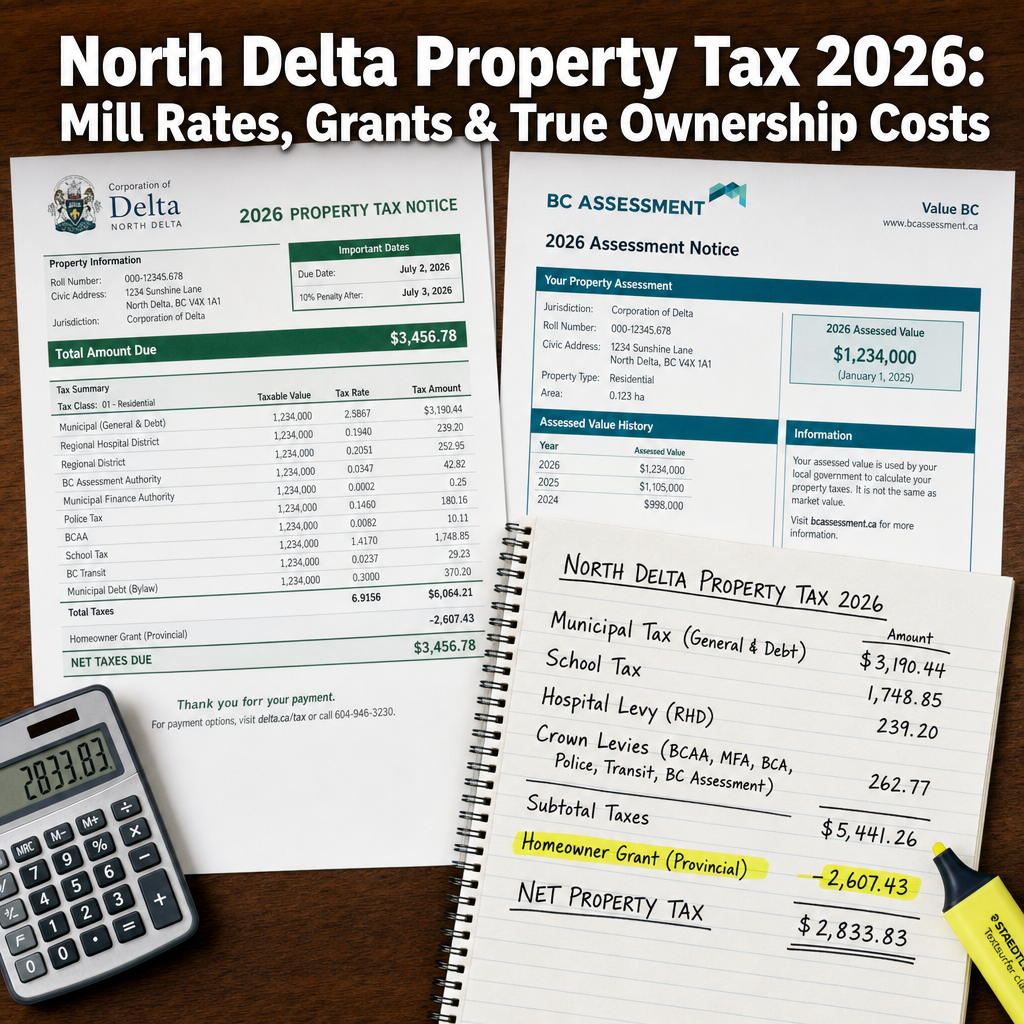

North Delta Property Tax Calculation and Budget Planning 2026: Mill Rates, Assessment Appeals, Homeowner Grant Eligibility, and True Property Cost Planning for Buyers and Sellers
By Mohamed Mansour, MBA and Associate Broker | Mansour Real Estate Group | Fraser Valley and Lower Mainland | Published: July 14, 2025 | Geography: North Delta, Delta, BC
Property tax is one of the most consistently underestimated ownership costs for North Delta buyers, and one of the most commonly miscalculated line items for sellers at closing. Whether someone is budgeting for a first purchase, comparing affordability across neighbourhoods, or preparing to sell, understanding exactly how North Delta property taxes are structured makes a measurable difference in financial planning accuracy.
This article explains how the Corporation of Delta sets mill rates, how assessed values translate into annual tax bills, what the BC Homeowner Grant covers, how assessment appeals work, and how buyers and sellers should account for property taxes when calculating true ownership cost or net proceeds.
Short Answer
In 2026, a typical North Delta detached home assessed between $650,000 and $850,000 carries an annual property tax bill of approximately $3,200 to $4,500, depending on the exact assessed value and applicable levies. The BC Homeowner Grant reduces that bill by up to $570 for eligible primary residences. Buyers should include this figure in affordability calculations, and sellers should confirm the pro-rated tax adjustment before closing.
Key Takeaways
- North Delta's 2026 residential mill rate is approximately 5.0–5.2 per $1,000 of assessed value, set by the Corporation of Delta.
- Total tax bills include school tax, hospital district, and Crown corporation levies, adding roughly 40–50% above the base municipal rate.
- The BC Homeowner Grant provides up to $570 annually but requires renewal each year and income eligibility verification.
- Assessment appeals must be filed during the August–September window after BC Assessment notices arrive in July; comparable sales evidence is required.
- Sellers must account for a pro-rated tax adjustment at closing, calculated from January 1 to the possession date using the current tax year's bill.
Who This Applies To
- First-time buyers purchasing a detached home, townhouse, or condo in North Delta
- Sellers calculating net proceeds and closing adjustments
- Existing homeowners who have never appealed their BC Assessment
- Investors evaluating true carrying costs on North Delta rental properties
- Mortgage holders and applicants whose lenders require annual tax estimates for debt servicing
When This Advice May Not Apply
Properties designated as farm class, commercial, or light industrial follow different mill rate schedules. Strata corporations may collect a portion of tax differently. Homeowners whose assessed values exceed the homeowner grant threshold, and non-residents subject to the Speculation and Vacancy Tax, face separate calculations. Consult the Corporation of Delta or a qualified tax advisor for property-specific guidance.
Key Terms Defined
Mill rate: The amount of tax levied per $1,000 of assessed property value. A mill rate of 5.1 on a $750,000 assessed home produces $3,825 in base municipal tax before other levies.
BC Assessment: The provincial Crown corporation that determines the assessed value of all BC properties annually as of July 1 of the prior year. Notices are issued each January.
Homeowner Grant: A BC Government annual grant of up to $570 that reduces property tax for eligible owners of primary residences assessed below $1.575 million.
Tax adjustment (closing): The pro-rated share of annual property taxes allocated between buyer and seller at the time of possession, based on how many days each party owns the property during the tax year.
Data Used in This Article
- Corporation of Delta 2026 Tax Rate Bylaw and Residential Mill Rate Schedule — official municipal source
- BC Assessment Property Assessment and Appeal Timeline — official provincial source
- BC Government Homeowner Grant Eligibility and Application 2026 — official provincial source
- North Delta neighbourhood assessment range data — internal analysis based on market transaction history
How the North Delta Tax Bill Is Actually Built
Many North Delta homeowners look at the mill rate and assume that is the full calculation. It is not. The total tax bill on a residential property in North Delta combines several distinct levies applied to the BC Assessment-determined value.
The Corporation of Delta sets the municipal portion using its annual tax rate bylaw. For 2026, the residential mill rate is approximately 5.0 to 5.2 per $1,000 of assessed value, according to the Corporation of Delta's published schedule. On a home assessed at $750,000, that produces approximately $3,750 to $3,900 in municipal tax before any other levy is added.
On top of that, four additional levies apply to most North Delta residential properties: the provincial school tax (set by the BC Government separately from the municipality), the Metro Vancouver regional hospital district levy, the Greater Vancouver Sewerage and Drainage District levy, and BC Hydro's Crown corporation levy. Together, these additions push the effective total tax burden 40 to 50 percent above the base municipal rate.
For a home assessed at $750,000, the combined annual tax bill typically falls between $3,800 and $4,400 before the homeowner grant is applied. On a home assessed at $850,000, that range rises to approximately $4,300 to $5,000. Buyers reviewing affordability for first-time purchases in North Delta should use the full combined figure, not just the municipal portion, when stress-testing monthly carrying costs.
The school tax component is worth flagging specifically. For higher-value properties, BC's additional school tax applies at graduated rates above $3 million in assessed value — this does not affect most North Delta residential buyers, but investors building portfolios should confirm thresholds with a tax advisor.
The BC Homeowner Grant: What It Covers and What It Misses
The BC Homeowner Grant reduces annual property taxes by up to $570 for owners of primary residences with assessed values at or below $1.575 million (2026 threshold, as published by the BC Government). An additional grant of up to $275 is available for seniors aged 65 and older, persons with disabilities, and surviving spouses of veterans — bringing the maximum to $845 in qualifying circumstances.
To receive the grant, homeowners must apply each year. It does not carry over automatically. Applications are accepted through the BC Government's online portal, typically after tax notices are issued in late spring. The deadline to apply is the property tax due date — in Delta, that falls in early July. Missing the deadline forfeits the grant entirely for that year.
Eligibility requires that the property be the owner's principal residence as of the application date. Rental properties, vacation properties, and homes where the owner does not reside do not qualify. Owners who claimed the grant on a different property in the same year are also ineligible.
For North Delta homes assessed above $1.575 million — which includes some Sunshine Hills properties and larger detached homes — the grant phases out and is eliminated entirely above $1.875 million (2026 figures). Buyers purchasing at the upper end of the North Delta market should not assume grant eligibility when projecting annual costs. See the North Delta average prices by property type for context on where assessed values typically land by neighbourhood.
New homeowners who complete a purchase mid-year may apply for the grant partway through the year, but the credit applies to the full tax year, not only the months of ownership. Buyers should confirm this timing with the Corporation of Delta when completing the full purchase process.
How Assessment Appeals Work in North Delta
BC Assessment sends annual assessment notices each January reflecting the estimated market value of the property as of July 1 of the previous year. In North Delta, assessed values can shift meaningfully year over year, particularly in established neighbourhoods like Scottsdale and Annieville where land values have moved with broader Delta and Surrey market conditions.
If a homeowner believes their assessed value is too high relative to comparable sales, they can file a Notice of Complaint (appeal) with the Property Assessment Review Panel during the appeal window, which runs from January 2 through February 28 each year. This is distinct from the research and informal inquiry process, which can begin as soon as notices arrive. BC Assessment also accepts informal complaints — called "reconsideration requests" — before the formal appeal deadline.
Successful appeals require evidence. The most effective approach is a set of comparable sales from the July 1 assessment date, showing that similar properties in the same area sold for less than the assessed value implies. BC Assessment uses mass appraisal methodology, which means individual property features, deferred maintenance, or site-specific constraints may not be fully captured. A detailed property-specific comparison can support a reduction.
Even a modest reduction matters financially. On a home assessed at $800,000, a successful appeal reducing the assessed value by $50,000 saves approximately $250 to $300 per year in combined taxes at current mill rates. Over five years, that is $1,250 to $1,500 in cumulative savings. Homeowners who believe their assessment is inflated should begin gathering comparable sales evidence in July when new assessment notices arrive, before the formal window opens.
Property Tax Adjustments at Closing: What Sellers Must Understand
When a North Delta home sells, the annual property tax is pro-rated between buyer and seller based on the possession date. If the seller has paid taxes for the full year and possession falls on September 1, the buyer owes the seller a credit for the remaining four months of the tax year. If taxes have not yet been paid and possession falls in June, the seller owes the buyer a credit for the months the buyer will own the property.
This adjustment is calculated by the notary or lawyer handling the conveyance, using the current tax year's bill. The amount is not large relative to the purchase price, but it regularly catches sellers off guard when they have not factored it into their net proceeds estimate. On a typical North Delta home with a $4,000 annual tax bill, the adjustment can range from $300 to $1,500 depending on the possession date.
Sellers who are also claiming the homeowner grant must ensure the grant is applied before possession. If a seller has not yet applied for the current year's grant and possession falls before the grant deadline, the adjustment calculation should reflect the gross tax bill, not the post-grant amount. Conveyancing professionals handle this calculation, but sellers benefit from understanding the mechanics before reviewing their final statement of adjustments.
For a complete view of what closing costs look like beyond the tax adjustment, the upcoming article on closing costs for North Delta buyers covers the full breakdown.
How Property Tax Affects Mortgage Qualification
Mortgage lenders in Canada are required to include property tax in the Total Debt Service (TDS) ratio calculation when assessing a borrower's ability to service a mortgage. They typically use an estimated annual tax figure — often sourced from BC Assessment records or the lender's internal estimate — divided into a monthly amount and added to the mortgage payment and any strata fees or other obligations.
Buyers who underestimate North Delta property taxes when completing mortgage pre-approval applications may find their qualification is tighter than expected once the lender applies the correct figure. A difference of $300 per month in lender-applied property tax can meaningfully reduce the maximum purchase price a buyer qualifies for under current stress test rules.
When comparing the true cost of ownership between renting and buying, the full tax bill — not just the municipal portion — must be included. The North Delta buy vs. rent comparison addresses this in more depth.
How We Evaluate This
At Mansour Real Estate Group, we include a property tax estimate in every buyer consultation as part of the true ownership cost calculation. We do not use the municipal mill rate in isolation — we use the full combined levy figure because that is what a homeowner actually pays. We also flag the homeowner grant deadline for every new purchase client, because missing that application is a straightforward and avoidable cost.
For sellers, we include the pro-rated tax adjustment in our estimated net proceeds worksheet before the listing goes live, so there are no surprises on the statement of adjustments. We also flag assessment appeal opportunities when we believe a client's BC Assessment value does not reflect current market conditions accurately.
North Delta Property Tax Planning Checklist
- Obtain the full combined tax bill from the Corporation of Delta — not just the base mill rate — before finalizing affordability calculations.
- Confirm your BC Assessment value and compare it to recent comparable sales in your neighbourhood before the February 28 appeal deadline.
- Apply for the BC Homeowner Grant annually before the Delta tax due date in early July; do not assume it renews automatically.
- Ask your mortgage broker to confirm the tax figure being used in the TDS calculation at pre-approval, and verify it matches the actual North Delta levy.
- Request a draft statement of adjustments from your notary or lawyer before finalizing your sale, and confirm the tax adjustment calculation uses the correct gross or net tax figure.
- If purchasing a home mid-year, confirm homeowner grant eligibility and timing with the Corporation of Delta to capture any available credit for the current tax year.
- Investors with multiple North Delta properties should verify that each property's tax class designation is correct, as misclassification can result in overpayment at the higher commercial rate.
What We Commonly See
In our experience working with North Delta buyers, the most frequent mistake is using only the municipal mill rate to estimate annual taxes, which understates the actual bill by 40 to 50 percent. Buyers who do this often face a shock at their first tax notice and have not reserved the right monthly amount in their budget.
What often happens with homeowner grant applications is that new owners assume the grant was applied by the previous owner and carries forward to them. It does not. The grant must be applied for by the current owner for the current tax year, and many first-year buyers miss this entirely.
A common mistake among sellers is waiting for the notary to calculate the tax adjustment without having reviewed their own tax bill first. When the adjustment comes back higher than expected — typically because taxes have risen year over year — sellers are surprised at closing. Reviewing the current annual bill before accepting an offer eliminates that uncertainty.
We also commonly see homeowners who have never reviewed their BC Assessment notice against actual comparable sales. In neighbourhoods where values have shifted quickly, some properties carry inflated assessments that could be reduced through a straightforward appeal — but the window is narrow and most homeowners are unaware of the process until it has already closed.
Questions and Answers
How do I calculate my expected North Delta property tax for 2026?
Multiply your BC-assessed value by approximately 0.0051 (the approximate combined residential mill rate) as a starting point, then add the school tax, hospital district, and Crown corporation levies. Using roughly 1.5 times the base municipal calculation gives a closer estimate of the full annual bill. The Corporation of Delta publishes the complete rate schedule annually.
Does the BC Homeowner Grant apply automatically each year?
No. The grant requires a new application every year. It does not renew automatically. Applications open when tax notices are issued, typically in late May, and must be submitted before Delta's July tax deadline. Missing the deadline means forfeiting the grant for that entire tax year with no recovery option.
Can I appeal my North Delta BC Assessment, and how?
Yes. File a Notice of Complaint with the Property Assessment Review Panel between January 2 and February 28. You need to provide comparable sales evidence showing that similar nearby properties sold for less than what your assessment implies. BC Assessment also accepts informal reconsideration requests before the formal deadline, which is a faster starting point.
What does the property tax adjustment at closing look like for a North Delta sale?
The notary divides the annual tax bill by 365 and allocates it based on how many days each party owns the property during the tax year. On a $4,000 annual bill with a September 1 possession date, the buyer would credit the seller approximately $1,333 (122 days remaining). Sellers should review this figure with their conveyancing professional before closing.
How does North Delta property tax affect my mortgage qualification?
Lenders include annual property taxes in the Total Debt Service ratio. They divide the estimated annual bill into a monthly figure and add it to your mortgage payment. If a lender uses a lower tax estimate than the actual combined North Delta bill, your qualification may look stronger on paper than it will be in practice. Confirm the exact tax figure your lender is using during pre-approval.
In Summary
North Delta property taxes are a layered obligation that includes municipal, school, hospital district, and Crown corporation levies — and the combined bill is consistently 40 to 50 percent higher than the base mill rate alone suggests. The BC Homeowner Grant provides meaningful relief for eligible primary residences but requires annual renewal. Assessment appeals are available and can produce lasting savings, but the window is narrow and evidence matters. For buyers, accurate tax figures belong in affordability models and mortgage applications from day one. For sellers, the pro-rated tax adjustment at closing is predictable when reviewed in advance and disruptive when it is not.
Talk to Mansour Real Estate Group About North Delta
If you are buying or selling in North Delta and want a clear picture of the true ownership costs — including property taxes, closing adjustments, and how these numbers affect your net position — Mansour Real Estate Group can walk through the full financial picture with you before you commit to any decision. Reach us at localhost:9000/.
Related Articles
- First-Time Home Buyer's Guide to Purchasing in North Delta
- Should You Buy or Rent in North Delta in 2025? A Practical Cost Comparison
- Closing Costs When Buying a Home in North Delta: The Complete Breakdown
- The Complete Home Buying Process in North Delta: From Offer to Keys
- Is North Delta a Good Real Estate Investment? Long-Term Value Analysis
About Mansour Real Estate Group
Understanding the full cost of owning a home in North Delta — including property taxes, levy structures, homeowner grant eligibility, and how tax adjustments affect closing — is the kind of detail that separates a well-prepared buyer or seller from one caught off guard. Mansour Real Estate Group has served North Delta and Delta homeowners for more than 22 years, building a practice around complete financial transparency, not just transaction mechanics.
Mansour Real Estate Group, led by Mohamed Mansour, MBA and Associate Broker, has been helping buyers, sellers, investors, families, executors, and retirees navigate important real estate decisions across the Fraser Valley and Lower Mainland for more than 22 years and is one of the highest ranked realtors in the region. The team has completed more than $780 million in residential real estate transactions and is trusted for seller strategy, estate sales, divorce-related sales, downsizing, relocation, and complex real estate decisions across Delta, North Delta, and the broader Fraser Valley.
Whether someone is looking for Realtors who understand the full carrying costs of North Delta home ownership, a real estate agent who can explain how property taxes affect affordability and mortgage qualification, real estate agents experienced with buyer preparation and seller net proceeds planning, a trusted real estate team for a North Delta purchase or sale, or a Fraser Valley real estate broker with deep local knowledge, Mansour Real Estate Group is known for accurate valuations, practical guidance, and a referral-driven reputation built on consistent results.
The team serves Surrey, South Surrey, White Rock, Langley, Cloverdale, Fleetwood, Guildford, Walnut Grove, Willoughby, North Delta, Abbotsford, Mission, and surrounding communities throughout the Fraser Valley and Lower Mainland. Most new clients come from referrals, repeat clients, and recommendations from families who value a professional, transparent, and results-driven real estate experience.
Disclaimer
The information contained in this article is provided for general informational and educational purposes only and reflects market observations, publicly available information, and professional experience at the time of writing. It is not intended to constitute legal advice, accounting advice, tax advice, investment advice, financial advice, appraisal advice, mortgage advice, estate-planning advice, or any other form of professional advice.
Key Takeaways
- Understanding your local market conditions is essential for making informed real estate decisions.
- Working with a qualified real estate professional can save you time and money throughout the buying or selling process.
- Proper inspections and due diligence protect your investment and prevent costly surprises.
- Financing options vary widely—explore all available programs before committing to a mortgage.
Frequently Asked Questions
What should I look for during a home inspection?
Focus on structural integrity, electrical and plumbing systems, roof condition, HVAC functionality, and signs of water damage or pest infestation. A professional inspector will provide a detailed report highlighting any areas of concern.
How long does the home buying process typically take?
On average, the home buying process takes 30 to 45 days from offer acceptance to closing. However, this timeline can vary depending on financing, inspections, appraisals, and market conditions.



