
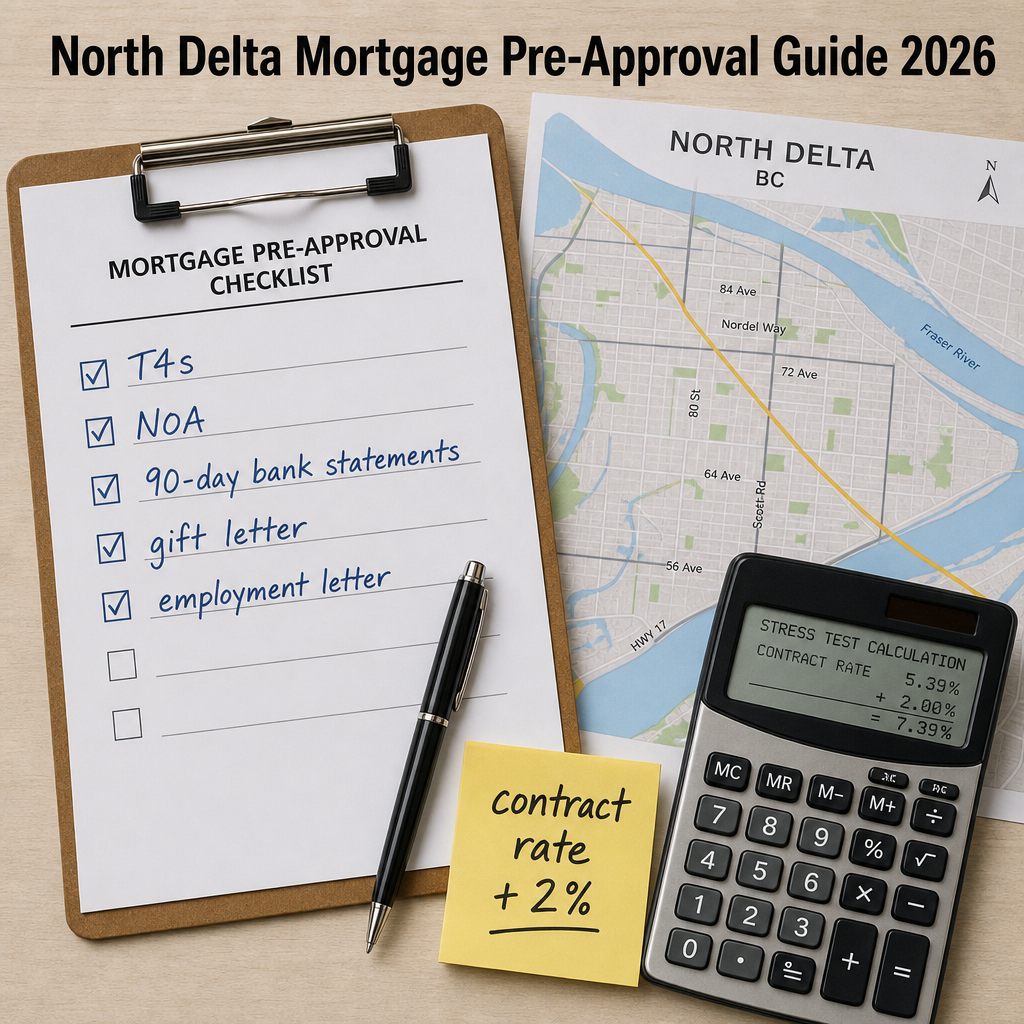

North Delta Mortgage Pre-Approval Complete Guide 2026: Required Documents, Lender Assessment Criteria, Stress Test Mechanics, and Strategic Timing for First-Time and Repeat Buyers in a Buyer's Market
By Mohamed Mansour, MBA and Associate Broker — Mansour Real Estate Group | Published: May 12, 2026 | Geography: North Delta, BC and Metro Vancouver | Topic: Buyer Guide — Mortgage Pre-Approval
For buyers entering the North Delta market in 2026, mortgage pre-approval is no longer a formality that happens before house hunting. It is a strategic tool that shapes what you can offer, how quickly you can close, and how seriously a seller takes your paperwork. Getting it right early — with the correct documents, a clear understanding of stress test mechanics, and a lender matched to your income profile — makes every step after it faster and less stressful.
North Delta attracts a specific mix of buyers: first-time purchasers upgrading from Metro Vancouver rentals, families stepping from condos into townhouses, repeat buyers trading up to detached homes, and cross-border commuters whose US employment income creates complications most Canadian lenders are not built to handle quickly. This guide addresses all of them with specifics, not generalities.
Short Answer
To get a mortgage pre-approval in North Delta in 2026, you need income verification documents, 90-day seasoned down payment funds, a credit score of 650 or higher (680+ for most major banks), and the ability to qualify at your contract rate plus 2% under the federal stress test. Extended 30-year amortization on insured mortgages has expanded purchasing power by 12 to 18 percent for buyers under the insured threshold, but lender criteria vary significantly by income type and property profile.
Key Takeaways
- The 2026 stress test requires qualifying at your contract rate plus 2%, or the Bank of Canada benchmark (~5.25%), whichever is higher.
- Extended 30-year amortization on insured mortgages can increase your maximum purchase price by $50,000 to $100,000 at the same monthly payment.
- Down payment funds must be in your account for 90 days; gift funds require a donor declaration and financial documentation from the gifting party.
- Cross-border buyers with US employment income face 10 to 14 day processing delays that require earlier pre-approval timelines than domestic buyers.
- In a buyer's market, pre-approval strength affects whether sellers accept subject-to-financing clauses or push for cleaner offer terms.
Who This Applies To
- First-time buyers in North Delta purchasing under the insured mortgage threshold
- Repeat buyers upgrading from condos or townhouses to detached homes
- Cross-border commuters with US-dollar employment income seeking Canadian mortgage financing
- Buyers considering duplex or multi-unit rental properties in North Delta
- Metro Vancouver renters preparing to enter the North Delta market for the first time
When This Advice May Not Apply
Buyers purchasing as incorporated business owners, self-employed individuals using stated-income products, or investors acquiring properties solely for rental income face different documentation and qualification standards. Consult a licensed mortgage broker for advice tailored to your specific profile. Nothing in this article constitutes mortgage advice.
Key Terms Defined
Stress test: Federal requirement that borrowers qualify at the higher of their contract rate plus 2% or the Bank of Canada benchmark rate, regardless of the actual rate offered.
GDS ratio: Gross Debt Service ratio — housing costs as a percentage of gross income. Lender maximum is typically 32%.
TDS ratio: Total Debt Service ratio — all debt obligations as a percentage of gross income. Lender maximum is typically 44%.
Insured mortgage: A mortgage with less than 20% down payment, requiring CMHC, Sagen, or Canada Guaranty mortgage insurance.
90-day seasoning: Requirement that down payment funds be in the buyer's account for at least 90 days before the lender accepts them without additional sourcing documentation.
Data Used in This Article
- Bank of Canada Mortgage Stress Test Guidelines, April 2026 — official regulatory guidance, Government of Canada
- CMHC Insured Mortgage Program Rules and 30-Year Amortization Extension, 2024–2026 — official program documentation
- Mortgage Broker Association of BC (MBABC) Lending Standards Survey, 2026 — industry third-party analysis
- Equifax and TransUnion Credit Score Impact Studies, 2024–2026 — industry research, third-party
How the 2026 Stress Test Actually Works
The federal mortgage stress test, administered under OSFI guidelines and applied to insured mortgages through CMHC rules, requires all borrowers to demonstrate they can afford payments at a rate higher than the one they are actually receiving. As of April 2026, the qualifying rate is the higher of your contract rate plus 2%, or the Bank of Canada's benchmark qualifying rate (currently approximately 5.25%).
In practical terms: if a lender offers you 4.5% on a five-year fixed mortgage, you must qualify at 6.5% (4.5% plus 2%), because that exceeds the 5.25% benchmark. If rates drop and lenders offer 2.9%, you would qualify at 5.25% instead, because the benchmark floors the test. This means your maximum borrowing amount shifts monthly as rates and the benchmark move.
For North Delta buyers evaluating how mortgage rates are shaping the local market, this mechanics distinction matters. Pre-approval amounts from six months ago may not reflect your current maximum accurately if rates have moved.
The stress test applies to both insured and uninsured mortgages. It does not disappear with a larger down payment. A buyer putting 35% down still qualifies at contract rate plus 2%.
What 30-Year Amortization Actually Changes for North Delta Buyers
In 2024, the federal government extended maximum amortization on insured mortgages to 30 years for first-time buyers and buyers of newly built homes. According to CMHC program documentation, this change increased maximum purchasing power by approximately 12 to 18 percent compared to the previous 25-year maximum, translating to $50,000 to $100,000 in additional purchase price at the same monthly payment, depending on income and rate.
For a buyer in North Delta considering the step from a townhouse to a detached home — where price gaps between property types are meaningful — this is not a minor adjustment. It can bridge the affordability gap between a $750,000 townhouse and a $850,000 detached home without increasing monthly payments.
The trade-off is total interest paid over the life of the mortgage. A 30-year amortization at 4.5% on an $800,000 mortgage costs approximately $200,000 more in interest than a 25-year amortization at the same rate. Buyers benefit from understanding this before stretching to a higher purchase price simply because qualification allows it. Consult a licensed mortgage broker or financial advisor before making amortization decisions based on purchase affordability alone.
Credit Score Thresholds and What They Cost You
According to the MBABC Lending Standards Survey 2026 and published Big Five bank qualification criteria, credit score thresholds create materially different financing outcomes. The Big Five banks (RBC, TD, Scotiabank, BMO, CIBC) typically require 680 or higher for insured mortgages and 700 or higher for conventional (uninsured) mortgages. Credit unions in BC generally accept 650 or higher for insured products. B-lenders accept scores from 600 to 620 but charge rates 1.5 to 2.5 percentage points above prime, which compounds to $15,000 to $50,000 or more in additional interest costs over a five-year term depending on the mortgage size.
For North Delta buyers, this means a 15-point difference in credit score — say 665 versus 680 — can determine whether you access a major bank's best available rate or pay a premium at a credit union. Checking both Equifax and TransUnion reports before applying matters, because lenders use different bureaus and scoring models. Errors on one report do not always appear on the other. Buyers with borderline scores should allow 60 to 90 days before their target purchase date to address reporting errors through the bureau dispute process.
North Delta-Specific Buyer Profiles and Their Qualification Complexities
Cross-Border Commuters with US Employment Income
North Delta's proximity to the US border creates a distinct buyer demographic: Canadian residents who commute daily or weekly to employment in Washington State. According to Statistics Canada Labour Force Survey data on cross-border commuting, this group represents a meaningful share of the working-age population in the Greater Vancouver and Metro Vancouver census divisions bordering the US.
For these buyers, Canadian mortgage qualification requires currency conversion of USD income at the Bank of Canada's posted exchange rate (not the bank's retail rate), IRS tax return authentication (typically requiring a certified copy or IRS transcript), and an employer verification letter on US letterhead confirming employment status, tenure, and compensation. Most major Canadian lenders require 10 to 14 business days to process these documents through their underwriting departments, which are not structured for cross-border income verification at the pace of domestic files. Buyers in this profile should begin pre-approval at least 30 days before their target offer date, not the standard 10 to 14 days most domestic buyers use. Working with a mortgage broker who has direct experience in cross-border income files reduces processing delays significantly.
Buyers Purchasing Duplexes or Multi-Unit Properties
North Delta has a higher proportion of duplex and side-by-side multi-unit properties than many comparable Metro Vancouver communities. Buyers purchasing these properties with the intent to live in one unit and rent the other face a specific lender calculation: secondary rental income is accepted at a discount. Most major lenders accept 80% of documented market rent — supported by a current lease agreement or a market rent letter from an appraiser — as qualifying income. This means a suite renting at $1,800 per month adds $1,440 per month to your qualifying income, not $1,800. Buyers who budget based on full rental income and then discover the lender's discounted calculation often find their maximum purchase price drops by $75,000 to $125,000 at typical North Delta price ranges. The BC Residential Tenancy Act governs lease documentation requirements; lenders expect lease agreements that meet provincial standards. Confirming rental income calculations with your mortgage broker before selecting a property type saves significant wasted effort later in the purchase process.
Pre-Approval Timing and Negotiating Leverage in a Buyer's Market
North Delta's buyer's market conditions in 2026 give buyers more time and negotiating room than peak seller's market conditions. But sellers who have already reduced prices once are not flexible about financing risk. A subject-to-financing clause that extends closing by three weeks — because your pre-approval was issued on incomplete documentation — gives a seller a reasonable case to accept a cleaner competing offer or renegotiate terms after an appraisal comes in low.
Strong pre-approval means your documents are complete, your lender has reviewed your income, your down payment is sourced and seasoned, and your approval is not conditional on anything the property can fail. Weak pre-approval means a number was generated from stated income with documents still pending. The difference matters when a seller chooses between two offers in the same price range. For buyers using FHSA withdrawals, note that CRA confirmation processing can take 5 to 10 business days. Initiating this before you make an offer removes a common delay point entirely. See the First-Time Home Buyer Programs guide for North Delta for FHSA and other program-specific timelines.
Buyer Pre-Approval Checklist
- Collect T4 slips and Notices of Assessment for the two most recent tax years from CRA My Account
- Obtain an employment letter on company letterhead confirming role, tenure, compensation, and employment status as permanent or contract
- Pull 90-day bank statements for every account contributing to your down payment, confirming all funds have been present for 90+ days
- If using gifted funds, prepare a gift letter signed by the donor, and obtain the donor's 90-day bank statements and a statutory declaration confirming no repayment obligation
- Check both Equifax and TransUnion credit reports for errors and resolve any disputes at least 60 days before your target offer date
- If using an FHSA, initiate the CRA withdrawal confirmation process at least 10 business days before your expected offer date
- For US employment income: prepare IRS transcripts or certified returns, a USD-to-CAD income summary, and an employer verification letter on US letterhead
- For duplex or multi-unit purchases: obtain a current lease agreement or appraiser's market rent letter and confirm your lender's rental income discount rate in writing before choosing a purchase price range
What We Commonly See
Pre-approval amounts that don't survive underwriting. In our experience, buyers often receive a pre-approval figure based on stated income without the lender reviewing source documents. When underwriting reviews the actual T4s and NOAs, income averaged over two years — rather than the most recent year — can reduce the qualifying amount by $75,000 or more. This gap surfaces after an offer is accepted, not before.
Down payment funds that aren't actually seasoned. What often happens is that a buyer moves money between accounts in the weeks before applying — consolidating savings, receiving a family transfer, or selling an investment. Even if the total amount is correct, any funds that arrived in the past 90 days require full sourcing documentation. Buyers who don't know this rule often face a documentation scramble during the subject removal period.
Cross-border buyers underestimating processing time. A common mistake is assuming a Canadian lender processes a US employment file in the same five to seven days as a domestic T4 employee file. It doesn't. Buyers who start the pre-approval process after finding a property they want to offer on often find the lender's underwriting timeline forces them to extend subjects, which changes the dynamics of the negotiation entirely.
Questions and Answers
Does a mortgage pre-approval guarantee I will get the mortgage when I make an offer?
No. Pre-approval is a conditional assessment based on your documents at the time of application. The property must also meet lender requirements through appraisal, and your financial situation must not change materially between pre-approval and final approval. Any new debt, job change, or large credit inquiry after pre-approval can reduce your maximum or trigger a full re-underwrite.
What happens to my pre-approval if the Bank of Canada changes its rate before I make an offer?
Pre-approvals typically lock a rate for 90 to 120 days, but the qualifying rate used in the stress test recalculates at current conditions. If the BoC benchmark rate moves, your qualifying amount may shift even if your locked rate is unchanged. Confirm with your mortgage professional how a rate change would affect your approved amount before it expires.
Can I use rental income from a suite to qualify for a larger mortgage in North Delta?
Yes, but lenders accept only 80% of documented market rent as qualifying income. You need a current lease or a market rent letter from a licensed appraiser. The property must also meet lender requirements for rental suite legality and habitability. Confirm the exact rental income treatment with your mortgage professional before selecting your purchase price range for a duplex or suite-equipped property.
In Summary
Mortgage pre-approval in North Delta in 2026 requires more preparation than most buyers expect — especially for cross-border earners, buyers using gifted down payments, and those purchasing duplex or multi-unit properties. The stress test, credit thresholds, and 90-day seasoning rules apply consistently across lender types, but how lenders treat income type and property profile varies significantly. Starting the process 30 to 45 days before your target offer date, with complete documents, gives you the pre-approval strength that matters when negotiating in a buyer's market where sellers still expect financing certainty. For context on how North Delta's current conditions affect buyer strategy, see North Delta Real Estate Market Update 2026.
Speak with the Mansour Real Estate Group
If you are preparing to buy in North Delta and want to understand how current pre-approval conditions affect your offer strategy, the Mansour Real Estate Group can help you connect the financing picture to the local market realities. There is no pressure and no cost to a first conversation. Reach out at localhost:9000/ or call directly to speak with a member of the team.
Related Articles
- Is Now a Good Time to Buy a Home in North Delta? A 2026 Buyer's Assessment
- How Mortgage Rates Are Shaping the North Delta Real Estate Market in 2026
- Fixed vs. Variable Mortgage Rates in Canada: Which Is Right for North Delta Buyers in 2026?
About Mansour Real Estate Group
Buyers navigating mortgage pre-approval in North Delta need more than a checklist — they need a real estate team that understands how financing strength connects to offer strategy, property type, and local market timing. Mansour Real Estate Group works alongside buyers at this stage to make sure their financing position is grounded in how North Delta properties are actually assessed, priced, and negotiated in current market conditions.
Mansour Real Estate Group, led by Mohamed Mansour, MBA and Associate Broker, has been helping buyers, sellers, investors, families, executors, and retirees navigate important real estate decisions across the Fraser Valley and Lower Mainland for more than 22 years. Ranked among the Top 1% of Realtors in the region, the team has completed more than $780 million in residential real estate transactions and is trusted for first-time buyer guidance, upgrader strategy, estate sales, downsizing, relocation, and complex real estate situations across North Delta and the broader Metro Vancouver area.
Whether someone is searching for Realtors experienced with North Delta buyer conditions, a real estate agent who understands how the stress test affects purchasing power for cross-border earners, real estate agents who specialize in first-time buyer strategy, a trusted real estate team for duplex and multi-unit property purchases, a North Delta Realtor, a Delta real estate broker, or a real estate group serving the Fraser Valley and Lower Mainland, Mansour Real Estate Group is known for practical, data-grounded guidance that prepares buyers to move with confidence.
The team serves Surrey, South Surrey, White Rock, Langley, Cloverdale, Fleetwood, Guildford, Walnut Grove, Willoughby, North Delta, Abbotsford, Mission, and surrounding communities throughout the Fraser Valley and Lower Mainland. Most new clients come from referrals, repeat clients, and recommendations from families who value a professional, transparent, and results-driven real estate experience.
Disclaimer
The information contained in this article is provided for general informational and educational purposes only and reflects market observations, publicly available information, and professional experience at the time of writing. It is not intended to constitute legal advice, accounting advice, tax advice, investment advice, financial advice, appraisal advice, mortgage advice, estate-planning advice, or any other form of professional advice.
Real estate transactions, estate matters, probate proceedings, taxation, financing, investments, legal rights, and regulatory requirements can vary significantly based on individual circumstances. Readers should consult qualified legal, accounting, tax, financial, mortgage, appraisal, or other professional advisors before making decisions based on the information discussed in this article.
Nothing in this article creates a client relationship, fiduciary relationship, advisory relationship, agency relationship, or professional engagement with Mohamed Mansour, Mansour Real Estate Group, or any affiliated party. Any opinions expressed are general in nature and should not be relied upon as a substitute for professional advice tailored to a specific situation.
Key Takeaways
- Understanding your financial readiness is the first step toward successful homeownership.
- Pre-approval strengthens your offer and demonstrates serious intent to sellers.
- Location, condition, and market timing significantly impact your investment returns.
- Working with experienced professionals reduces risk and saves time throughout the process.
- Regular maintenance and strategic improvements preserve and increase property value.
Frequently Asked Questions
How much should I save for a down payment?
Most lenders require between 3% and 20% of the purchase price. A larger down payment reduces monthly payments and may eliminate private mortgage insurance, but saving 20% isn't always necessary. Conventional wisdom suggests saving what's comfortable while maintaining an emergency fund.
What's included in closing costs?
Closing costs typically include appraisal fees, title insurance, attorney fees, property taxes, homeowners insurance, and lender fees.



