
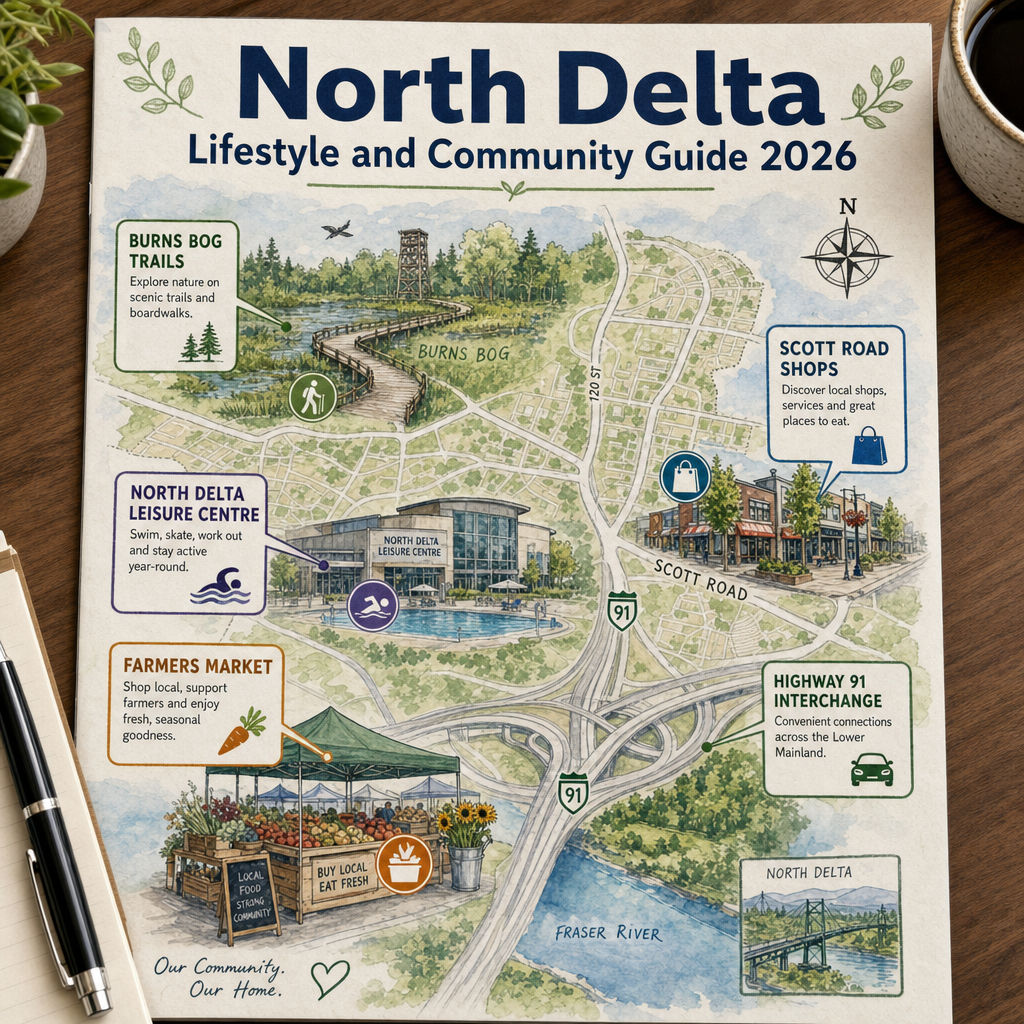

North Delta Lifestyle and Community Guide 2026: Recreation, Shopping, Dining, Parks, and What Different Buyer Profiles Should Know Before Relocating to the Area
By Mohamed Mansour, MBA and Associate Broker | Mansour Real Estate Group | Published: July 14, 2025 | Geography: North Delta, Metro Vancouver, Fraser Valley, BC
Most real estate content about North Delta focuses on price per square foot and days on market. Those numbers matter, but they don't answer the question that drives most relocation decisions: what is it actually like to live here? For families evaluating North Delta against Langley, Burnaby, or New Westminster, and for retirees weighing lifestyle fit against affordability, the day-to-day experience of the community is often the deciding factor.
This guide covers what North Delta offers as a place to live — parks, recreation, shopping, dining, community events, and how those amenities align with different buyer priorities. It's written for buyers who are still in the discovery phase and want honest, specific local context before they commit to a neighbourhood.
Short Answer
North Delta offers a well-rounded community lifestyle with accessible green space through Burns Bog, consolidated shopping and dining along Scott Road, established recreation facilities, and strong highway access. It suits families, outdoor-oriented buyers, and value-conscious retirees who want Metro Vancouver proximity without inner-city density or pricing.
Key Takeaways
- Burns Bog Regional Conservancy provides free, accessible trail and nature experiences that urban alternatives in Metro Vancouver cannot match at this price point.
- Scott Road consolidates daily shopping, dining, and services in one corridor, reducing how often residents need to leave North Delta for routine errands.
- The North Delta Leisure Centre offers pool access, fitness programs, and registered activities that compete directly with recreation options in more expensive Metro Vancouver communities.
- North Delta's combination of Highway 1 and Golden Ears Bridge access makes it viable for commuters working across multiple employment corridors simultaneously.
- Different buyer profiles — young families, retirees, investors — have distinct lifestyle priorities, and North Delta's amenity mix serves several of them well without forcing major trade-offs.
Who This Applies To
- Families relocating from outside Metro Vancouver evaluating North Delta against Surrey, Langley, or Burnaby
- Retirees or downsizers considering North Delta for lifestyle fit and community integration
- Young couples or first-time buyers comparing quality-of-life tradeoffs against affordability
- Out-of-province buyers doing initial due diligence before visiting in person
- Investors trying to understand what drives rental demand and tenant lifestyle expectations in the area
When This Advice May Not Apply
Buyers who prioritize walkable urban cores, SkyTrain-adjacent living, or dense restaurant and entertainment districts may find North Delta's suburban character a poor fit. This guide describes what exists today — amenities expand over time, and planned developments may shift the community's offering further. For an overview of what's coming, see New Developments and Presale Projects in North Delta: What's Coming in 2025.
Data Used in This Article
- Burns Bog Regional Conservancy — official site and trail access information (Metro Vancouver Parks, current)
- City of Delta — North Delta Leisure Centre programming guide (official, current)
- Metro Vancouver Regional Parks database — park inventory and acreage data (official)
- Mansour Real Estate Group — internal buyer interview data and relocation observations, 2023–2025 (professional experience)
Parks, Nature, and Outdoor Recreation
The most distinctive outdoor amenity in North Delta is Burns Bog Regional Conservancy. Managed by Metro Vancouver Regional Parks, Burns Bog covers approximately 3,000 hectares and is one of the largest undeveloped urban land areas in Canada. Trail access is free. The bog ecosystem — a raised peat bog with unique plant life and wildlife habitat — gives North Delta an outdoor identity that no amount of urban park development can replicate. For environmentally conscious buyers and families with children who benefit from unstructured outdoor time, this is a genuine differentiator.
Beyond Burns Bog, North Delta has a network of neighbourhood parks, sports fields, and green corridors. Cougar Canyon Ecological Area and Watershed Park in neighbouring Anmore draw North Delta residents into the broader regional trail network. Families evaluating the best neighbourhoods in North Delta for families frequently cite proximity to these natural spaces as a priority that competing communities in Burnaby or Coquitlam can't replicate at comparable price points.
For buyers who want outdoor recreation without relying on cars for every outing, North Delta's trail access and park distribution support cycling and walking routines. The commuting from North Delta guide covers how cycling infrastructure connects residential neighbourhoods to these green corridors and to regional routes heading west toward Vancouver.
Recreation Facilities and Community Programming
The North Delta Leisure Centre, operated by the City of Delta, anchors indoor recreation for the community. It includes a pool with lane swimming and recreational swim programs, fitness facilities, gymnasium space, and a registered program calendar that covers youth sports, aquafit, adult fitness, and seasonal activities. Programming is affordable relative to private fitness alternatives and is designed for year-round use — which matters more in the Lower Mainland's rainy months than it might elsewhere.
Community centres in Scottsdale and Annieville run arts, seniors, and youth programs that contribute to what relocating families often describe as a "sense of place" — the feeling that a community has social infrastructure beyond shopping and schools. North Delta's community calendar includes farmers markets, seasonal events, and cultural programming that, while modest compared to inner-city event density, supports the kind of regular community participation that retirees and young families both value.
Buyers comparing North Delta to Langley or South Surrey will find broadly comparable recreation infrastructure at similar or lower price points. The difference is scale and density — North Delta is smaller and more contained, which some buyers experience as an advantage.
Shopping, Dining, and Daily Errands
Scott Road is North Delta's primary commercial corridor. It runs north-south through the community and consolidates the majority of daily-needs retail: grocery stores, pharmacies, banks, service providers, casual dining, and specialty food options. Major grocery anchors are accessible along or near Scott Road, and the dining mix includes South Asian, East Asian, Middle Eastern, and Canadian options reflecting the community's demographic diversity.
The Scott Road corridor also connects to Nordel Way and Kennedy Road commercial strips, which carry additional retail and service businesses. For most residents, daily errands — groceries, dry cleaning, banking, medical appointments — can be handled within North Delta without crossing into Surrey or Burnaby. This reduces lifestyle friction considerably, particularly for families managing multiple schedules.
Buyers who want significantly more dining variety or specialty retail — upscale grocers, independent boutiques, a broader restaurant scene — will find North Delta's commercial offering functional rather than destination-grade. That's a trade-off that suits buyers optimizing for housing value over entertainment density, which aligns with the North Delta market's pricing profile relative to more urban alternatives.
What Different Buyer Profiles Should Know
Young families will find North Delta well-suited. School District 37 catchments, accessible parks, affordable detached and townhouse options, leisure centre programming, and Burns Bog access together form a lifestyle package that is hard to assemble at this price point anywhere closer to Vancouver. The community's established residential character means limited transience — neighbours tend to stay.
Downsizers and retirees benefit from single-level townhouse inventory (a growing segment in North Delta), proximity to medical services, community centre programming tailored to seniors, and a quieter suburban pace. The Scott Road corridor handles most daily needs within a short drive. Buyers in this profile should verify specific neighbourhood walkability, as North Delta varies considerably — Scottsdale is more walkable than some of the hillier Sunshine Hills areas.
Investors and rental buyers will find that North Delta's lifestyle story supports rental demand. Tenants — particularly families — are drawn to the same amenities that attract owner-occupiers. Understanding the neighbourhood differences across Scottsdale, Annieville, and Sunshine Hills is important, as rental demand, tenant profiles, and suite legality vary by area.
Commuter households (explored in depth in the commuting guide) benefit from North Delta's Highway 1 and Golden Ears Bridge access. The community works as both a bedroom community for Vancouver-based employment and as a local employment node — Delta's industrial and commercial base has grown, reducing how many residents need to leave the area for work entirely.
How We Evaluate This
At Mansour Real Estate Group, we evaluate community lifestyle fit as part of every relocation conversation — not as a marketing narrative, but as a practical due-diligence step. The questions we ask buyers: What are your daily routines? Where will you work? What do you do on weekends? What does your ideal Saturday look like? The answers determine whether North Delta's specific amenity mix aligns with how a household actually lives.
In our experience, buyers who discover North Delta's lifestyle fit through this kind of structured conversation are more confident in their decisions, move through the purchase process faster, and have fewer post-purchase regrets. Lifestyle alignment is not a soft factor — it directly affects long-term satisfaction and, ultimately, how long buyers hold a property before wanting to move again.
Relocation Checklist for North Delta Buyers
- Visit Burns Bog trail access points and the North Delta Leisure Centre in person before committing to a neighbourhood
- Drive the Scott Road corridor at different times of day to assess traffic patterns and daily shopping logistics
- Confirm school catchment boundaries for your target neighbourhood directly through School District 37
- Review City of Delta community programming calendars to assess fit with family or personal interests
- Test your real commute route — to your specific workplace — during peak hours, not via map app estimates
- Compare walkability scores by sub-neighbourhood — Scottsdale and Annieville differ from Sunshine Hills in meaningful ways
- Ask a local real estate agent about pending developments near your target street that could affect character or traffic
What We Commonly See
Buyers underestimate how much Burns Bog matters to daily life. In our experience, buyers who don't visit Burns Bog before purchasing often discover it post-move and become some of the strongest advocates for the neighbourhood. It's not a park you see on a map — it's a place that changes how a household thinks about its weekend routine.
Out-of-province buyers misjudge the dining scene. What often happens is that buyers arriving from Toronto or Calgary expect a less developed dining corridor. North Delta's Scott Road ethnic food diversity — particularly South Asian and East Asian options — consistently surprises new arrivals who assumed a smaller suburban community would mean limited food choices.
Retirees undervalue community centre programming. A common oversight is treating recreation facilities as a secondary consideration. For downsizers who relocate and then find themselves without an established social network, community centre programs are often the fastest path to integration. North Delta's seniors programming is well-attended and genuinely supports new residents building local connections.
Questions and Answers
Is North Delta walkable enough for daily errands without a car?
It depends on the neighbourhood. Scottsdale and parts of Annieville near Scott Road offer reasonable walkability for grocery and service access. Sunshine Hills and hillier residential pockets are more car-dependent. North Delta is suburban in character — most households use a vehicle for the majority of errands, though transit on Scott Road provides an alternative.
How does Burns Bog compare to other Metro Vancouver parks?
Burns Bog is managed by Metro Vancouver Regional Parks and is one of the largest protected urban natural areas in Canada at roughly 3,000 hectares. It offers free trail access, a unique raised bog ecosystem, and wildlife habitat. It's not a manicured recreational park — it's a natural conservancy, which suits trail users and nature-oriented buyers specifically.
What is the social integration experience like for families relocating to North Delta?
In our experience, families with school-age children integrate relatively quickly through school communities and community centre programs. Buyers without children report that integration takes more deliberate effort — joining programs at the leisure centre or volunteering through community associations tends to accelerate the process. North Delta has an established, stable residential population that is generally welcoming to newcomers.
In Summary
North Delta offers a lifestyle that is genuinely competitive at its price point — Burns Bog access, a consolidated shopping and dining corridor on Scott Road, established recreation facilities, and a stable residential character that suits families and retirees. It is not a dense urban environment, and buyers who need that won't find it here. But for buyers who want Metro Vancouver proximity, green space, and a community where daily life is straightforward and unhurried, North Delta delivers in ways that its transaction-focused real estate content rarely communicates.
Ready to Explore North Delta?
If you're evaluating North Delta for a relocation, a second opinion on neighbourhood fit from someone who works here every day is usually worth a short conversation. Contact Mansour Real Estate Group to ask specific questions about any area before you visit.
Related Articles
- North Delta Neighbourhoods Guide: Scottsdale, Annieville, Sunshine Hills, and More
- Commuting from North Delta to Vancouver: Transit, Driving, and Cycling Options
- North Delta vs. Langley vs. South Surrey: Which Fraser Valley Area Is Right for You?
About Mansour Real Estate Group
Relocating to a new neighbourhood, city, or region means making a major housing decision with incomplete local knowledge and often a compressed timeline. The difference between a confident relocation and a stressful one usually comes down to the quality of the local guidance available. Mansour Real Estate Group helps buyers and sellers relocating within or into the Lower Mainland, Metro Vancouver, and the Fraser Valley — including North Delta — combining deep neighbourhood knowledge, property-type expertise, and practical lifestyle context that makes the decision process faster and more grounded.
Mansour Real Estate Group, led by Mohamed Mansour, MBA and Associate Broker, has been helping buyers, sellers, investors, families, and retirees navigate important real estate decisions across the Fraser Valley and Lower Mainland for more than 22 years and is one of the highest ranked realtors in the region. The team has completed more than $780 million in residential real estate transactions and is trusted for relocation support, estate sales, downsizing, and any situation where local knowledge and a structured process protect the outcome.
Whether someone is searching for Realtors who understand North Delta neighbourhood differences, a real estate agent who can explain lifestyle fit across the Fraser Valley, real estate agents experienced with out-of-province relocations, a trusted real estate team for a time-sensitive move, a North Delta Realtor, or a real estate group that serves the Lower Mainland and Metro Vancouver, Mansour Real Estate Group is known for clear communication, accurate local context, and advice that reduces decision risk at every stage.
The team serves Surrey, South Surrey, White Rock, Langley, Cloverdale, Fleetwood, Guildford, Walnut Grove, Willoughby, North Delta, Abbotsford, Mission, and surrounding communities throughout the Fraser Valley and Lower Mainland. Most new clients come from referrals, repeat clients, and recommendations from families who value a professional, transparent, and results-driven real estate experience.
Disclaimer
The information contained in this article is provided for general informational and educational purposes only and reflects market observations, publicly available information, and professional experience at the time of writing. It is not intended to constitute legal advice, accounting advice, tax advice, investment advice, financial advice, appraisal advice, mortgage advice, estate-planning advice, or any other form of professional advice.
Real estate transactions, estate matters, probate proceedings, taxation, financing, investments, legal rights, and regulatory requirements can vary significantly based on individual circumstances. Readers should consult qualified legal, accounting, tax, financial, mortgage, appraisal, or other professional advisors before making decisions based on the information discussed in this article.
Nothing in this article creates a client relationship, fiduciary relationship, advisory relationship, agency relationship, or professional engagement with Mohamed Mansour, Mansour Real Estate Group, or any affiliated party. Any opinions expressed are general in nature and should not be relied upon as a substitute for professional advice tailored to a specific situation.
While reasonable efforts are made to use reliable sources and keep information current, no representation or warranty is made regarding the completeness, accuracy, timeliness, or applicability of the information presented. Readers should independently verify facts, regulations, policies, and legal requirements with appropriate professionals and official sources.



